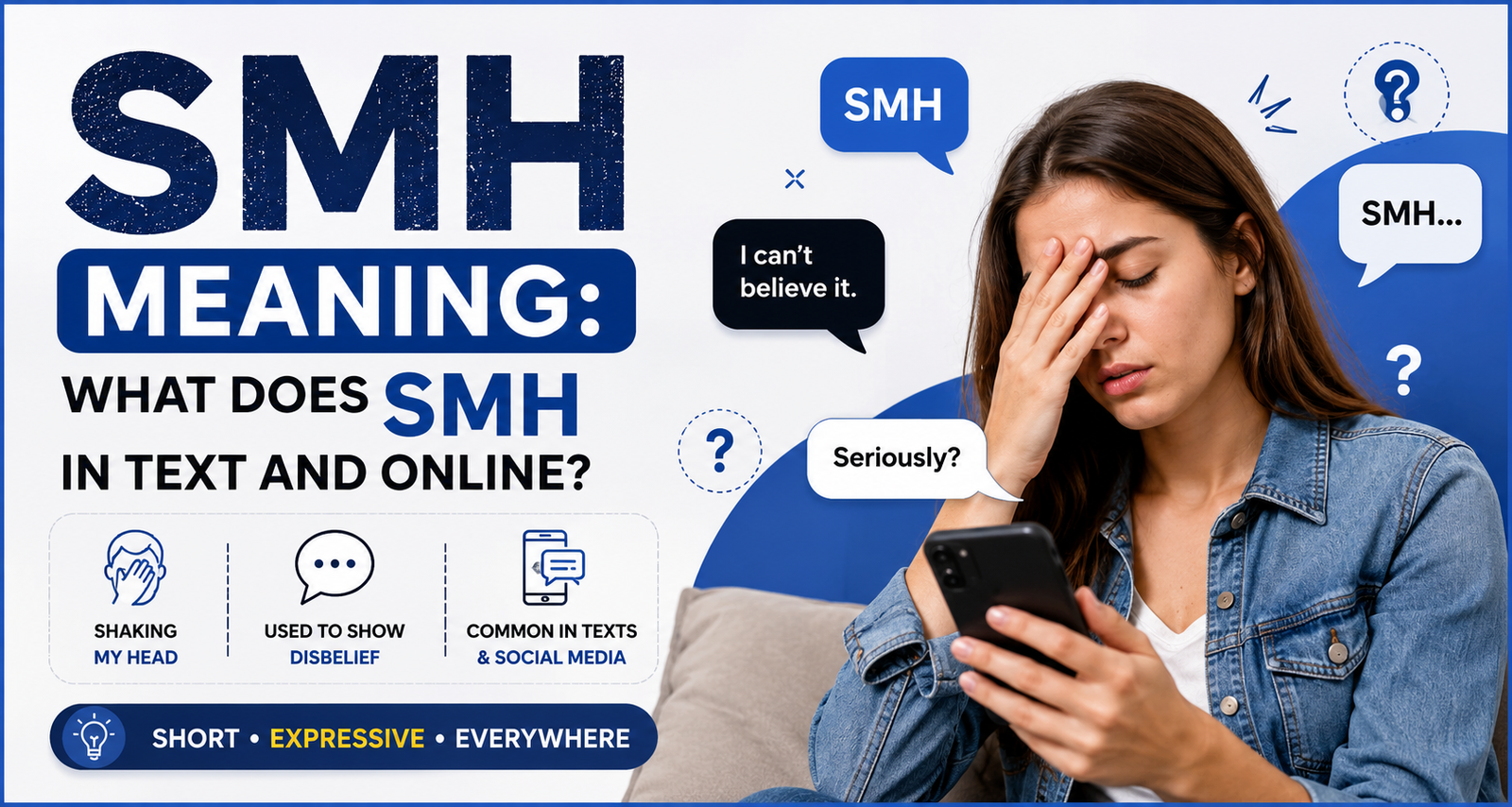
If you have ever received a message that simply says “SMH”, you may have wondered what those three letters mean. SMH meaning is “shaking my head.” It is a popular internet abbreviation used in text messages, social media posts, comments, and online conversations to show disbelief, disappointment, frustration, disagreement, or disapproval.
The idea behind SMH is simple. Imagine someone hearing something surprising, unreasonable, or disappointing and physically shaking their head. In online communication, people use “SMH” to express that same reaction without having to describe the gesture.
Because SMH is informal internet slang, its exact feeling can depend on the situation. Sometimes it sounds serious, while in other conversations it can be playful, sarcastic, or humorous. This guide explains the SMH meaning, pronunciation, origin, examples, synonyms, antonyms, common uses, and differences between related expressions.
What Does SMH Mean?
SMH stands for “shaking my head.” It is an initialism formed from the first letters of the three words. Merriam-Webster defines SMH as an informal abbreviation used to express disapproval, dismay, or disbelief.
In simple English, SMH means “I cannot believe this,” “That is disappointing,” or “I do not agree with this.” The exact meaning depends on the context and the person’s tone.
For example, if a friend tells you that they forgot their homework again, you might reply:
“SMH, you forgot it again?”
Here, SMH shows mild frustration or disbelief. It does not necessarily mean that the person is seriously angry.
SMH Meaning in Simple English
A simple way to understand SMH is:
SMH = I am shaking my head because I cannot believe what happened.
It can communicate feelings such as:
- Disbelief
- Disappointment
- Frustration
- Disapproval
- Annoyance
- Mild embarrassment
- Surprise
- Amusement
The expression is usually informal and is most natural in digital conversations.
How Do You Pronounce SMH?
SMH is normally pronounced by saying the individual letters:
S-M-H
Most people do not pronounce SMH as a single word. When spoken aloud, it is generally read as the three letter names.
For example, someone might say, “S-M-H, I cannot believe you did that.” However, the abbreviation is much more common in written communication than in everyday speech.
What Is the Origin of SMH?
The exact origin of SMH is not completely certain. The expression comes from the physical gesture of shaking your head, which people commonly use to communicate disagreement, disbelief, disappointment, or frustration.
Merriam-Webster records evidence of SMH being used online as far back as the 1990s, including a 1994 Usenet example. Dictionary.com notes that the abbreviation became increasingly visible in internet communication during the 2000s.
The abbreviation became easier to spread as online messaging and social media grew. Instead of writing a complete reaction such as “I cannot believe this,” users could simply type SMH.
How SMH Became Popular
Internet slang developed partly because people wanted fast ways to communicate emotions and reactions. Abbreviations such as LOL, OMG, BRB, and SMH became useful because they could express a larger idea with only a few characters.
SMH became especially recognizable in online conversations during the 2000s and 2010s. Dictionary.com notes that the term appeared in Urban Dictionary in 2004 and spread through social media platforms during the following years.
Today, SMH is widely understood as a casual internet expression. It can appear in texts, comments, memes, posts, and group chats.
What Does SMH Mean in Text?
When someone uses SMH in a text, they are usually reacting to something they find disappointing, ridiculous, unbelievable, or frustrating.
For example:
Person A: “I left my lunch at home again.”
Person B: “SMH 😂”
Here, the response is probably playful rather than angry.
Another example:
“SMH, why would you ignore the instructions?”
In this case, the writer is showing disapproval or frustration.
The important thing to remember is that SMH does not always communicate the same level of emotion. A laughing emoji can make it playful, while a serious conversation can make it sound more critical.
What Does SMH Mean on Social Media?
On social media, SMH works as a short reaction to a post, comment, event, or opinion.
Someone might write:
“People really believe that? SMH.”
This suggests that the writer finds the situation difficult to understand or believes the idea is unreasonable.
SMH is also commonly placed at the beginning or end of a sentence. For example:
- “SMH, that was completely unnecessary.”
- “I cannot believe he forgot again, smh.”
- “They changed the schedule at the last minute. SMH.”
The abbreviation is flexible, which helps explain why it has remained useful in online communication.
Common Uses of SMH
SMH for Disbelief
One of the most common uses of SMH is to show that you cannot believe something happened.
For example:
“She missed the bus after leaving home early. SMH.”
The writer is expressing disbelief at the situation.
SMH for Disappointment
SMH can also communicate disappointment.
For example:
“We were supposed to clean the room, but everyone left. SMH.”
Here, the abbreviation suggests that the person is disappointed by what happened.
SMH for Frustration
When something repeatedly goes wrong, SMH can express frustration.
For example:
“My computer restarted right before I saved the project. SMH.”
The writer is not necessarily angry at another person. They are simply frustrated with the situation.
SMH as a Joke
SMH is not always serious. Friends often use it humorously when someone makes a harmless mistake.
For example:
“I opened the refrigerator and forgot why I was there. SMH.”
In this context, SMH adds humor to the situation.
SMH About Yourself
You can also use SMH when talking about your own mistake.
For example:
“I studied the wrong chapter for the test. SMH.”
This means something like, “I cannot believe I made that mistake.”
Examples of SMH in Sentences
Understanding examples makes the SMH meaning much easier to remember.
- “SMH, I cannot believe you forgot your keys again.”
- “He arrived late after being told to come early. SMH.”
- “SMH, that was such an unnecessary mistake.”
- “I accidentally sent the message to the wrong group. SMH.”
- “They changed the meeting time without telling anyone. SMH.”
- “SMH, I put my phone in the refrigerator.”
- “You really watched the entire movie without realizing it was the wrong one? SMH.”
- “The bus left just as I reached the stop. SMH.”
- “SMH, why did I forget my own password?”
- “She finished the assignment but forgot to submit it. SMH.”
These examples show that SMH can describe both serious disappointment and lighthearted mistakes.
SMH vs. SMDH
A common variation of SMH is SMDH, which stands for “shaking my damn head.” It generally has a stronger or more emphatic tone than ordinary SMH.
Compare these examples:
SMH: “You forgot the appointment again.”
SMDH: “You forgot the appointment again? SMDH.”
Both expressions show disappointment, but SMDH adds extra emphasis.
Because SMDH contains a mild swear word, SMH is generally the safer and more neutral choice in casual conversations.
SMH vs. LOL
LOL means “laugh out loud.” It is normally used to show amusement.
SMH, on the other hand, usually communicates disbelief, disappointment, or disapproval.
For example:
“That joke was hilarious LOL.”
This shows laughter.
“You forgot your own birthday? SMH.”
This shows disbelief or playful criticism.
Sometimes both can appear together when something is funny and unbelievable:
“You really did that LOL SMH.”
The combination suggests amusement mixed with disbelief.
SMH vs. OMG
OMG means “oh my God.” It usually expresses surprise, shock, excitement, or strong emotion.
SMH is more closely connected to disbelief or disapproval.
For example:
“OMG, we won the game!”
This communicates excitement.
“SMH, we lost because nobody followed the instructions.”
This communicates frustration or disappointment.
Synonyms and Similar Expressions for SMH
There is no perfect one-word synonym for SMH because the abbreviation combines an emotional reaction with an implied gesture. However, several expressions can communicate a similar idea.
Common alternatives include:
- “I cannot believe it.”
- “Seriously?”
- “What were you thinking?”
- “That is disappointing.”
- “Unbelievable.”
- “Come on.”
- “I have no words.”
- “That makes no sense.”
- “You have got to be kidding.”
- “I cannot even.”
The best alternative depends on the situation.
For a polite conversation, “I cannot believe it” or “That is disappointing” may be better. With close friends, “Seriously?” or “Come on” can sound more natural.
Antonyms of SMH
Because SMH expresses a reaction rather than a traditional dictionary concept, it does not have exact antonyms. However, expressions that communicate the opposite emotional response can include:
- “Well done!”
- “Great job!”
- “I agree.”
- “That makes sense.”
- “Absolutely!”
- “Good idea!”
- “Nice!”
- “I am impressed.”
- “That is amazing.”
- “Exactly!”
For example, if someone tells you they completed a difficult project successfully, replying “SMH” would usually suggest disbelief or criticism. A response such as “Great job!” communicates approval instead.
Is SMH Rude?
SMH is not automatically rude, but it can sound rude depending on the context.
If you send “SMH” to a close friend after a harmless mistake, they may understand it as a joke. But if you use it while discussing someone’s serious mistake, it could sound dismissive or judgmental.
For example:
“You forgot your umbrella again? SMH 😂”
This can be playful.
But:
“SMH. You should have known better.”
This can sound critical.
When communicating with teachers, employers, unfamiliar people, or in formal situations, it is usually better to write your meaning clearly instead of relying on internet slang.
When Should You Use SMH?
SMH is most appropriate in informal digital conversations.
You can use it when:
- Talking with friends
- Sending casual text messages
- Commenting on social media
- Participating in informal group chats
- Reacting to humorous mistakes
- Expressing mild disbelief
- Discussing an unexpected situation
The meaning is usually understood by people who are familiar with internet slang.
When Should You Avoid SMH?
There are situations where SMH may not be the best choice.
Avoid using it in:
- Formal school assignments
- Professional emails
- Official documents
- Academic essays
- Formal applications
- Serious professional communication
For example, instead of writing:
“SMH, the project was delayed again.”
a professional message might say:
“The repeated delay is disappointing, and we should discuss how to prevent it in the future.”
The second version is clearer and more appropriate for formal communication.
Does SMH Always Mean “Shaking My Head”?
No, although “shaking my head” is by far the standard meaning. Some dictionaries and slang references mention alternative interpretations, including “scratching my head,” particularly when someone is confused.
Context is important.
If someone writes:
“I have been trying to understand this problem for an hour. SMH.”
they might be using SMH to communicate confusion.
However, when SMH appears in ordinary social media or texting conversations, “shaking my head” is the meaning readers are most likely to understand.
SMH Meaning in Different Situations
The emotional meaning of SMH can change slightly depending on the situation.
| Situation | Likely Meaning |
| A friend makes a silly mistake | Playful disbelief |
| Someone behaves badly | Disapproval |
| Something goes wrong | Frustration |
| Unexpected news appears | Disbelief |
| Someone repeats the same mistake | Annoyance |
| You make your own mistake | Self-directed frustration |
| A funny situation occurs | Humorous disbelief |
This flexibility is one reason SMH works so well in casual online communication.
Why Is SMH So Popular?
The main advantage of SMH is that it communicates a complete emotional reaction with only three letters.
Online conversations do not include the same facial expressions, gestures, or body language that people use during face-to-face communication. Abbreviations such as SMH help fill that gap.
When someone writes “SMH,” the reader can imagine the person shaking their head. That gives the message an emotional tone without requiring a long explanation.
The abbreviation is also quick to type, easy to recognize, and useful across many different situations.
SMH in Modern Internet Language
Internet slang continues to change, but some expressions become established enough to remain recognizable for years. SMH is one of those expressions.
It has appeared in online communication since at least the 1990s, while its broader popularity grew through internet forums, messaging, and social media.
Today, people may use lowercase “smh” or uppercase “SMH.” Both generally mean the same thing. Lowercase forms can feel more casual, while uppercase letters may add emphasis.
For example:
“smh I forgot again”
can feel relaxed and conversational.
“SMH, I cannot believe this.”
may appear more emphatic.
Frequently Asked Questions About SMH
What does SMH mean?
SMH means “shaking my head.” It is an internet abbreviation used to express disbelief, disappointment, frustration, disapproval, or annoyance.
What does SMH mean in texting?
In texting, SMH usually means “shaking my head.” It is a quick way to react to something surprising, disappointing, frustrating, or unreasonable.
Is SMH slang?
Yes. SMH is informal internet and texting slang. It is common in casual digital communication but is generally not appropriate for formal writing.
Is SMH rude?
It can be. SMH may sound playful among friends but can sound dismissive or judgmental in a serious conversation. Context and tone matter.
What does SMDH mean?
SMDH usually means “shaking my damn head.” It is a stronger version of SMH and expresses greater frustration or disbelief.
Can SMH be used for yourself?
Yes. You can use SMH when you make a mistake yourself.
For example:
“I left my notebook at home. SMH.”
This expresses mild frustration or amusement about your own mistake.
What is the opposite of SMH?
There is no exact opposite, but expressions such as “great job,” “I agree,” “well done,” and “that makes sense” can communicate approval instead of disbelief or disapproval.
Can SMH be used in formal writing?
It is better to avoid SMH in formal writing. Use complete words and sentences instead so your meaning is clear and professional.
Does SMH mean “scratching my head”?
Sometimes people use SMH to mean “scratching my head,” especially when describing confusion. However, “shaking my head” is the standard and most widely recognized meaning.
Is SMH still used today?
Yes. SMH remains a recognizable internet abbreviation and continues to appear in texts, social media posts, comments, and other informal online conversations.
Final Thoughts on SMH Meaning
The SMH meaning is simple: “shaking my head.” It is an informal internet abbreviation used when someone wants to express disbelief, disappointment, frustration, disapproval, or sometimes humorous disbelief.
The expression comes from a familiar real-world gesture. When people shake their heads, they may be showing that they disagree, cannot believe something, or are disappointed. SMH brings that same idea into digital communication.
Understanding SMH is useful because internet slang is now a normal part of everyday online conversation. Whether you see “SMH” in a text, comment, meme, or social media post, you can usually interpret it as a quick reaction similar to “I cannot believe this” or “That is disappointing.”
The key is context. With friends, SMH can be playful and funny. In a serious conversation, it may sound critical. In formal writing, a clearer phrase is usually the better choice. Once you understand these differences, SMH becomes an easy and useful piece of modern internet vocabulary.