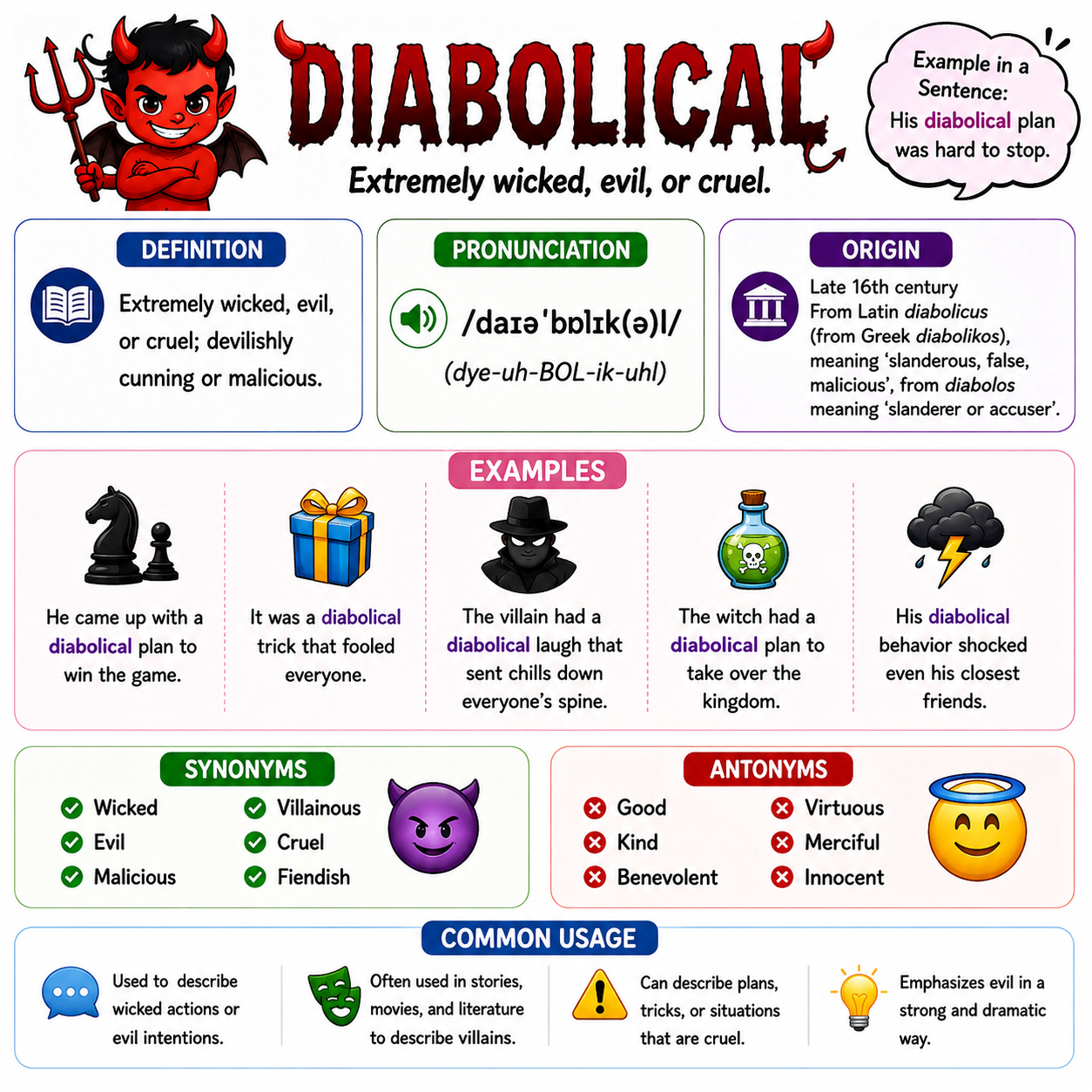
Diabolical Meaning: The word diabolical is a strong English adjective used to describe something extremely evil, cruel, shocking, or unpleasant. It can describe a person, action, plan, idea, situation, or even something that is simply extremely bad. In everyday British English, the word is also commonly used informally to mean “terrible” or “awful.”
Understanding the diabolical meaning is useful because the word can sound much stronger than ordinary words such as bad or unpleasant. Its exact meaning depends on the context. For example, “a diabolical plan” usually suggests an intentionally evil or harmful plan, while “the traffic was diabolical” simply means the traffic was extremely bad.
diabolical (dye-uh-BOL-ih-kul)
What Does Diabolical Mean?
The simplest diabolical meaning is extremely evil, cruel, or wicked. The word traditionally refers to something associated with the devil, which explains why it has such a strong connection with evil. Merriam-Webster defines it as something “of, relating to, or characteristic of the devil” and also as “extremely evil.”
However, diabolical does not always have a religious meaning. In modern English, people often use it as an intense way to describe something extremely bad or shocking. Cambridge Dictionary gives examples such as describing terrible conditions or very poor driving as “diabolical.”
Simple Definition
Diabolical means:
- Extremely evil
- Very cruel or wicked
- Like something associated with the devil
- Extremely bad or unpleasant in informal usage
- Shockingly harmful or unacceptable
The word is generally stronger than simply saying bad, mean, or unpleasant.
Diabolical Pronunciation
The pronunciation of diabolical can look difficult at first, but it becomes easier when divided into parts.
Diabolical: dye-uh-BOL-ih-kul
The main stress falls on the “bol” sound.
The word is pronounced slightly differently in American and British English. Cambridge lists the American pronunciation as approximately /ˌdaɪ.əˈbɑː.lɪ.kəl/ and the British pronunciation as /ˌdaɪ.əˈbɒl.ɪ.kəl/.
A related word is diabolic, which is shorter and means essentially the same thing. Merriam-Webster lists diabolic as a variant of diabolical.
Origin and History of Diabolical
The history of diabolical goes back many centuries. Merriam-Webster explains that the English word developed from diabolic and ultimately traces through Middle English, Middle French, Late Latin, and Greek. The Greek diabolos meant an “accuser,” “backbiter,” or “slanderer.”
The Latin form was diabolus, which became associated with the devil. From related forms came words connected with the idea of something devilish or evil.
Etymological records place diabolical in English around the beginning of the sixteenth century, while the related adjective diabolic appeared earlier.
How the Meaning Developed
Originally, the word had a close connection with the devil and things considered devilish. Over time, its meaning expanded.
Today, diabolical can refer to:
- A morally evil action
- A cruel person or behavior
- A sinister plan
- A frightening or wicked idea
- Something extremely unpleasant
- Something extremely bad in informal British usage
This development shows how English words can become broader as people use them in different situations.
Diabolical Meaning in Simple English
If you are learning English, think of diabolical as a very strong word for evil or extremely bad.
For example:
“The villain created a diabolical plan.”
This means the villain created an extremely evil or cruel plan.
But consider:
“The weather was diabolical.”
Here, the speaker probably does not mean that the weather was literally connected with the devil. Instead, they mean the weather was extremely unpleasant or terrible.
This second use is especially common in British English. Oxford notes that diabolical can informally mean “extremely bad or annoying,” while also retaining its meaning of being morally evil or like a devil.
Examples of Diabolical in Sentences
The best way to understand the diabolical meaning is to see the word in different contexts.
Examples Showing Evil or Cruelty
- The criminal was accused of carrying out a diabolical scheme.
- The story describes a diabolical villain who enjoys causing trouble.
- Everyone was shocked by the diabolical nature of the plan.
- The investigators uncovered a diabolical plot.
- The character’s diabolical behavior made him the main villain of the story.
In these examples, diabolical suggests deliberate evil, cruelty, or wickedness.
Examples Meaning Extremely Bad
- The traffic was diabolical this morning.
- The service at the restaurant was absolutely diabolical.
- We experienced diabolical weather during the trip.
- His performance was diabolical.
- The team’s results were diabolical.
Here, the word means extremely bad, disappointing, or unpleasant, rather than literally devilish.
Diabolical vs. Diabolic
Diabolical and diabolic are closely related and often interchangeable.
Both can describe something that is:
- Devilish
- Extremely evil
- Wicked
- Cruel
- Sinister
However, diabolical is often more familiar in everyday English. Merriam-Webster recognizes diabolic as a variant, while dictionaries also note that diabolic can have the same basic meaning.
For general writing, diabolical is usually a natural choice when you want a strong adjective.
Synonyms of Diabolical
There are many synonyms for diabolical, but the best choice depends on the context.
Strong Synonyms
- Evil
- Wicked
- Devilish
- Demonic
- Fiendish
- Sinister
- Cruel
- Malicious
- Monstrous
- Vile
For example, “a diabolical plan” could also be described as a sinister plan, wicked plan, or evil plan.
Synonyms for the “Extremely Bad” Meaning
When diabolical means “terrible,” suitable alternatives include:
- Terrible
- Awful
- Horrible
- Dreadful
- Abysmal
- Appalling
- Outrageous
- Disgraceful
- Unacceptable
Collins also lists words such as wicked, cruel, savage, and monstrous among synonyms when diabolical emphasizes evil.
Antonyms of Diabolical
An antonym is a word with the opposite meaning. Since diabolical can mean either extremely evil or extremely bad, its opposite depends on the context.
Possible antonyms include:
- Good
- Kind
- Benevolent
- Compassionate
- Merciful
- Moral
- Virtuous
- Admirable
- Excellent
- Wonderful
- Pleasant
For example:
Diabolical behavior ↔ kind behavior
A diabolical plan ↔ a benevolent plan
Diabolical conditions ↔ excellent conditions
Common Usage of Diabolical
The word diabolical appears frequently in books, journalism, fiction, conversations, and descriptions of difficult situations.
Describing a Plan
One common phrase is “diabolical plan.” It usually suggests a plan that is clever but extremely harmful, dishonest, or evil.
Example:
The fictional villain developed a diabolical plan to take control of the kingdom.
Describing a Person
A person can be called diabolical when their behavior is extremely cruel or evil.
Example:
The novel’s diabolical villain became one of its most memorable characters.
Describing a Situation
The word can also describe an extremely unpleasant situation.
Example:
The travel conditions became diabolical after the storm.
Describing Performance
In British informal English, diabolical can be used to criticize something strongly.
Example:
The team’s performance was diabolical.
Oxford specifically notes this informal British use for something extremely bad or annoying.
Is Diabolical Always a Negative Word?
Yes, diabolical is strongly negative in its standard uses.
When it describes evil, it suggests something morally wrong, cruel, or wicked. When it means “extremely bad,” it still expresses strong criticism.
For example:
“She gave a diabolical performance.”
This is clearly negative.
However, context can sometimes make the word humorous or exaggerated. Someone might jokingly describe a difficult puzzle as “diabolical” because it is extremely challenging. In this situation, the word does not necessarily suggest real evil.
Diabolical in British vs. American English
The word is used in both British and American English, but there is an important difference in everyday usage.
In American English, diabolical often strongly suggests evil, devilish behavior, or an extremely clever and harmful plan.
In British English, it can also be an informal intensifier meaning very bad, terrible, or outrageous. Cambridge and Oxford both document this usage.
For example:
American-style context:
“The villain had a diabolical scheme.”
British informal context:
“The traffic was diabolical.”
Both are correct, but the intended meaning is different.
Diabolical vs. Evil
Although diabolical and evil are synonyms in some situations, they are not always equally strong.
Evil is a broad word describing serious moral wrong.
Diabolical is more dramatic and often creates an image of something exceptionally wicked, cruel, or devilish.
Compare:
“It was an evil act.”
with:
“It was a diabolical act.”
The second sentence sounds more intense and dramatic.
Diabolical vs. Terrible
The difference between diabolical and terrible depends on context.
Terrible can describe something bad, unpleasant, frightening, or disappointing.
Diabolical is more extreme and has an additional connection to evil or the devil.
For example:
“The food was terrible.”
This simply means the food was very bad.
“The food was diabolical.”
This can mean the food was extremely bad, particularly in informal British usage.
Diabolical vs. Sinister
These words are related but slightly different.
Sinister often suggests something threatening, mysterious, or harmful.
Diabolical usually suggests something even more strongly evil, cruel, or devilish.
For example:
“There was a sinister atmosphere in the building.”
This suggests something felt threatening or suspicious.
“The villain had a diabolical plan.”
This suggests deliberate and extreme wickedness.
Related Forms of Diabolical
Several related words can help expand your vocabulary.
Diabolically
Diabolically is the adverb form.
It describes an action performed in an extremely evil, wicked, or sometimes extremely difficult way.
Example:
The puzzle was diabolically difficult.
Here, diabolically means extremely or almost frustratingly difficult.
Diabolicalness
Diabolicalness is the noun form and refers to the quality or state of being diabolical. It is much less common in everyday conversation than diabolical.
Diabolic
Diabolic is another adjective with essentially the same core meaning as diabolical.
How to Use Diabolical Correctly
Because diabolical is a strong word, it should be used when you want to express an extreme reaction.
It works naturally before nouns:
- diabolical plan
- diabolical scheme
- diabolical behavior
- diabolical act
- diabolical villain
- diabolical plot
- diabolical situation
It can also appear after linking verbs:
The conditions were diabolical.
His behavior was diabolical.
The service was diabolical.
Using the word carefully makes your writing more expressive without making it sound exaggerated.
Common Phrases With Diabolical
Some common combinations include:
- Diabolical plan — an extremely wicked or harmful plan
- Diabolical scheme — a sinister or dishonest plan
- Diabolical plot — an evil or cleverly harmful plot
- Diabolical genius — someone portrayed as extremely clever and evil
- Diabolical behavior — extremely cruel or wicked behavior
- Diabolical conditions — extremely bad conditions
- Diabolically difficult — extremely difficult
The phrase “diabolical genius” is particularly interesting because it combines intelligence with wickedness. Cambridge describes diabolical in American English as meaning “very evil but often intelligent” in this type of context.
When Should You Use the Word Diabolical?
Use diabolical when ordinary words such as bad or mean do not fully express the intensity you want.
It is especially appropriate in:
- Creative writing
- Reviews
- Storytelling
- Journalism
- Literary descriptions
- Informal British English
- Discussions of villains or fictional plots
In formal writing, however, make sure the word accurately reflects the situation. Calling a minor inconvenience “diabolical” may sound exaggerated unless you are intentionally using strong or humorous language.
Frequently Asked Questions About Diabolical Meaning
What is the simplest meaning of diabolical?
The simplest meaning of diabolical is extremely evil, cruel, or wicked. In informal British English, it can also mean extremely bad or unpleasant.
Is diabolical a bad word?
It is a negative adjective, but it is not a swear word. It is used to describe something very evil, cruel, terrible, or unpleasant.
What is the pronunciation of diabolical?
It is commonly pronounced approximately “dye-uh-BOL-ih-kul.” The stress falls on the middle part of the word.
What is the origin of diabolical?
The word ultimately comes from Greek diabolos, meaning an accuser, backbiter, or slanderer, through Latin and French forms before entering English.
What is a synonym for diabolical?
Depending on the context, synonyms include evil, wicked, sinister, fiendish, devilish, cruel, monstrous, terrible, awful, and abysmal.
What is the opposite of diabolical?
Possible antonyms include good, kind, compassionate, benevolent, virtuous, excellent, and pleasant.
Can diabolical mean very bad?
Yes. In informal British English, diabolical can mean extremely bad, shocking, or unpleasant.
Is diabolic the same as diabolical?
They are closely related and have essentially the same core meaning. Diabolic is a recognized variant of diabolical.
Can diabolical be used for something difficult?
Yes. In phrases such as “diabolically difficult,” the word can emphasize that something is exceptionally difficult or challenging.
Conclusion
The diabolical meaning is centered on the idea of something extremely evil, cruel, wicked, or devilish. The word has a long history connected to Greek diabolos and later Latin and French forms, and it entered English centuries ago.
In modern English, diabolical has a wider range of uses. It can describe an evil character, a sinister plan, or cruel behavior, but it can also simply mean extremely bad or unpleasant, particularly in informal British English.
If you remember one simple idea, remember this: diabolical is a very strong word for something extremely evil or extremely bad. Understanding its context will help you use it naturally in conversation, school writing, creative work, and everyday English.