Grifter Meaning: The word grifter is often used in everyday English, news reports, books, movies, and online conversations to describe someone who tricks other people for money or personal gain. It is an informal word, and it usually carries a strongly negative meaning.
In simple terms, a grifter is a person who uses deception, clever tricks, false promises, or manipulation to get money, property, or other benefits from people. A grifter may be described as a con artist, swindler, scammer, or fraudster, although the exact meaning can change slightly depending on the situation.
This guide explains grifter meaning, pronunciation, word origin, examples, synonyms, antonyms, common phrases, and the difference between related words. It also explains how the word is used in modern English so you can understand it clearly and use it correctly.
Grifter Meaning in Simple English
The simplest definition of grifter is:
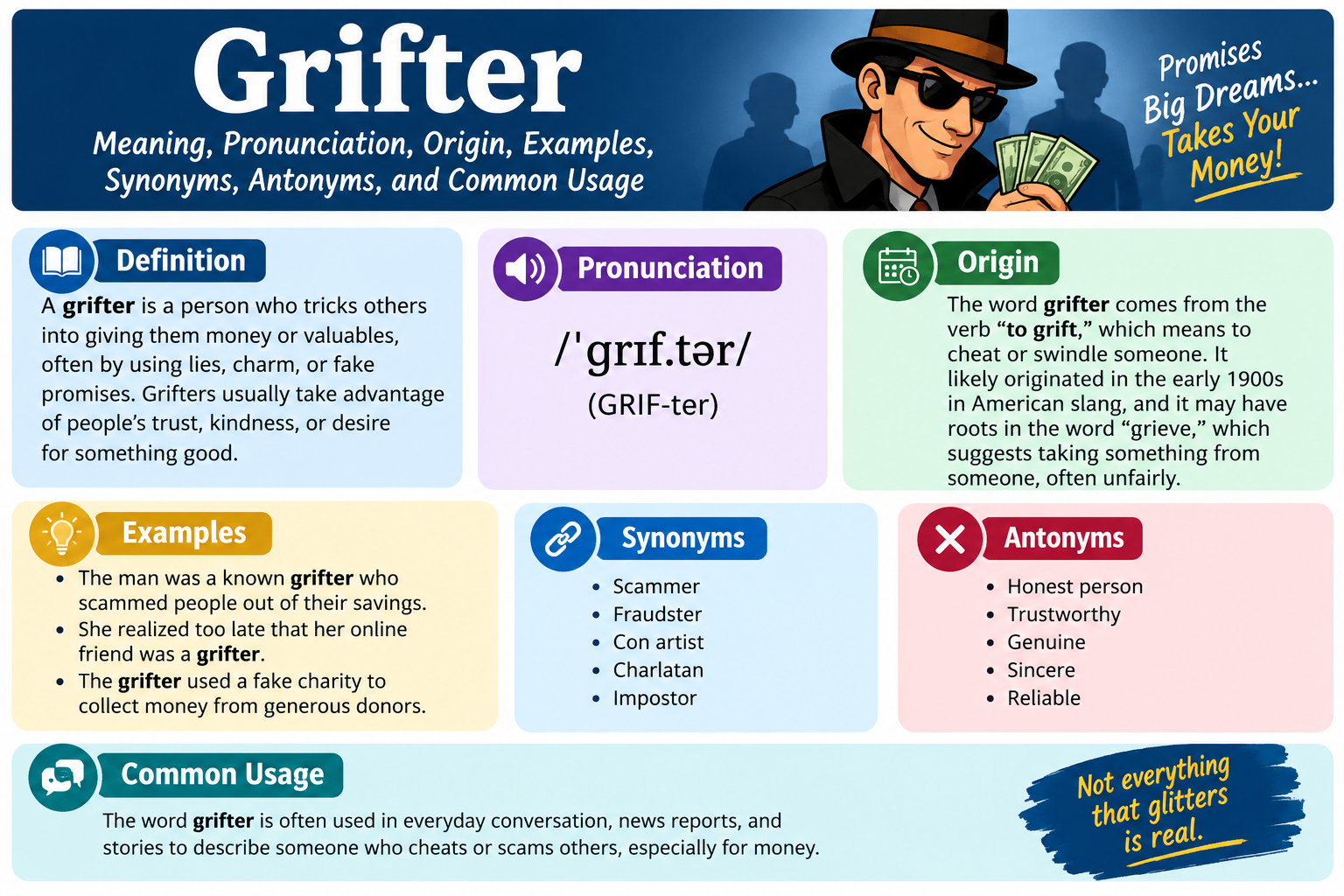
A grifter is someone who tricks or deceives people to get money, property, or some other personal benefit.
The word normally describes a person who relies on deception rather than physical force. For example, someone might pretend to have special knowledge, make false promises, or create a convincing story to persuade another person to hand over money.
Merriam-Webster defines grifter in connection with grift, which means obtaining money or property illegally, often through a confidence game.
A grifter can therefore be thought of as a person who makes a living, or repeatedly tries to benefit, through dishonest schemes.
Quick Definition
| Word | Meaning |
| Grifter | A person who tricks others for money or personal gain |
| Part of speech | Noun |
| Pronunciation | GRIF-ter |
| Plural | Grifters |
| Related verb | Grift |
| Related noun | Grift |
| Typical tone | Informal and negative |
| Common synonyms | Scammer, swindler, con artist, fraudster |
The Oxford Advanced Learner’s Dictionary similarly defines a grifter as someone who tricks people into giving them money or other things.
How to Pronounce Grifter
The word grifter is pronounced:
grifter (GRIF-ter)
It sounds like “GRIF-ter.”
The first part rhymes approximately with words such as “lift” and “gift.” The stress is placed on the first syllable.
The pronunciation is commonly represented as /ˈɡrɪftər/ in American English. Oxford lists both British and American pronunciation forms.
What Does Grifter Mean in a Sentence?
When you see grifter in a sentence, it usually refers to someone who gains an advantage through dishonesty or deception.
For example:
- The grifter convinced people that his business was legitimate.
- Police warned residents about a grifter targeting unsuspecting customers.
- The novel follows a clever grifter who travels from city to city.
- She realized that the friendly stranger was actually a grifter.
- The documentary explores how the grifter gained people’s trust.
In each example, the important idea is deception for personal benefit.
Grifter Definition and Meaning
A grifter is not simply someone who makes a mistake or behaves selfishly. The word generally suggests deliberate dishonesty.
A person may be called a grifter when they intentionally create a false impression to get something valuable. That valuable thing may be money, property, attention, influence, or another personal advantage.
For example, imagine someone falsely claims to represent a successful organization and uses that false identity to persuade people to give them money. Calling that person a grifter would make sense because the person is deliberately using deception for personal gain.
The word is particularly associated with confidence tricks and scams. Merriam-Webster notes that a grifter may be a scammer, con artist, crooked gambler, or another kind of nonviolent criminal who depends on cleverness or deceit.
Grifter Origin and Etymology
The origin of grifter is interesting because its history is connected to the older word graft.
Merriam-Webster gives the first known use of grift as 1902 and describes its etymology as possibly an alteration of graft.
Etymonline traces grifter to early twentieth-century American slang and says it was probably an alteration of grafter. It was originally associated with carnival and circus slang and later developed a broader meaning referring to nonviolent criminals.
From Graft to Grift
The older word graft could refer to dishonest ways of obtaining money or benefits. Over time, grift developed as a related slang term.
The noun grift appeared in the early twentieth century, while the verb grift became established soon afterward. Merriam-Webster notes that the verb was appearing in print by 1915.
The word grifter eventually became a familiar term for someone who carries out such schemes.
Historical Meaning of Grifter
The historical meaning of grifter was closely connected to the world of traveling entertainment, carnivals, sideshows, and confidence tricks.
Early uses could describe people involved in dishonest schemes, including those who attempted to deceive visitors or separate them from their money. Merriam-Webster’s historical discussion shows that grifter and grafter overlapped in meaning during their early development.
Over time, the meaning became broader. Today, a grifter does not have to be connected with a carnival or traveling show. The word can describe many different kinds of people who use deception to gain an advantage.
Grifter vs. Scammer
Grifter and scammer are very similar, but they are not always used in exactly the same way.
A scammer is generally someone who uses a dishonest scheme to trick people. The word is extremely common in modern conversations about online fraud, fake offers, and financial deception.
A grifter often suggests a person whose dishonest behavior is more of a pattern, lifestyle, or personal identity.
For example:
- Someone sending one fraudulent message might be called a scammer.
- Someone who repeatedly moves from one deceptive scheme to another might be described as a grifter.
There is plenty of overlap, however, so the two words can sometimes be used interchangeably.
Grifter vs. Con Artist
A con artist is someone who uses a confidence trick to deceive people.
A grifter can be a con artist, and a con artist can be called a grifter. The main difference is one of emphasis.
Con artist highlights the act of deception itself, while grifter often emphasizes the person’s broader behavior or way of making money.
For example:
The con artist created a convincing story.
This focuses on the trick.
The man was a lifelong grifter.
This suggests that dishonest schemes were a repeated part of his life.
Grifter vs. Fraudster
The word fraudster is more formal than grifter.
A fraudster is someone who commits fraud. The term often appears in legal, financial, and news contexts.
Grifter, on the other hand, is more informal and conversational.
Compare:
- Authorities arrested the fraudster.
- Everyone eventually realized that he was a grifter.
Both sentences describe dishonest behavior, but the second sounds more informal.
Grifter vs. Thief
A thief takes something that belongs to someone else without permission. A grifter typically uses deception or manipulation to obtain something.
That distinction is important.
A person who secretly takes someone’s belongings may be called a thief. A person who persuades someone to voluntarily hand over money through a false story may be called a grifter.
Merriam-Webster specifically notes that grifting generally involves cleverness or deceit rather than physical force.
Common Synonyms for Grifter
Several English words have meanings similar to grifter.
Scammer
A scammer is someone who uses a dishonest scheme to deceive another person.
This is probably one of the most common modern alternatives to grifter.
Swindler
A swindler deliberately cheats people out of money or property.
This word can sound slightly more formal or old-fashioned than scammer.
Con Artist
A con artist uses deception and confidence tricks to get something from another person.
It is one of the closest synonyms for grifter.
Fraudster
A fraudster is a person who commits fraud.
It is especially common in formal writing, journalism, and discussions involving financial wrongdoing.
Hustler
Hustler can sometimes mean a person who uses dishonest methods to make money, but it also has several neutral or positive meanings. Therefore, it is not always a direct synonym for grifter.
Charlatan
A charlatan is someone who falsely claims to have special knowledge, skills, or abilities.
This word is especially useful when the deception involves pretending to be an expert.
Antonyms of Grifter
There is no single perfect opposite of grifter, but several words express contrasting ideas.
Honest Person
An honest person does not deliberately deceive others for personal gain.
Trustworthy Person
A trustworthy person is someone others can reasonably rely on to act honestly and responsibly.
Benefactor
A benefactor provides help or money to others, usually without trying to deceive them.
Philanthropist
A philanthropist uses wealth or resources to support people, organizations, or causes.
These words are not exact dictionary opposites, but they express ideas that contrast strongly with the dishonest behavior associated with a grifter.
Examples of Grifter in Everyday English
Understanding examples is one of the easiest ways to learn the word.
Example One
The grifter told customers that his product could solve every problem.
Here, the word suggests that the seller is making dishonest claims to get money.
Example Two
She discovered that the friendly businessman was actually a grifter.
The sentence suggests that the person’s friendly appearance hid dishonest intentions.
Example Three
The story follows a young grifter who travels from town to town.
Here, grifter describes a character who repeatedly uses dishonest schemes.
Example Four
The community warned elderly residents about a suspected grifter.
This usage describes someone believed to be trying to deceive people.
Example Five
He was accused of being a grifter after several questionable business deals.
This sentence shows that the word can also be used when discussing someone’s reputation or alleged behavior.
Grifter in Modern Internet Language
The meaning of grifter has expanded in online conversations.
Today, people sometimes use the word more broadly for someone who appears to manipulate an audience or community for personal benefit. This modern usage can be informal and sometimes subjective.
For example, someone might call an online personality a grifter if they believe that person is constantly promoting questionable claims, products, or ideas for money.
However, this usage should be treated carefully. Calling a real person a grifter is a strong accusation of dishonesty. It is better to distinguish between a person’s proven actions and someone’s opinion about them.
The broader modern usage is reflected in some contemporary dictionary and language discussions, where grifter can be used for people perceived as manipulating systems or audiences for selfish gain.
What Does “Grift” Mean?
Grift is the related noun and verb.
As a noun, a grift can mean a dishonest scheme or way of making money.
As a verb, to grift means to obtain money or property through dishonest means.
For example:
- He made money through a grift.
- They accused him of trying to grift customers.
- The group was involved in an elaborate grift.
Merriam-Webster defines grift as obtaining money or property illicitly, including through a confidence game.
What Does “Grifting” Mean?
Grifting is the present participle of grift.
It means engaging in deceptive behavior to obtain money, property, or another benefit.
For example:
The documentary explains how the suspect spent years grifting unsuspecting people.
The word can also appear in informal expressions such as “grifters gonna grift,” which is a playful way of saying that people who habitually deceive others will continue doing so.
Is Grifter a Bad Word?
Grifter is not a swear word, but it is definitely a negative word.
Calling someone a grifter usually means accusing them of dishonest or deceptive behavior.
Because of this, the word should be used carefully when talking about real people. If you are writing formally about a person who has not been found guilty of wrongdoing, it is often better to describe the specific behavior rather than make an unsupported accusation.
For example, instead of saying:
“He is a grifter.”
A more neutral statement might be:
“He has been accused of using misleading claims to attract customers.”
This distinction is especially important in journalism and professional writing.
Common Phrases With Grifter
Several expressions use the word grifter or its related forms.
“A Professional Grifter”
This describes someone who appears to make deception a regular way of earning money.
“Career Grifter”
This informal expression suggests that dishonest schemes have been a long-term part of someone’s activities.
“Grift Someone”
This means to deceive someone for money or another benefit.
“A Clever Grifter”
This phrase describes someone who is considered skilled at creating convincing deceptions.
“A Known Grifter”
This phrase suggests that someone has an established reputation for dishonest schemes.
How to Use Grifter Correctly
Use grifter as a noun when referring to a person.
Correct:
The grifter convinced several people to trust him.
You can also use the plural:
The police warned residents about traveling grifters.
The related verb is grift:
They accused him of trying to grift customers.
And the noun grift can describe the dishonest scheme:
The entire operation was a carefully planned grift.
Grifter in Formal and Informal English
The word grifter is generally considered informal.
It works well in:
- Everyday conversations
- Fiction
- Movies and television discussions
- Informal articles
- Online conversations
- Popular journalism
In highly formal writing, words such as fraudster, fraudulent actor, or a precise description of the alleged conduct may be more suitable.
Still, grifter is widely understood, particularly in American English.
Why People Use the Word Grifter
The word is useful because it describes more than simply dishonest behavior. It often creates an image of someone who is clever, manipulative, opportunistic, and experienced at gaining people’s trust.
A grifter may appear friendly, confident, knowledgeable, or successful. The central idea is that this appearance is used to obtain some personal advantage through deception.
That is why the word appears frequently in stories about confidence tricks and people who manipulate others.
Frequently Asked Questions About Grifter Meaning
What does grifter mean in simple words?
A grifter is a person who tricks or deceives people to get money, property, or another personal benefit. In simple English, a grifter is a dishonest person who uses clever schemes rather than straightforward work to gain something.
Is grifter the same as scammer?
They are very similar. Both words can describe someone who deceives people for money or personal gain. However, grifter can suggest a person who repeatedly engages in deceptive schemes, while scammer is a broader and very common modern term.
Is grifter a negative word?
Yes. Grifter is a negative and informal word because it usually suggests deliberate dishonesty, deception, or fraud.
What is the opposite of grifter?
There is no perfect one-word opposite. Depending on the context, honest person, trustworthy person, benefactor, or philanthropist can express an opposing idea.
Where did the word grifter come from?
The word developed in early twentieth-century American slang. Its exact origin is uncertain, but major dictionaries connect it with graft or grafter. Merriam-Webster records grift from the early twentieth century, while Etymonline connects grifter with carnival and circus slang.
Is grifter a formal word?
No. Grifter is generally informal, although it is common and widely understood. In formal contexts, fraudster or a precise description of the person’s conduct may be more appropriate.
Can grifter be used as a verb?
No. Grifter is normally a noun. The related verb is grift.
For example:
The man was accused of grifting customers.
What is the difference between grift and grifter?
Grift refers to the dishonest scheme or the act of obtaining something through deception. Grifter refers to the person who carries out that behavior.
Can a person be called a grifter without committing a crime?
In everyday speech, people sometimes use grifter broadly to criticize someone they believe behaves dishonestly or manipulates others. However, because it implies serious dishonesty, it is wise to avoid making the accusation without reliable evidence.
Final Thoughts on Grifter Meaning
The grifter meaning is simple once you understand the central idea: a grifter is someone who uses deception or dishonest schemes to obtain money, property, or another personal benefit.
The word has roots in early twentieth-century American slang and is probably connected to the older term graft. Over time, grifter developed from a term associated with confidence tricks and carnival slang into a broader word for people who repeatedly use deception for personal gain.
Today, grifter is commonly used as an informal synonym for con artist, swindler, or scammer. It can appear in conversations, books, news articles, entertainment, and online discussions. Because it is a strong negative label, however, it should be used responsibly when describing real people.
Understanding words like grifter, grift, scammer, fraudster, and con artist can make it easier to understand modern English. Once you remember that a grifter is essentially someone who gains through deception, the meaning becomes much easier to recognize in everyday sentences.