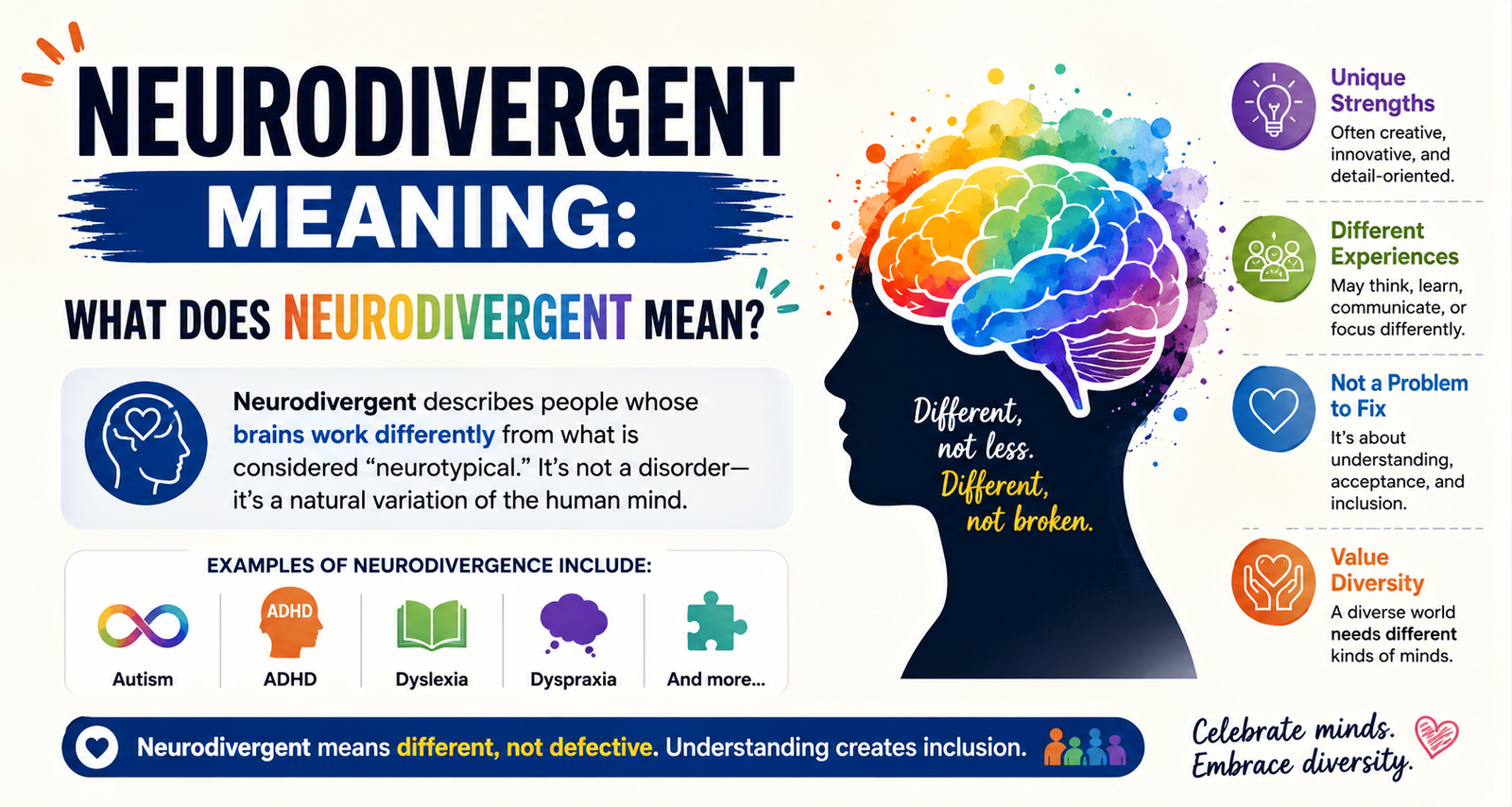
The neurodivergent meaning is simple: neurodivergent describes a person whose brain processes information, experiences, learns, communicates, or responds to the world in ways that differ from what is considered typical or “neurotypical.”
The word is commonly used when talking about differences in how people think and experience the world. It can include people with conditions or neurological differences such as autism, ADHD, dyslexia, Tourette syndrome, and some other forms of cognitive or developmental variation. However, neurodivergent is a broad descriptive term, not a medical diagnosis by itself.
The term has become increasingly common in conversations about education, workplaces, mental health, accessibility, disability, and identity. Understanding the word can make discussions about neurological differences more respectful and easier to follow.
What Does Neurodivergent Mean in Simple English?
In simple English, neurodivergent means having a brain that works or processes things differently from what is considered typical.
The word combines two ideas:
- Neuro relates to the nervous system and brain.
- Divergent means different or moving away from something that is considered standard.
So, neurodivergent can be understood as “neurologically different from the typical pattern.”
This does not automatically mean that something is wrong with a person. The term is often used to recognize natural or developmental differences in how people think, communicate, learn, focus, remember information, experience sensations, or interact with their surroundings.
A Simple Example
Imagine two students are given the same classroom assignment. One student understands the instructions immediately, while another student needs written instructions, additional time, or a quieter environment to concentrate.
The second student’s brain may process information differently. If that student has a neurological difference such as ADHD, autism, or dyslexia, they may describe themselves as neurodivergent.
The term focuses on difference rather than automatically treating difference as a personal failure.
How Do You Pronounce Neurodivergent?
Neurodivergent is generally pronounced like “NOOR-oh-dye-VER-jent.”
The word has several syllables, and the main emphasis is commonly placed around the “ver” part.
You may hear small differences in pronunciation depending on the speaker’s accent, but the general pronunciation remains recognizable.
What Is the Origin of Neurodivergent?
The word neurodivergent comes from the broader neurodiversity movement, which developed around the idea that differences in human brains should be understood as part of human variation.
The term neurodiversity is widely associated with Australian sociologist Judy Singer, who used the concept in the late twentieth century while discussing neurological differences and autism. The related language of neurodivergence later developed as a way to describe people whose neurological functioning differs from what society generally considers typical.
Today, neurodiversity is used in discussions about autism and many other neurological or developmental differences.
It is important to understand that the terminology has evolved over time. Different communities may use neurodivergent, neurodiverse, and related words somewhat differently.
Neurodivergent vs. Neurotypical
One of the easiest ways to understand neurodivergent is to compare it with neurotypical.
Neurotypical generally refers to people whose neurological development and functioning are considered relatively typical within the social and cultural context being discussed.
Neurodivergent refers to people whose neurological functioning differs from those typical patterns.
The terms are not meant to divide people into “better” and “worse” groups. They are descriptive terms that can help people talk about differences in brain function and experience.
For example, a person with ADHD may experience attention, organization, impulse control, or time management differently from a neurotypical person.
Likewise, an autistic person may experience communication, sensory information, routines, or social interaction differently.
What Conditions Can Be Associated With Neurodivergence?
Neurodivergent is an umbrella term, so it can be used in connection with several neurological or developmental conditions.
Depending on the person and community, neurodivergence may include:
- Autism
- ADHD
- Dyslexia
- Dyscalculia
- Dyspraxia
- Tourette syndrome
- Some other developmental or neurological differences
There is no single universal list that everyone uses. Some people use the word narrowly, while others use it more broadly.
Most importantly, simply behaving differently does not mean that someone is neurodivergent. The term should not be used as a diagnosis based on a few personality traits or online descriptions.
What Does Being Neurodivergent Feel Like?
There is no single experience of being neurodivergent because neurodivergent people are not all alike.
One person may experience difficulty filtering background sounds, while another may struggle mainly with organization or sustained attention. Someone else may have strong preferences for routines, particular learning methods, or specific communication styles.
Some people may experience challenges in environments designed around typical ways of learning and communicating. Others may find that their neurological differences are connected with strengths such as creativity, detailed thinking, strong interests, pattern recognition, or unusual approaches to solving problems.
These experiences vary significantly from person to person.
Common Examples of Neurodivergence
Autism
Autism is one of the conditions most frequently discussed in conversations about neurodivergence.
Autistic people can have differences in communication, sensory processing, social interaction, routines, and interests. Autism is a spectrum, meaning that autistic people can have very different strengths, needs, and experiences.
Using the word neurodivergent can provide a broader way to discuss these differences without reducing a person to a diagnosis.
ADHD
ADHD is another commonly recognized form of neurodivergence.
People with ADHD may experience differences involving attention, impulsivity, activity level, planning, organization, or executive functioning.
Not every person with ADHD has the same experiences. Some may struggle with managing tasks and deadlines, while others may experience periods of intense focus on activities they find highly engaging.
Dyslexia
Dyslexia is associated with differences in reading and language processing.
A person with dyslexia may find certain aspects of reading, spelling, or processing written language more difficult, while having strengths in other areas.
Calling someone neurodivergent can acknowledge that their brain processes information differently without suggesting that they are less intelligent.
Tourette Syndrome
Tourette syndrome involves involuntary movements and vocalizations known as tics.
The condition is another example that may be included within broader discussions of neurodivergence.
However, people with Tourette syndrome have different experiences, and the label neurodivergent does not describe every aspect of their individual identity.
Neurodivergent Examples in Everyday Life
The word can be used in many ordinary sentences.
Here are some examples:
- “She identifies as neurodivergent and prefers written instructions.”
- “The school is creating a more supportive environment for neurodivergent students.”
- “He learned more about neurodivergence after discovering that he has ADHD.”
- “The company wants to make its workplace more accessible to neurodivergent employees.”
- “Some neurodivergent people prefer predictable routines.”
- “The teacher offered several ways for students to complete the assignment.”
These examples show that neurodivergent is normally used as an adjective.
How Is Neurodivergent Used in a Sentence?
Neurodivergent usually comes before a noun or after a form of “to be.”
Examples include:
Before a noun:
“The organization provides support for neurodivergent students.”
After a verb:
“He is neurodivergent.”
Talking about a group:
“The event aims to create a welcoming environment for neurodivergent people.”
The word can describe an individual or group, but it should be used respectfully and accurately.
Neurodivergent as an Identity Term
Some people use neurodivergent as part of how they describe themselves.
For them, the word can provide a way to talk about their experiences without focusing only on a medical diagnosis. It can also connect them with broader communities that discuss accessibility, education, communication, and acceptance.
Other people may prefer to identify primarily by a specific diagnosis, such as autistic or having ADHD. Some may not use the word at all.
There is no requirement for someone to describe themselves as neurodivergent simply because the term might apply to them.
Is Neurodivergent a Medical Diagnosis?
No. Neurodivergent is not itself a medical diagnosis.
It is a broad descriptive term used in social, educational, community, and sometimes clinical discussions.
A person should not assume they are neurodivergent simply because they recognize a few traits in an online article or social media post.
For concerns about learning, attention, communication, development, or other areas of functioning, a qualified healthcare or educational professional can provide appropriate guidance.
This distinction is important because online descriptions can be useful for learning vocabulary but cannot replace a professional assessment.
Neurodivergent vs. Neurodiverse
These two words are sometimes confused.
Neurodivergent usually describes an individual or individuals whose neurological functioning differs from what is considered typical.
Neurodiverse more broadly describes variation among brains or a group containing different neurological profiles.
For example:
“She is neurodivergent.”
This describes an individual.
A broader statement might be:
“The classroom is neurodiverse.”
This suggests that the classroom contains students with different neurological ways of processing information.
Usage can vary, so the meaning should always be considered in context.
Neurodivergent vs. Neurotypical
The terms neurodivergent and neurotypical are often used as contrasting descriptions.
| Term | Simple Meaning |
| Neurodivergent | A person whose neurological functioning differs from typical patterns |
| Neurotypical | A person whose neurological functioning is considered relatively typical |
| Neurodiversity | The variation among different human brains |
These terms describe differences. They should not be interpreted as ranking one neurological type above another.
Synonyms for Neurodivergent
There is no perfect synonym for neurodivergent, because the term covers a broad range of experiences.
Depending on the context, related expressions may include:
- Neurologically different
- Neuroatypical
- Non-neurotypical
- Having a neurological difference
- Having a developmental difference
However, these terms are not always interchangeable.
For example, neuroatypical may be used differently depending on the community, while “neurological difference” is broader and less connected to the neurodiversity movement.
When possible, it is best to use the language a person prefers for themselves.
Antonyms of Neurodivergent
The most commonly used contrasting term is neurotypical.
However, neurotypical is not a perfect “opposite” in every situation. It simply refers to neurological functioning that is considered typical within a particular social or cultural context.
There are also phrases such as:
- Neurologically typical
- Typical neurological development
- Non-neurodivergent
But neurotypical is generally the clearest and most widely recognized term.
Is Neurodivergent a Negative Word?
No. Neurodivergent is not inherently a negative word.
It is often used as neutral or affirming language when discussing differences in how people think, learn, communicate, and experience the world.
However, individual preferences matter. Some people may prefer person-first language, while others may prefer identity-first language.
For example, one person might say:
“I am a person with autism.”
Another might say:
“I am autistic.”
Both preferences can be valid. Respecting the language a person chooses for themselves is usually the most considerate approach.
Common Usage of Neurodivergent
You may encounter the word in several settings.
Education
Schools and teachers may use neurodivergent when discussing different learning needs and accessible teaching methods.
For example:
“The school offers flexible learning options for neurodivergent students.”
Workplace
Companies may discuss neurodivergent employees as part of conversations about accessibility and inclusive workplaces.
For example:
“The company is reviewing its workplace policies to better support neurodivergent employees.”
Social Media
The term is also common on social media, where people share personal experiences about autism, ADHD, dyslexia, sensory differences, and related topics.
Everyday Conversations
People may use the word when describing themselves or explaining why they prefer certain communication or learning methods.
Why Understanding Neurodivergent Meaning Matters
Knowing what neurodivergent means can make conversations about neurological differences more respectful.
Instead of assuming that everyone should communicate, learn, focus, or behave in exactly the same way, the concept recognizes that people can have different neurological experiences.
For example, one person may perform best with spoken instructions, while another may understand information better when it is written down. A quiet environment may help one person focus, while another may prefer background sound.
These differences do not automatically indicate intelligence, effort, personality, or character.
Understanding the term can therefore help people communicate more thoughtfully in schools, families, workplaces, and communities.
Frequently Asked Questions About Neurodivergent Meaning
What is the neurodivergent meaning?
Neurodivergent generally means that a person’s brain processes information, experiences, or responds to the world differently from what is considered typical.
What does neurodivergent mean in simple terms?
In simple terms, neurodivergent means having a brain that works differently from the typical pattern.
Is ADHD neurodivergent?
ADHD is commonly included under the broad umbrella of neurodivergence. However, neurodivergent is a descriptive umbrella term rather than a diagnosis.
Is autism neurodivergent?
Yes. Autism is commonly described as a form of neurodivergence, and many autistic people use neurodivergent as a broader description of their neurological experience.
Is dyslexia neurodivergent?
Dyslexia is commonly included in discussions of neurodivergence because it involves differences in reading and language processing.
What is the opposite of neurodivergent?
The commonly used contrasting term is neurotypical, which generally describes neurological functioning considered typical.
Can someone identify as neurodivergent without a diagnosis?
Some people use the term based on their personal understanding and identity, while others prefer to use it only after receiving a formal diagnosis. The term itself is not a diagnosis, and personal preferences vary.
Is neurodivergent the same as disabled?
Not necessarily. Neurodivergence and disability can overlap, but they are not identical concepts. Some neurodivergent people consider themselves disabled, while others do not.
What is the difference between neurodivergent and neurodiverse?
Neurodivergent generally describes an individual whose neurological functioning differs from typical patterns. Neurodiverse refers more broadly to variation among different neurological types.
Can neurodivergent people have strengths?
Yes. Neurodivergent people can have many different strengths, just as neurotypical people can. Individual abilities vary widely, and it is important not to assume that every neurodivergent person has the same strengths or challenges.
Final Thoughts on Neurodivergent Meaning
The neurodivergent meaning is best understood as a difference in neurological functioning or processing compared with what is considered typical. It is a broad term commonly used in conversations about autism, ADHD, dyslexia, Tourette syndrome, and other neurological or developmental differences.
The word does not describe one specific personality or experience. Neurodivergent people can have very different abilities, challenges, communication styles, learning preferences, and personal identities.
It is also important to remember that neurodivergent is not a diagnosis. It is a broad descriptive term, and people can choose different words to describe their own experiences.
Ultimately, understanding neurodivergence is about recognizing that human brains do not all work in exactly the same way. Learning the meaning of the term can encourage clearer communication, greater accessibility, and more respectful conversations about neurological differences.