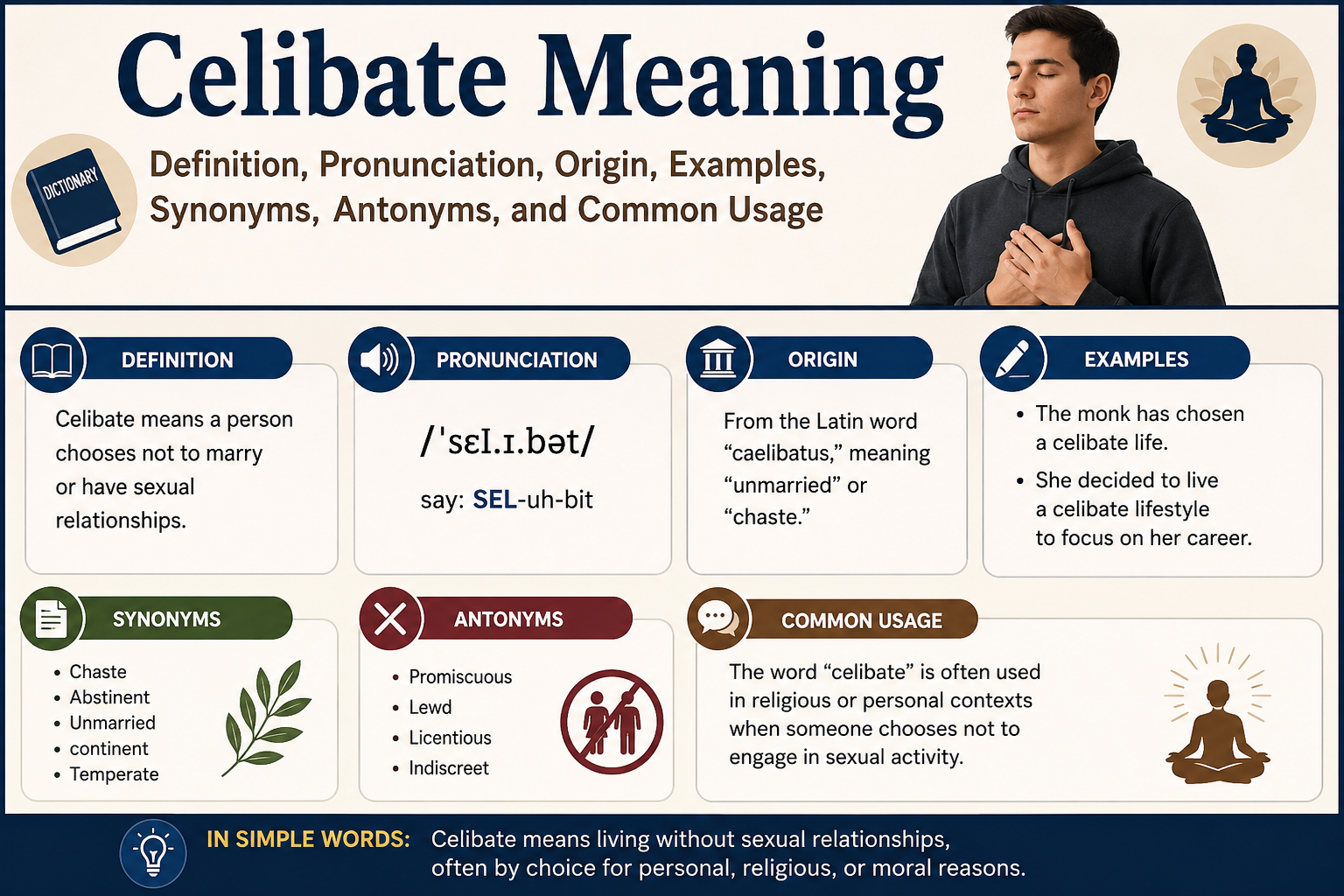
Understanding the celibate meaning is useful because the word appears in discussions about personal choices, religion, relationships, history, and lifestyle. Although celibate is often associated with religious traditions, the word can also describe a person who chooses not to engage in sexual relationships, depending on the context.
In simple English, celibate generally means not having sexual relations, especially because a person has made a personal, religious, or philosophical choice. The exact meaning can vary slightly depending on how the word is being used.
This guide explains the celibate meaning in clear, simple language. It covers pronunciation, origin, examples, synonyms, antonyms, common expressions, related words, and frequently asked questions.
What Does Celibate Mean?
The simplest celibate meaning is a person who does not engage in sexual activity, often as a deliberate choice.
celibate (SELL-uh-bit)
The word is most commonly used as an adjective:
- “He lives a celibate life.”
- “She has chosen to remain celibate.”
- “The religious order requires its members to be celibate.”
It can also be used as a noun to describe a person who practices celibacy:
- “He is a celibate.”
However, in ordinary conversation, people often use celibate as an adjective rather than a noun.
The related noun is celibacy, which refers to the state or practice of being celibate.
Celibate Meaning in Simple English
In very simple English, celibate means choosing not to have sexual relationships.
The reason for this choice can differ from person to person. Some people may choose celibacy for religious reasons, while others may make the choice for personal, philosophical, or lifestyle reasons.
It is important not to assume that every celibate person has the same beliefs or reasons. The word describes a choice or condition, not necessarily a person’s religion or personality.
For example, if someone says:
“I have decided to remain celibate.”
They are saying that they have chosen not to engage in sexual relationships.
The word itself does not tell us why they made that decision.
Pronunciation of Celibate
The word celibate is commonly pronounced:
SELL-uh-bit
The stress falls on the first syllable.
The pronunciation can be broken down into three simple parts:
cel – i – bate
In normal English speech, it sounds approximately like “SELL-uh-bit.”
The related word celibacy is pronounced approximately:
SELL-uh-buh-see
Learning both words together can be helpful because they are frequently used in the same discussions.
Celibate vs. Celibacy
Although celibate and celibacy are closely related, they have different grammatical roles.
Celibate
Celibate is usually an adjective describing a person or their lifestyle.
Example:
“After making a personal decision, he chose a celibate lifestyle.”
It can also function as a noun in some contexts.
Celibacy
Celibacy is a noun describing the practice or state of being celibate.
Example:
“She decided that celibacy was an important part of her personal life.”
A simple way to remember the difference is:
Celibate = describes the person or lifestyle.
Celibacy = describes the practice or state.
Origin and History of Celibate
The history of celibate goes back many centuries.
The English word comes through French and Latin sources. It is connected with the Latin word caelebs, meaning unmarried or single. The concept developed over time and became strongly associated with religious practices in several traditions.
Historically, being unmarried and practicing sexual abstinence were not always exactly the same thing. This distinction is important because the modern word can be used more broadly than its original associations.
Over the centuries, celibacy became particularly important in certain religious institutions. In some traditions, religious leaders or members of particular orders were expected to avoid marriage and sexual relationships as part of their religious commitment.
Today, the word has a broader use. A person does not have to belong to a religious organization to describe themselves as celibate.
Why Do People Choose Celibacy?
There is no single reason why someone might choose to be celibate.
Some people make the decision because of religious beliefs. In certain religious traditions, celibacy can be connected with devotion, spiritual discipline, or service.
Others may make a personal choice that has nothing to do with religion. Someone might want to focus on education, work, personal goals, family responsibilities, or other areas of life.
Some people may also use the term simply to describe a period during which they are intentionally avoiding sexual relationships.
The important point is that celibacy can have different meanings and motivations for different people. The word itself does not provide a complete explanation of someone’s reasons.
Examples of Celibate in Sentences
Learning the celibate meaning becomes easier when you see how the word works in real sentences.
Here are several examples:
- “He chose to remain celibate for personal reasons.”
- “The monk followed a celibate lifestyle.”
- “She decided to practice celibacy for a period of her life.”
- “The organization has a long tradition of celibate religious leaders.”
- “His decision to be celibate was deeply personal.”
- “The character in the novel lived a celibate life.”
- “Celibate members of the religious community followed specific rules.”
- “She explained that her decision to remain celibate was not connected to anyone else.”
- “The historical figure was known for a celibate lifestyle.”
- “The discussion focused on the meaning of celibacy in religious history.”
These examples show that celibate can be used in religious, historical, personal, and general contexts.
Celibate in Religious Contexts
One of the most familiar uses of celibate appears in religious discussions.
Some religious traditions have forms of celibacy associated with spiritual dedication. In such settings, celibacy may be viewed as a discipline that allows a person to devote more attention to religious service or spiritual goals.
However, religious rules differ considerably across traditions and institutions. Some religious communities require celibacy for particular roles, while others do not.
It is therefore important to avoid treating celibacy as a universal religious rule. Its meaning and importance depend on the particular tradition being discussed.
When reading historical or religious material, the surrounding context can help explain whether celibate refers specifically to avoiding marriage, avoiding sexual relationships, or following a broader religious discipline.
Celibate in Everyday Language
Outside religious contexts, celibate can simply describe someone’s personal decision not to engage in sexual relationships.
For example, a person might say:
“I’m choosing to be celibate right now.”
This does not necessarily indicate a religious belief. It can simply describe a personal boundary or lifestyle decision.
In everyday conversations, however, people may use related terms such as single, abstinent, or not dating. These terms are not always exact synonyms.
For example, someone can be single without being celibate, because being unmarried does not automatically mean avoiding sexual relationships.
Likewise, someone can be dating while choosing celibacy. The word is therefore more specific than simply saying someone is single.
Celibate vs. Single
The words celibate and single are sometimes confused, but they do not mean the same thing.
Single generally means that a person is not currently married or in a committed romantic relationship.
Celibate refers specifically to abstaining from sexual relationships or activity, often as a deliberate choice.
A person can be:
- Single but not celibate.
- Celibate but romantically interested in someone.
- Married but temporarily practicing abstinence.
- Unmarried and intentionally celibate.
Therefore, being single does not automatically mean being celibate.
This distinction is especially important when discussing someone’s personal life because assumptions can easily lead to misunderstandings.
Celibate vs. Abstinent
Celibate and abstinent can overlap, but they are not always identical.
Abstinent generally means deliberately avoiding a particular activity. The activity could be sexual activity, alcohol, certain foods, or something else, depending on the context.
Celibate, on the other hand, is specifically connected with sexual abstinence and, traditionally, with remaining unmarried.
For example:
“She’s abstinent from a particular activity” is broader.
“He is celibate” specifically refers to a sexual or marital choice.
The exact distinction can depend on the context in which the words are being used.
Synonyms of Celibate
Several words are related to the celibate meaning, although they may not be perfect substitutes.
Abstinent
Abstinent describes someone who deliberately avoids a particular activity. When the context is sexual, it can overlap with celibate.
Chaste
Chaste traditionally refers to avoiding sexual activity considered inappropriate or outside accepted moral standards. It can have religious or moral associations.
Unmarried
This means not married, but it is not an exact synonym for celibate.
Ascetic
An ascetic is someone who practices self-discipline and may avoid various pleasures for spiritual or philosophical reasons. Celibacy can sometimes be part of an ascetic lifestyle.
Single
Single can sometimes appear in similar conversations, but it does not specifically mean celibate.
Because these words have different shades of meaning, it is better to choose the word that accurately describes the situation rather than treating all of them as interchangeable.
Antonyms of Celibate
There is no single perfect antonym for celibate in every context.
Depending on the sentence, possible contrasting terms include:
- Sexually active
- Married
- Non-celibate
- Sexually involved
- In a sexual relationship
However, married is not a perfect opposite because a married person could theoretically practice celibacy.
Similarly, single is not the opposite of celibate because a single person may also be celibate.
This is why context matters when selecting an antonym.
Common Phrases Using Celibate
The word celibate appears in several common expressions.
Celibate Life
A celibate life refers to a lifestyle involving sexual abstinence.
Example:
“He chose to live a celibate life because of his personal beliefs.”
Celibate Lifestyle
A celibate lifestyle emphasizes celibacy as an ongoing personal choice.
Example:
“She has chosen a celibate lifestyle while focusing on her goals.”
Celibate Person
This simply describes someone who practices celibacy.
Example:
“He described himself as a celibate person.”
Celibate Priest
This phrase is generally used when discussing religious traditions or institutions in which particular priests are expected to practice celibacy.
Because religious rules can vary, the specific tradition should always be considered.
Celibate Community
A community may be described as celibate when its members follow rules or traditions requiring sexual abstinence.
Is Celibate the Same as Being Single?
No. Being single and being celibate are different concepts.
A single person is generally someone who is not married or not currently in a committed relationship. A celibate person is someone who chooses sexual abstinence, often as part of a personal, religious, or philosophical decision.
For example, someone may be single and sexually active, while another single person may choose celibacy.
This is one of the most important distinctions to understand when learning the celibate meaning.
Is Celibacy Always Religious?
No.
Although celibacy has strong historical and religious associations, people can choose celibacy for many different reasons.
A person may choose it for personal values, lifestyle preferences, spiritual reasons, or other individual goals.
It is therefore inaccurate to assume that someone is religious simply because they describe themselves as celibate.
The surrounding context is essential for understanding what the word means for a particular person.
How to Use Celibate Correctly
The adjective celibate should generally be used when you are describing a person, lifestyle, or choice connected with sexual abstinence.
Correct examples include:
- “He lives a celibate lifestyle.”
- “She chose to remain celibate.”
- “The group has a tradition of celibate religious service.”
- “His decision to be celibate is personal.”
Avoid assuming that single automatically means celibate.
For respectful communication, it is also better to avoid labeling someone as celibate unless they have described themselves that way or the context clearly establishes it.
Why Context Matters With the Word Celibate
Words related to relationships and personal choices can carry different meanings depending on the situation.
For example, a historical text may use celibacy in a religious sense. A modern article might use it to describe a personal lifestyle decision. A dictionary may explain the broader definition.
Understanding the context prevents confusion.
It is also worth remembering that celibate describes a particular aspect of someone’s life. It does not tell you everything about their personality, beliefs, relationships, or values.
Frequently Asked Questions About Celibate Meaning
What is the simple meaning of celibate?
Celibate means choosing not to engage in sexual relationships or activity. The choice may be connected with religion, personal beliefs, or other reasons.
What is the pronunciation of celibate?
Celibate is commonly pronounced “SELL-uh-bit.” The stress is on the first syllable.
What is the noun form of celibate?
The noun form is celibacy. It refers to the state or practice of being celibate.
Is celibate the same as single?
No. Single generally means unmarried or not currently in a committed relationship, while celibate specifically refers to sexual abstinence.
Is celibate the same as abstinent?
They can overlap, especially when discussing sexual abstinence. However, abstinent is a broader term and can refer to avoiding activities other than sexual relationships.
What is the opposite of celibate?
There is no perfect opposite in every situation. Depending on context, terms such as sexually active or non-celibate may express the contrast.
Can a married person be celibate?
The words are not exact opposites. A married person could choose to practice celibacy or abstinence, depending on the circumstances.
Is celibacy always connected to religion?
No. Although celibacy has an important place in some religious traditions, people may also choose it for personal or philosophical reasons.
What is a synonym for celibate?
Possible related words include abstinent, chaste, and, in some contexts, unmarried. However, these words do not have exactly the same meaning.
What does celibate lifestyle mean?
A celibate lifestyle means intentionally avoiding sexual relationships or activity. The reasons behind the lifestyle can differ from person to person.
Final Thoughts on Celibate Meaning
The celibate meaning is straightforward: celibate describes someone who chooses sexual abstinence, often because of personal, religious, or philosophical reasons.
The word is closely related to celibacy, which is the noun describing the state or practice itself. It should not automatically be confused with being single, because a person can be single without being celibate.
The term also has a long history, with roots connected to Latin and centuries of use in religious and social contexts. Today, its meaning is broader and can describe personal choices outside religion as well.
When you see celibate in a sentence, look at the surrounding context. Ask whether the writer is discussing religion, history, personal lifestyle, or sexual abstinence. That context will usually make the intended meaning clear.