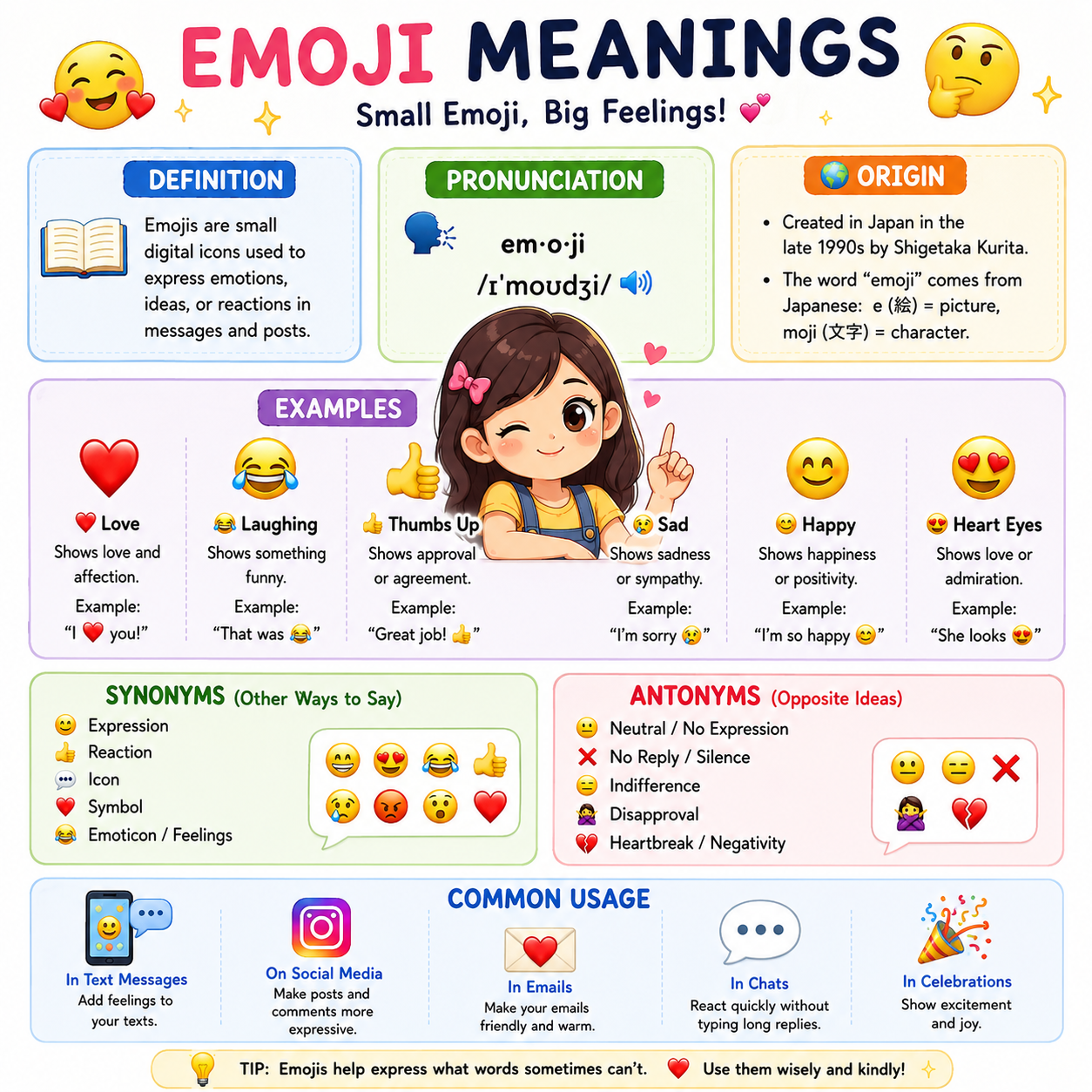
Emoji Meanings have become an important part of everyday digital communication. From a simple 😊 to a celebratory 🎉 or a thoughtful ❤️, these small pictures can add emotion, humor, context, and personality to a message. They are used in text messages, social media posts, emails, comments, online conversations, and many other forms of digital communication.
But what do emoji meanings actually mean? Does every emoji have one fixed definition? Not necessarily. The meaning of an emoji can change depending on the situation, culture, relationship between people, and even the platform where it appears. Unicode explains that emoji are pictographs and that their meanings can vary according to language, culture, and context.
This complete guide to emoji meanings explains the word in simple English, including its pronunciation, origin, examples, synonyms, antonyms, common uses, popular emoji meanings, and frequently asked questions.
What Does Emoji Mean?
An emoji is a small digital picture or symbol used in electronic communication to express an idea, emotion, object, activity, or reaction.
In simple English, an emoji is a picture that helps communicate something in a message.
For example:
- 😊 can express happiness or friendliness.
- 😂 can show that something is very funny.
- ❤️ can express love, care, or affection.
- 👍 can mean approval, agreement, or encouragement.
- 🎉 can represent celebration or excitement.
- 😢 can communicate sadness.
- 🤔 can suggest thinking, questioning, or uncertainty.
Unicode describes emoji as colorful pictographs that can represent faces, weather, vehicles, buildings, food, animals, plants, feelings, emotions, and activities.
The important thing to remember is that an emoji does not always communicate one exact idea. Its meaning depends heavily on context.
Emoji Pronunciation
The word emoji is pronounced approximately like ee-MOH-jee.
The Oxford Advanced Learner’s Dictionary gives the pronunciation as /ɪˈməʊdʒi/. It also lists both emoji and emojis as acceptable plural forms.
Is It Emoji or Emojis?
Both forms are commonly used in English.
For example:
- “I added three emoji to the message.”
- “I added three emojis to the message.”
Unicode generally uses emoji as the plural because the word comes from Japanese, while emojis is also widely accepted in English.
Origin of the Word Emoji
The word emoji comes from Japanese.
It is formed from:
- e (絵) = picture or drawing
- moji (文字) = character or written symbol
Therefore, the basic meaning is picture character or pictograph. The similarity between “emoji” and the English words “emotion” or “emoticon” is coincidental.
Emoji became available on Japanese mobile phones in the late 1990s. Different Japanese mobile phone companies developed their own collections, which eventually created compatibility problems between devices. Unicode later helped create a common system for representing emoji across different computers and phones.
This standardization played a major role in helping emoji become a worldwide part of digital communication.
A Brief History of Emoji
The history of emoji is closely connected with mobile communication in Japan.
Early emoji were developed for Japanese mobile phones so people could communicate ideas visually in short messages. These symbols became popular because they could add meaning without requiring long explanations.
As mobile communication expanded internationally, the need for a common encoding system became more important. Unicode began incorporating emoji characters so that digital systems could represent them more consistently.
Unicode records that some emoji were added in Unicode 5.2 in 2009, followed by a much larger group in Unicode 6.0 in 2010. Additional emoji were introduced in later Unicode versions.
Today, emoji are used around the world in conversations between friends, family members, classmates, coworkers, businesses, and online communities.
Why Are Emoji So Popular?
One major reason for the popularity of emoji is that written messages do not naturally include facial expressions, gestures, or tone of voice.
Consider the sentence:
“Okay.”
Depending on the situation, it could sound neutral, friendly, annoyed, uncertain, or dismissive.
Now compare:
“Okay 😊”
The emoji gives the reader an additional clue about the writer’s attitude.
Unicode notes that emoji can help compensate for some of the emotional and visual information that is normally present during face-to-face communication.
Emoji can therefore make digital conversations feel more expressive and personal.
Common Emoji Meanings
There are thousands of emoji, and each can have multiple uses. Below are some familiar examples.
😊 Smiling Face With Smiling Eyes
This emoji commonly expresses happiness, warmth, friendliness, gratitude, or gentle positivity.
Example:
“Thanks for helping me today 😊”
Here, the emoji makes the message feel warmer and more appreciative.
😂 Face With Tears of Joy
This emoji is commonly used when something is extremely funny.
Example:
“That video was hilarious 😂”
It can also be used simply to show strong amusement.
❤️ Red Heart
The red heart is commonly associated with love, affection, care, appreciation, and emotional support.
Example:
“Thank you for being there for me ❤️”
Its exact meaning depends on the relationship and context.
👍 Thumbs Up
The thumbs-up emoji can communicate agreement, approval, acknowledgment, or encouragement.
Example:
“See you after school 👍”
It can also simply mean “Okay” or “Sounds good.”
🎉 Party Popper
The party-popper emoji commonly represents celebration, excitement, congratulations, or a happy event.
Example:
“You passed your exam! 🎉”
😢 Crying Face
This emoji usually communicates sadness, disappointment, emotional pain, or sympathy.
Example:
“I missed the final episode 😢”
The surrounding words are important because the emoji can sometimes be used humorously.
🤔 Thinking Face
The thinking-face emoji can suggest that someone is considering an idea, asking a question, or feeling unsure.
Example:
“I wonder why that happened 🤔”
😎 Smiling Face With Sunglasses
This emoji is often associated with confidence, coolness, relaxation, fun, or a playful attitude.
Example:
“Finished everything early 😎”
🙏 Folded Hands
This emoji can have different meanings depending on context. It may express thanks, prayer, respect, hope, or a request.
Example:
“Please wish me luck 🙏”
It is a good example of why emoji meanings cannot always be reduced to one definition.
🔥 Fire
The fire emoji is often used to describe something exciting, impressive, excellent, popular, or energetic.
Example:
“That performance was 🔥”
It can also be used literally when discussing fire.
Emoji Meanings Depend on Context
One of the most important facts about emoji meanings is that an emoji does not always have a single universal interpretation.
Unicode specifically explains that emoji are encoded primarily according to their general appearance rather than one fixed intended meaning. Their interpretation can change based on culture, language, and context.
For example, 🙏 might mean:
- Thank you
- Please
- Hope
- Prayer
- Respect
- A request
Similarly, 👍 might mean approval in one conversation but simple acknowledgment in another.
The words around an emoji are therefore just as important as the symbol itself.
Emoji Meaning vs. Emoji Name
An emoji’s official Unicode name is not necessarily the same thing as its everyday meaning.
Unicode explains that a character name acts as a unique identifier and may not cover all the possible meanings associated with an emoji.
For example, an emoji may have an official name describing its appearance, while people use it in several figurative ways online.
This is why understanding emoji meanings requires looking at both the symbol and the situation in which it is used.
Emoji and Emoticons: What Is the Difference?
Emoji and emoticons are related but are not exactly the same.
An emoticon is generally made from ordinary keyboard characters to create an expression.
Examples include:
- 🙂
- 🙁
- 😉
An emoji, on the other hand, is a pictographic character or sequence represented digitally.
Unicode distinguishes emoticons as text-character sequences intended to represent facial expressions or gestures, while emoji are colorful pictographs that can represent a much broader range of subjects.
In everyday conversation, however, people sometimes use the terms loosely.
Synonyms for Emoji
There is no perfect synonym for emoji, but several related words can help explain the concept.
Common Related Words
- Pictograph — a picture used to communicate an idea
- Icon — a visual symbol representing something
- Symbol — a sign that represents an idea or concept
- Digital symbol — a symbol used electronically
- Picture character — a character represented visually
“Pictograph” is especially close to the technical description used by Unicode.
Antonyms of Emoji
There is no exact antonym for emoji because emoji describes a type of visual communication rather than an opposite concept.
However, depending on the context, you could contrast emoji with:
- Plain text
- Written words
- Text-only communication
- Verbal language
For example, someone could write “I am happy” using plain text instead of using 😊.
These are not true dictionary antonyms, but they represent different communication methods.
How to Use Emoji in Everyday Communication
Emoji can be useful when they support the message rather than replace important information.
In Text Messages
Friends and family often use emoji to express emotions quickly.
Example:
“Good luck today! 🍀”
On Social Media
Emoji can add personality to captions and comments.
Example:
“Beautiful day at the park 🌳☀️”
In Online Conversations
Emoji can make short responses seem friendlier.
Example:
“Sounds great! 👍”
In Professional Communication
Emoji can sometimes be appropriate in casual professional settings, but their use should depend on the workplace and audience.
A simple 🙂 may feel friendly, while using many unrelated emoji could make a serious message harder to understand.
Are Emoji a Language?
Emoji are an important communication system, but they are not a complete language in the same way that English, Spanish, Urdu, or Japanese is.
Unicode notes that emoji do not have the grammar and vocabulary required to replace written language completely. Instead, they generally work alongside words and provide additional emotional or visual information.
People can create messages entirely from emoji, but such messages often require interpretation and can have several possible meanings.
Why Can the Same Emoji Look Different?
Emoji can look slightly different depending on the device, operating system, application, or font being used.
For example, an emoji sent from one phone may have a different artistic design when viewed on another device. The basic concept is generally intended to remain recognizable, but details such as facial expression, color, shape, or objects can vary.
This is another reason why people sometimes interpret the same emoji differently.
Cultural Differences in Emoji Meanings
Culture can strongly influence how people understand symbols.
An emoji that seems ordinary to one person may have a special meaning in another cultural setting. Even the same gesture can carry different associations depending on where someone lives.
Unicode recognizes that emoji interpretation can vary by language and culture.
When communicating with someone from a different cultural background, it is therefore helpful to consider the surrounding conversation instead of assuming that an emoji has only one meaning.
Common Mistakes When Using Emoji
Using emoji is easy, but misunderstandings can happen.
Using Too Many Emoji
A message filled with symbols can become difficult to read.
Assuming One Meaning
An emoji may have several interpretations, so avoid automatically assuming what another person intended.
Ignoring the Context
The words surrounding an emoji often explain its intended meaning.
Using an Emoji in a Serious Message Without Thinking
Some situations require clear language. If the subject is important, words should carry the main message and emoji should be secondary.
Emoji Meanings in Modern Digital Communication
Emoji have changed the way people express emotion online. They can make messages shorter, friendlier, funnier, or more expressive.
They are especially useful because digital conversations lack many features of face-to-face communication. A person cannot hear your voice or see your facial expression when reading a normal text message, so an emoji can provide an additional emotional clue.
At the same time, emoji should not be treated as universal translations. Their meanings can shift with context, culture, and online trends. Emojipedia similarly considers historical origins, intended meanings, common real-world use, cultural alternatives, and platform design when explaining emoji meanings.
Frequently Asked Questions About Emoji Meanings
What does emoji mean in simple English?
Emoji means a small digital picture or symbol used to communicate an idea, feeling, object, activity, or reaction. The word comes from Japanese and is connected to the ideas of “picture” and “character.”
How do you pronounce emoji?
Emoji is commonly pronounced ee-MOH-jee. The Oxford Advanced Learner’s Dictionary lists its English pronunciation as /ɪˈməʊdʒi/.
Where did emoji originate?
Modern emoji originated with Japanese mobile phone communication. Emoji became available on Japanese mobile phones in 1999 and later spread internationally through Unicode standardization and widespread smartphone use.
What is the difference between emoji and emoticons?
Emoji are pictographic digital symbols, while emoticons traditionally use ordinary keyboard characters to create expressions, such as 🙂 or :-(. Unicode treats these as distinct concepts.
Does every emoji have one meaning?
No. Emoji can have multiple meanings. Their interpretation may depend on language, culture, context, and how people commonly use them.
What is the most important thing to remember about emoji meanings?
Context matters. Instead of looking at an emoji as having one permanent definition, consider the surrounding words, the relationship between the people communicating, and the situation.
Are “emoji” and “emojis” both correct?
Yes. Both forms are accepted in English. Unicode generally uses “emoji” as the plural, while “emojis” is also common in English usage.
Can emoji replace words?
Emoji can sometimes communicate a simple idea by themselves, but they are not a complete replacement for written language. They work best as an addition to words and can provide emotion, tone, or visual context.
Conclusion
Emoji meanings are more interesting than simply memorizing a list of symbols. Emoji are visual characters that help people communicate emotions, ideas, reactions, objects, and activities in digital conversations. Their name comes from Japanese, combining concepts associated with “picture” and “character,” and their modern history is closely connected with Japanese mobile phones and later Unicode standardization.
The most important lesson is that an emoji does not always have one fixed meaning. A symbol such as ❤️, 👍, 🙏, 😂, or 🤔 can communicate different ideas depending on the conversation and the people involved. Understanding the context is therefore just as important as recognizing the picture itself.
Whether you use emoji in text messages, social media posts, comments, or everyday online conversations, they can make digital communication more expressive. Used thoughtfully, they add personality and emotion while helping written messages feel more natural and human.