The word furlough can be confusing because its meaning changes slightly depending on the situation. You may see it in workplace news, military discussions, government announcements, or conversations about prisons and public institutions. Although the contexts are different, the central idea is the same: furlough usually means an approved period away from normal duties or work.
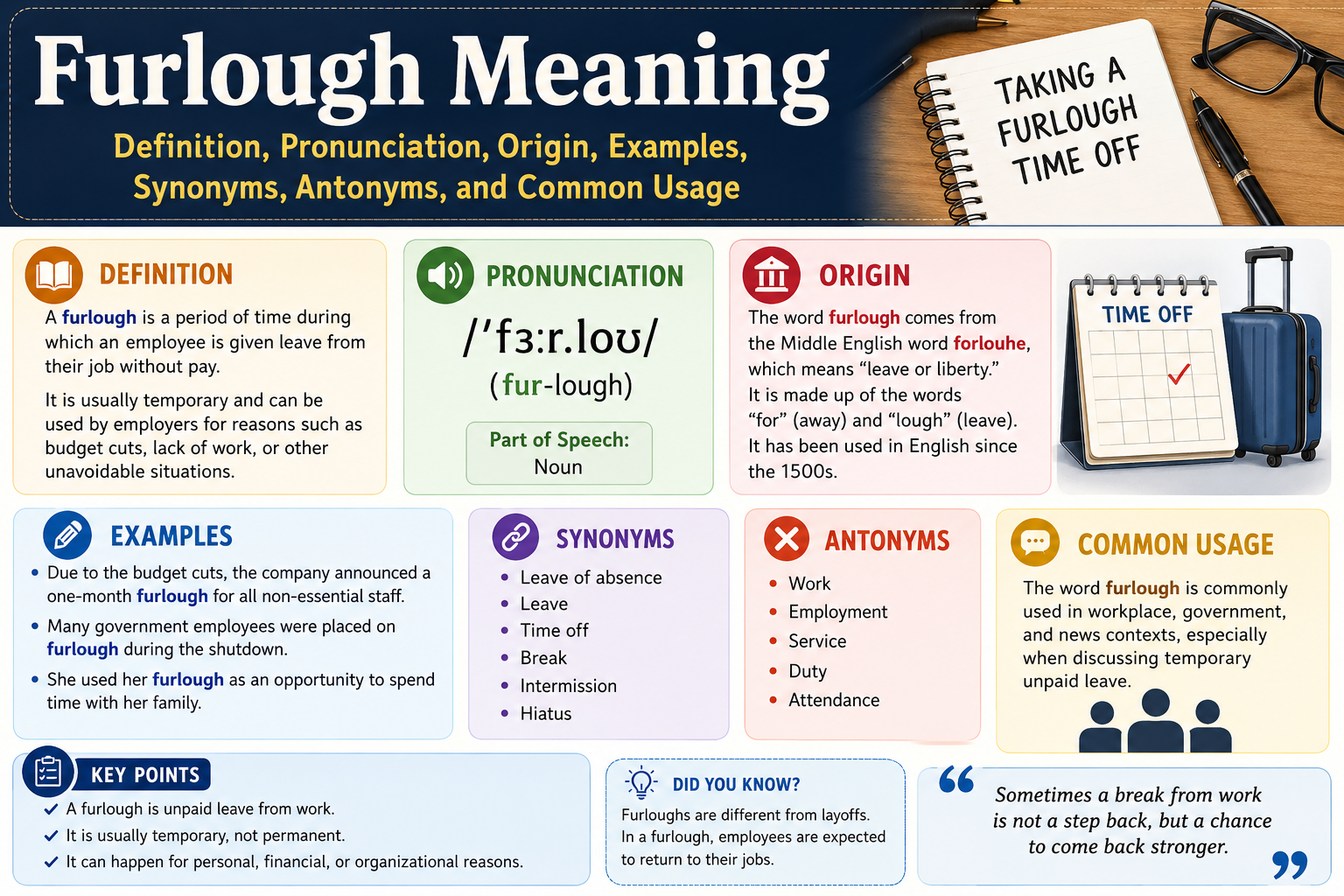
In simple English, a furlough is a temporary leave or break from work, duty, or an institution. For an employee, it can mean being told not to work for a period of time, sometimes without regular pay, while remaining employed. In a military context, it can mean official permission for a service member to leave their assigned duties temporarily.
This detailed guide explains furlough meaning, pronunciation, origin, examples, synonyms, antonyms, grammar, common expressions, and the difference between furlough and similar words.
Furlough Meaning in Simple English
The simplest furlough meaning is:
A furlough is a temporary period when someone is allowed or required to be away from their usual work or duties.
The word can describe different situations.
For example, a company may place employees on furlough during a temporary business slowdown. The employees may still officially work for the company, but they are not working during the furlough period.
A soldier may also receive furlough, meaning they receive official permission to be away from their military duties for a certain amount of time.
The exact rules of a furlough depend on the employer, government, military organization, or other institution involved.
What Does Furlough Mean at Work?
In the workplace, furlough generally refers to a temporary suspension of work. Unlike a permanent job loss, a furlough usually means the employment relationship continues.
For example, a company facing temporary financial difficulties might ask employees to stop working for several weeks. Instead of permanently dismissing them, the company could place them on furlough.
Whether employees receive pay or benefits during furlough depends on the specific arrangement and applicable laws.
Furlough vs. Layoff
A furlough and a layoff are not always the same.
A furlough is generally intended to be temporary. The employee may remain connected to the employer and may be expected to return to work.
A layoff can also be temporary in some circumstances, but it often involves a reduction in the workforce because an employer does not currently have enough work or resources.
The exact legal meanings can differ between countries and employment systems, so workplace policies and local law matter.
What Does Furlough Mean in the Military?
In military English, furlough traditionally means official permission for a member of the armed forces to be absent from duty for a limited period.
For example:
The soldier was granted furlough to visit family.
In this sentence, furlough is essentially an authorized period of leave.
Military furlough may have specific rules about how long the person can be away, where they can go, and when they must return.
This is one of the older and more traditional uses of the word.
Furlough Pronunciation
Furlough is pronounced:
furlough (FUR-loh)
It sounds approximately like “FUR-loh.”
The first syllable sounds like “fur,” while the second sounds similar to “low.”
The pronunciation can initially seem surprising because the spelling does not clearly show how the word sounds.
Furlough as a Noun
Furlough is commonly used as a noun.
For example:
- She is on furlough this week.
- The company announced a temporary furlough.
- His furlough lasted several weeks.
- The employee returned after a short furlough.
Here, furlough refers to the period of authorized or required absence.
The plural form is furloughs.
For example:
Several employees were placed on furloughs during the downturn.
In many workplace contexts, however, people more naturally say that employees were placed on furlough.
Furlough as a Verb
Furlough can also be used as a verb.
When an organization furloughs someone, it temporarily requires or allows that person to stop working or leave their normal duties.
Examples include:
The company furloughed several employees during the slowdown.
The government furloughed some workers during the funding disruption.
The organization decided to furlough staff temporarily.
As a verb, furlough is particularly common in discussions about employment.
Furlough Origin and Etymology
The history of furlough is quite interesting.
The English word comes from the Dutch word verlof, meaning permission, leave, or license. English adopted the term through military usage, and it became associated with official permission for a soldier to be absent from duty.
The word later developed broader uses, especially in employment and government contexts.
The historical connection to the idea of permission to leave is still visible in the modern meaning. Whether someone is a soldier receiving authorized leave or an employee temporarily away from work, the basic concept involves an approved or established period of absence.
Historical Development of Furlough
Originally, furlough was strongly connected to military life.
A soldier normally has specific duties and responsibilities. A furlough provided an official period away from those responsibilities while maintaining the person’s military status.
Over time, the word moved beyond military language.
Today, one of its most recognizable uses is in the workplace. Companies, government agencies, and other organizations may use the term when workers temporarily stop working.
This shift shows how English words can develop broader meanings while keeping an important part of their original idea.
Furlough Examples in Everyday English
Learning through examples can make furlough meaning much easier to understand.
Example: Workplace
The company placed some employees on furlough because of a temporary drop in demand.
This means the employees temporarily stopped working rather than necessarily losing their jobs permanently.
Example: Government
Several government workers were furloughed during the funding disruption.
Here, furlough refers to a temporary interruption of work connected with government operations.
Example: Military
The service member received furlough to spend time with family.
In this example, furlough means authorized military leave.
Example: General Use
After months of demanding work, the employee welcomed a short furlough.
This emphasizes a temporary break from normal duties.
Example: Returning to Work
The staff returned to their regular schedules after the furlough ended.
This highlights the temporary nature of the absence.
Common Synonyms for Furlough
The best synonym depends on the context.
Leave
Leave is probably the most common general synonym.
For example:
The employee was granted leave.
In military contexts, leave is also widely used.
Time Off
Time off is an informal expression for a period when someone does not work.
For example:
She took some time off from work.
However, time off does not necessarily have the same formal or organizational meaning as furlough.
Break
A break can describe a temporary period away from work or activity.
It is more general than furlough.
Absence
Absence simply means a state of being away.
It does not necessarily imply that the absence was officially approved.
Suspension
In some employment situations, suspension can be similar to furlough, but the words are not exact equivalents.
A suspension may be disciplinary, whereas a furlough is often related to operational or financial circumstances.
Layoff
Layoff can sometimes be similar to furlough, particularly when work is temporarily unavailable. However, the terms have different meanings in many workplace settings.
Antonyms of Furlough
There is no single perfect opposite of furlough, but several words express the contrasting idea.
Work
If furlough means temporarily not working, then work represents the opposite condition.
Duty
In a military context, returning to duty contrasts with being on furlough.
Employment
Remaining actively employed and working normally can contrast with being placed on furlough.
Attendance
Being present at work is another idea that contrasts with a temporary absence.
Active Service
In military language, active service can contrast with a period of authorized leave.
These are contextual opposites rather than exact dictionary antonyms.
Furlough vs. Vacation
One common source of confusion is the difference between furlough and vacation.
A vacation is normally a planned period when an employee takes time away from work for rest, travel, family activities, or personal reasons.
A furlough, especially in employment contexts, is usually initiated or required by the employer or organization rather than simply chosen by the employee.
For example:
She took a vacation to visit her relatives.
This suggests a personal choice.
The company placed her on furlough.
This suggests an organizational decision.
Another important difference is that vacation policies generally involve established rules about paid leave, while furlough arrangements can involve a temporary suspension of work and potentially different pay rules.
Furlough vs. Leave
Leave is a broad term covering many kinds of authorized absence from work.
Someone might take:
- Medical leave
- Parental leave
- Personal leave
- Military leave
- Annual leave
A furlough is a more specific term and often suggests a temporary interruption connected to an employer, military organization, or institution.
Therefore, furlough can be considered a type of leave in some contexts, but the words are not always interchangeable.
Furlough vs. Unpaid Leave
Unpaid leave means an employee takes approved time away from work without receiving their normal wages for that period.
A furlough can involve unpaid time, but the two terms are not identical.
For example, an employee may request unpaid leave for personal reasons. A furlough, by contrast, may be imposed by an employer because of temporary operational conditions.
The details depend on the specific employment arrangement.
Furlough vs. Suspension
A suspension can mean that someone is temporarily prohibited from working or performing a particular duty.
The reason is often important.
A suspension may be related to disciplinary concerns, an investigation, or another organizational issue.
A furlough is generally not intended to suggest wrongdoing by the employee. It is often connected with business conditions, funding problems, temporary closures, or other operational circumstances.
Therefore, describing an employee as furloughed does not automatically mean that the employee did something wrong.
Furlough in Government
The term furlough frequently appears in discussions about government employment.
When funding or operations are disrupted, some government workers may be temporarily furloughed under the rules that apply to their organization.
In this context, furlough generally means the employee is temporarily not performing their normal duties because of the operational situation.
Government furlough rules can be complicated, and they vary by country and legal system. Therefore, news reports may use the term broadly while the exact employment consequences depend on official policy.
Furlough in Business
Businesses may use furloughs when they face temporary challenges.
Possible reasons can include:
- A temporary decline in demand
- Seasonal changes
- Financial pressure
- Temporary closure
- Supply problems
- Organizational restructuring
- Unexpected disruptions
The goal is often to reduce immediate labor costs without permanently ending employment relationships.
However, being furloughed can still create financial uncertainty for workers, particularly when the period lasts longer than expected.
Why Companies Use Furloughs
From an organizational perspective, a furlough may allow a business to reduce short-term expenses while keeping employees connected to the organization.
For example, a seasonal business may experience a period when there is not enough work for its entire staff. Instead of permanently eliminating positions, it may temporarily furlough some workers and bring them back when demand increases.
Whether this approach is appropriate depends on the organization’s circumstances and applicable employment laws.
Common Phrases Using Furlough
Several expressions are frequently used with furlough.
“On Furlough”
This means someone is currently experiencing a furlough.
He is currently on furlough.
“Placed on Furlough”
This means an organization has temporarily stopped the person’s normal work.
The employees were placed on furlough.
“Furloughed Employees”
This refers to workers who have been placed on furlough.
The company contacted furloughed employees about the reopening.
“Temporary Furlough”
This emphasizes that the absence is not intended to be permanent.
The organization announced a temporary furlough.
“Return From Furlough”
This describes coming back to normal duties.
The workers returned from furlough in early spring.
Is Furlough a Bad Thing?
Not necessarily.
The word itself is neutral. It describes a situation rather than automatically judging it.
For a military member, furlough may simply mean approved time away from duty. In employment, however, furlough can be stressful if it involves reduced income or uncertainty about when work will resume.
The emotional and financial effect therefore depends on the circumstances.
It is also important to distinguish furlough from termination. Being furloughed generally indicates that the work interruption is temporary, although the precise legal status varies by situation.
Is Furlough Paid or Unpaid?
There is no universal answer.
A furlough may be paid or unpaid, depending on the type of furlough, the organization involved, employment contracts, workplace policies, and applicable law.
In many workplace discussions, furlough is associated with a temporary period when employees do not receive their normal wages for work they are not performing. But this should not be assumed in every situation.
If you encounter the term in a specific workplace or legal document, the relevant policy should be checked for the exact rules.
Is Furlough the Same as Being Fired?
No.
Being fired generally means an employer ends an employee’s employment.
Being furloughed usually means the employee remains connected to the organization but temporarily stops working or performing normal duties.
This is one of the most important differences to understand.
For example:
The employee was fired.
This normally means the employment relationship ended.
The employee was furloughed.
This normally suggests a temporary work interruption.
The exact legal consequences can vary, so the terms should always be interpreted within their specific employment context.
How to Use Furlough in a Sentence
Here are several natural sentence patterns:
As a noun:
The staff returned after a two-week furlough.
With “on”:
Several workers are currently on furlough.
As a verb:
The company decided to furlough part of its workforce.
In a military context:
The soldier received furlough before returning to duty.
In a government context:
Some public employees were placed on furlough.
These examples show how flexible the word can be while retaining its basic meaning.
Frequently Asked Questions About Furlough Meaning
What does furlough mean in simple terms?
Furlough means a temporary period away from normal work or duties. It can refer to employees who temporarily stop working or military members who receive authorized leave.
What is the basic furlough meaning at work?
At work, furlough usually means an employee is temporarily required or permitted to stop working. The person may remain employed, but their work schedule and pay can be affected according to the relevant rules.
How do you pronounce furlough?
Furlough is pronounced approximately “FUR-loh.” The first syllable receives the main stress.
Is furlough the same as vacation?
No. Vacation is generally time off chosen or requested by an employee. A furlough is usually an organizationally established or authorized temporary absence and can occur for reasons unrelated to personal vacation.
Is furlough the same as a layoff?
Not necessarily. Both can involve a temporary lack of work, but their meanings and legal consequences can differ. A furlough generally emphasizes a temporary interruption while maintaining an employment connection.
Is furlough paid?
It depends on the situation. Some furlough arrangements may involve pay or other compensation, while others may involve unpaid time. The applicable workplace policy and law determine the details.
Can furlough be used as a verb?
Yes. Furlough can be used as both a noun and a verb.
For example:
The company placed employees on furlough.
And:
The company furloughed employees temporarily.
What is the opposite of furlough?
There is no exact single antonym. Depending on context, work, duty, active service, or regular employment can express the opposite idea.
Where did the word furlough originate?
Furlough entered English through Dutch verlof, meaning permission or leave. It became associated with military leave before developing broader workplace and institutional meanings.
Does furlough mean you lost your job?
Usually, no. Furlough generally describes a temporary interruption of work rather than an immediate permanent termination. However, the exact status depends on the specific arrangement.
Final Thoughts on Furlough Meaning
The furlough meaning becomes much easier to understand when you focus on the central idea of temporary absence from normal work or duty.
In a military setting, furlough can mean authorized leave from service. In the workplace, it often describes a temporary suspension of work, sometimes because an organization is dealing with financial, operational, or funding difficulties. The person may remain employed even though they are temporarily not working.
The word has an interesting history, beginning with a term related to permission or leave and later becoming an established part of English military and workplace vocabulary.
Understanding the difference between furlough, vacation, leave, layoff, suspension, and termination is especially useful because these words can describe very different situations. When you encounter furlough in a conversation, article, employment document, or news report, look at the surrounding context to determine exactly what kind of temporary absence is being discussed.