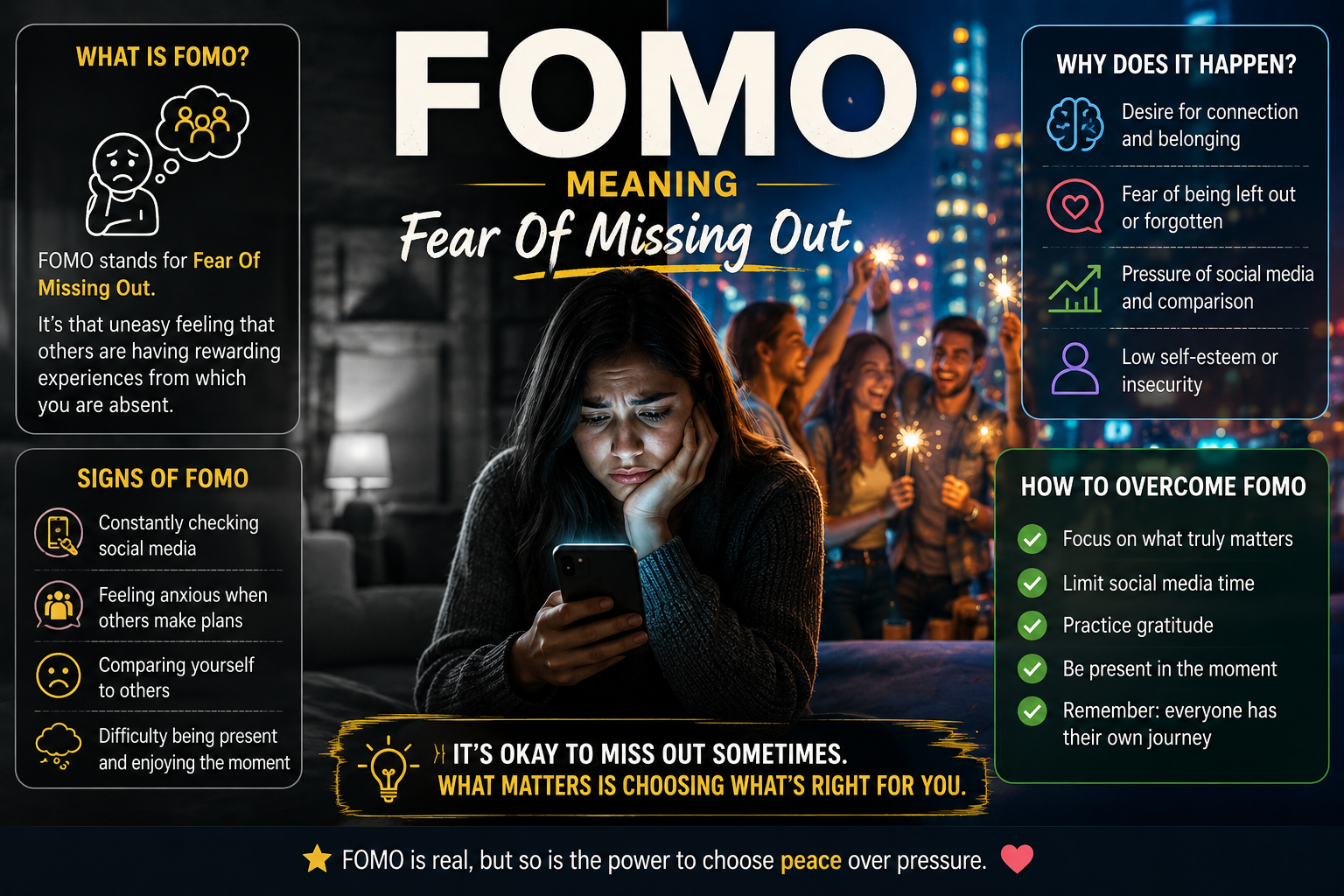
The FOMO meaning is “fear of missing out.” It describes the feeling that other people are enjoying something exciting, important, or valuable without you. When someone experiences FOMO, they may worry that they are missing a fun event, an opportunity, a social experience, a trend, or something that could improve their life.
FOMO is especially common in the age of social media. People constantly see photos, videos, posts, stories, and updates showing what others are doing. Even when those posts represent only a small part of someone’s life, they can create the impression that everyone else is having more fun or achieving more.
FOMO is not limited to social media. A person can experience it when friends go somewhere without them, when coworkers receive an exciting opportunity, when a popular product sells quickly, or when people around them seem to be making progress.
Understanding FOMO meaning can help people recognize this feeling and make better decisions instead of acting only because they are afraid of being left out.
What Does FOMO Mean?
FOMO stands for “fear of missing out.”
In simple English, FOMO means worrying that you are missing something enjoyable, important, or valuable while other people are experiencing it.
For example, imagine that several friends go to a party and post pictures online. You were not invited, or you decided not to attend. After seeing their pictures, you may start thinking that you should have gone. You might feel disappointed, left out, or worried that you missed an unforgettable experience.
That feeling is FOMO.
FOMO can also happen when someone sees people buying a new product, traveling to a popular destination, attending an event, joining a trend, or achieving a goal. The person may feel pressure to participate simply because other people are doing it.
How Do You Pronounce FOMO?
FOMO is pronounced “FOH-moh.”
It is normally spoken as a word rather than saying each letter separately.
The full phrase, fear of missing out, is pronounced naturally as an ordinary English phrase.
What Is the Origin of FOMO?
The term FOMO became popular in modern English through discussions about social behavior, technology, and social media. One of the people strongly associated with the early use of the term is marketing strategist Dan Herman, who discussed the concept in the early development of the idea.
The abbreviation later became widely known through business, marketing, technology, and social media conversations. As smartphones and social platforms became part of everyday life, people gained more opportunities to see what others were doing in real time.
This made the feeling easier to recognize and discuss.
The word became especially common in online communication because abbreviations are convenient in text messages, comments, headlines, and social posts. Today, FOMO is a familiar term in everyday English.
FOMO Meaning in Simple English
The easiest way to understand FOMO is:
FOMO means feeling worried that you are missing something while other people are enjoying it or benefiting from it.
Here are some simple examples:
- Your friends go out without you, and you feel left out.
- Everyone is talking about a new show, and you feel pressured to watch it.
- People online are traveling, and you feel like your own life is less exciting.
- A popular product is almost sold out, and you suddenly want to buy it.
- Your classmates join an activity, and you feel that you should join too.
FOMO does not always mean that a person genuinely wants the thing they are missing. Sometimes they simply dislike the idea of being excluded.
What Causes FOMO?
FOMO can have several causes. Social comparison is one of the most common. People naturally compare their experiences, achievements, appearance, possessions, and social lives with those of others.
Social media can make this comparison stronger because users often see carefully selected moments from other people’s lives. A person may see someone’s vacation photos but not see the stressful travel, financial costs, arguments, or ordinary days behind those pictures.
Another cause is uncertainty. People may worry that an opportunity will disappear if they do not act immediately. This can happen with sales, invitations, events, educational opportunities, or social activities.
Peer pressure can also contribute to FOMO. When everyone around you seems interested in something, it can be difficult to feel comfortable choosing differently.
FOMO and Social Media
FOMO and social media are closely connected.
Platforms allow people to see what friends, classmates, celebrities, influencers, and other users are doing almost instantly. This constant flow of information can make it seem as though something exciting is always happening somewhere.
For example, someone might open social media and see several people attending a concert. Even if they were perfectly happy at home before checking their phone, they may suddenly feel that they are missing out.
The problem is that social media usually shows selected moments rather than complete reality. People tend to share celebrations, achievements, vacations, meals, events, and exciting experiences. Ordinary or difficult moments are often less visible.
This can create an unrealistic comparison.
FOMO Examples in Everyday Life
FOMO can appear in many ordinary situations.
Example: Friends
A group of friends makes plans without you. After seeing their photos, you feel disappointed and wish you had gone.
This is a classic example of social FOMO.
Example: Shopping
A website says a product is available for a limited time. You were not planning to buy it, but the message makes you feel that you need to purchase it immediately.
That can be shopping-related FOMO.
Example: Entertainment
Everyone at school is discussing a popular movie or series. You feel pressured to watch it because you do not want to be the only person who does not understand the conversation.
This is another form of FOMO.
Example: Opportunities
You hear that someone received an opportunity that you did not pursue. You suddenly worry that you made the wrong choice.
This can be career, education, or opportunity-related FOMO.
FOMO in Relationships
FOMO can also affect friendships and relationships.
Someone might worry that their friends are becoming closer to other people. They may feel anxious when friends spend time together without them.
For example, a person may see two friends hanging out and immediately wonder whether they are being replaced. The feeling can become stronger when social media provides constant updates.
However, one event does not necessarily mean that a friendship is changing. Healthy friendships allow people to have different activities, relationships, and interests.
Recognizing FOMO can help someone avoid making assumptions based on a single photo or post.
FOMO at School
Students can experience FOMO when they see classmates attending events, joining clubs, playing games, going on trips, or participating in social activities.
A student may feel pressure to participate simply because others are doing it.
FOMO can sometimes encourage people to try new experiences, which is not necessarily bad. However, problems can arise when someone ignores their own interests or boundaries just to fit in.
A useful question is:
“Would I actually want to do this if nobody else were doing it?”
If the answer is no, the decision may be driven mainly by FOMO.
FOMO at Work
Adults can experience FOMO in professional environments as well.
For example, an employee may worry that coworkers are getting better opportunities, attending networking events, learning new skills, or receiving recognition.
This feeling can sometimes motivate positive action. A person may decide to learn a new skill or speak with a manager about career development.
However, constant comparison can also create unnecessary stress. Other people’s career paths are not necessarily a useful measurement of your own progress.
FOMO and Buying Decisions
Businesses sometimes use FOMO to encourage customers to make quick purchases.
Common examples include phrases such as:
- Limited-time offer
- Almost sold out
- Only a few remaining
- Ending soon
- Last chance
- Exclusive access
These messages can create urgency.
There is nothing automatically wrong with a limited-time offer, but consumers should pause before making an expensive decision. Ask whether you genuinely need the product or whether the urgency is making you feel pressured.
What Is the Opposite of FOMO?
A popular opposite of FOMO is JOMO, meaning “joy of missing out.”
JOMO describes the positive feeling of choosing not to participate in something and being comfortable with that decision.
For example, you might decide not to attend a crowded event because you would rather spend a quiet evening reading, watching a movie, exercising, or spending time with family.
Instead of thinking, “Everyone is there, so I must go,” JOMO encourages the thought, “I am happy with what I chose to do.”
FOMO Synonyms
FOMO does not have one perfect synonym because it describes a specific emotional experience. However, several words and phrases have similar meanings.
Some related terms include:
- Fear of exclusion
- Feeling left out
- Social anxiety
- Peer pressure
- Social comparison
- Worry about missing something
- Fear of being left behind
- Desire to belong
- Concern about missing opportunities
These terms are related to FOMO but are not always exact replacements.
FOMO Antonyms
The most commonly discussed opposite of FOMO is JOMO, or “joy of missing out.”
Other concepts that can contrast with FOMO include:
- Contentment
- Confidence
- Independence
- Satisfaction
- Self-assurance
- Peace of mind
- Mindfulness
- Acceptance
These ideas describe being comfortable with your own choices instead of constantly worrying about what other people are doing.
Common Usage of FOMO
FOMO is commonly used in casual conversations, text messages, social media posts, marketing discussions, and online articles.
For example:
“I had FOMO when I saw everyone’s pictures from the concert.”
“I bought the tickets because I didn’t want FOMO.”
“Social media can give people serious FOMO.”
“I decided to stay home and avoid FOMO-driven decisions.”
The word can be used as both a noun and an informal conversational term.
For example:
“I have FOMO.”
Or:
“That post gave me FOMO.”
FOMO vs. Peer Pressure
FOMO and peer pressure are related, but they are not exactly the same.
FOMO is the internal fear that you are missing something.
Peer pressure involves influence from other people that encourages you to behave in a certain way.
For example, you might see friends attending an event and feel FOMO without anyone contacting you. If your friends directly pressure you to attend because “everyone else is going,” that becomes peer pressure.
The two experiences can happen together.
FOMO vs. Envy
FOMO and envy can also overlap.
FOMO focuses on the fear of missing an experience or opportunity. Envy involves wanting something that another person has.
Imagine that your friend travels to another country. You might experience FOMO because you wish you were part of the trip. You might experience envy because you want the opportunity they have.
The emotions are related but not identical.
How to Handle FOMO
Experiencing FOMO is normal. The goal is not necessarily to eliminate every uncomfortable feeling but to understand it before making decisions.
Pause Before Acting
When you suddenly feel that you must participate, buy something, or respond immediately, take a moment.
Ask yourself whether you genuinely want the experience.
Reduce Unnecessary Comparison
Constantly comparing your life with other people’s online posts can make FOMO stronger. Taking regular breaks from social media can create more mental space.
Focus on Your Priorities
Think about what actually matters to you. Your priorities may be different from those of your friends or people you follow online.
Remember That Posts Are Selective
A social media post usually shows one moment. It does not provide the complete story of someone’s life.
Practice Contentment
Instead of focusing only on what you are missing, notice what you already have. This can make it easier to feel satisfied with your choices.
Why FOMO Matters Today
FOMO has become an important modern expression because technology has changed how people experience social comparison.
In the past, someone might hear about a friend’s weekend several days later. Today, they may see photos and updates while the event is happening.
This constant connection can be useful, but it can also make people feel that they need to stay informed and involved all the time.
Understanding FOMO meaning helps people recognize when a decision is being influenced by fear rather than genuine interest.
Frequently Asked Questions About FOMO Meaning
What does FOMO stand for?
FOMO stands for “fear of missing out.” It describes anxiety or worry about missing an enjoyable, important, or valuable experience that other people are having.
What is FOMO in simple words?
In simple words, FOMO means being afraid that you are missing something while other people are enjoying it or benefiting from it.
Is FOMO a real word?
Yes. FOMO is a widely used English abbreviation. It appears frequently in everyday conversations, social media, marketing, psychology discussions, and popular culture.
What is an example of FOMO?
If your friends attend an event and you feel upset after seeing their photos because you think you should have been there, you are experiencing FOMO.
What is the opposite of FOMO?
The commonly recognized opposite is JOMO, which means “joy of missing out.” It describes feeling comfortable and even happy with choosing not to participate.
Is FOMO always bad?
No. FOMO is not automatically harmful. It can sometimes encourage someone to try a new activity or take an opportunity they genuinely want. Problems can occur when fear of missing out controls decisions or creates constant comparison.
Why is FOMO common on social media?
Social media makes it easy to see what other people are doing. Because users often share their most exciting moments, viewers may feel that everyone else is enjoying a better or more interesting life.
How do you use FOMO in a sentence?
You can say, “I had FOMO after seeing everyone else’s photos from the event.”
Is FOMO the same as jealousy?
Not exactly. FOMO is mainly about fearing that you are missing an experience or opportunity. Jealousy or envy can involve wanting something another person has. The two feelings can occur at the same time.
Can FOMO affect shopping?
Yes. Limited-time promotions, low-stock messages, and exclusive offers can create urgency and encourage people to purchase something because they fear missing the opportunity.
Conclusion: Understanding the FOMO Meaning
The FOMO meaning is simple: FOMO stands for “fear of missing out,” the feeling that you are missing an exciting, valuable, or important experience while other people are enjoying it.
FOMO is especially common in a connected digital world where social media constantly shows people what others are doing. It can appear in friendships, relationships, school, work, entertainment, shopping, and everyday decision-making.
Although FOMO is a normal human feeling, recognizing it can help you make more thoughtful choices. Before following a trend, attending an event, buying something, or comparing yourself with others, take a moment to ask whether you genuinely want it.
The most important lesson is that you do not have to participate in everything other people are doing. A satisfying life is not measured by how many experiences you never miss. It is built around choices that match your own values, interests, goals, and well-being.
Understanding FOMO can therefore be more than learning a popular abbreviation. It can help you become more aware of social pressure, online comparison, and the reasons behind your own decisions.