Understanding integrity meaning can help you communicate more clearly when talking about honesty, character, trust, and doing what is right. Integrity is a powerful quality because it describes more than simply telling the truth. It also involves staying faithful to your values, keeping your promises, taking responsibility for your actions, and behaving consistently even when nobody is watching.
In everyday English, people often use the word integrity to describe someone they can trust. A person with integrity generally tries to do the right thing rather than choosing what is easiest or most convenient. The word can also describe something that remains whole, strong, or undamaged, such as the structural integrity of a building.
What Is the Integrity Meaning?
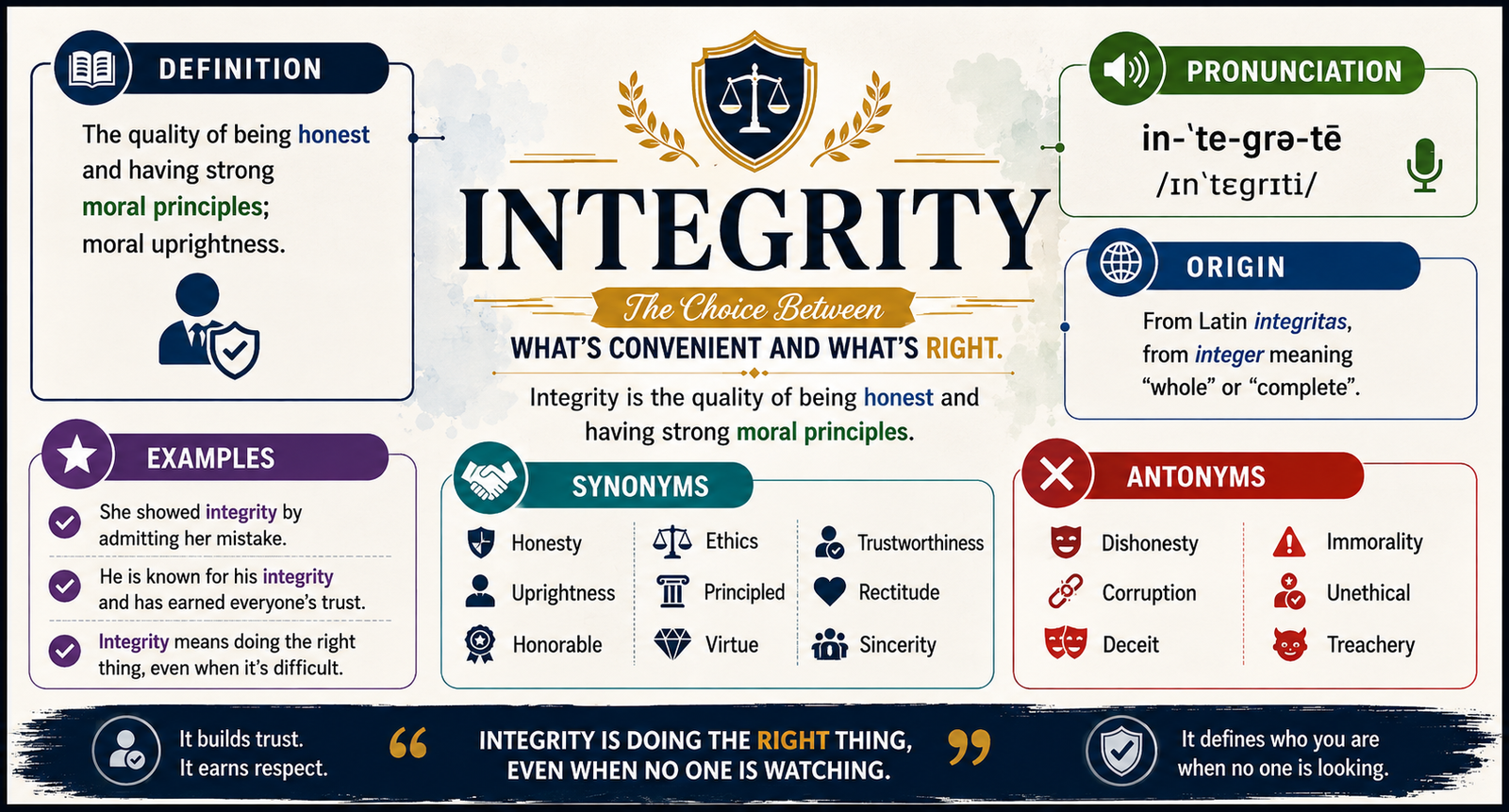
The simplest integrity meaning is the quality of being honest, trustworthy, and guided by strong moral principles. It can describe a person’s character, behavior, or commitment to doing what they believe is right. Merriam-Webster also gives integrity meanings connected with being sound, unimpaired, complete, or undivided.
For example, if someone finds money that does not belong to them and makes an effort to return it, that action can demonstrate integrity. The important point is not simply that the person followed a rule. It is that they chose to act honestly even when they could have benefited by doing otherwise.
Integrity is therefore closely connected with trust. When people know that someone has integrity, they are more likely to believe that person’s words and rely on their decisions.
Integrity Pronunciation
The word integrity is pronounced approximately as in-TEG-ri-tee.
The main stress falls on the middle part of the word. Integrity is a noun, so common expressions include “a person of integrity,” “personal integrity,” “professional integrity,” and “maintain your integrity.”
Simple Definition of Integrity
In very simple English, integrity means doing what is right and being honest and dependable.
A person who has integrity usually:
- Tells the truth.
- Keeps promises.
- Takes responsibility for mistakes.
- Treats people fairly.
- Does not deliberately deceive others.
- Follows important principles.
- Stays true to their values.
- Does the right thing even when it is difficult.
Integrity does not mean that a person never makes mistakes. Everyone makes mistakes. A person with integrity can make an error, admit it, apologize when appropriate, and try to correct the situation.
This is one reason integrity is better understood as a pattern of behavior rather than a claim that someone is perfect.
What Does Integrity Mean in a Person?
When people say that someone “has integrity,” they are usually praising that person’s character. It means the person is considered honest, principled, trustworthy, and reliable.
For example, imagine a student accidentally receives extra credit because of a teacher’s mistake. If the student points out the error instead of keeping the unfair advantage, that can be an example of integrity.
Similarly, an employee who admits that they made a mistake in an important project is showing integrity. They may feel uncomfortable admitting the error, but honesty and responsibility are more important than protecting their image.
Integrity can also mean consistency between what someone says and what they actually do. If a person says that fairness matters but repeatedly treats others unfairly, their actions do not match their stated values.
Integrity Meaning in Everyday Life
Integrity appears in many ordinary situations. It does not require dramatic decisions or heroic actions. Small choices can reveal a person’s character.
Returning something that belongs to another person is one example. Giving proper credit for someone else’s work is another. Keeping a promise, admitting when you are wrong, and refusing to spread information you know is false can also demonstrate integrity.
These choices may seem small, but repeated actions shape how other people view us. Over time, honest and responsible behavior can build a strong reputation.
Integrity also matters when nobody is checking. If a person behaves responsibly only because they are being watched, their behavior may not reflect genuine integrity. True integrity is connected to internal values rather than simply fear of punishment.
Origin and History of the Word Integrity
The history of integrity is closely connected with the idea of being whole or complete. The English word developed through Middle English and French from the Latin word integritas, which referred to soundness, wholeness, completeness, purity, and blamelessness.
The word has been used in English since around the late Middle Ages. Its meaning gradually developed in different directions. Alongside the idea of being whole or undamaged, integrity came to describe moral soundness and upright character.
This history helps explain why integrity can describe both people and things. A person can have moral integrity, while a building can have structural integrity. In both cases, the underlying idea involves something being sound, whole, or not corrupted.
The Connection Between Integrity and Wholeness
The connection between integrity and wholeness is especially interesting. A person with moral integrity can be thought of as someone whose actions and values fit together rather than being divided by dishonesty or hypocrisy.
For example, suppose someone strongly believes that people should be treated fairly. They then try to apply that principle when dealing with friends, classmates, coworkers, and strangers. Their actions are consistent with their values.
That consistency is an important part of integrity. The person is not simply saying what sounds good. Their behavior supports what they claim to believe.
The same basic idea appears in other uses of the word. A structure has integrity when its parts remain sound and function together properly. A work of art can have integrity when its essential qualities remain coherent and complete.
Moral Integrity vs. Structural Integrity
The word integrity has more than one important meaning. The two most common broad uses are moral integrity and structural or physical integrity.
Moral integrity refers to honesty, strong principles, and trustworthy behavior. When someone says, “She is a person of integrity,” this is usually the meaning intended.
Structural integrity refers to the condition of something being sound and able to remain whole. For example, an engineer might discuss the structural integrity of a bridge after an earthquake.
The meanings are different, but they share the central idea of being sound and not compromised. Merriam-Webster lists moral uprightness, unimpaired condition, and completeness as major meanings of the word.
Examples of Integrity
Examples make the integrity meaning easier to understand. Consider these everyday situations.
Admitting a Mistake
A student accidentally submits the wrong file for an assignment. Instead of pretending that nothing happened, the student tells the teacher what happened and accepts the consequences.
That is an example of integrity because the student chooses honesty and responsibility over avoiding embarrassment.
Giving Credit to Others
A person uses an idea that originally came from a friend or coworker. Instead of presenting the idea as their own, they acknowledge the original source.
Giving appropriate credit shows respect and honesty.
Keeping a Promise
Someone promises to help a friend with an important task. When the time comes, they make a genuine effort to keep that promise.
Keeping commitments can strengthen trust and demonstrate integrity.
Returning Something That Is Not Yours
A person finds an item that belongs to someone else. Rather than keeping it, they try to return it.
This is a simple example of choosing honesty over personal benefit.
Speaking Truthfully
A person may have an opportunity to make themselves look better by exaggerating what happened. Instead, they explain the situation accurately.
Truthfulness is one of the central ideas associated with integrity.
Integrity in a Sentence
Here are some natural examples of how the word integrity is used:
- Everyone respects her because she has strong personal integrity.
- He showed integrity by admitting his mistake.
- The company wants employees to act with honesty and integrity.
- His integrity earned the trust of his colleagues.
- She refused to compromise her integrity for personal gain.
- The engineers inspected the building’s structural integrity.
- The journalist’s professional integrity was important to her.
- The organization works to protect the integrity of its records.
These examples show that integrity can describe personal character as well as the soundness or completeness of something.
Common Phrases With Integrity
Several expressions containing the word integrity are common in English.
A Person of Integrity
This phrase describes someone who is considered highly honest, trustworthy, and principled.
Example: “Everyone considered the teacher a person of integrity.”
Personal Integrity
Personal integrity refers to the principles and honesty that guide an individual’s behavior.
Example: “Personal integrity matters when making difficult decisions.”
Professional Integrity
Professional integrity describes ethical and responsible behavior in a workplace or profession.
Example: “The organization expects employees to maintain professional integrity.”
With Integrity
The phrase “with integrity” means behaving honestly and according to strong principles.
Example: “She handled the disagreement with integrity.”
Maintain Your Integrity
This means continuing to follow your principles even when you face pressure to compromise them.
Example: “He maintained his integrity despite the difficult circumstances.”
Structural Integrity
Structural integrity refers to the strength and soundness of a physical structure.
Example: “The engineers checked the bridge’s structural integrity.”
Integrity Synonyms
There are many words related to integrity, although they are not always exact replacements. Merriam-Webster lists words such as morality, virtue, honesty, character, ethics, honor, probity, uprightness, and trustworthiness among related terms.
Honesty
Honesty means being truthful and avoiding lies or deception. It is one of the closest everyday synonyms for integrity.
Morality
Morality concerns principles about right and wrong behavior. Integrity can reflect a person’s commitment to those principles.
Virtue
Virtue refers to a morally good quality or behavior.
Character
Character describes the qualities that shape how a person behaves, especially in difficult situations.
Honor
Honor can refer to respect for ethical standards, duties, or one’s responsibilities.
Trustworthiness
Trustworthiness describes someone who can be relied upon to act honestly and responsibly.
Uprightness
Uprightness means having strong moral standards and behaving honestly.
Probity
Probity is a more formal word meaning proven honesty and moral integrity.
Integrity Antonyms
Understanding the opposite of integrity can make the meaning clearer. Common antonyms and related opposites include:
- Dishonesty
- Corruption
- Deception
- Immorality
- Untrustworthiness
- Hypocrisy
- Fraudulence
- Crookedness
- Unethical behavior
Merriam-Webster’s thesaurus identifies dishonesty, corruption, immorality, and related terms among the antonyms or near-antonyms of integrity.
For example, if integrity means acting honestly and responsibly, dishonesty involves deliberately failing to tell the truth or behaving deceptively. Corruption involves allowing improper influence or personal benefit to undermine ethical standards.
Integrity vs. Honesty
Integrity and honesty are closely related, but they are not exactly the same.
Honesty mainly focuses on truthfulness. It means not lying, stealing, or deliberately deceiving others.
Integrity is broader. It can include honesty, but it also involves keeping commitments, following principles, accepting responsibility, treating people fairly, and remaining consistent with your values. Merriam-Webster similarly distinguishes integrity as a broader quality involving trustworthiness and incorruptibility.
For example, telling the truth about a mistake is honesty. Taking responsibility for the mistake, working to fix it, and continuing to act responsibly afterward demonstrate a broader pattern of integrity.
Why Is Integrity Important?
Integrity is important because trust depends heavily on consistent behavior. People are more comfortable relying on someone when they believe that person’s words and actions are dependable.
In school, integrity can encourage students to complete their own work, acknowledge sources, and be honest about mistakes. In professional settings, integrity can support responsible decision-making and healthy working relationships.
Integrity also matters in friendships and family relationships. People do not need their friends or relatives to be perfect. They usually need them to be truthful, dependable, respectful, and willing to take responsibility when something goes wrong.
How Can Someone Develop Integrity?
Integrity is not simply something a person either has or does not have. It can be strengthened through everyday choices.
One useful habit is to think carefully before making promises. Only make commitments you genuinely intend to keep. If circumstances change and you cannot keep a promise, communicate honestly instead of quietly ignoring it.
Another helpful habit is accepting responsibility. When you make a mistake, avoid automatically blaming another person. Ask what happened, recognize your part in the situation, and consider how you can make things better.
It is also useful to think about your values. Knowing what matters to you can make difficult decisions easier because you have principles to guide your choices.
Integrity in School
Integrity is especially important in education. Academic integrity means completing schoolwork honestly and giving proper credit when using someone else’s ideas or material.
For students, this can include doing their own work, following classroom rules, acknowledging sources, and asking for help when they do not understand something instead of pretending to know the answer.
Academic integrity is not about being perfect. A student can struggle with a subject and still act with integrity. Asking a teacher for clarification or admitting confusion is often a more responsible choice than pretending everything is fine.
Integrity at Work
Professional integrity means behaving responsibly and ethically in a workplace or profession. It can involve accurate communication, keeping commitments, respecting confidential information, and taking responsibility for mistakes.
Employers often value integrity because trust is important for teamwork. A person who communicates honestly can make it easier for others to understand problems and find solutions.
Professional integrity also means avoiding situations where personal interests unfairly influence responsibilities. A trustworthy professional understands that reputation is built through repeated actions rather than one impressive moment.
Integrity in Friendships
Integrity can make friendships stronger because trust grows when people know they can depend on one another.
A friend with integrity does not need to agree with everything you say. In fact, honest disagreement can be healthier than pretending to agree. A trustworthy friend can express their opinion respectfully while still caring about your feelings.
Integrity also involves respecting boundaries and keeping private matters private when appropriate. Being dependable during ordinary situations can matter just as much as being supportive during major events.
Is Integrity the Same as Being Perfect?
No. Integrity does not mean perfection.
A person with integrity can make mistakes, misunderstand situations, lose their temper, or make a poor decision. What matters is how they respond afterward.
Someone who admits an error and tries to repair the damage may demonstrate more integrity than someone who never admits mistakes because they are afraid of looking imperfect.
This distinction is important because expecting perfection can create an unrealistic understanding of integrity. Integrity is about honest and responsible conduct, not never making an error.
What Does “A Man or Woman of Integrity” Mean?
The phrase “a person of integrity” is a strong compliment. It means the person is viewed as honest, principled, trustworthy, and reliable.
When someone says, “She is a woman of integrity,” they are usually describing her character rather than one specific action. They are suggesting that honesty and ethical behavior are consistent parts of how she lives and makes decisions.
The same applies to “a man of integrity” or simply “a person of integrity.” The phrase focuses on character and trustworthiness.
Quick Integrity Meaning Guide
| Feature | Meaning |
| Word | Integrity |
| Part of speech | Noun |
| Simple meaning | Honesty, strong principles, and trustworthiness |
| Pronunciation | in-TEG-ri-tee |
| Main moral idea | Doing what is right and staying true to your values |
| Common synonyms | Honesty, morality, virtue, character, honor |
| Common antonyms | Dishonesty, corruption, deception |
| Another meaning | Being whole, sound, or undamaged |
| Common phrase | A person of integrity |
| Related adjective | Integral is related etymologically, but it does not mean exactly the same thing |
Frequently Asked Questions About Integrity Meaning
What is the simple meaning of integrity?
Integrity simply means being honest, trustworthy, and guided by strong moral principles. It also involves behaving consistently with your values and taking responsibility for your actions.
What is an example of integrity?
Admitting that you made a mistake instead of blaming another person is an example of integrity. Returning something that does not belong to you is another simple example.
Is integrity the same as honesty?
Not exactly. Honesty focuses mainly on telling the truth and avoiding deception. Integrity is broader and can include honesty, responsibility, fairness, reliability, and consistency with personal principles.
What are the synonyms of integrity?
Common synonyms include honesty, morality, virtue, character, honor, trustworthiness, uprightness, ethics, and probity. The best synonym depends on the context.
What is the opposite of integrity?
Common opposites include dishonesty, corruption, deception, immorality, hypocrisy, and untrustworthiness.
Can integrity describe an object?
Yes. Integrity can describe the soundness or completeness of something. For example, “structural integrity” refers to whether a building, bridge, or other structure remains sound and strong.
Why is integrity important?
Integrity helps create trust. People are more likely to rely on someone when that person’s words, decisions, and actions consistently reflect honesty and responsibility.
How do you use integrity in a sentence?
You can say, “She showed integrity by admitting her mistake,” or “He is known as a person of integrity.” You can also use the word for physical structures, as in “The inspection confirmed the building’s structural integrity.”
What does “a person of integrity” mean?
It means a person who is considered honest, principled, trustworthy, and dependable. The phrase is generally used as a strong positive description of someone’s character.
Conclusion: Understanding Integrity Meaning
The integrity meaning is centered on honesty, strong character, trustworthiness, and consistency with one’s principles. In simple English, integrity means trying to do what is right and being someone others can trust.
The word also has a broader meaning connected with being whole, complete, or sound. Its history comes through Middle English and French from Latin roots associated with wholeness and soundness, which helps explain the connection between moral integrity and structural integrity.
Integrity is not about being perfect. It is about how you respond to choices, mistakes, responsibilities, and difficult situations. Whether in school, friendships, family life, work, or everyday decisions, integrity can help build lasting trust and respect.
In the end, integrity is best understood not as something a person simply claims to have, but as a quality shown through consistent actions. When words and actions match, honesty guides decisions, and responsibility matters even when nobody is watching, integrity becomes visible in everyday life.