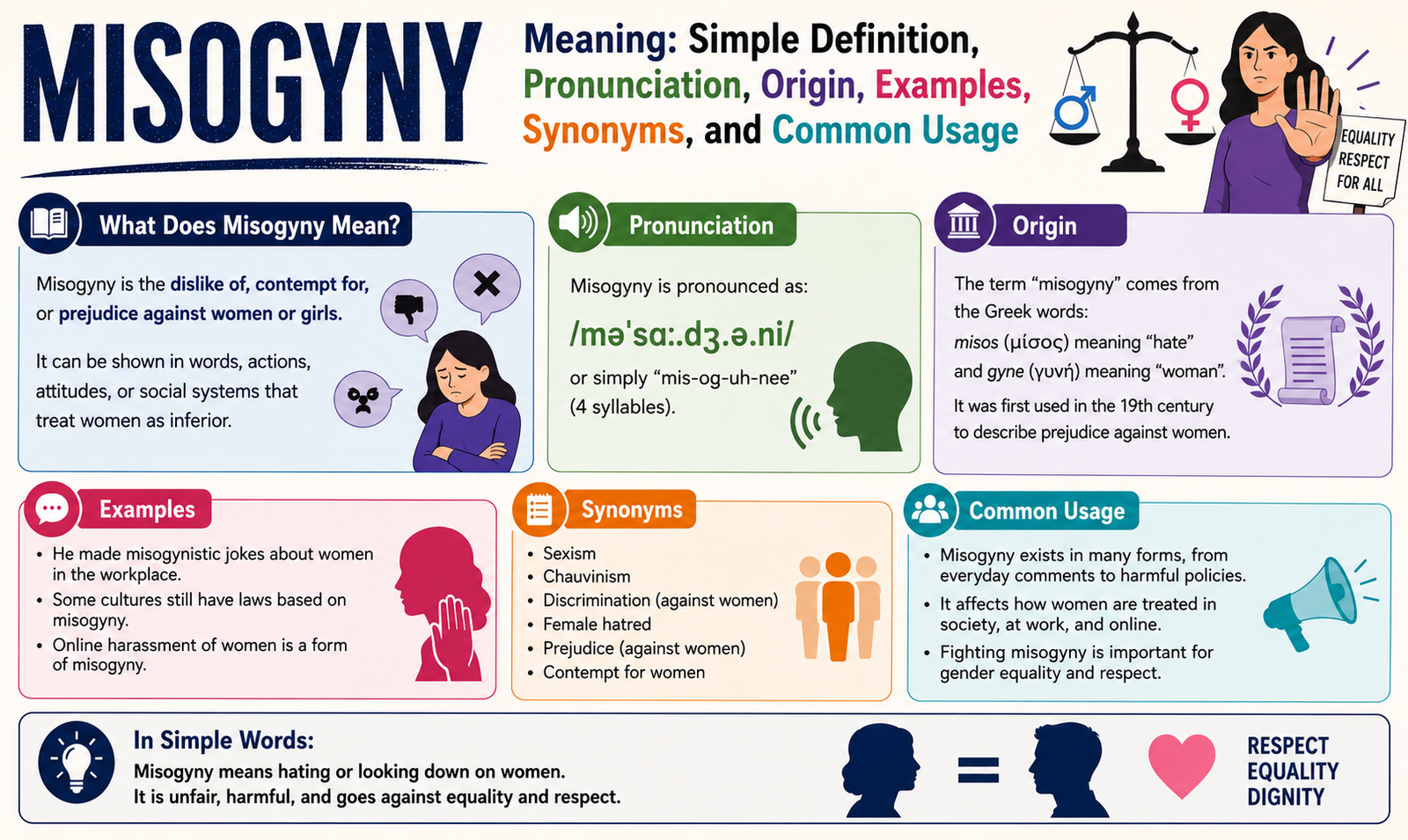
If you have searched for misogyny meaning, you may have come across the word in discussions about gender, discrimination, relationships, politics, workplaces, entertainment, or social media. Misogyny is a strong term, and understanding it correctly is important because it describes more than simply disliking one person.
In simple English, misogyny means hatred of, contempt for, or prejudice against women or girls. It can appear through insulting attitudes, unfair treatment, stereotypes, exclusion, harassment, or beliefs that women are less capable or less deserving of respect than men.
Misogyny can be obvious, such as openly expressing hatred toward women. It can also be less obvious, appearing through repeated stereotypes, double standards, unfair expectations, or behavior that treats women as inferior. The word can describe an individual attitude, a pattern of behavior, or broader social practices that disadvantage women.
This guide explains the misogyny meaning in clear and simple language. It covers pronunciation, word origin, examples, synonyms, antonyms, common usage, related terms, misunderstandings, and frequently asked questions.
What Does Misogyny Mean?
Misogyny means hatred, contempt, or prejudice directed toward women or girls. The term is generally used when negative attitudes toward women are connected to their gender rather than to a specific individual disagreement.
For example, if someone believes that women are naturally incapable of leadership simply because they are women, that belief can be described as misogynistic. Similarly, repeatedly treating women as less intelligent, less trustworthy, or less deserving of opportunities because of their gender can reflect misogyny.
The word is often used alongside concepts such as sexism, gender discrimination, and gender inequality. However, these terms do not always mean exactly the same thing.
Misogyny is particularly associated with hostility, contempt, or deeply negative attitudes toward women. Sexism is a broader concept that can include stereotypes, prejudice, and discriminatory beliefs or practices based on sex or gender.
Misogyny Meaning in Simple English
In very simple words, misogyny means having strong negative attitudes toward women because they are women.
It may involve:
- Believing women are inferior to men.
- Treating women unfairly because of their gender.
- Using degrading stereotypes about women.
- Disrespecting women as a group.
- Expecting women to follow unfair gender rules.
- Blaming women for problems because of their gender.
- Excluding women from opportunities based on gender.
Not every disagreement involving a woman is misogyny. Context matters. A person can criticize an individual woman without the criticism being misogynistic. The term becomes relevant when hostility, prejudice, contempt, or unfair treatment is connected to her being a woman or to attitudes about women generally.
How Do You Pronounce Misogyny?
The word misogyny is commonly pronounced approximately like mih-SOJ-uh-nee.
The pronunciation may sound unfamiliar at first because the spelling does not immediately reveal how the word is spoken. The middle part sounds similar to “soj,” and the ending sounds like “uh-nee.”
The adjective misogynistic is pronounced approximately like mih-soj-uh-NIS-tik.
What Is the Origin of the Word Misogyny?
The word misogyny has ancient Greek roots. It comes from Greek words connected to misos, meaning “hatred,” and gynē, meaning “woman.” The basic idea behind the word is therefore hostility or hatred toward women.
The term entered English centuries ago and has continued to develop in meaning and usage. Historically, writers used it to describe negative attitudes toward women, particularly attitudes involving contempt or hostility.
Today, the word is commonly used in discussions about gender inequality, discrimination, harassment, cultural attitudes, media representation, and social behavior.
Understanding its origin helps explain why misogyny is stronger than simply saying someone is “rude” or “unfair.” The word specifically connects the negative attitude to women or femininity.
What Is the Difference Between Misogyny and Sexism?
Misogyny and sexism are closely related, but they are not identical.
Sexism is a broad term for prejudice, stereotyping, or discrimination based on sex or gender. It can involve assumptions about what men and women should do, how they should behave, or what opportunities they should receive.
Misogyny is more specifically associated with hostility, contempt, or prejudice toward women.
For example, saying that women and men should have different opportunities simply because of their gender may be described as sexist. An attitude that women are inherently inferior or deserving of contempt may be described as misogynistic.
The two ideas can overlap. Misogynistic attitudes can be a form of sexism, while sexist behavior does not always involve the same degree of hostility or contempt.
Examples of Misogyny
Examples can make the misogyny meaning much easier to understand. The following examples are general and focus on attitudes and behavior rather than repeating harmful insults.
Workplace Example
Imagine a workplace where a qualified woman is repeatedly passed over for leadership opportunities solely because managers believe women are not good leaders.
That attitude may reflect sexism and misogyny because the woman is being judged according to a gender-based belief rather than her qualifications.
Education Example
Suppose someone argues that girls should not study certain subjects because women are supposedly less intelligent or less capable in those areas.
Such a claim relies on a gender stereotype and can reflect misogynistic thinking.
Everyday Conversation Example
A person repeatedly makes degrading generalizations about women and dismisses women’s opinions simply because they come from women.
If the behavior reflects contempt toward women as a group, it can be described as misogynistic.
Online Example
Social media discussions can sometimes include comments that attack women as a group rather than responding to a specific person’s ideas or actions.
When hostility is directed toward women because they are women, the behavior may be described as misogynistic.
Double-Standard Example
Imagine a situation in which a confident man is praised for being assertive while a woman displaying similar behavior is automatically described as difficult or unacceptable because of her gender.
A repeated pattern of this kind can reflect gender bias and, depending on the broader context, misogynistic attitudes.
What Does Misogynistic Mean?
Misogynistic is the adjective form of misogyny.
If someone or something is described as misogynistic, it means that it expresses or reflects hatred, contempt, prejudice, or hostility toward women.
For example:
- “The comment was criticized as misogynistic.”
- “The organization was accused of maintaining misogynistic attitudes.”
- “The article examines misogynistic stereotypes in popular culture.”
The noun is misogyny, while the adjective is misogynistic.
What Are Common Forms of Misogyny?
Misogyny does not always look the same. It can range from openly hostile beliefs to subtle patterns of unfair treatment.
Verbal Misogyny
This involves language that expresses contempt or hostility toward women. It can include degrading stereotypes, generalizations, or statements claiming that women are naturally inferior.
Social Misogyny
Social misogyny can appear when women are treated as less valuable, less capable, or less deserving of respect because of their gender.
Institutional Misogyny
The term can also be used when rules, practices, or systems consistently disadvantage women because of gender-based assumptions or discriminatory structures.
It is important to distinguish between an individual person’s behavior and broader institutional patterns. Calling something institutional misogyny generally requires evidence of a wider and persistent pattern rather than one isolated incident.
Cultural Misogyny
Cultural attitudes can reinforce ideas about how women “should” behave. Repeated stereotypes in entertainment, advertising, traditions, or social conversations can contribute to harmful expectations about women.
Misogyny vs. Misandry
Another term that sometimes appears alongside misogyny is misandry.
Misandry means hatred, contempt, or prejudice toward men or boys. Misogyny specifically concerns women and girls.
The two words describe different forms of gender-based hostility:
| Term | Simple meaning |
| Misogyny | Hatred, contempt, or prejudice toward women |
| Misandry | Hatred, contempt, or prejudice toward men |
| Sexism | Prejudice or discrimination based on sex or gender |
| Gender discrimination | Unfair treatment based on gender |
These terms should be used carefully. A negative comment about one individual does not automatically establish a broader attitude toward an entire gender.
Synonyms and Related Words for Misogyny
There is no perfect synonym for misogyny, because it describes a specific type of gender-based hostility. However, several related words may appear in similar discussions.
Common Related Terms
- Woman-hatred
- Anti-woman prejudice
- Sexism
- Gender prejudice
- Gender discrimination
- Hostility toward women
- Contempt for women
- Anti-woman bias
These expressions are related but not always interchangeable.
For instance, gender discrimination can involve unfair treatment based on gender without necessarily involving hatred or contempt. Sexism is also broader than misogyny.
What Is the Antonym of Misogyny?
There is no single perfect antonym for misogyny.
However, concepts that contrast with misogyny include:
- Respect for women
- Gender equality
- Gender equity
- Inclusion
- Fairness
- Equal treatment
- Anti-sexism
- Appreciation of women’s rights
A person who believes women and men deserve equal dignity and opportunities is expressing an attitude that contrasts strongly with misogyny.
However, simply saying someone “likes women” is not necessarily the opposite of misogyny. Respect and equality involve treating women as individuals with equal rights and dignity.
How Is Misogyny Used in Everyday Language?
The word misogyny is common in modern discussions about social issues, gender equality, entertainment, politics, workplaces, education, and online culture.
Here are some natural examples:
- “The documentary explores misogyny in popular culture.”
- “The article discusses the effects of misogyny in the workplace.”
- “She spoke about how misogyny can affect women’s opportunities.”
- “The comment was criticized for being misogynistic.”
- “The discussion focused on sexism and misogyny.”
The word is usually used when the speaker wants to describe a broader gender-based attitude rather than an ordinary disagreement.
Is Every Criticism of a Woman Misogyny?
No. Criticizing a woman does not automatically mean the criticism is misogynistic.
People can disagree with anyone regardless of gender. A political opinion, professional decision, public statement, or personal action can be criticized without the criticism being sexist or misogynistic.
The key question is whether gender is relevant to the criticism.
For example, criticizing a person’s work because of its quality is not automatically misogyny. But criticizing the same person because “women should not behave that way” introduces a gender-based assumption.
Context, language, patterns, and intent can all matter when determining whether behavior is misogynistic.
Why Is Understanding Misogyny Important?
Understanding misogyny meaning matters because the word is sometimes used casually or incorrectly. Knowing what it actually means helps people discuss gender-related issues more accurately.
Misogyny can affect how women are treated in different parts of life. It can influence expectations, opportunities, relationships, workplace experiences, public conversations, and social attitudes.
Learning about the concept also helps people recognize the difference between an isolated disagreement and a broader pattern of gender-based prejudice.
Good communication depends on using strong words carefully. When the term misogyny is used accurately, it can help describe serious problems without turning every disagreement into a gender-based accusation.
Misogyny in Social Media
Social media has made conversations about misogyny more visible. People can discuss gender-related experiences instantly, while harmful stereotypes can also spread quickly.
Online misogyny can include generalized hostility toward women, gender-based harassment, degrading stereotypes, or attempts to silence women because of their gender.
At the same time, not every disagreement online is misogyny. A disagreement about a person’s opinion or behavior should not automatically be classified as misogynistic simply because the person involved is a woman.
The most useful approach is to examine the actual language and behavior. Is the criticism about the individual’s actions, or is it based on assumptions about women as a group?
Misogyny in Popular Culture
Books, films, television, advertising, music, and other forms of popular culture have often been discussed in relation to gender stereotypes.
A fictional character, storyline, or cultural tradition may be criticized for presenting women as inferior, helpless, unintelligent, or valuable only for certain roles.
However, analyzing a fictional work for misogyny does not necessarily mean every person involved in creating or enjoying it is personally misogynistic. Cultural criticism often examines patterns and messages rather than making simple judgments about individuals.
This distinction is important because representation can be complicated. A work may contain misogynistic ideas while also criticizing those ideas.
How Can People Respond to Misogyny?
Responding to misogyny depends on the situation. In everyday life, people can challenge unfair stereotypes, support respectful communication, and avoid treating people differently because of gender.
In schools and workplaces, clear policies and respectful reporting systems can help address discrimination and harassment.
It is also useful to listen to people who experience gender-based prejudice and take their concerns seriously. Creating fair environments is not only about avoiding openly hostile behavior; it also involves recognizing people as individuals rather than judging them according to stereotypes.
Frequently Asked Questions About Misogyny Meaning
What does misogyny mean in simple words?
Misogyny means hatred, contempt, or prejudice against women or girls. It can appear through hostile attitudes, stereotypes, unfair treatment, or behavior based on the belief that women are inferior.
How do you pronounce misogyny?
Misogyny is commonly pronounced approximately mih-SOJ-uh-nee.
What is a person who hates women called?
A person who expresses hatred, contempt, or strong prejudice toward women may be described as a misogynist. The adjective is misogynistic.
Is misogyny the same as sexism?
Not exactly. Sexism is a broader concept involving prejudice, stereotypes, or discrimination based on sex or gender. Misogyny specifically refers to hostility, contempt, hatred, or prejudice toward women.
What is the opposite of misogyny?
There is no exact one-word antonym, but ideas such as gender equality, respect for women, fairness, inclusion, and equal treatment contrast with misogyny.
What is the difference between misogyny and misandry?
Misogyny refers to hostility or prejudice toward women, while misandry refers to hostility or prejudice toward men.
Can women be misogynistic?
Yes. Misogyny describes an attitude or behavior, not the gender of the person expressing it. A woman can hold or express misogynistic beliefs about women, just as a man can.
Is every sexist comment misogynistic?
Not necessarily. Sexism is a broader category. Some sexist comments may involve gender stereotypes or discrimination without expressing the level of hostility or contempt associated with misogyny.
Is misogyny always obvious?
No. Misogyny can be explicit, but it can also appear through stereotypes, double standards, exclusion, or repeated assumptions about what women can or cannot do.
Why is misogyny considered harmful?
Misogyny can contribute to disrespect, discrimination, exclusion, harassment, and unequal treatment. It can also reinforce stereotypes that limit how women are viewed and treated.
Final Thoughts on Misogyny Meaning
The misogyny meaning is simple at its core: misogyny is hatred, contempt, or prejudice toward women or girls. The term has ancient Greek roots and is now widely used when discussing gender-based hostility, discrimination, stereotypes, and inequality.
Understanding the word requires more than memorizing a dictionary definition. It is important to recognize the difference between ordinary disagreement and prejudice based on gender. Criticism of an individual is not automatically misogyny, while repeated hostility or unfair treatment directed at women because they are women can reflect misogynistic attitudes.
Knowing the meaning, pronunciation, origin, examples, synonyms, and related terms makes it easier to use misogyny accurately. Most importantly, clear language can support better conversations about respect, fairness, dignity, and equality.