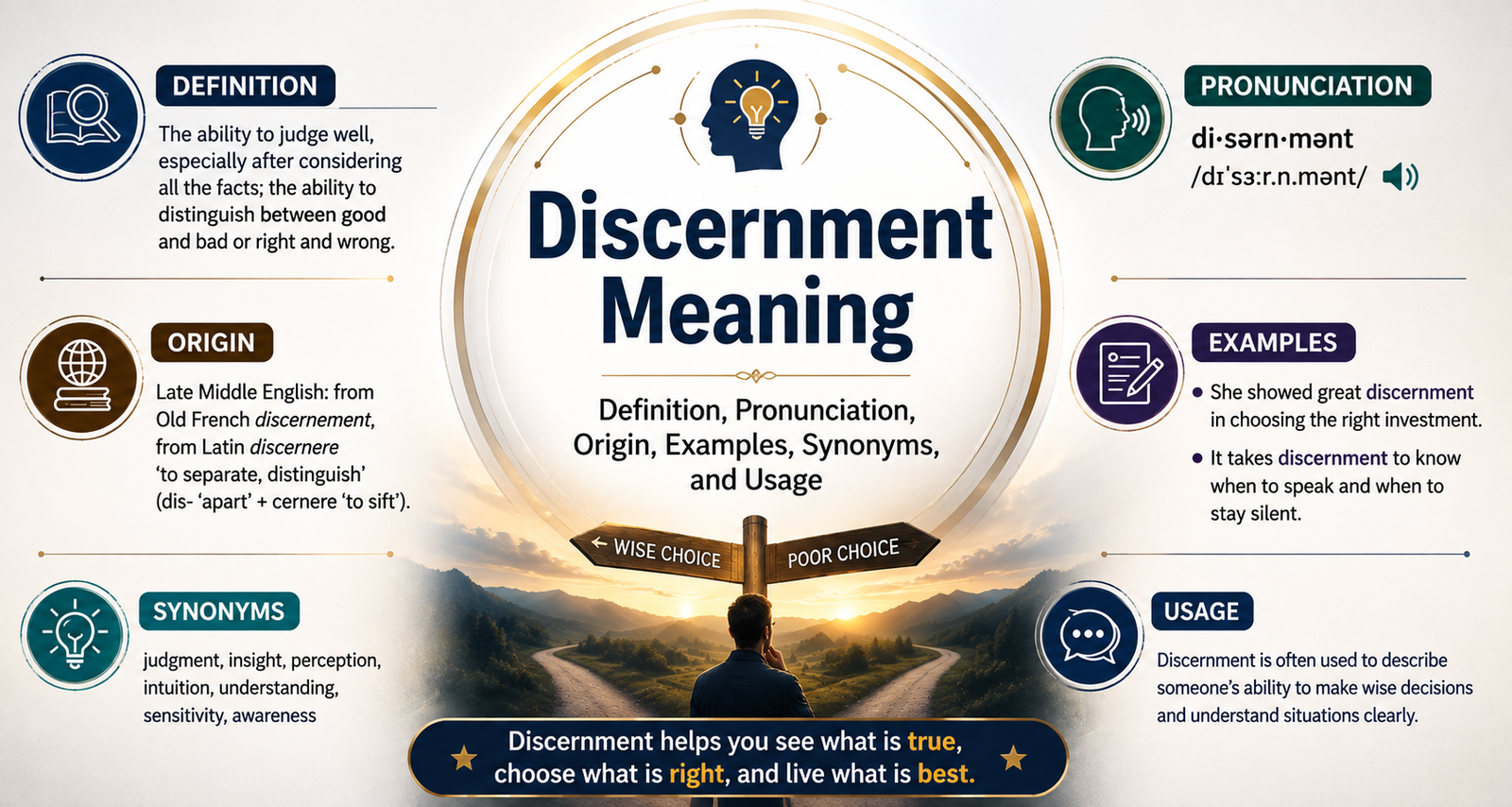
What does discernment mean? In simple English, discernment is the ability to notice important differences, understand a situation clearly, and make a good judgment about what is true, valuable, appropriate, or trustworthy.
Someone with discernment does not simply accept everything at face value. They look carefully, consider the details, and use good judgment before reaching a conclusion.
For example, if two job offers look attractive, a person with discernment will look beyond the salary. They may consider the company culture, responsibilities, long-term opportunities, working conditions, and whether the job matches their goals. That careful ability to recognize what really matters is discernment.
Discernment is useful in everyday life, relationships, education, business, leadership, and decision-making. It can help people distinguish between a good opportunity and a misleading one, useful information and misinformation, or a genuine person and someone who is pretending to be trustworthy.
This article explains the discernment meaning in simple English, including its pronunciation, origin, examples, synonyms, antonyms, common expressions, and frequently asked questions.
What Does Discernment Mean?
Discernment means the ability to judge something carefully and understand the difference between similar things.
In simple terms:
Discernment is the ability to recognize what is important, true, good, suitable, or different by using careful judgment.
The word often suggests more than simply noticing something. It involves understanding and evaluating what you notice.
For example:
- You may notice that two products have different prices.
- With discernment, you may understand why one product is actually better value.
- You may hear two people give conflicting explanations.
- With discernment, you consider the evidence and decide which explanation is more reliable.
So, discernment combines observation, understanding, and judgment.
Discernment Pronunciation
The word discernment is pronounced approximately:
di-SURN-ment
The first syllable is usually unstressed, while the main stress falls on “surn.”
The related verb discern is pronounced approximately dih-SURN.
How to Use Discernment in a Sentence
Here are a few natural examples:
- “She showed great discernment when choosing a business partner.”
- “Good discernment is important when evaluating information online.”
- “His discernment helped him recognize the weaknesses in the proposal.”
- “Parents often need discernment when deciding what advice to follow.”
- “The editor selected the best submissions with considerable discernment.”
Discernment Meaning in Simple English
A simple way to understand discernment is “the ability to see and judge things clearly.”
Imagine that you are shopping for a used car. Two cars may look almost identical in photographs. One has a much lower price, so it may seem like the obvious choice.
However, you investigate further. You check the vehicle’s history, maintenance records, mileage, condition, and seller’s reputation. You discover that the cheaper car has serious mechanical problems.
Choosing the better car requires more than simply seeing the price. It requires discernment.
Discernment helps you ask:
- What is really happening?
- What details matter?
- What should I trust?
- What differences are important?
- What choice makes the most sense?
Discernment vs. Simple Observation
Discernment is closely related to observation, but they are not the same.
Observation means noticing something.
Discernment means recognizing what that observation means and judging its importance.
For example:
Observation: “The customer is asking many questions.”
Discernment: “The customer is carefully comparing options and probably needs detailed information before making a decision.”
The second response requires interpretation and judgment.
Discernment vs. Judgment
The words discernment and judgment are closely connected.
Judgment is the ability to form an opinion or make a decision.
Discernment emphasizes the ability to recognize subtle differences and understand what is significant before making that judgment.
For example:
“He used good judgment and chose the safer option.”
This focuses on the decision.
“He showed discernment by recognizing risks that others had overlooked.”
This focuses more on his ability to identify and understand those risks.
Good discernment often leads to good judgment.
Origin of the Word Discernment
The word discernment comes from the verb discern, which ultimately traces back to Latin.
The Latin verb discernere means “to separate,” “distinguish,” or “divide.” It combines ideas associated with separating things so that their differences can be recognized.
The word entered English through Old French and developed into the modern English discern and discernment.
This history helps explain the word’s modern meaning. When you use discernment, you are essentially separating one possibility from another in your mind by recognizing meaningful differences.
Over time, discernment came to be associated not only with recognizing physical differences but also with making thoughtful judgments about people, ideas, situations, quality, and truth.
What Does It Mean to Have Discernment?
To have discernment means that you can look beyond the obvious and recognize distinctions that may not immediately be visible.
A discerning person might notice:
- whether information is credible
- whether an argument has weaknesses
- whether someone is being sincere
- whether an opportunity is genuinely worthwhile
- whether a product offers real value
- whether advice fits a particular situation
- whether a decision could create hidden problems
Discernment does not mean assuming that everything is suspicious. Instead, it means thinking carefully before deciding what something means or whether it should be trusted.
Examples of Discernment
Understanding the word through examples can make its meaning much easier to remember.
Example 1: Choosing a Friend
Suppose someone meets a new person who is charming and friendly.
Instead of immediately trusting them, the person pays attention to how they treat others, whether their actions match their words, and how they behave when things do not go their way.
That careful evaluation demonstrates discernment.
Sentence:
“She used discernment when deciding whom to trust.”
Example 2: Evaluating News
You see a dramatic claim on social media.
Rather than sharing it immediately, you check where the information came from, look for reliable evidence, and compare it with trustworthy sources.
That is discernment.
Sentence:
“Readers need discernment when evaluating information online.”
Example 3: Making a Purchase
A product has thousands of positive-looking reviews, but many reviews seem vague or suspicious.
A discerning buyer investigates further instead of assuming the product is excellent.
Sentence:
“His discernment helped him avoid buying an unreliable product.”
Example 4: Hiring an Employee
A candidate has an impressive résumé, but an interviewer notices that the candidate cannot explain several important claims in detail.
The interviewer considers the entire situation rather than relying only on the résumé.
Sentence:
“The manager used discernment during the hiring process.”
Example 5: Giving Advice
A friend asks whether they should accept a new opportunity.
Someone with discernment does not automatically say yes or no. They ask questions and consider the friend’s circumstances, priorities, risks, and goals.
Sentence:
“She offered thoughtful advice with considerable discernment.”
Example 6: Recognizing Quality
Two paintings may look similar to an inexperienced viewer, but an experienced art collector can recognize differences in technique, materials, originality, and craftsmanship.
Sentence:
“The collector developed strong discernment through years of experience.”
Discernment in Everyday Life
Discernment is not only a formal or intellectual skill. People use it in ordinary situations every day.
You may use discernment when:
- deciding whether an advertisement is believable
- choosing between competing products
- evaluating someone’s advice
- deciding which information to share
- selecting a job
- managing money
- resolving a disagreement
- deciding whether to trust a new acquaintance
- determining which priorities deserve your attention
In each case, the goal is similar: look carefully, recognize meaningful differences, and make a thoughtful choice.
Discernment in Relationships
Discernment can be especially useful in personal relationships.
A person may say something kind, but their behavior over time may tell a different story. Discernment allows you to consider both words and actions.
For example, someone who repeatedly promises to help but never follows through may require a different level of trust than someone whose actions consistently support their words.
Discernment does not mean judging people unfairly. Instead, it encourages you to pay attention to patterns and evidence rather than making decisions based on a single moment.
Discernment in Business
Business leaders regularly need discernment.
A manager may have to decide:
- which proposal is strongest
- which risks are acceptable
- which opportunities are realistic
- which customers to prioritize
- which employees need additional support
- which information is reliable
- which trends are temporary and which may have long-term importance
Good business decisions often depend on the ability to distinguish between what looks attractive and what is actually valuable.
Discernment in Leadership
Strong leaders need more than confidence or technical knowledge. They also need the ability to recognize important differences and make balanced decisions.
A discerning leader can distinguish between:
- urgent problems and important problems
- useful criticism and unhelpful negativity
- genuine risks and unnecessary fears
- short-term gains and long-term consequences
- strong evidence and unsupported claims
This makes discernment particularly valuable when a situation is complicated or uncertain.
Discernment in Spiritual or Religious Contexts
The word discernment is also frequently used in religious and spiritual writing.
In this context, it can refer to the ability to distinguish between different thoughts, influences, choices, or paths and determine which one is consistent with one’s faith, values, or understanding of God’s will.
For example:
“She spent time in prayer and reflection while seeking discernment about her decision.”
Here, discernment means seeking clarity and wisdom before making an important spiritual or personal choice.
The exact interpretation varies between religious traditions, but the central idea remains the same: carefully distinguishing between possibilities and recognizing the right or appropriate course of action.
Synonyms for Discernment
There are several words that can be used as synonyms for discernment, depending on the context.
Common Synonyms
- judgment
- wisdom
- insight
- perception
- awareness
- understanding
- discrimination
- sensitivity
- good sense
- wisdom
- acumen
These words overlap with discernment but are not always exact replacements.
Discernment vs. Insight
Insight is the ability to understand something deeply, especially something that is not immediately obvious.
Discernment emphasizes distinguishing and evaluating different possibilities.
Example:
Insight: “She had insight into the customer’s concerns.”
Discernment: “She showed discernment when deciding which customer concerns required immediate action.”
Discernment vs. Wisdom
Wisdom usually refers to good sense and sound understanding developed through knowledge and experience.
Discernment is more specifically about recognizing differences and making careful distinctions.
A wise person may use discernment as part of making a good decision.
Discernment vs. Perception
Perception is the way you notice or understand something.
Discernment goes a step further by emphasizing careful distinction and judgment.
Antonyms of Discernment
The opposite of discernment can vary depending on the situation.
Possible antonyms include:
- confusion
- ignorance
- carelessness
- thoughtlessness
- indiscrimination
- poor judgment
- naivety
- blindness
- misunderstanding
- gullibility
For example, if someone accepts every online claim without checking it, you might describe their approach as lacking discernment.
Similarly, someone who makes decisions without considering important differences may be showing poor judgment.
Common Phrases With Discernment
Here are some expressions commonly associated with the word.
“Use Discernment”
This means to think carefully and evaluate something before making a decision.
Example:
“Use discernment when deciding which financial advice to follow.”
“Show Discernment”
This means to demonstrate good judgment or the ability to recognize important differences.
Example:
“The editor showed discernment when selecting the strongest articles.”
“Lack of Discernment”
This describes a failure to recognize important differences or make careful judgments.
Example:
“His lack of discernment led him to trust unreliable information.”
“Develop Discernment”
This means becoming better at evaluating situations and recognizing meaningful distinctions.
Example:
“Experience can help people develop discernment.”
“Discernment Skills”
This phrase refers to abilities that help someone evaluate information, people, situations, or choices carefully.
Example:
“Critical thinking and discernment skills are valuable in the workplace.”
How to Develop Better Discernment
Discernment is not necessarily something people either have or do not have. It can improve with practice and experience.
Slow Down Before Deciding
Many poor decisions happen because people react too quickly.
Give yourself time to consider the situation, particularly when the decision is important.
Ask Better Questions
Instead of accepting the first explanation, ask:
- What evidence supports this?
- What might I be missing?
- Are there other explanations?
- What are the possible consequences?
- Who benefits from this claim?
Questions can reveal details that are easy to overlook.
Look for Patterns
One event may not tell you much.
Repeated behavior can provide stronger information.
For example, judging someone’s reliability based on one missed appointment may be unfair. Looking at their behavior over many months gives you more useful evidence.
Separate Facts From Opinions
Discernment becomes easier when you distinguish between what is known and what is merely assumed.
Ask yourself whether a statement is:
- a verified fact
- an interpretation
- an opinion
- a prediction
- an emotional reaction
This distinction is particularly important when consuming online information.
Learn From Experience
Experience can sharpen discernment because it teaches you to recognize patterns.
However, experience alone is not enough. Good discernment also requires openness to new evidence and a willingness to correct mistakes.
Why Discernment Matters
Discernment matters because modern life requires people to make decisions in situations filled with information, choices, opinions, and competing claims.
A person cannot investigate every detail forever. At some point, they must decide what deserves attention and what does not.
Discernment helps with that process.
It can reduce impulsive decisions, improve problem-solving, and encourage people to consider evidence before acting.
It is especially valuable when the answer is not obvious.
Frequently Asked Questions About Discernment
What is the simple meaning of discernment?
Discernment means the ability to recognize important differences and make careful, sensible judgments.
What does discernment mean in a sentence?
For example: “She showed discernment when choosing between the two offers.”
This means she carefully evaluated the offers and recognized which one was more suitable.
How do you pronounce discernment?
It is commonly pronounced approximately “dih-SURN-ment,” with the main stress on the second syllable.
What is the synonym of discernment?
Depending on the context, synonyms include judgment, insight, perception, wisdom, awareness, understanding, and good sense.
What is the opposite of discernment?
Possible opposites include confusion, carelessness, poor judgment, ignorance, gullibility, and indiscrimination.
There is no single perfect antonym for every context.
Is discernment the same as wisdom?
Not exactly. Wisdom is broad and involves sound understanding and judgment. Discernment specifically involves recognizing differences and determining what is important or appropriate.
Is discernment a skill?
Yes. Discernment can be developed through experience, critical thinking, careful observation, reflection, and learning from mistakes.
What does lack of discernment mean?
A lack of discernment means someone has difficulty recognizing important differences or evaluating a situation carefully before making a decision.
What does discernment mean in Christianity?
In Christian contexts, discernment commonly refers to prayerfully and thoughtfully distinguishing between different choices, influences, or directions and seeking to understand which path aligns with Christian faith and values.
What is an example of discernment in everyday life?
Suppose you receive an email claiming that you have won a prize. Instead of clicking immediately, you check the sender, look for warning signs, and verify the claim independently. That careful evaluation is an example of discernment.
Can discernment be learned?
Yes. People can strengthen discernment by slowing down decisions, asking questions, examining evidence, learning from experience, and considering alternative explanations.
Final Thoughts on Discernment Meaning
The word discernment describes an important ability: the ability to recognize meaningful differences and use that understanding to make thoughtful judgments.
In simple English, discernment means seeing beyond the obvious and deciding carefully what something really means, what matters, or what is appropriate.
It is useful in almost every part of life. You can use discernment when choosing a career, evaluating information, selecting a product, building relationships, managing a business, or making an important personal decision.