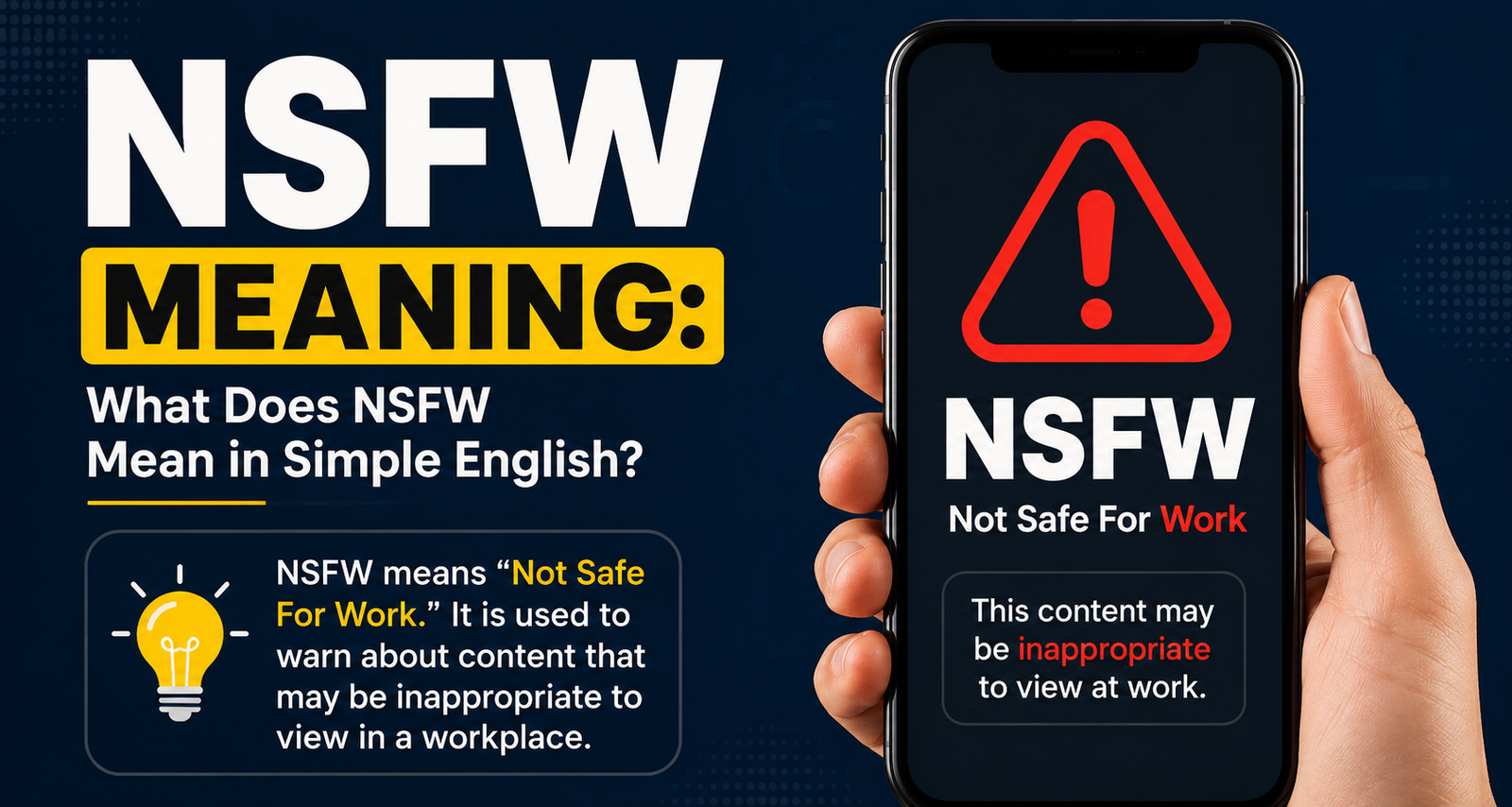
NSFW Meaning: If you have seen NSFW on social media, websites, chat messages, forums, or online posts, you may have wondered what it means. The abbreviation is common on the internet, but its meaning is not always obvious to someone who is new to online slang.
NSFW stands for “Not Safe For Work.” It is an internet warning used to indicate that online content may be inappropriate to open in a workplace, school, public place, or other setting where people are expected to view suitable material. The warning can refer to sexually explicit material, graphic violence, strong language, disturbing imagery, or other content that may be unsuitable for the surrounding environment.
The important thing to understand about NSFW meaning is that it is primarily a content warning. It tells a person to pause before opening something because the material may not be appropriate for every audience or situation.
This guide explains the NSFW meaning, pronunciation, origin, examples, synonyms, antonyms, common usage, and frequently asked questions in simple English. It focuses on understanding the term rather than describing inappropriate material.
What Does NSFW Mean?
NSFW means “Not Safe For Work.”
It is an abbreviation used online to warn people that a particular post, image, video, webpage, message, or other piece of content may be unsuitable to view in a professional or public environment.
For example, someone might write “NSFW warning” before sharing a post. This does not necessarily mean the content is illegal or dangerous. It simply tells the reader that the material may contain something inappropriate for a workplace, classroom, family setting, or public environment.
The phrase became especially useful as internet users began sharing different types of content through email, forums, websites, social media, and messaging platforms. A short warning such as NSFW allowed people to make a quick decision about whether they should open something.
NSFW Meaning in Simple English
In very simple English, NSFW means “this content may not be appropriate to look at in a public or professional place.”
Think of NSFW as a digital warning sign. Just as a sign can tell you to be careful before entering a particular area, an NSFW label tells you to think about your surroundings before opening the content.
The abbreviation is often associated with adult or sexually explicit content, but that is not its only meaning. Depending on the website or community, NSFW can also be used for content containing graphic violence, disturbing images, excessive profanity, or other material that may make people uncomfortable.
The exact meaning therefore depends on context.
What Does Each Letter in NSFW Stand For?
NSFW is made from the first letters of four words:
- N = Not
- S = Safe
- F = For
- W = Work
Together, they form Not Safe For Work.
The phrase is not usually meant literally. It does not necessarily mean that viewing the content at work will cause physical harm. Instead, “not safe” means that the content may be inappropriate for the environment.
For example, a person might see an NSFW label on a website and understand that they should avoid opening the page while sitting in a shared office or classroom.
How Do You Pronounce NSFW?
NSFW is normally pronounced by saying each letter separately:
“en ess eff double-you.”
It is an abbreviation rather than a regular word, so people generally do not pronounce it as one combined word.
You may hear someone say:
- “This link is NSFW.”
- “There is an NSFW warning.”
- “That post was marked NSFW.”
The abbreviation is especially common in online conversations, so recognizing its pronunciation can make digital communication easier to understand.
The Origin of NSFW
The exact history of NSFW is connected to the early culture of internet forums, email groups, and online communities. As people began sharing workplace-accessible internet content, users needed a quick way to warn others that a particular item might be inappropriate to view around coworkers or in professional settings.
The phrase “Not Safe For Work” eventually became a widely recognized internet abbreviation.
Its popularity grew alongside online communities where users could share links, pictures, discussions, and other material. Instead of writing a long warning every time, users could simply add NSFW to the title or message.
Over time, the abbreviation became part of everyday internet vocabulary. Today, people may encounter it on social media, discussion boards, messaging services, blogs, websites, and content-sharing platforms.
Why Is NSFW Used Online?
The main purpose of NSFW is to give people a warning before they open potentially inappropriate content.
Online content can appear unexpectedly, and people may browse the internet in places where certain material would be embarrassing, disruptive, or inappropriate. A warning gives users a chance to decide whether they want to continue.
For example, someone might be browsing a website at school and see an NSFW label. The warning allows them to avoid opening the content rather than discovering its nature unexpectedly.
This is particularly useful in shared environments where screens may be visible to teachers, coworkers, family members, or other people nearby.
What Kind of Content Can Be Marked NSFW?
The meaning of NSFW depends on the website and context. It is commonly used for content that may be inappropriate for general audiences.
This can include:
- Sexually explicit or adult-oriented material
- Graphic violence
- Disturbing imagery
- Extremely strong language
- Other content considered inappropriate for professional or public settings
An important point is that NSFW is not a precise rating system. Different websites and communities may use the label differently.
One platform might use NSFW mainly for sexual content, while another could apply the label to violent or disturbing material. When in doubt, it is best to treat the warning seriously and avoid opening questionable content in public or shared environments.
NSFW Examples in Everyday Sentences
Understanding examples can make the NSFW meaning easier to remember.
Example One
“The website marked the post NSFW.”
This means the website warned users that the post may contain material unsuitable for some environments.
Example Two
“Check the warning before opening the link; it is labeled NSFW.”
Here, NSFW tells the reader to consider where they are before viewing the link.
Example Three
“I saw an NSFW warning on the page and decided not to open it at school.”
This example shows how the warning can help someone avoid inappropriate material in a classroom or public setting.
Example Four
“The forum uses NSFW tags for posts that may not be suitable for everyone.”
In this case, NSFW is being used as a community content label.
Example Five
“Why does this post have an NSFW tag?”
The person is asking why the content has been marked as potentially inappropriate.
Common Ways NSFW Is Used
NSFW can appear in several forms online.
NSFW Tag
An NSFW tag is a label attached to content to warn users before they view it.
NSFW Warning
An NSFW warning directly tells readers that content may not be appropriate for a workplace or other public setting.
NSFW Content
The phrase NSFW content refers broadly to material that has been marked as potentially unsuitable for professional or general environments.
NSFW Link
An NSFW link is a link that leads to content that may be inappropriate to open in certain settings.
NSFW Image
An NSFW image is an image that has been labeled as unsuitable for some audiences or environments.
These expressions are common in internet conversations, but their exact application can differ between platforms.
Is NSFW the Same as Adult Content?
Not always.
Many people associate NSFW with adult or sexually explicit material because that is one of its most common uses. However, NSFW is a broader warning.
For example, a post containing disturbing violence or extremely graphic imagery could potentially receive an NSFW label even if it has nothing to do with sexual content.
The phrase therefore describes the suitability of content for a particular environment, rather than identifying one specific type of material.
NSFW vs. SFW
A useful term to know alongside NSFW is SFW, which generally means “Safe For Work.”
SFW is used to describe content considered appropriate to view in a workplace or other ordinary public setting.
The two abbreviations can be understood as opposites in everyday internet usage:
NSFW: Not Safe For Work
SFW: Safe For Work
However, these labels are informal rather than universal content ratings. What one community considers SFW might not be viewed the same way by another community.
Synonyms for NSFW
NSFW does not have one perfect synonym because it is an abbreviation with a specific internet meaning. However, several phrases can communicate a similar idea.
Not Suitable for Work
This phrase is very close to the original meaning of NSFW.
Inappropriate for Work
This describes material that may not be suitable to view in a professional environment.
Adult Content Warning
This can be used when the warning specifically concerns adult-oriented material.
Content Warning
This is a broader term. It can warn users about many types of potentially uncomfortable or inappropriate material.
Viewer Discretion Advised
This is another warning phrase suggesting that people should use their judgment before viewing certain material.
These expressions are related to NSFW, but they should not always be treated as exact synonyms.
What Is the Antonym of NSFW?
The closest common opposite of NSFW is SFW, meaning “Safe For Work.”
SFW is used to describe content that is generally considered suitable for viewing in a workplace or public environment.
Other phrases that can express the opposite idea include:
- Appropriate for work
- Suitable for general audiences
- Workplace appropriate
- Safe for public viewing
However, SFW is the most direct internet abbreviation used as the counterpart to NSFW.
NSFW and Social Media
The term NSFW is frequently encountered on social media and online communities. Platforms may use different systems for labeling, filtering, hiding, or restricting potentially inappropriate material.
A post may contain a warning so users know what to expect before viewing it. Some services may automatically blur or hide certain content, while others rely on community labels or user settings.
Because platform policies can change, users should follow the rules of the particular website they are using.
It is also important to remember that an NSFW label does not automatically tell you exactly what the content contains. It is a general warning, not a detailed description.
Why Content Warnings Matter
Content warnings can be helpful because people have different comfort levels and different reasons for avoiding certain material.
A warning can give someone the opportunity to decide whether they want to continue. It can also reduce the chance of accidentally displaying inappropriate content in a shared environment.
For younger internet users in particular, seeing an NSFW label is a good reason to stop and avoid opening material that is intended for adults or otherwise unsuitable for their age group.
Understanding the warning does not mean that someone needs to seek out the content. The label is primarily there to help people make safer and more appropriate choices online.
Common Misunderstandings About NSFW
One common misunderstanding is that NSFW always means pornography. That is too narrow. The abbreviation can cover several types of inappropriate or disturbing material.
Another misunderstanding is that NSFW means content is automatically illegal. That is also incorrect. NSFW is a general content warning and does not itself determine whether something is legal or illegal.
Some people also think that NSFW means something cannot be viewed anywhere. The original phrase specifically refers to work environments, but online usage has expanded. Today, people may use it for material that is inappropriate for school, public spaces, family settings, or general audiences.
NSFW Meaning in Text Messages and Chats
People sometimes use NSFW casually in messages.
For example:
“That link is NSFW.”
This means the sender believes the link may lead to inappropriate material.
Someone might also say:
“Is this NSFW?”
Here, the person is asking whether content should receive an inappropriate-content warning.
Another example is:
“Please add an NSFW warning.”
This means the sender wants people to be warned before viewing the material.
The abbreviation is short, which makes it convenient for online conversations where people frequently use acronyms.
NSFW Meaning in Internet Slang
NSFW belongs to a large group of internet abbreviations that developed as online communication became more popular.
Other abbreviations may express emotions, reactions, or common phrases. NSFW is different because its primary purpose is to label or warn about content.
Understanding abbreviations like NSFW can make websites and online conversations easier to navigate. However, unfamiliar internet slang should not be assumed to have exactly the same meaning everywhere. Context matters.
Frequently Asked Questions About NSFW Meaning
What does NSFW stand for?
NSFW stands for “Not Safe For Work.” It is an internet warning indicating that content may be inappropriate to view in a workplace, school, public area, or other shared environment.
What is the simple meaning of NSFW?
In simple English, NSFW means “this content may not be appropriate to view here.” It is a warning that encourages someone to consider their surroundings before opening the content.
How do you pronounce NSFW?
NSFW is pronounced by saying the letters separately: “en ess eff double-you.”
Does NSFW always mean sexual content?
No. Although NSFW is often associated with adult-oriented material, it can also refer to graphic violence, disturbing imagery, strong language, or other content that may be unsuitable for certain environments.
What is the opposite of NSFW?
The common opposite is SFW, which stands for “Safe For Work.” It generally describes content considered appropriate for workplace or public viewing.
Is NSFW a bad word?
No. NSFW is an abbreviation and content warning. The letters themselves are not a bad word.
Why do websites use NSFW warnings?
Websites and online communities use NSFW warnings to help users recognize potentially inappropriate content before opening or viewing it.
Is NSFW an official rating?
Usually, no. NSFW is generally an informal internet label rather than a universal content-rating system. Different platforms and communities may apply it differently.
Can NSFW mean something other than adult material?
Yes. Depending on the context, it can refer to content involving graphic violence, disturbing imagery, strong language, or other material considered unsuitable for public or professional settings.
What does an NSFW tag mean?
An NSFW tag is a warning placed on online content to indicate that the material may not be appropriate for work, school, public spaces, or general audiences.
Is SFW the same as NSFW?
No. They have opposite meanings. SFW means “Safe For Work,” while NSFW means “Not Safe For Work.”
Should you open NSFW content at school or work?
If something is labeled NSFW, it is generally best not to open it in a school, workplace, or shared public environment. The warning is there to help you avoid potentially inappropriate material.
Final Thoughts on NSFW Meaning
The NSFW meaning is straightforward: NSFW stands for “Not Safe For Work,” an internet warning used for content that may be inappropriate to view in a workplace, school, public setting, or other shared environment.
Although the abbreviation is often connected with adult material, it can also be used for graphic violence, disturbing imagery, strong language, or other content that may not be suitable for everyone. Its exact meaning depends on the platform and context.
The easiest way to remember NSFW is to think of it as a digital warning sign. When you see the label, it is a reminder to consider where you are and whether the content is appropriate for that setting.
Knowing the NSFW meaning, pronunciation, origin, examples, related terms, and common usage can make internet communication much easier to understand. Most importantly, recognizing the warning can help people make thoughtful choices about what they view and where they view it.