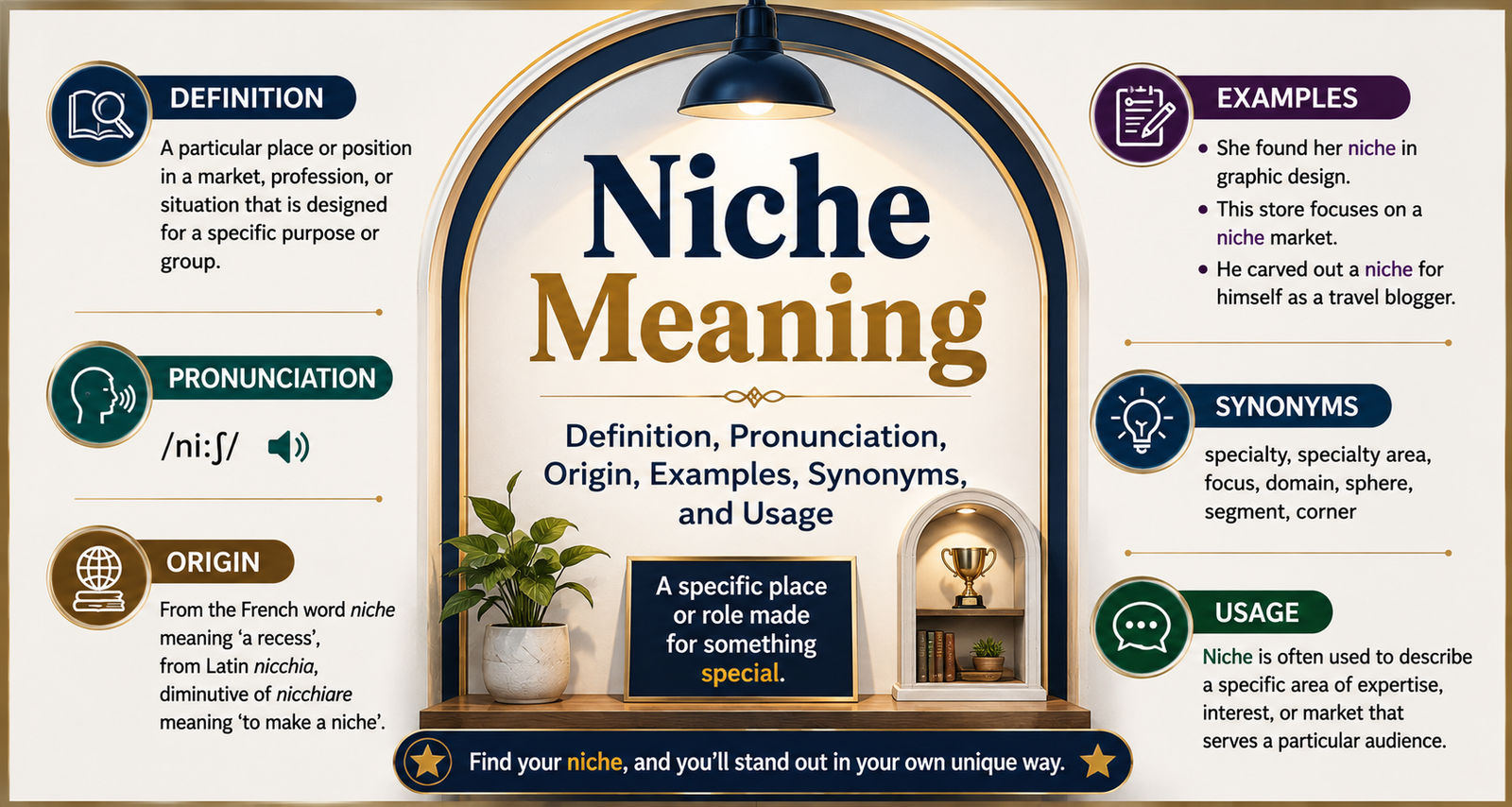
Niche Meaning: The word “niche” is common in everyday English, business, marketing, biology, and online content. However, its meaning can change slightly depending on the context. You may hear someone talk about a “niche market,” a “niche audience,” a “niche hobby,” or an animal’s “ecological niche.”
So, what does niche mean?
In simple English, a niche is a specific position, role, area, or group that suits a particular person, product, business, or living thing. It often describes something specialized rather than broad or general.
For example, instead of selling clothes for everyone, a company might sell clothing specifically for tall women who enjoy hiking. That specialized market is a niche.
The word can also describe a small area or a special role. In biology, for example, an animal’s niche refers to how it lives and functions within its environment.
This guide explains the niche meaning, pronunciation, origin, examples, synonyms, antonyms, common usage, and frequently asked questions in simple English.
What Does Niche Mean?
The simplest definition of niche is:
A niche is a specialized area, position, interest, or market that is designed for or suited to a particular group or purpose.
The exact meaning depends on how the word is being used.
Niche Meaning in Simple English
In everyday language, you can think of a niche as a small, specific place or area where something or someone fits especially well.
For example:
- A bakery that sells only gluten-free cakes serves a niche market.
- Someone who collects rare antique maps has a niche hobby.
- A website about vintage cameras targets a niche audience.
- In nature, a particular bird may have a specific ecological niche.
The key idea is specialization.
Something described as niche is usually not intended for everyone. Instead, it appeals to a particular group of people or serves a particular purpose.
Niche Pronunciation
The most common English pronunciation of niche is:
neesh
It rhymes approximately with words such as “quiche.”
The pronunciation may sometimes vary, particularly among English speakers in different regions. A pronunciation closer to “nitch” is also heard, especially in some varieties of English.
However, “neesh” is a very common pronunciation and is widely understood.
How to Use Niche in a Sentence
Here are some natural examples:
- “She found a niche in the online education market.”
- “This website focuses on a niche audience.”
- “He has a niche interest in historical architecture.”
- “The company serves a very specific niche.”
- “Birds occupy different niches within an ecosystem.”
Niche as a Noun
As a noun, niche can refer to a specialized position, market, interest, or role.
For example:
“The company found a profitable niche.”
Here, niche means a particular part of the market where the company can successfully operate.
Another example:
“She has created a niche for herself as a travel writer.”
This means she has established a specialized role or area in which she is recognized.
Common Noun Patterns
You will often see niche used in expressions such as:
- niche market
- niche audience
- niche business
- niche product
- niche industry
- niche website
- niche community
- niche hobby
- niche interest
- niche publication
- niche service
Niche as an Adjective
“Niche” is also commonly used as an adjective.
For example:
“That is a niche product.”
This means the product is designed for a relatively small or specialized group of customers.
Another example:
“She creates content about a niche subject.”
The subject is specialized and probably does not appeal to a very broad audience.
In modern English, especially in business and digital marketing, “niche” is frequently used this way.
Niche Meaning in Business
In business, a niche is a specific segment of a larger market.
Imagine the entire food industry as a huge market. Within it are many smaller markets:
- vegetarian food
- vegan desserts
- organic baby food
- sugar-free snacks
- gluten-free bread
- high-protein meals
Each of these can represent a niche.
A business may choose a niche because serving a specific group can make it easier to understand customers and create products that meet their particular needs.
Example of a Niche Market
Suppose a company sells shoes.
Selling “shoes” is a very broad market.
Selling “running shoes” is more specific.
Selling “running shoes for people with wide feet” is even more specialized.
That final group can be considered a niche market.
A niche does not necessarily have to be tiny. It simply needs to be more specific than the broader market.
Niche Meaning in Marketing
In marketing, a niche is a clearly defined group of customers with shared interests, needs, problems, or characteristics.
For example, a general fitness business might target people who want to exercise.
A niche fitness business might focus on:
- fitness for new mothers
- strength training for older adults
- home workouts for office workers
- yoga for runners
- beginner fitness for people over 50
The more specific focus helps a business communicate directly with the people most likely to value its products or services.
What Is a Niche Audience?
A niche audience is a relatively specific group of people interested in a particular topic, product, service, or type of content.
For example, a website about general travel has a broad audience.
A website about budget travel for solo backpackers in Southeast Asia has a much more specific audience.
That is a niche audience.
Niche Meaning in SEO
In SEO and content marketing, a niche is a focused subject or market around which a website creates content.
For example, “health” is an extremely broad topic.
A website might narrow that topic to:
healthy meal preparation for busy professionals
That is a more focused niche.
Other examples include:
- beginner gardening
- home coffee brewing
- budget photography equipment
- hiking with dogs
- indoor plants for small apartments
- personal finance for college students
A niche website usually focuses on a defined subject rather than attempting to cover everything.
Why Do People Choose a Niche for SEO?
A focused niche can help a website:
- Understand its audience better.
- Create highly relevant content.
- Build topical authority.
- Address specific search queries.
- Develop a recognizable identity.
- Attract people with particular interests.
However, choosing a niche does not automatically guarantee search-engine success. Useful, accurate, original content and a good user experience still matter.
Niche Meaning in Social Media
On social media, a niche is a specific subject or interest around which a creator builds content.
For example, instead of creating content about “lifestyle,” a creator might focus on:
- minimalist living
- budget home organization
- vintage fashion
- beginner photography
- plant care
- language learning
These are more specialized niches.
A creator who consistently produces useful content for a particular audience can build a community around that subject.
Niche Meaning in Biology
The word has a more technical meaning in ecology.
An organism’s ecological niche describes its role and way of living within an ecosystem.
It can include factors such as:
- where the organism lives
- what it eats
- when it is active
- how it interacts with other organisms
- what environmental conditions it needs
- how it obtains resources
For example, two species may live in the same forest but occupy different ecological niches because they eat different foods or use different parts of the environment.
In simple terms, an ecological niche describes how an organism fits into its environment and what role it plays there.
Niche Meaning in Architecture
“Niche” has another traditional meaning: a small recessed space in a wall, often designed to hold a statue, ornament, or other object.
For example:
“The statue was placed inside a niche in the stone wall.”
This meaning is different from the modern business meaning, but both ideas involve a specific place or position.
Origin of the Word Niche
The word niche comes into English through French and ultimately traces back to an Italian word associated with a recess or small cavity.
Its older physical meaning referred to a recessed space in a wall, especially one used to display a statue.
Over time, the idea of a “special place” developed into broader meanings.
The word eventually came to describe a particular position or role, including a role within an ecosystem and a specialized position within a market.
This development explains why the modern meanings of niche may seem different at first. They share the underlying idea of a particular place or position where something belongs or functions.
Examples of Niche in Everyday English
Here are several examples showing how native speakers commonly use the word.
Example 1: Business
“The company found a profitable niche selling eco-friendly office supplies.”
Meaning: The company identified a specific group of customers interested in environmentally friendly office products.
Example 2: Hobby
“Collecting antique postcards is a fairly niche hobby.”
Meaning: It is a specialized interest that relatively few people have compared with common hobbies.
Example 3: Online Content
“Her blog occupies a niche in the travel industry.”
Meaning: Her blog focuses on a specific part of the larger travel market.
Example 4: Product
“The company produces niche software for professional photographers.”
Meaning: The software is designed for a specialized group rather than general users.
Example 5: Ecology
“Each species has its own ecological niche.”
Meaning: Each species has a particular role and way of living within its ecosystem.
Example 6: Architecture
“The architect designed a small niche for displaying artwork.”
Meaning: The architect created a recessed space in the wall for artwork.
Synonyms for Niche
The best synonym depends on the context.
General Synonyms
Possible synonyms include:
- specialty
- area
- role
- position
- place
- field
- sphere
- segment
- category
- specialization
For example:
“She found her niche in graphic design.”
Could become:
“She found her specialty in graphic design.”
However, “niche” and “specialty” are not always interchangeable.
Business Synonyms
In business and marketing, related terms include:
- market segment
- specialty market
- target market
- specialized market
- customer segment
- sector
For example:
“The company serves a niche market.”
Could be expressed as:
“The company serves a specialized market.”
Niche Synonyms for a Person’s Role
When describing someone’s position or area of expertise, words such as these may work:
- specialty
- field
- role
- calling
- area of expertise
- specialization
For example:
“He found his niche as a science writer.”
could mean that he found his particular area of professional strength.
Antonyms of Niche
There is no single perfect opposite of “niche” in every situation.
Depending on the context, possible opposites include:
- general
- broad
- mainstream
- mass-market
- universal
- widespread
- common
For example, a niche product is specialized, while a mass-market product is designed for a broad audience.
Similarly, a niche topic may attract a relatively specific audience, while a mainstream topic may interest a much larger portion of the public.
Niche vs. Mainstream
The difference is mainly about specialization and audience size.
A niche subject appeals to a particular group.
A mainstream subject appeals to a broad audience.
For example:
Mainstream: cooking
Niche: traditional sourdough baking for beginners
Both can be valuable. A niche is not necessarily better than a mainstream market. It simply has a more specific focus.
Niche vs. Specialty
These words are closely related, but there is a slight difference.
A specialty is something a person or business is particularly skilled at or focused on.
A niche often describes the specific position, audience, or market where that specialty exists.
For example:
“Photography is her specialty.”
This focuses on what she is particularly skilled at.
“Wedding photography for destination weddings is her niche.”
This focuses on the specific area of the photography market she serves.
Niche vs. Segment
A market segment is a portion of a larger market.
A niche is typically more specialized and focused.
For example, “men’s footwear” could be considered a market segment.
“Handmade leather hiking boots for men who prefer traditional craftsmanship” is much more niche.
The terms can overlap, though, and businesses may use them differently.
Common Phrases With Niche
Some expressions appear frequently in modern English.
Niche Market
A specialized section of a larger market.
Example:
“Small businesses often succeed by serving a niche market.”
Niche Audience
A specific group of people with a shared interest.
Example:
“The podcast has built a loyal niche audience.”
Niche Product
A product created for a particular group or purpose.
Example:
“It is a niche product, but customers who need it love it.”
Niche Hobby
A specialized hobby that relatively few people participate in.
Example:
“Restoring old radios is a niche hobby.”
Find Your Niche
This phrase means to discover a particular area, role, market, or subject where you fit well.
Example:
“After trying several careers, she finally found her niche in teaching.”
Niche Down
This expression is especially common in marketing and online business.
It means to make a business or content topic more specific.
For example, someone might start with:
Fitness → home fitness → home fitness for beginners → home strength training for women over 40
Each step makes the focus narrower.
Is Niche Always a Positive Word?
Not necessarily.
“Niche” is generally neutral, but its meaning depends on context.
It can be positive when describing specialization:
“She has built a successful niche business.”
It can also suggest that something has limited mainstream appeal:
“The magazine covers a very niche subject.”
In that sentence, “niche” simply means specialized. It does not automatically mean good or bad.
How to Use Niche Correctly
Here are some practical tips.
Use “Niche” for Something Specific
“Niche” works best when there is a clear area of specialization.
Good example:
“He runs a niche website about vintage fountain pens.”
Less natural:
“I have a niche about everything.”
The second sentence lacks a clear specialized area.
Use “Niche Market” for Business Contexts
When discussing customers and commerce, “niche market” is often the clearest expression.
Example:
“The company identified a niche market for affordable equipment designed for beginner climbers.”
Don’t Assume Niche Means Tiny
A niche can be smaller than the overall market without being extremely small.
The important idea is specificity, not simply size.
Why Finding a Niche Can Be Useful
Having a niche can help individuals and businesses focus their efforts.
For a business, specialization may make it easier to understand customer needs and develop relevant products.
For a content creator, a niche can provide a clear direction for producing articles, videos, podcasts, or social media posts.
For an individual professional, finding a niche can mean developing expertise in a particular area.
For example, a writer who covers every possible subject may have difficulty developing a clear identity. A writer who specializes in technical topics for small businesses may become known for that particular expertise.
Frequently Asked Questions About Niche
What is the simple meaning of niche?
Niche means a specific area, position, role, interest, or market suited to a particular person, product, group, or purpose.
How do you pronounce niche?
The most common pronunciation is “neesh.” A pronunciation closer to “nitch” is also used by some English speakers.
What is an example of a niche?
A website that publishes advice specifically for beginner gardeners living in apartments serves a niche audience. Its specialized subject is its niche.
What does niche mean in business?
In business, a niche is a specialized part of a larger market that focuses on particular customers and their specific needs.
What does niche mean in marketing?
In marketing, a niche is a clearly defined target group or specialized market that a business or creator aims to serve.
What does niche mean in SEO?
In SEO, a niche is a focused topic or market around which a website creates relevant content for a specific audience.
What is a niche audience?
A niche audience is a specific group of people who share a particular interest, need, problem, or characteristic.
What is a niche product?
A niche product is designed for a particular group of customers or a specialized purpose rather than for the general market.
Is niche a positive word?
Usually, “niche” is neutral. In some contexts, it can suggest specialization and expertise; in others, it can imply that something appeals to a relatively small audience.
What is the opposite of niche?
There is no exact opposite in every context. Depending on the sentence, possible opposites include mainstream, broad, general, universal, and mass-market.
What does “find your niche” mean?
“Find your niche” means discovering a particular area, role, subject, or market where your skills and interests fit well.
What does “niche down” mean?
“Niche down” means making a broad subject, business, or target audience more specific and focused.
Is niche the same as specialty?
They are similar but not identical. A specialty usually describes a particular skill or area of expertise, while a niche often describes a specific position, audience, role, or market.
Final Thoughts on Niche Meaning
The word niche essentially describes a specific place, role, area, or market where something fits or functions particularly well.
Its meaning becomes clearer when you look at the context.
In business, a niche is a specialized market. In marketing, it can be a clearly defined audience. In SEO, it is often a focused subject or market. In everyday conversation, it can describe a specialized interest or activity. In ecology, it refers to an organism’s role and way of living within its environment. In architecture, it can mean a recessed space in a wall.