RSVP Meaning: If you have ever received a wedding invitation, birthday invitation, formal event card, or business invitation, you have probably seen the letters RSVP. But what does RSVP mean, and what should you do when an invitation asks you to RSVP?
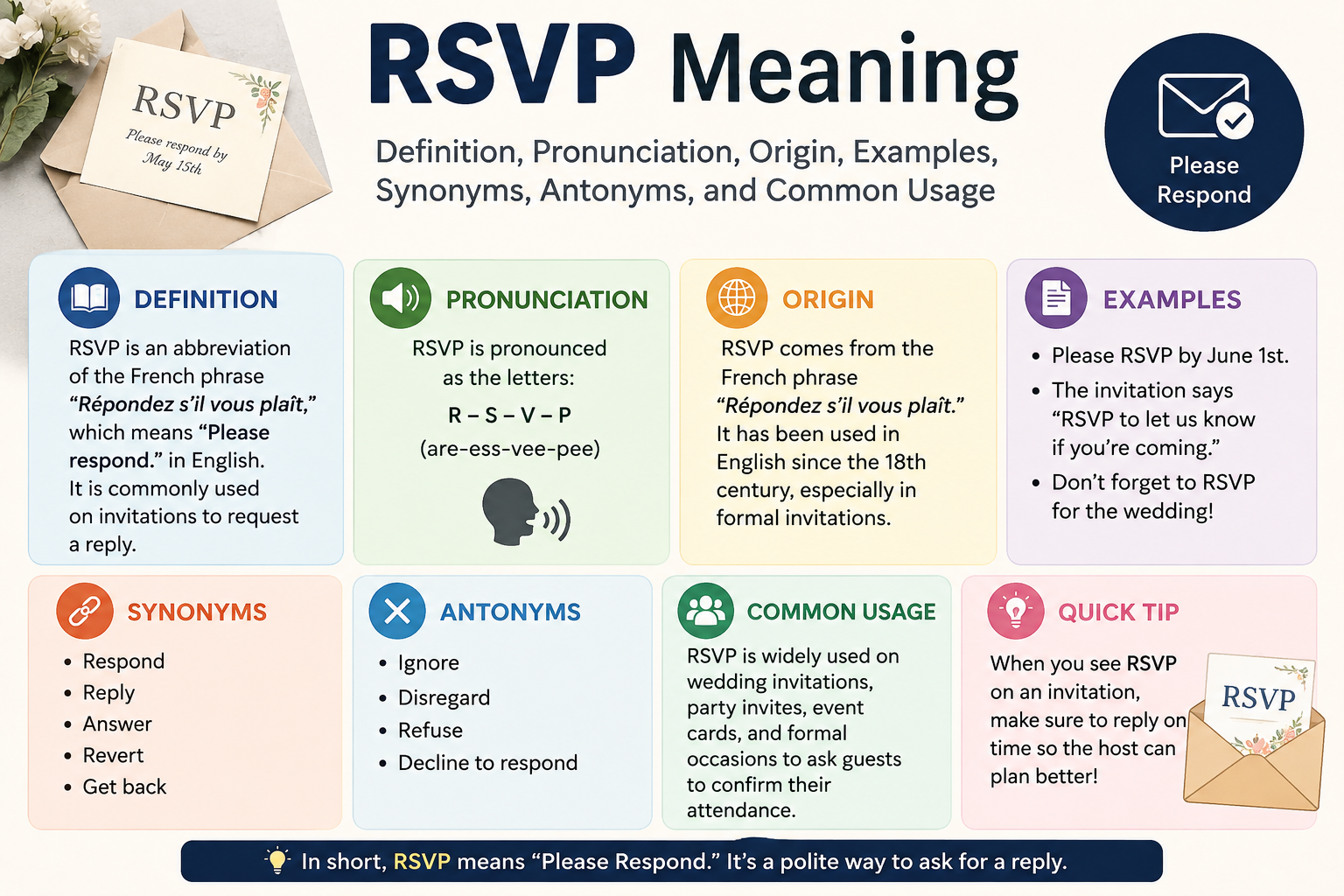
The RSVP meaning is simply “please reply” or “please respond.” The term comes from the French phrase “répondez s’il vous plaît,” which literally asks the invited person to respond. In English, RSVP is commonly placed on invitations when the host wants to know whether a guest plans to attend.
Understanding RSVP is useful because it is more than just a group of letters on an invitation. An RSVP helps hosts plan seating, food, activities, venue space, and other details. For guests, responding to an RSVP request is a simple way to communicate clearly and politely.
What Does RSVP Mean?
The basic RSVP meaning is “please reply.” It tells the person receiving an invitation that the host would like an answer about attendance. If you see “RSVP by Friday,” for example, the host is asking you to confirm whether you will attend by Friday.
RSVP is an abbreviation of the French expression “répondez s’il vous plaît.” Cambridge Dictionary defines it as an abbreviation used on invitations to ask people to tell the host whether they are coming.
In modern English, RSVP can function as both a noun and a verb. You can say that an invitation asks for an RSVP, or you can say that someone needs to RSVP to an event.
Simple Definition of RSVP
In very simple English:
RSVP = Please tell me if you are coming.
For example:
“Please RSVP by Monday.”
This means:
“Please tell us by Monday whether you will attend.”
The response can usually be given through the method mentioned on the invitation, such as a phone number, email address, reply card, or online form.
RSVP Pronunciation
RSVP is normally pronounced by saying each letter separately:
The pronunciation is generally “R-S-V-P.” Major English dictionaries give essentially the same letter-by-letter pronunciation.
Although RSVP comes from French, English speakers generally do not pronounce the abbreviation as a French word. Instead, they say the individual English letter names.
What Does RSVP Stand For?
RSVP stands for the French phrase:
“Répondez s’il vous plaît.”
The phrase means “please reply” or “please respond.” The French Academy also recognizes R.S.V.P. as the abbreviation used on an invitation when the recipient is expected to confirm attendance.
Here is a simple breakdown:
| Letter | French word | General meaning |
| R | Répondez | Reply / respond |
| S | S’il | If it |
| V | Vous | You |
| P | Plaît | Pleases |
Taken together, the phrase politely asks the recipient to respond.
Origin and History of RSVP
The origin of RSVP is French. The abbreviation was borrowed into English from “répondez s’il vous plaît,” a formal expression used on invitations to request a response.
Dictionary sources date the English use of RSVP to the late nineteenth century. Dictionary.com lists its first recorded use around 1895–1900, while Collins likewise traces the word to the French expression meaning “please reply.”
The use of French wording on formal invitations reflects the historical influence of French on English etiquette and social vocabulary. Over time, RSVP became familiar to English speakers and is now widely understood without most people needing to know the original French phrase.
Interestingly, the expression remains recognizable in French-speaking contexts as well, although usage can vary by region and situation. The French Academy still records R.S.V.P. as an invitation abbreviation.
RSVP Meaning in Simple English
If you want the easiest possible explanation, remember this:
RSVP means that someone wants you to answer an invitation.
Suppose your friend sends you an invitation that says:
“You are invited to my birthday party. RSVP by Saturday.”
Your friend wants you to say whether you are coming.
You might reply:
“Yes, I’ll be there.”
Or:
“Thank you for inviting me, but I won’t be able to attend.”
Both are RSVP responses because both give the host the information they requested.
What Does It Mean to RSVP to an Invitation?
To RSVP to an invitation means to respond to the invitation and tell the host whether you plan to attend.
The response is usually expected before a specific deadline. Cambridge Dictionary notes that RSVP is used at the end of written invitations when the recipient should say whether they will attend.
For example, imagine an invitation says:
RSVP by September 10.
You should respond before that date.
If you can attend, you can say:
“Thank you for the invitation. I’m happy to confirm that I’ll attend.”
If you cannot attend, you can say:
“Thank you for inviting me. Unfortunately, I won’t be able to attend.”
A clear response helps the host organize the event.
Examples of RSVP in Sentences
Understanding examples can make the RSVP meaning much easier to remember.
Here are some natural examples:
- “Please RSVP by Friday.”
- “I need to RSVP to the wedding invitation.”
- “Have you sent your RSVP yet?”
- “We received your RSVP this morning.”
- “The invitation says to RSVP by email.”
- “She forgot to RSVP to the party.”
- “Please RSVP before the deadline.”
- “Only guests who RSVP will have reserved seating.”
- “I already sent my RSVP.”
- “The host is waiting for everyone’s RSVP.”
RSVP can also be used as a verb in casual English.
For example:
“Please RSVP before Thursday.”
Here, RSVP means reply to the invitation.
As a noun, you might say:
“We received fifty RSVPs.”
Here, RSVPs means responses to the invitation. Cambridge Dictionary and Collins both recognize these noun and verb uses in English.
RSVP Examples for Different Situations
Wedding Invitations
Weddings often require careful planning, so invitations commonly request an RSVP.
Example:
“Please RSVP by October 5.”
The couple may need the final guest count to organize meals, seating, and venue arrangements.
Birthday Parties
A birthday invitation might say:
“RSVP to Sarah by Tuesday.”
This tells guests to contact Sarah and confirm whether they will attend.
School or Community Events
An invitation to a school event, workshop, or community gathering may also request an RSVP.
For example:
“Please RSVP if you plan to attend the parent meeting.”
Business Events
RSVP is also common in professional settings.
For example:
“Please RSVP for the annual conference.”
In this situation, the organizer may need an accurate attendance estimate for seating, materials, or refreshments.
Formal Dinners
A formal dinner invitation may ask guests to RSVP before a specific date.
The host may use the responses to prepare an appropriate number of places and meals.
RSVP Synonyms
There is no perfect single-word synonym for RSVP because RSVP is specifically associated with responding to an invitation. However, several phrases can express a similar idea.
Common alternatives include:
- Please reply
- Please respond
- Please confirm
- Confirm your attendance
- Let us know if you can attend
- Kindly respond
- Confirm your presence
- Reply by the stated date
- Tell us whether you can attend
For everyday communication, “please respond” and “please confirm” are especially clear alternatives.
For example:
RSVP by Friday.
can be rewritten as:
Please confirm your attendance by Friday.
The second version is longer but may be easier for people unfamiliar with RSVP.
RSVP Antonyms
RSVP does not have a true direct antonym because it is an abbreviation describing a request for a response. Still, several ideas can express the opposite situation.
Possible contrasting expressions include:
- No response required
- No reply necessary
- Do not respond
- No confirmation needed
- Open invitation
For example, if an invitation says “No RSVP required,” it means that guests do not need to confirm their attendance in advance.
This is different from an invitation that specifically says “RSVP required.”
RSVP vs. “Please RSVP”
An interesting point about the RSVP meaning is that people often write “please RSVP.”
Technically, RSVP already comes from the French phrase meaning “please reply.” Therefore, adding “please” creates a form of repetition. However, “please RSVP” is extremely common in modern English, and most speakers consider it natural and clear.
For example:
“Please RSVP by Friday.”
is widely understood.
It simply means:
“Please respond by Friday.”
So while the wording has a historical redundancy, it is normal in everyday English.
RSVP vs. Regrets Only
Sometimes invitations use the phrase “regrets only.” This has a different meaning from a standard RSVP.
With a traditional RSVP request, the host generally wants you to provide a response about attendance.
With “regrets only,” you usually contact the host only if you cannot attend.
For example:
RSVP by Friday
means you should respond with your attendance decision.
Regrets only
means you generally respond only if you are unable to attend.
Because invitation wording can differ, it is always best to follow the exact instructions provided by the host.
How to Respond to an RSVP Request
Responding to an RSVP request is usually straightforward.
First, check the invitation carefully. Look for the RSVP deadline and the preferred response method. The invitation may provide a telephone number, email address, reply card, website, or online form.
Next, decide whether you can attend. If you can, confirm your attendance clearly. If you cannot, politely decline.
Finally, respond before the deadline whenever possible.
Example of Accepting an Invitation
A simple response could be:
“Thank you for the invitation. I’m pleased to confirm that I’ll attend.”
Example of Declining an Invitation
You could write:
“Thank you for inviting me. I’m sorry, but I won’t be able to attend.”
Example of a Casual RSVP
For an informal gathering, you might simply say:
“Thanks! I’ll be there.”
The right response depends on the relationship between you and the host and the formality of the event.
Why Is an RSVP Important?
An RSVP may seem like a small detail, but it can make event planning much easier.
Hosts often need to know how many people will attend. This information can affect seating arrangements, food orders, venue capacity, activity planning, printed materials, and other preparations.
For a small gathering, even a few unexpected guests can create problems. For a large event, an inaccurate guest count can make planning significantly harder.
That is why responding to an RSVP is generally considered a basic courtesy. It gives the host useful information and helps prevent unnecessary uncertainty.
Common Places Where You See RSVP
The term RSVP appears in many types of invitations and event communications.
Common examples include:
- Wedding invitations
- Birthday invitations
- Graduation celebrations
- Dinner invitations
- Business conferences
- Networking events
- School events
- Charity functions
- Community gatherings
- Formal ceremonies
- Workshops
- Meetings
- Holiday parties
You may see RSVP printed at the bottom of a physical invitation or displayed prominently on a digital invitation.
Modern event platforms may also replace the abbreviation with clearer phrases such as “Will you attend?”, “Confirm attendance,” or “Respond to invitation.”
Common Mistakes With RSVP
People sometimes misunderstand RSVP or use it incorrectly.
One common mistake is ignoring the RSVP deadline. If a host gives a deadline, responding on time is helpful because event arrangements may depend on that information.
Another mistake is assuming that receiving an invitation automatically confirms attendance. An invitation is a request to attend; an RSVP is the response.
It is also helpful to follow the requested response method. If the invitation says to respond through an online form, using the specified form may make it easier for the organizer to keep accurate records.
Finally, avoid assuming that you can bring extra guests unless the invitation says so. If the invitation does not make this clear, asking the host is more considerate than simply bringing someone else.
Is RSVP Formal or Informal?
RSVP is traditionally associated with formal invitations, but it is now common in both formal and informal situations.
You can see RSVP on a wedding invitation, but you might also see it on an online birthday invitation or a casual event page.
The word itself has a somewhat formal history because of its connection with traditional invitation etiquette. However, modern speakers use it comfortably in everyday conversation.
For example:
“Did you RSVP for the party?”
sounds perfectly natural in casual English.
RSVP in Digital Invitations
The way people RSVP has changed significantly with digital communication.
Instead of mailing a reply card, guests may now click a button, complete an online form, or respond through an event platform.
Digital invitations often make the process very simple. A guest may see buttons such as:
Yes, I’m attending
No, I can’t attend
Maybe
The basic RSVP meaning remains the same even when the method of responding changes. The goal is still to tell the organizer whether you plan to attend.
Grammar: How to Use RSVP Correctly
RSVP can be used as both a noun and a verb.
RSVP as a Verb
Examples:
“Please RSVP by Monday.”
“I need to RSVP to the invitation.”
“Did you RSVP yet?”
RSVP as a Noun
Examples:
“We are waiting for your RSVP.”
“The organizer received several RSVPs.”
“Your RSVP has been recorded.”
Both uses are established in English dictionaries.
The plural form is usually written RSVPs.
Is “RSVP” Capitalized?
Because RSVP comes from an abbreviation, it is commonly written in capital letters:
RSVP
You may also see older or more formal versions such as:
R.S.V.P.
Oxford lists both RSVP and R.S.V.P. as forms used in English.
In casual digital communication, lowercase rsvp may also appear, but uppercase RSVP remains the most recognizable form.
Quick Facts About RSVP
| Feature | Information |
| Word | RSVP |
| Meaning | Please reply or please respond |
| Original language | French |
| Full phrase | Répondez s’il vous plaît |
| Main use | Invitations |
| Pronunciation | R-S-V-P |
| Word type | Abbreviation; also noun and verb |
| Common purpose | Confirm attendance |
| Common setting | Events and invitations |
| Plural form | RSVPs |
FAQs About RSVP Meaning
What does RSVP mean in simple words?
RSVP means “please reply.” When an invitation asks you to RSVP, the host wants you to tell them whether you plan to attend.
What does RSVP stand for?
RSVP stands for the French phrase “répondez s’il vous plaît,” which means “please reply” or “please respond.”
How do you pronounce RSVP?
RSVP is normally pronounced by saying each letter separately: “R-S-V-P.” English dictionaries provide pronunciations based on the individual letter names.
Is RSVP a French word?
RSVP comes from French, but the abbreviation is also widely used in English. Its source phrase is “répondez s’il vous plaît.”
What does it mean to RSVP to a party?
To RSVP to a party means to tell the host whether you will attend. You should normally respond using the method and deadline given on the invitation.
Can RSVP be used as a verb?
Yes. You can say “I need to RSVP” or “Please RSVP by Friday.” English dictionaries recognize RSVP as a verb meaning to reply to an invitation.
What does “RSVP by Friday” mean?
It means you should respond to the invitation no later than Friday. Your response should normally indicate whether you plan to attend.
What does “RSVP required” mean?
“RSVP required” means the organizer wants you to confirm your attendance rather than simply showing up without responding.
What does “no RSVP required” mean?
It means you do not need to respond or confirm your attendance in advance. You can follow any other instructions provided by the host.
Is “please RSVP” correct?
Yes, “please RSVP” is widely used in modern English. Although RSVP itself comes from a French phrase containing a request to reply, the expression “please RSVP” is common and easily understood.
Final Thoughts on RSVP Meaning
The RSVP meaning is simple: please reply or please respond to an invitation. The abbreviation comes from the French phrase “répondez s’il vous plaît” and has been used in English invitations for well over a century.
Today, RSVP can appear on everything from formal wedding invitations to casual digital event pages. Whether you respond by email, phone, reply card, or online form, the purpose remains the same: let the host know whether you plan to attend.
Remember the easiest definition: RSVP means “please tell me if you are coming.” When you see RSVP on an invitation, check the deadline, follow the requested response method, and give the host a clear answer. That small response can make event planning much easier and is a simple way to show consideration for the person organizing the event.