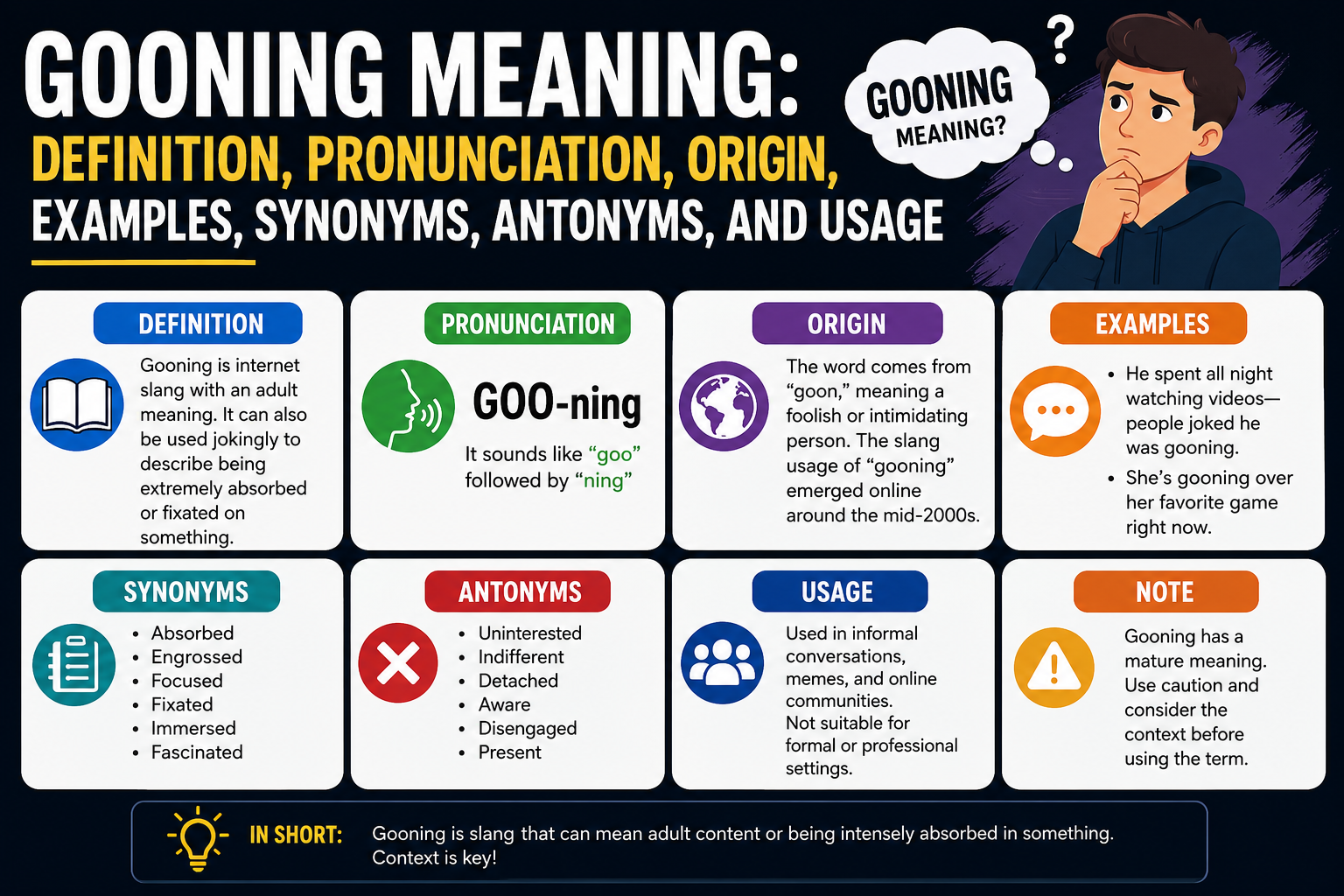
Gooning Meaning: If you have seen the word “gooning” in internet comments, memes, or slang conversations, you may have wondered what it means. The term can be confusing because it has more than one use, and some of its meanings are intended for adults.
In general, gooning is mature internet slang. Its most established dictionary meaning is sexual and therefore is not appropriate for children or general conversation. Merriam-Webster currently lists “gooning” as vulgar slang and gives it an adult definition.
At the same time, people sometimes use the word jokingly online to describe being extremely absorbed, distracted, or fixated on something. Because slang can change meaning depending on the community and context, understanding where the word appears is important.
What Does Gooning Mean?
The simplest safe explanation is that gooning is a mature slang term with an adult meaning, although it is also sometimes used humorously online to mean being extremely absorbed or fixated on something.
The adult meaning is the original and more established modern slang usage. Because that meaning involves sexual behavior, it is best understood as NSFW or mature language, rather than as ordinary everyday vocabulary. Merriam-Webster identifies the term as vulgar slang and records its first known use in this sense around 2005.
On social media and meme culture, however, the word can sometimes be used more loosely. Someone might use it as an exaggerated joke about being completely absorbed in a video, game, trend, or other piece of online content. This broader meme usage can make the word especially confusing for someone encountering it for the first time.
Is Gooning a Bad Word?
“Bad word” is not quite the best description. A better description is mature or vulgar slang.
The word is not suitable for formal writing, school assignments, professional communication, or situations where you want to use clear and respectful language. It can also be misunderstood because some readers will recognize its adult meaning even when a person intends it as a joke.
For that reason, neutral words such as focused, absorbed, distracted, fascinated, or obsessed are usually better choices when you want to communicate clearly.
Gooning Pronunciation
The word gooning is pronounced approximately GOO-ning. The first part sounds like “goo,” while the ending sounds like the “-ning” in words such as “running.”
The spelling is straightforward: g-o-o-n-i-n-g.
Although pronunciation is simple, knowing the meaning is more important because the term can carry a mature meaning that is not obvious from the sound of the word.
Where Did the Word Gooning Come From?
The history of gooning is connected to the older word goon. The word “goon” has been used in English for a foolish or silly person and, in other contexts, for an intimidating person or hired enforcer.
The modern slang term developed a substantially different meaning online. Merriam-Webster traces the documented adult slang usage of “gooning” to around 2005.
Internet communities then helped spread the term. References to the word became more visible in online slang dictionaries, forums, memes, and later social-media discussions. Know Your Meme notes early references dating to the mid-2000s and describes the term’s later spread through online communities.
This is a good example of how internet language develops. A familiar word can acquire a new meaning inside a particular community, and that meaning can later spread much more widely.
How the Meaning Changed Online
Internet slang rarely stays fixed. A word may begin in a niche community, become popular in memes, and eventually be used jokingly by people who do not know its original meaning.
That appears to have happened with gooning. Some users now use the word humorously to describe someone who is intensely focused on something or who has spent an unusually long time watching or interacting with online content. However, this is not the safest meaning to assume when you encounter the word because the adult meaning remains important.
The result is a word with context-dependent usage. A meme may use it as exaggerated internet humor, while another online conversation may use it with its original mature meaning.
Gooning Meaning in Internet Slang
In broad internet slang, gooning can sometimes be used as an exaggerated way of saying that someone is deeply absorbed, fixated, or zoned out.
For example, a meme might jokingly describe somebody spending hours watching the same type of content as being “in gooning mode.” In that context, the writer may simply be exaggerating the idea of being extremely absorbed.
However, this casual interpretation should not be confused with the established adult definition. Because the mature meaning is widely recognized, the term can easily sound inappropriate or confusing outside a meme-oriented setting.
That is why context matters so much when interpreting slang.
Examples of the Word in Context
Because the primary meaning of gooning is mature, it is better to use non-explicit examples when explaining how the word may appear in internet culture.
Here are examples of the non-adult, humorous usage:
- “He spent the whole afternoon watching the same type of videos—people joked that he was gooning.”
- “The meme uses ‘gooning’ as a joke about being completely absorbed in online content.”
- “She did not recognize the slang and searched for the meaning.”
- “That word can be confusing because it has a mature meaning as well as some newer meme usage.”
These examples demonstrate the language without describing adult behavior.
Synonyms for Gooning
There is no perfect synonym because gooning is slang and its meaning changes according to context.
When someone uses it in the broader, non-adult sense of being highly absorbed, possible alternatives include:
- Absorbed
- Focused
- Fixated
- Fascinated
- Engrossed
- Preoccupied
- Distracted
- Obsessed
- Zoned out
- Immersed
These alternatives are usually much clearer.
For example, instead of saying “He was gooning over the game,” you could say, “He was completely absorbed in the game.” The second sentence communicates the idea without the mature slang association.
Antonyms for Gooning
Again, there is no exact opposite because slang meanings vary. If the intended meaning is being extremely absorbed or distracted, useful opposites include:
- Attentive
- Aware
- Focused elsewhere
- Uninterested
- Indifferent
- Detached
- Present
- Disengaged
The best choice depends on what the speaker is trying to communicate.
For example, if “gooning” is being used jokingly to describe someone who has lost track of time online, an opposite idea might be being present and aware of your surroundings.
Is Gooning Appropriate for School or Formal Writing?
No. Gooning is not a good word for school essays, academic writing, job applications, professional emails, or other formal communication.
There are several reasons. First, the word is slang. Second, its established meaning is mature and vulgar. Third, readers may interpret it differently depending on their familiarity with internet culture.
If you are writing an article, essay, presentation, or report, choose a precise neutral term instead. Words such as absorbed, distracted, fascinated, fixated, or immersed are much more suitable.
Why Do People Search for Gooning Meaning?
People commonly search for the meaning of unusual internet slang because they encounter it without enough context.
A person may see the word in a meme, comment, gaming conversation, video caption, or message and wonder whether it is harmless slang or something inappropriate. Since the term has both mature and joking internet associations, simply guessing from context can lead to misunderstanding.
Searching for a definition is therefore useful. It helps people recognize that gooning is not ordinary everyday English and that its established meaning is mature.
Gooning vs. Similar Internet Slang
Internet slang often overlaps in meaning, but similar words are not necessarily interchangeable.
For example, zoned out usually describes someone who is mentally distracted or not paying attention. Obsessed describes very strong interest in something. Immersed means being deeply involved in an activity.
Gooning, by contrast, has a specific mature slang history. Some people now use it jokingly to suggest extreme fixation, but the word retains its adult association.
This distinction matters when interpreting messages. If a person wants to say that they were simply very interested in a movie or game, “immersed” or “absorbed” is clearer and less likely to be misunderstood.
Common Mistakes About the Word
One common mistake is assuming that every use of gooning has exactly the same meaning. Internet slang can develop different meanings across communities, and the surrounding conversation matters.
Another mistake is treating the word as ordinary vocabulary. It is better classified as informal and mature slang, so it should not be casually inserted into formal conversations.
A third mistake is assuming that a humorous meme interpretation completely replaces the original meaning. It does not. The established adult meaning remains important, which is why people should be cautious when using or repeating the word.
How to Respond If You See the Word Online
If you encounter gooning online and do not understand it, there is no need to repeat the term yourself.
First, look at the surrounding context. Then remember that the word has a mature meaning and may not be appropriate for your age or situation.
If someone uses it toward you and you are uncomfortable, you can simply ignore the message, leave the conversation, or talk to a trusted adult about what happened. You do not need to participate in a conversation simply because other people are using slang.
Gooning Meaning: Quick Reference
| Feature | Explanation |
| Word | Gooning |
| Type | Internet slang |
| Pronunciation | GOO-ning |
| Formality | Very informal |
| Register | Mature/vulgar slang |
| Main established meaning | Adult slang |
| Broader meme usage | Sometimes used humorously for extreme fixation |
| Suitable for school writing? | No |
| Better neutral alternatives | Absorbed, focused, immersed, fascinated |
Frequently Asked Questions About Gooning Meaning
What does gooning mean?
Gooning is a mature internet slang term with an established adult meaning. In some meme and social-media contexts, people also use it jokingly to describe being extremely absorbed or fixated on something.
How do you pronounce gooning?
It is pronounced GOO-ning, with the first syllable sounding like “goo.” The word has two main spoken parts: “goo” and “ning.”
Is gooning slang?
Yes. Gooning is slang, not a standard formal English expression. Its established meaning is vulgar and mature, although some internet users have adopted it for humorous, non-adult meme usage.
Is gooning appropriate for school?
No. It is better to avoid the term in schoolwork and formal communication because it has a mature slang meaning. Use words such as focused, absorbed, immersed, or fascinated instead.
Why does gooning appear in memes?
Some internet communities use the word jokingly to describe extreme fixation or spending a very long time consuming online content. This meme usage can make the term appear more innocent than its established mature meaning.
What are some synonyms for gooning?
Depending on the intended non-adult meaning, alternatives include absorbed, engrossed, immersed, fixated, fascinated, preoccupied, and obsessed. None is an exact replacement for the mature slang meaning.
Is gooning a formal English word?
No. It is best understood as informal internet slang. Merriam-Webster does record the term, but specifically labels its established definition as vulgar slang.
What does gooning mean on social media?
On social media, the meaning can depend heavily on context. Some users employ it as a joke about being intensely absorbed in something, while others use it according to its established mature meaning. Therefore, the safest interpretation comes from examining the surrounding conversation.
Final Thoughts on Gooning Meaning
The gooning meaning can be confusing because the word has developed different uses across internet communities. Its established dictionary meaning is mature and vulgar, while some meme culture uses the term more loosely to describe extreme focus or fixation. Merriam-Webster records the adult slang sense and dates its first known use in that sense to around 2005.
For everyday communication, especially at school or in formal settings, it is best to avoid the term. If you simply want to describe someone who is deeply interested in something, words such as absorbed, immersed, fascinated, focused, or engrossed are clearer and more appropriate.
Understanding slang is useful, but you do not have to use every slang word you encounter. When a term has a mature meaning, knowing its context and choosing safer, clearer language is usually the smartest approach.