CTE Meaning: If you have searched for CTE meaning, you may have noticed that these three letters can appear in medical articles, sports discussions, education, and everyday online conversations. The exact meaning depends on the context. One of the most common uses of CTE, especially in health and sports, is chronic traumatic encephalopathy, a brain disease associated with repeated head impacts.
In this guide, we will explain CTE meaning in simple English. You will learn how to pronounce CTE, where the term comes from, what it means medically, how it is used in sentences, related words, synonyms and antonyms, and answers to common questions. The goal is to make a complicated term easier to understand without using unnecessary medical language.
CTE Meaning in Simple English
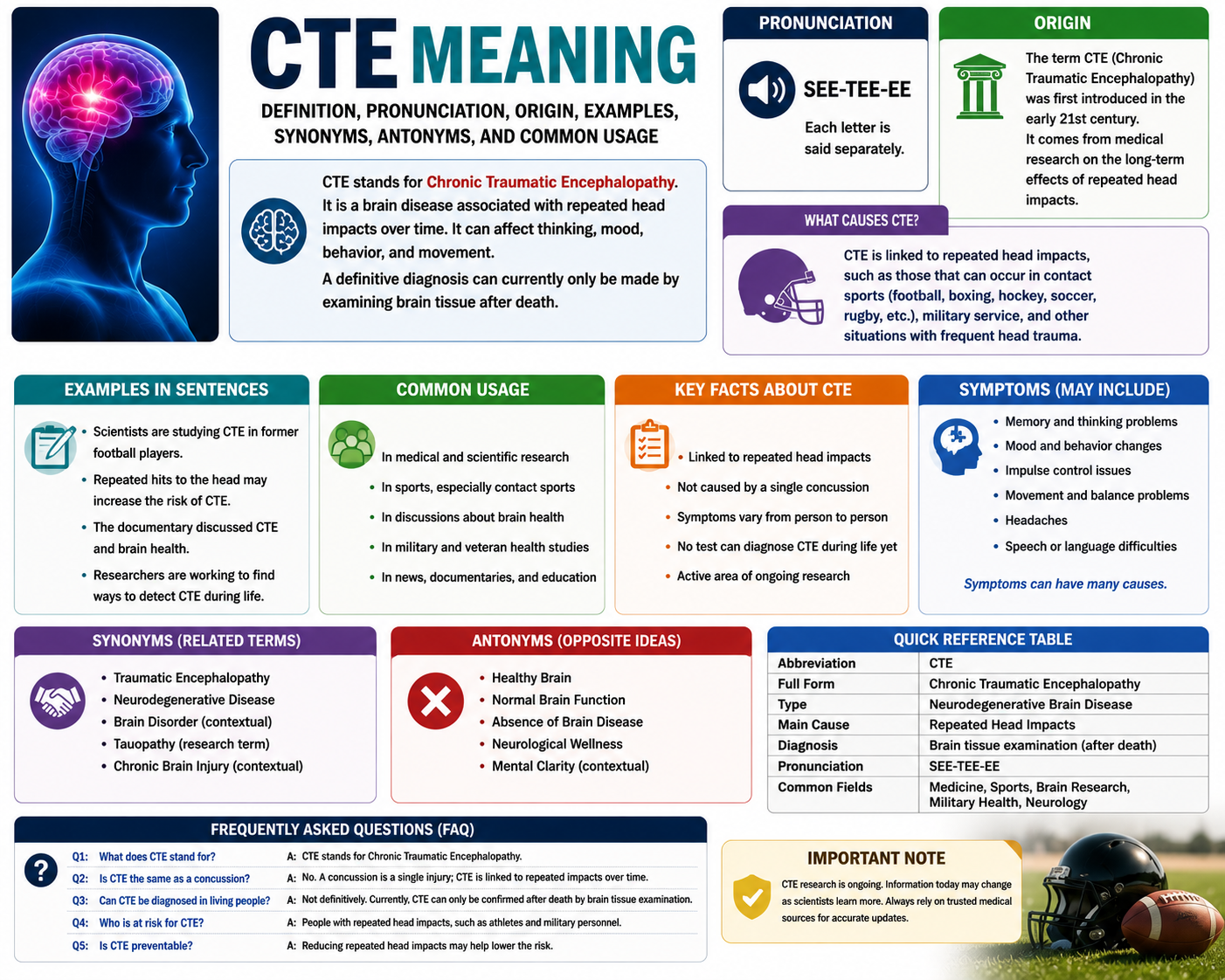
CTE stands for chronic traumatic encephalopathy. It is a brain disease associated with repeated impacts to the head. Researchers have studied it particularly in people who have experienced repeated head impacts through activities such as contact sports or military service.
The word can be understood by breaking it into three parts. Chronic means something that develops or continues over a long period. Traumatic relates to physical injury or trauma. Encephalopathy is a general medical term describing a condition that affects the brain.
Put together, chronic traumatic encephalopathy refers to a condition involving long-term brain changes associated with repeated head trauma. CTE is a specific neuropathological diagnosis, meaning that the disease is identified by characteristic changes in brain tissue rather than simply by symptoms reported during a person’s lifetime.
Quick Definition of CTE
| Term | Meaning |
| CTE | Chronic traumatic encephalopathy |
| Type | Neurological condition |
| Main association | Repeated head impacts |
| Common context | Sports, medicine, brain research, military health |
| Pronunciation | See-tee-ee |
| Diagnosis | Definitive diagnosis requires examination of brain tissue after death |
It is important to understand that having a concussion or experiencing a head injury does not automatically mean a person has CTE. Researchers are still studying exactly how repeated head impacts, brain changes, symptoms, and long-term outcomes are connected.
How Do You Pronounce CTE?
CTE is normally pronounced by saying each letter separately:
So, CTE pronunciation is “see-tee-ee.”
Because CTE is an abbreviation rather than an ordinary word, people generally do not pronounce it as a single word. In conversation, you will usually hear someone say the three letters individually.
For example:
“Researchers are studying CTE in people who experienced repeated head impacts.”
Here, CTE is pronounced see-tee-ee.
What Does Chronic Traumatic Encephalopathy Mean?
The full form of CTE is chronic traumatic encephalopathy. The term describes a particular type of brain disease associated with repeated head impacts.
Modern research defines CTE through characteristic changes in brain tissue, especially abnormal accumulation of phosphorylated tau protein in specific areas of the brain. These changes are examined microscopically during neuropathological evaluation.
This distinction matters because symptoms alone cannot establish a definitive diagnosis of CTE in a living person. Current medical references explain that definitive CTE diagnosis requires examination of brain tissue after death. During life, clinicians and researchers may instead use the concept of traumatic encephalopathy syndrome, or TES, when evaluating symptoms and a history of repeated head impacts.
What Does “Chronic” Mean in CTE?
Chronic means long-lasting or developing over an extended period. It does not mean that every person exposed to head impacts will develop a progressive condition.
In the name CTE, the word helps distinguish the condition from an immediate injury. A concussion, for example, may happen suddenly, while CTE refers to characteristic long-term pathological changes associated with repeated head impacts.
What Does “Traumatic” Mean in CTE?
Traumatic refers to physical trauma or injury. In the context of CTE, researchers are interested in trauma involving the head and brain.
Repeated impacts can occur in different settings. Research has examined people with histories involving contact or collision sports and military exposure, among other circumstances.
What Does “Encephalopathy” Mean?
Encephalopathy is a broad medical term for a condition involving the brain. It comes from medical terminology used to describe abnormal brain function or brain disease.
Therefore, the full phrase chronic traumatic encephalopathy essentially describes a long-term brain disorder associated with trauma.
Origin and History of the Term CTE
The history behind CTE is older than its current popularity suggests. Earlier medical descriptions connected repeated head trauma in boxers with a condition sometimes called “punch drunk” syndrome or dementia pugilistica. Later researchers developed the terminology and pathological understanding that led to the modern concept of CTE.
Dictionary references record the abbreviation CTE as dating back to the middle of the twentieth century.
Over time, researchers began examining the condition beyond boxing. Studies have investigated brain tissue from people with histories of repeated head impacts in sports and military settings. The discovery and study of characteristic tau-related changes helped establish CTE as a distinct neuropathological condition.
The subject became especially well known among the public because of discussions surrounding professional sports and brain health. Today, CTE remains an active area of scientific research, with researchers working to understand risk factors, disease mechanisms, clinical symptoms, and possible methods for identifying the condition during life.
Why Is CTE Associated With Repeated Head Impacts?
One of the most important ideas behind CTE meaning is repeated exposure to head impacts.
Researchers have found CTE-related pathology in some people who experienced repeated head impacts over time. These exposures can occur in several environments, including certain contact sports and military service.
However, it would be inaccurate to say that repeated head impacts guarantee CTE. Scientists are still investigating why some people develop CTE pathology while others do not. Factors such as the amount and type of exposure, individual biology, and other influences may be important.
Current research also emphasizes the difference between risk and certainty. Having a history of head impacts can be relevant to CTE research, but it does not provide enough information by itself to determine whether someone has the disease.
Symptoms and Clinical Features Discussed in CTE Research
CTE is primarily a neuropathological diagnosis, but researchers have studied symptoms reported in people with confirmed or suspected disease.
Research has discussed possible changes involving thinking, memory, behavior, mood, and movement. Clinical presentations can vary considerably, and symptoms may have many different causes.
Some research has described features such as:
- Memory or thinking difficulties
- Changes in mood
- Behavioral changes
- Problems with impulse control
- Difficulties with movement
- Speech or language changes
- Headaches
- Changes in everyday functioning
These features should not be treated as a checklist for diagnosing CTE. A person experiencing one or more of these problems does not necessarily have CTE.
Medical professionals consider many possible explanations for neurological or psychological symptoms. Current clinical research uses the concept of traumatic encephalopathy syndrome to describe certain clinical presentations associated with a history of repetitive head impacts.
How Is CTE Diagnosed?
This is one of the most important facts to understand when researching CTE meaning.
At present, CTE can be definitively diagnosed through neuropathological examination of brain tissue after death. Researchers look for characteristic pathological changes under a microscope.
That means a scan, questionnaire, or ordinary medical examination cannot by itself provide a definitive CTE diagnosis.
Scientists are actively studying possible biomarkers and other methods that could eventually help identify CTE during life. Research into these methods is important because a reliable way to diagnose CTE in living people would improve both medical care and scientific understanding.
CTE vs. TES
CTE and TES are related terms, but they are not exactly the same.
CTE refers to characteristic pathological changes found in brain tissue. TES, or traumatic encephalopathy syndrome, is a clinical framework used to describe symptoms and other features in living people who have a history of repetitive head impacts.
Keeping these terms separate prevents a common misunderstanding: symptoms associated with TES do not automatically prove that someone has CTE.
Examples of CTE in Sentences
Understanding how an abbreviation is used can make its meaning much clearer. Here are some simple examples.
- “The researchers are studying the relationship between repeated head impacts and CTE.”
- “The article explains the history of CTE in contact sports.”
- “CTE is a subject of ongoing neurological research.”
- “The doctor explained that symptoms alone cannot confirm CTE.”
- “Scientists are investigating ways to identify CTE during life.”
- “The documentary discussed brain health and CTE.”
- “Researchers continue to study how repeated head impacts may contribute to CTE.”
These examples show that CTE is commonly used in medical, scientific, sports, and educational discussions.
CTE Meaning in Sports
Sports are one of the contexts in which people most often encounter the term CTE.
Researchers have studied CTE in connection with activities where people may experience repeated head impacts. These include sports such as boxing, American football, ice hockey, soccer, rugby, wrestling, and other activities involving potential head trauma.
The presence of CTE research in sports does not mean that every athlete in these sports develops the condition. Instead, scientists are trying to understand the relationship between repeated exposure and later brain pathology.
This research has also encouraged broader conversations about concussion awareness, safer sports practices, medical evaluation after head injuries, and ways to reduce unnecessary head impacts.
CTE Meaning in Medical and Scientific Writing
In medical writing, CTE is almost always used as an abbreviation for chronic traumatic encephalopathy.
For example, a research paper might discuss CTE pathology, CTE-associated brain changes, or the relationship between repetitive head impacts and CTE. Medical sources may also discuss tau proteins, neuropathology, neurodegeneration, and traumatic encephalopathy syndrome when explaining the condition.
Because medical abbreviations can have multiple meanings, context is important. If you see CTE in a completely different field, the intended definition may be different.
Synonyms and Related Terms for CTE
CTE is a medical abbreviation, so it does not have perfect synonyms in the same way that an ordinary adjective or noun might.
Still, several terms are closely related.
Chronic Traumatic Encephalopathy
This is the full form of CTE and the most direct equivalent.
Traumatic Encephalopathy
This is a broader term connected with brain changes following trauma. It should not automatically be treated as identical to CTE.
Dementia Pugilistica
This historical term has been associated with the neurological problems observed in some boxers exposed to repeated head trauma. Modern medical discussions generally use CTE when referring to the specific neuropathological disease.
Punch Drunk Syndrome
This is another historical expression associated with repeated head trauma in boxing. It is not the preferred modern scientific term for CTE.
Antonyms of CTE
Because CTE is the name of a medical condition, it does not have a direct antonym.
However, depending on the context, related contrasting ideas might include:
- Healthy brain function
- Absence of neurological disease
- No evidence of CTE pathology
- Normal neurological function
These phrases should not be considered exact medical opposites. They simply describe conditions that contrast with the presence of a neurological disorder.
Common Questions People Ask About CTE
People often search for CTE meaning because they encounter the term in sports news, medical articles, documentaries, or social media. Here are some of the most common questions.
What does CTE stand for?
CTE stands for chronic traumatic encephalopathy. It is a neurodegenerative brain disease associated with repeated head impacts.
How do you pronounce CTE?
CTE is pronounced “see-tee-ee.” Each letter is spoken separately.
Is CTE a disease?
Yes. CTE is recognized as a distinct neurodegenerative disease based on characteristic pathological changes in the brain. Definitive diagnosis currently requires examination of brain tissue after death.
Does every concussion cause CTE?
No. A concussion does not automatically mean a person will develop CTE. Researchers are studying the relationship between different forms of head trauma and CTE, and the causes and risk factors are more complicated than a simple one-injury-to-one-disease relationship.
Can CTE be diagnosed while someone is alive?
A definitive diagnosis of CTE currently requires neuropathological examination of brain tissue after death. Researchers are investigating biomarkers and other methods that might eventually help identify the disease during life.
Is CTE only found in athletes?
No. CTE research has included athletes as well as people with other histories of repeated head impacts, including military exposure.
What is the difference between CTE and a concussion?
A concussion is a type of traumatic brain injury that can happen after an impact or force affecting the brain. CTE refers to characteristic long-term pathological changes associated with repeated head impacts. They are related to brain trauma but are not the same thing.
Why is CTE discussed so often in sports?
Some sports involve repeated opportunities for head impacts, so researchers have studied whether long-term exposure is associated with CTE. This has made CTE an important topic in sports medicine and brain-health research.
Why Understanding CTE Meaning Matters
Learning CTE meaning is useful because the term appears frequently in discussions about brain health and repeated head impacts. However, it is equally important to understand what the term does not mean.
CTE is not simply another word for concussion. It is not a diagnosis that can be made from a single symptom. It is also not accurate to assume that everyone who participates in a contact sport will develop CTE.
Scientific understanding continues to develop. For example, a recent NIH-funded study reported a relationship between severe CTE pathology and dementia risk while finding no measurable relationship between less severe CTE and changes in thinking, mood, or daily functioning in that particular study.
This illustrates why CTE research needs to be interpreted carefully. Scientists continue to investigate how the amount of pathological change relates to symptoms and everyday functioning.
CTE Meaning: Key Facts at a Glance
| Question | Answer |
| What does CTE stand for? | Chronic traumatic encephalopathy |
| How is CTE pronounced? | See-tee-ee |
| What does it involve? | Characteristic brain pathology associated with repeated head impacts |
| Is it a neurological condition? | Yes |
| Is it linked to repeated head impacts? | Yes |
| Can symptoms alone confirm CTE? | No |
| Can CTE currently be definitively diagnosed during life? | No |
| What is TES? | Traumatic encephalopathy syndrome, a clinical concept related to symptoms after repetitive head-impact exposure |
| Is CTE still being researched? | Yes |
Final Thoughts on CTE Meaning
The simplest answer to CTE meaning is that CTE stands for chronic traumatic encephalopathy, a neurodegenerative brain disease associated with repeated head impacts. The condition has a long history of medical study, beginning with observations of neurological problems in boxers and expanding into research involving athletes and military populations.
One of the most important points is that CTE is a specific neuropathological diagnosis. Current evidence indicates that definitive diagnosis requires examination of brain tissue after death, while researchers continue to investigate ways to understand and potentially identify the condition during life.
If you encounter CTE in a medical, sports, or brain-health article, remembering the full phrase chronic traumatic encephalopathy will help you understand the discussion. At the same time, because CTE science continues to develop, claims about symptoms, causes, risk, and diagnosis should be interpreted using reliable medical and scientific sources rather than simplified internet claims.