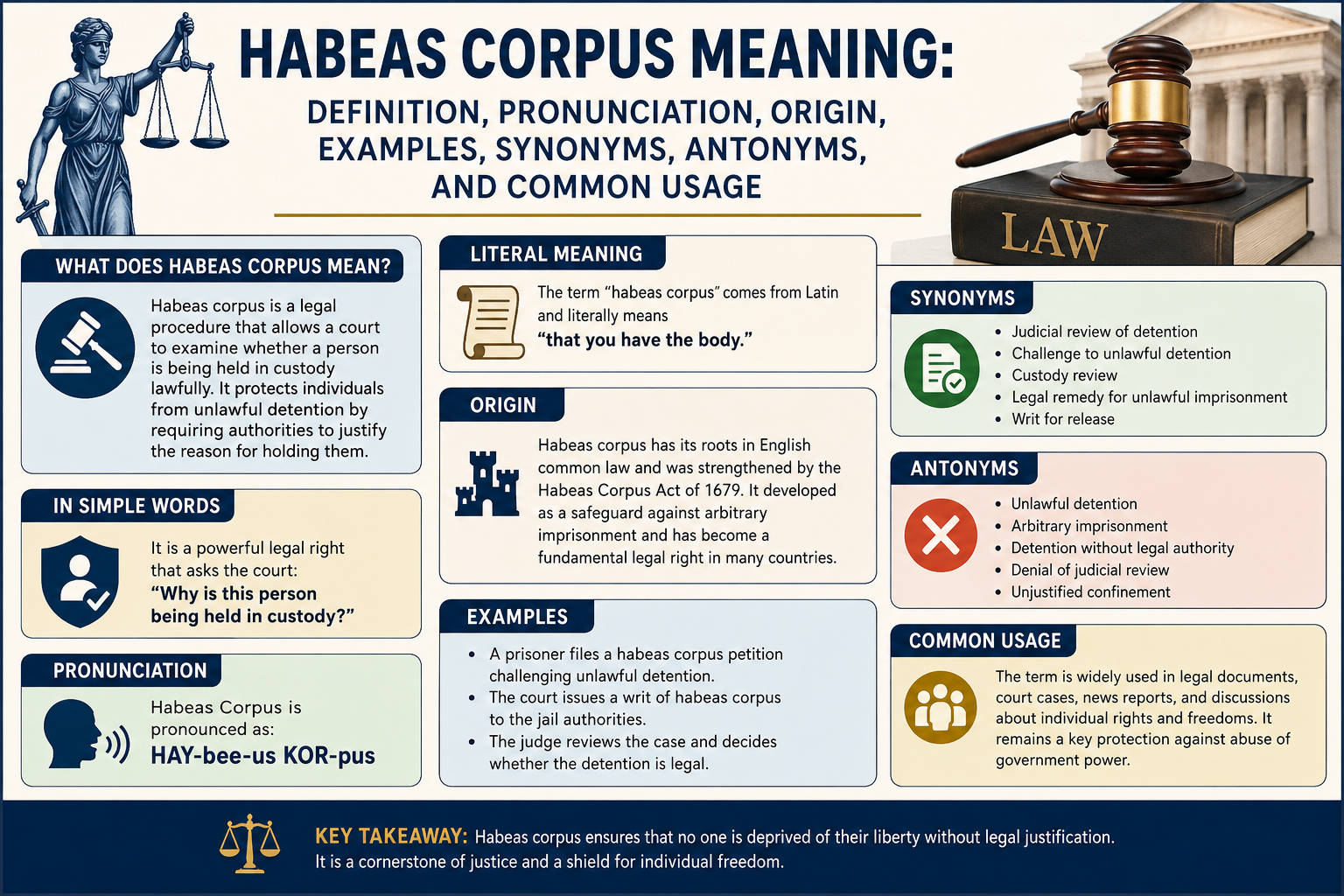
Habeas Corpus Meaning; Understanding legal terms can feel difficult because many of them come from Latin and are rarely used in everyday conversation. Habeas corpus is one of the most important legal phrases to know because it is closely connected with personal liberty, lawful detention, and the power of courts.
In simple English, habeas corpus is a legal procedure that allows a court to examine whether a person is being held in custody lawfully. It is commonly associated with prisoners or detainees who challenge the legal basis for their detention. The court can require the authority holding the person to explain why that person is being detained.
The phrase has a long history in English law and became an important part of legal traditions in countries influenced by English common law. In the United States, habeas corpus is specifically recognized in the Constitution, while federal statutes and court decisions explain how it operates.
Habeas Corpus Meaning in Simple English
The habeas corpus meaning is essentially a legal way to challenge unlawful detention. If someone is being held by the government or another authority, a habeas corpus proceeding can ask a court to determine whether there is a valid legal reason for keeping that person in custody.
The phrase does not simply mean that a person will automatically be released. Instead, it provides a method for judicial review. A court examines the legal basis for the detention and decides whether the person is being held according to the law.
A simple way to understand it is this:
Habeas corpus means asking a court to check whether someone’s detention is lawful.
This principle is important because government authorities have significant power over a person’s freedom. Habeas corpus provides a judicial safeguard against detention that lacks a proper legal basis.
What Does Habeas Corpus Literally Mean?
The words habeas corpus come from Latin. They are commonly translated as “that you have the body.” The phrase refers to the requirement that the person holding someone in custody bring that detainee before a court or otherwise respond to the court’s inquiry about the detention.
The full historical legal expression is associated with habeas corpus ad subjiciendum, which is translated as “that you have the body to submit to.” This is the form traditionally known as the “Great Writ,” because of its important role in protecting individual liberty.
The literal translation can sound strange in modern English. It does not mean that a court is simply interested in physically seeing someone’s body. Rather, it reflects an old legal command requiring the custodian to produce the detained person and provide a lawful explanation for the confinement.
Habeas Corpus Pronunciation
The usual English pronunciation of habeas corpus is approximately HAY-bee-us KOR-pus.
The pronunciation may vary slightly depending on accent, but HAY-bee-us KOR-pus is a useful pronunciation for everyday English.
Origin of Habeas Corpus
The history of habeas corpus reaches back to English common law. Its development is connected with the broader idea that government authorities should not be able to imprison people without lawful justification.
The principle is often discussed alongside the Magna Carta, issued at Runnymede in 1215 during the reign of King John. Magna Carta established important principles concerning lawful government and protection against arbitrary imprisonment. The National Archives explains that its provisions became part of the historical foundation of English common law.
It is important, however, to avoid saying that the modern habeas corpus procedure was fully created by Magna Carta. The legal remedy developed over centuries through English courts and later legislation. Cornell’s Legal Information Institute notes that English courts were actively considering habeas corpus petitions by the seventeenth century.
The Habeas Corpus Act
A major development came with the Habeas Corpus Act of 1679 in England. It strengthened protections associated with the writ and became one of the important historical documents in the development of modern ideas about individual liberty. The National Archives identifies the Habeas Corpus Act of 1679 alongside the Petition of Right and Bill of Rights as major English documents in the history of popular freedom.
Over time, habeas corpus became a powerful legal safeguard against unlawful imprisonment and arbitrary government action.
Habeas Corpus in American Law
Habeas corpus became part of American legal tradition through English common law. English colonists brought the legal concept to North America, and it was used in several British colonies before the American Revolution.
The framers of the U.S. Constitution considered habeas corpus important enough to include it directly in the Constitution. Article I, Section 9 contains what is known as the Suspension Clause, which says that the privilege of the writ shall not be suspended except in cases of rebellion or invasion when public safety requires it.
Congress also provided federal courts with authority to issue habeas corpus through the Judiciary Act of 1789. That legislation gave federal judges authority to issue the writ for inquiries into the causes of certain commitments.
Over American legal history, the scope and application of habeas corpus have changed. Today, it can be used in various circumstances involving detention, including certain challenges to criminal convictions and other forms of government custody.
Why Is Habeas Corpus Important?
The importance of habeas corpus comes from a basic principle: a government should have a lawful reason for taking away a person’s freedom.
Without judicial review, an authority could potentially hold someone without providing a meaningful legal explanation. Habeas corpus gives courts a way to examine the authority for the detention.
This makes the writ an important protection for individual liberty. The U.S. Supreme Court has described habeas corpus as a fundamental instrument for protecting freedom against arbitrary and unlawful government action.
Habeas corpus therefore represents more than a Latin phrase. It reflects a major legal idea: the power to detain a person should be subject to the law and, where appropriate, judicial scrutiny.
How Does Habeas Corpus Work?
The exact process depends on the country and legal system involved, so there is no single procedure that applies everywhere. In general, however, a person in custody or someone acting on that person’s behalf may ask a court to review the legality of the detention.
The court may then require the authority responsible for the custody to respond. The authority must identify the legal basis for holding the person. The court considers the relevant law and circumstances and determines whether the detention can legally continue.
If the detention is unlawful, the court may order appropriate relief, which can include release. In other situations, the court may determine that the detention has a sufficient legal basis.
Habeas Corpus Does Not Mean Automatic Release
One common misunderstanding is that filing for habeas corpus automatically means a prisoner will be released. That is not correct.
The central purpose is judicial examination of the legality of detention. A court may decide that the detention is lawful after reviewing the government’s explanation and the applicable law.
In other words, habeas corpus creates an opportunity for legal review rather than guaranteeing a particular result.
Examples of Habeas Corpus
Consider a simple hypothetical example. Suppose a person is being held in custody, but there is a serious legal question about whether the authority has the power to continue holding that person. A habeas corpus petition could ask a court to examine the legal basis for the detention.
Another example involves a prisoner who claims that a constitutional problem affected the legality of the custody. In some legal systems, habeas corpus can provide a procedure for raising such claims after conviction, although strict procedural requirements may apply.
Habeas corpus has also been used in circumstances involving immigration detention, military detention, extradition, bail, and other questions concerning the legal authority to hold someone. The exact availability of the remedy depends on the applicable law and circumstances.
Habeas Corpus Example in a Sentence
Here are some general examples showing how the phrase is used:
- The lawyer filed a habeas corpus petition challenging the legality of the detention.
- The court considered the habeas corpus application and reviewed the legal basis for custody.
- The case involved an important habeas corpus question concerning individual liberty.
- The judge issued a writ of habeas corpus requiring the detention authority to respond.
- The prisoner sought habeas corpus relief after raising a legal challenge to the detention.
These examples demonstrate that habeas corpus is primarily a legal term rather than an expression commonly used in casual conversation.
Common Usage of Habeas Corpus
The phrase appears frequently in legal writing, court decisions, constitutional discussions, history books, and news reports involving detention or imprisonment.
You may see expressions such as:
Habeas corpus petition: A formal legal request asking a court to review detention.
Writ of habeas corpus: The court order or traditional legal remedy associated with the habeas corpus procedure.
Habeas corpus relief: The remedy granted by a court following a successful habeas corpus challenge.
Habeas corpus proceeding: A court proceeding concerning the legality of detention.
Federal habeas corpus: A habeas corpus proceeding in a federal court, particularly in the United States.
The meaning of these expressions can vary according to jurisdiction, so legal documents should always be interpreted according to the law that applies to the particular case.
Synonyms for Habeas Corpus
Finding a perfect synonym for habeas corpus is difficult because it is a specific legal remedy. Ordinary words can describe its purpose, but they do not completely replace the legal term.
Useful related expressions include:
- Judicial review of detention
- Challenge to unlawful detention
- Custody review
- Legal challenge to imprisonment
- Review of detention
- Writ for release
- Protection against unlawful imprisonment
These are best understood as related descriptions rather than exact synonyms.
For example, saying “judicial review of detention” can help explain the concept to a general audience, but it does not carry precisely the same technical legal meaning as habeas corpus.
Antonyms of Habeas Corpus
There is no exact antonym for habeas corpus because it is the name of a particular legal remedy rather than a simple descriptive adjective.
However, concepts that contrast with its purpose include:
- Unlawful detention
- Arbitrary imprisonment
- Detention without legal authority
- Denial of judicial review
- Unjustified confinement
These expressions describe situations that habeas corpus is designed, in appropriate circumstances, to challenge.
Habeas Corpus vs. Appeal
Habeas corpus and an appeal are not the same thing.
An appeal generally asks a higher court to review a decision made by a lower court. Depending on the legal system, an appeal may challenge legal errors, factual findings, or other aspects of a judgment.
Habeas corpus, by contrast, focuses on the legality of a person’s custody or detention. In modern U.S. law, habeas corpus can involve constitutional challenges to criminal proceedings, but it remains distinct from an ordinary direct appeal.
This distinction matters because a person may have different legal remedies available at different stages of a case.
Habeas Corpus vs. Bail
Habeas corpus and bail are also different legal concepts.
Bail generally concerns whether a person accused of a crime can remain outside custody while a case proceeds, subject to conditions established by the court.
Habeas corpus concerns whether the person’s detention is legally justified. In some circumstances, habeas corpus proceedings can involve questions about bail, but the two concepts should not be treated as interchangeable. Cornell’s Legal Information Institute lists denial of bail among certain matters that may arise in habeas corpus proceedings.
What Is a Writ of Habeas Corpus?
A writ of habeas corpus is a formal court order connected with the habeas corpus remedy.
Historically, the writ directed the person or authority holding an individual to bring that person before the court and explain the reason for the detention. The court could then determine whether the detention was lawful.
The expression “Great Writ” is commonly associated with habeas corpus because of its historic importance as a protection of personal liberty.
Modern procedures differ by jurisdiction, but the central idea remains judicial examination of the legal basis for custody.
Habeas Corpus and Individual Rights
Habeas corpus is closely connected with the broader principle of due process and the rule of law.
A legal system based on the rule of law requires government officials to act within legal authority. When a person’s liberty is restricted, courts can play an important role in determining whether the government has acted lawfully.
The historical development of habeas corpus shows how legal systems gradually developed mechanisms to limit arbitrary detention. Its importance is therefore both practical and constitutional.
The National Archives notes that principles associated with Magna Carta influenced American constitutional development, while habeas corpus itself became an established part of the American legal tradition.
Modern Meaning of Habeas Corpus
Today, the habeas corpus meaning remains centered on the legality of detention, although its exact use varies between jurisdictions.
In the United States, federal habeas corpus can be used by certain state and federal prisoners to challenge unlawful custody under applicable federal law. It can also arise in areas such as immigration and military detention.
Modern habeas corpus law can be complicated. Procedural rules, deadlines, prior proceedings, jurisdiction, and other requirements may affect whether a particular petition can be heard.
For that reason, a general explanation of habeas corpus should not be treated as legal advice about a specific case.
Frequently Asked Questions About Habeas Corpus
What does habeas corpus mean?
Habeas corpus is a legal remedy used to ask a court to examine whether a person’s detention or custody is lawful. Its Latin meaning is commonly translated as “that you have the body.”
How do you pronounce habeas corpus?
It is commonly pronounced HAY-bee-us KOR-pus in English.
Is habeas corpus a law?
Habeas corpus is better understood as a legal remedy or writ that developed through English law and later became part of constitutional and statutory law in different jurisdictions. In the United States, it is specifically referenced in the Constitution and implemented through federal statutes and case law.
Does habeas corpus mean someone must be released?
No. A habeas corpus proceeding does not automatically guarantee release. The court reviews the legal basis for detention and determines what relief, if any, is appropriate.
Where did habeas corpus originate?
Habeas corpus developed from English common law. Its history is connected with medieval English legal principles and later developments in English courts and legislation. The concept became especially important as a protection against unlawful imprisonment.
Is habeas corpus mentioned in the U.S. Constitution?
Yes. Article I, Section 9 of the U.S. Constitution contains the Suspension Clause concerning the privilege of the writ of habeas corpus.
What is the main purpose of habeas corpus?
Its main purpose is to provide judicial review of the legal basis for a person’s detention. It serves as a safeguard against unlawful or arbitrary confinement.
Is habeas corpus the same as an appeal?
No. An appeal generally reviews a lower court’s decision, while habeas corpus focuses on the legality of custody or detention. In some circumstances, habeas proceedings can raise constitutional issues connected with a criminal case.
What is the “Great Writ”?
The “Great Writ” is a traditional name for habeas corpus, reflecting its historic importance as a protection of personal liberty.
Conclusion
The habeas corpus meaning is simple at its core: it is a legal mechanism that allows a court to examine whether a person’s detention is lawful. The phrase comes from Latin and is commonly translated as “that you have the body,” reflecting its historical function of requiring a person held in custody to be brought before a court or requiring the custodian to justify the detention.
Although its history reaches back to English common law, habeas corpus developed over many centuries and became an important safeguard for personal freedom. Its historical relationship with Magna Carta, the Habeas Corpus Act of 1679, English common law, and later American constitutional law shows how deeply the principle is connected with the rule of law.
In everyday terms, the easiest way to remember the concept is: habeas corpus gives a court a way to ask, “What is the legal reason this person is being held?” It does not automatically decide that the detention is unlawful, but it provides an important avenue for judicial review.
Because habeas corpus rules differ across legal systems and can involve complex procedural requirements, anyone dealing with an actual detention or legal case should rely on the law applicable to that jurisdiction and seek qualified legal advice where appropriate.