Cisgender MeaningUnderstanding the meaning of identity-related words can make conversations easier, especially when a term appears in news articles, education, healthcare, or social discussions. Cisgender is one such word. It is commonly used when discussing gender identity and is often mentioned alongside terms such as transgender.
In simple English, cisgender describes a person whose gender identity matches the sex they were assigned at birth. The word does not describe someone’s personality, appearance, interests, or sexual orientation. It simply refers to the relationship between a person’s gender identity and the sex they were assigned when they were born.
This guide explains the cisgender meaning, pronunciation, origin, examples, related words, common usage, and frequently asked questions in clear and easy-to-understand language.
Cisgender Meaning in Simple English
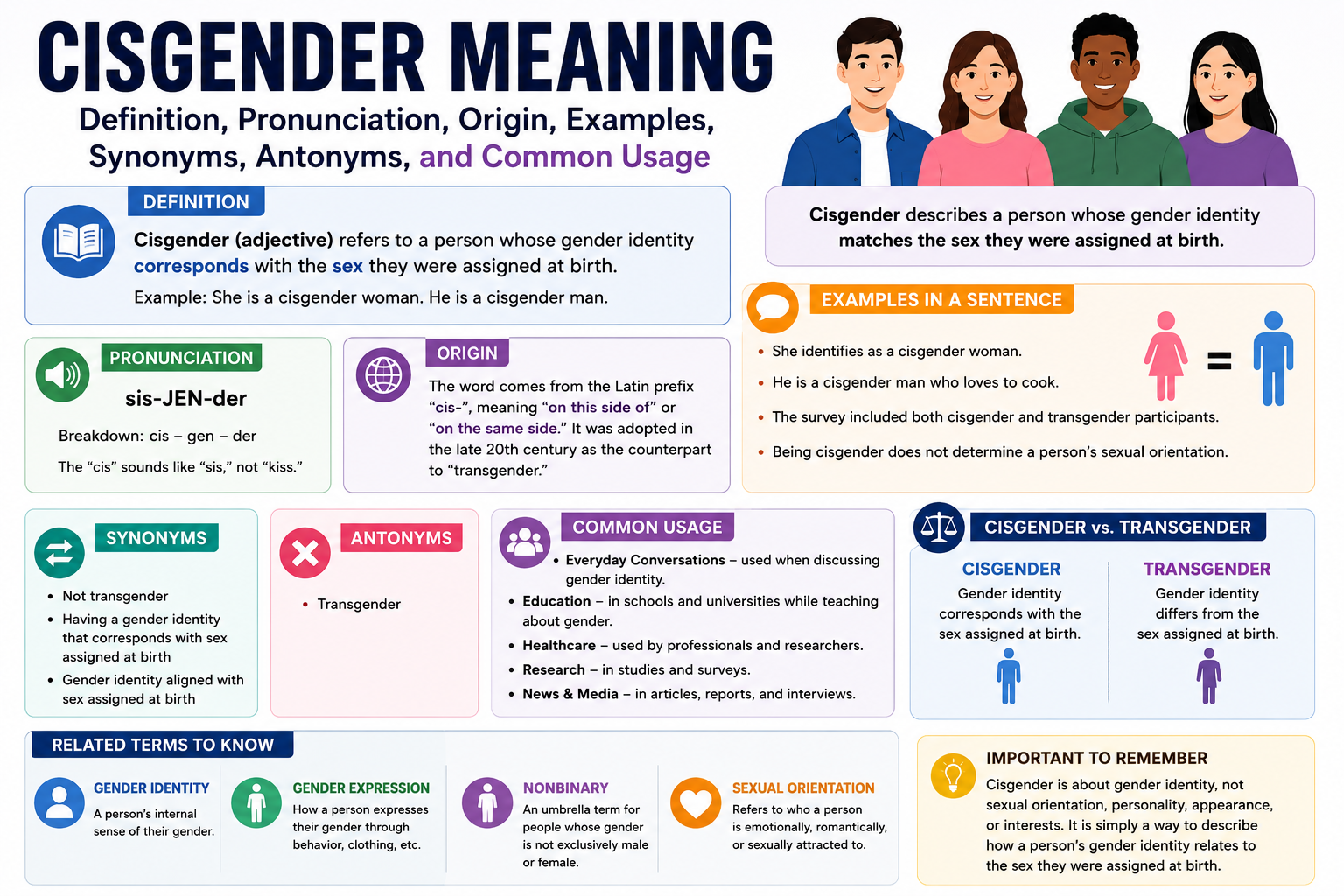
The simplest cisgender meaning is a person whose gender identity is the same as the sex they were assigned at birth.
For example, if a person was assigned female at birth and identifies as a woman, that person may be described as cisgender. Similarly, someone who was assigned male at birth and identifies as a man may be described as cisgender.
The word is mainly used as a descriptive term. It does not mean that a person behaves in a particular way or follows a specific set of interests. A cisgender person can have any personality, occupation, style, hobbies, or sexual orientation.
A Simple Definition
A straightforward definition is:
Cisgender: Describing someone whose gender identity corresponds with the sex they were assigned at birth.
It is important to understand that sex assigned at birth and gender identity are related concepts but are not exactly the same thing. Sex assigned at birth is generally recorded when a baby is born, while gender identity refers to how a person understands and identifies their own gender.
How Do You Pronounce Cisgender?
The word cisgender is generally pronounced with the first part sounding like “sis.”
The pronunciation can be broken into three simple parts: cis-gen-der.
The prefix cis- is pronounced like the word “sis,” rather than “kiss.” The word is commonly used as an adjective, as in “a cisgender woman” or “a cisgender man.”
What Does Cis Mean?
The prefix cis- comes from Latin and generally means “on this side of” or “on the same side.”
In the context of gender, the prefix is used to describe a relationship between gender identity and sex assigned at birth. It is often presented as a counterpart to trans-, another Latin-derived prefix associated with the idea of “across,” “beyond,” or “on the other side.”
This does not mean that cisgender and transgender people are opposites in terms of personality or worth. They are descriptive terms that can help explain different relationships between gender identity and sex assigned at birth.
Origin and History of the Word Cisgender
The history of cisgender is relatively modern, even though the prefix “cis-” is much older.
The Latin prefix cis- has been used for centuries to indicate something situated on the same side. It has appeared in scientific and geographical terminology long before its use in discussions about gender.
The modern gender-related use of cisgender developed during the late twentieth century. Researchers and writers began using the term as a straightforward counterpart to “transgender.” Over time, it became more common in academic writing, healthcare discussions, educational materials, journalism, and everyday conversations.
The development of the term also helped provide a more balanced vocabulary. Before “cisgender” became widely used, people sometimes used phrases such as “non-transgender” to describe people whose gender identity matched their sex assigned at birth. “Cisgender” provides a concise descriptive alternative.
Cisgender vs. Transgender
One of the easiest ways to understand cisgender meaning is to compare the term with transgender.
A cisgender person has a gender identity that corresponds with the sex they were assigned at birth. A transgender person has a gender identity that differs from the sex they were assigned at birth.
For example, consider these general examples:
| Term | Basic meaning |
| Cisgender | Gender identity corresponds with sex assigned at birth |
| Transgender | Gender identity differs from sex assigned at birth |
| Gender identity | A person’s internal understanding of their gender |
| Sex assigned at birth | The sex designation recorded when a person is born |
These definitions are useful for understanding the vocabulary, but every person’s experience of gender is individual.
Examples of Cisgender in a Sentence
Seeing the word in context can make its meaning easier to understand.
Example One
“She identifies as a cisgender woman.”
Here, the term indicates that she identifies as a woman and that this corresponds with the sex she was assigned at birth.
Example Two
“He is a cisgender man who works as a teacher.”
In this sentence, cisgender simply gives information about the person’s gender identity in relation to their sex assigned at birth.
Example Three
“The study included both cisgender and transgender participants.”
Here, the word is being used as a category in a research context.
Example Four
“Being cisgender does not determine a person’s sexual orientation.”
This example highlights an important distinction: gender identity and sexual orientation are different aspects of a person’s identity.
Cisgender and Gender Identity
Gender identity refers to a person’s internal sense of their gender. A person may identify as a man, woman, both, neither, or in another way.
Cisgender specifically describes a situation in which a person’s gender identity corresponds with the sex they were assigned at birth.
For example, a person assigned male at birth who identifies as a man may be described as cisgender. A person assigned female at birth who identifies as a woman may also be described as cisgender.
The term does not tell us everything about a person. It does not explain their personality, clothing, interests, behavior, or relationships.
Cisgender Does Not Mean Straight
A common misunderstanding is that cisgender and straight mean the same thing. They do not.
Cisgender relates to gender identity. Straight, also called heterosexual, relates to sexual orientation.
A cisgender person may be heterosexual, gay, lesbian, bisexual, or have another sexual orientation. Likewise, a transgender person can have any sexual orientation.
Keeping these concepts separate makes conversations about identity much clearer.
Gender Identity vs. Sexual Orientation
Gender identity answers a question such as:
“How does this person understand their gender?”
Sexual orientation concerns questions such as:
“Who is this person attracted to?”
These are different areas of identity, so one term should not be used as a substitute for the other.
Is Cisgender a Gender?
Cisgender is generally not a separate gender identity in itself. Instead, it is a descriptive adjective that explains the relationship between someone’s gender identity and their sex assigned at birth.
For instance, a person may be a cisgender woman. In that phrase, “woman” describes the person’s gender, while “cisgender” provides additional information about how that gender relates to their sex assigned at birth.
The same applies to expressions such as “cisgender man.”
Common Uses of Cisgender
The term appears in many different settings.
Everyday Conversations
People may use cisgender when discussing gender identity or explaining differences between gender-related terms.
Education
Schools, universities, and educational resources may use the term when teaching students about gender, identity, or social terminology.
Healthcare
Healthcare professionals and researchers may use terms such as cisgender and transgender when discussing patient populations or studying health outcomes.
Research
Researchers sometimes divide participants into groups based on gender identity. In these settings, “cisgender” can provide a precise and neutral category.
News and Media
Journalists may use the word when reporting on subjects involving gender identity, public policy, research, or social issues.
Synonyms for Cisgender
There is not always a perfect synonym for cisgender, because the word has a specific meaning.
Possible descriptive alternatives include:
- Not transgender
- Having a gender identity that corresponds with sex assigned at birth
- Gender identity aligned with sex assigned at birth
However, these alternatives are not always interchangeable. “Cisgender” is generally the shorter and more established term in contexts where precise gender-related language is appropriate.
Antonyms of Cisgender
The term most commonly contrasted with cisgender is transgender.
The two words describe different relationships between gender identity and sex assigned at birth.
It is worth noting that “antonym” here is being used in a descriptive sense. Cisgender and transgender are not opposites in the same way that “hot” and “cold” are opposites. Instead, they describe different categories within discussions of gender identity.
Related Terms You May See
Understanding a few related terms can make the cisgender meaning easier to remember.
Transgender
Transgender describes a person whose gender identity differs from the sex they were assigned at birth.
Gender Identity
Gender identity refers to someone’s internal understanding or experience of their gender.
Gender Expression
Gender expression refers to how a person may communicate or present aspects of gender through clothing, hairstyle, behavior, voice, or other forms of presentation.
Nonbinary
Nonbinary is an umbrella term often used by people whose gender identity is not exclusively male or female.
Sexual Orientation
Sexual orientation refers to patterns of romantic, emotional, or sexual attraction. It is separate from gender identity.
Why Is the Word Cisgender Used?
The word can make conversations about gender more precise.
Without the term, discussions may describe one group as “normal” and another group as a special category. Using cisgender provides a neutral descriptive term for people whose gender identity corresponds with their sex assigned at birth.
This can be particularly useful in research, healthcare, education, and discussions where different gender experiences need to be described accurately.
The term is not intended to label someone negatively. Like many descriptive terms, its usefulness depends on context and whether it is relevant to the discussion.
How to Use Cisgender Respectfully
Using identity-related language respectfully usually starts with understanding what the term actually describes.
First, use cisgender when the information is relevant. There is usually no need to mention someone’s gender identity in a conversation where it has nothing to do with the topic.
Second, avoid assuming someone’s identity based on appearance. A person’s clothing, hairstyle, voice, or physical features cannot reliably tell you how they identify.
Third, remember that people can describe themselves in different ways. If someone has shared how they identify, respecting their preferred language is generally the most considerate approach.
Common Misunderstandings About Cisgender
Several misconceptions can make the word seem more complicated than it really is.
Cisgender Does Not Mean “Normal”
Cisgender does not mean normal, better, or more common in a way that gives someone greater value. It is simply a descriptive term.
Cisgender Does Not Describe Personality
Being cisgender does not tell you whether someone is masculine, feminine, outgoing, quiet, traditional, modern, or anything else about their personality.
Cisgender Does Not Determine Sexual Orientation
A cisgender person can have many different sexual orientations. Gender identity and sexual orientation are separate concepts.
Cisgender Does Not Mean Someone Has Never Questioned Their Gender
People may think about or explore their gender identity at different points in life. The term describes a person’s identity, not every thought or question they may have had.
Frequently Asked Questions About Cisgender Meaning
What does cisgender mean in simple terms?
Cisgender means that a person’s gender identity corresponds with the sex they were assigned at birth. For example, someone assigned female at birth who identifies as a woman may be described as cisgender.
What is the opposite of cisgender?
The term most commonly contrasted with cisgender is transgender. Transgender describes people whose gender identity differs from the sex they were assigned at birth.
Is cisgender the same as heterosexual?
No. Cisgender describes gender identity, while heterosexual describes sexual orientation. A cisgender person can have any sexual orientation.
How do you pronounce cisgender?
Cisgender is commonly pronounced “sis-JEN-der.” The first part sounds like “sis.”
Where does the word cisgender come from?
The word combines the Latin-derived prefix cis-, meaning “on this side” or “on the same side,” with “gender.” Its modern gender-related use developed in the late twentieth century.
Is cisgender a negative word?
No. Cisgender is generally used as a neutral descriptive term. Whether any identity-related word feels appropriate can depend on context and personal preference.
Can a woman be cisgender?
Yes. A woman may be described as cisgender if she identifies as a woman and that corresponds with the sex she was assigned at birth.
Can a man be cisgender?
Yes. A man may be described as cisgender if he identifies as a man and that corresponds with the sex he was assigned at birth.
Does cisgender describe someone’s sexuality?
No. It describes gender identity in relation to sex assigned at birth. Sexual orientation is a separate concept.
Why Understanding Cisgender Meaning Matters
Learning the meaning of terms such as cisgender can make conversations more accurate and respectful. Gender-related vocabulary is used in many areas, including education, healthcare, research, journalism, and everyday communication.
Knowing the definition also helps prevent common misunderstandings. In particular, it is useful to remember that gender identity, gender expression, sex assigned at birth, and sexual orientation are related concepts but are not interchangeable.
A clear understanding of these terms allows people to read articles, research papers, and discussions with greater confidence. It also makes it easier to communicate without relying on assumptions about other people’s identities.
Conclusion
The cisgender meaning is straightforward: cisgender describes a person whose gender identity corresponds with the sex they were assigned at birth.
The word comes from the Latin-derived prefix “cis-,” meaning “on this side” or “on the same side,” and became established as a modern gender-related term in the late twentieth century. It is commonly used alongside transgender and appears in education, research, healthcare, media, and everyday discussions.
Most importantly, cisgender is a term about gender identity, not sexual orientation, personality, appearance, or personal interests. Understanding this distinction makes the word easier to use correctly and helps create clearer conversations about gender and identity.