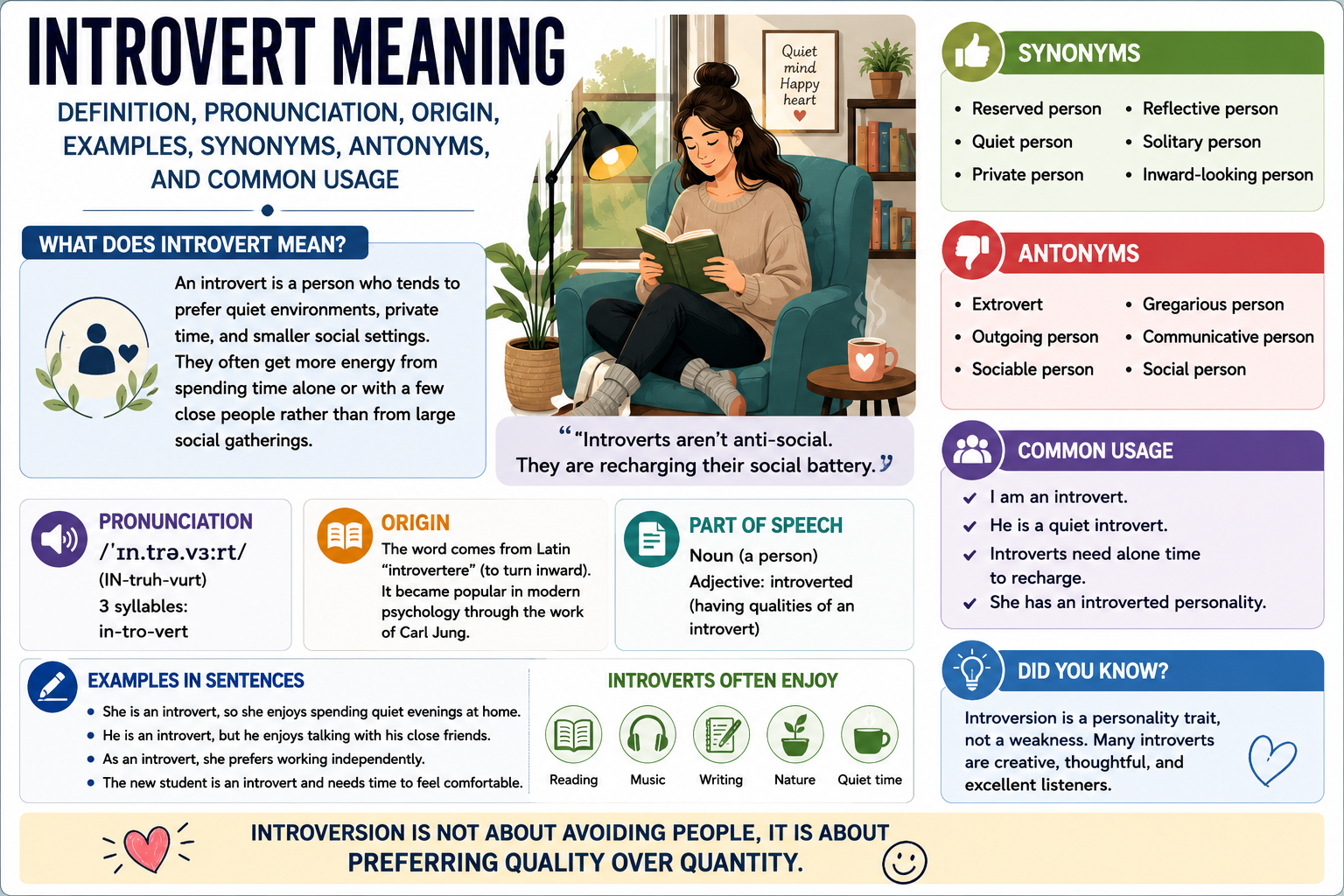
Introvert Meaning: The word introvert is commonly used to describe a person who tends to feel comfortable with quiet surroundings, private time, and smaller social settings. An introvert may enjoy spending time alone or with a few close people rather than constantly being around large groups. However, being an introvert does not mean that someone is shy, unfriendly, antisocial, or unable to communicate.
In simple English, the introvert meaning is a person who often gets more enjoyment or energy from their inner thoughts and quieter activities than from constant social interaction. Introversion is a personality tendency, and people can express it in many different ways.
An introvert may enjoy reading, studying, writing, listening to music, working independently, taking a peaceful walk, or having a thoughtful conversation with a close friend. At the same time, an introvert can also enjoy parties, public speaking, teamwork, and meeting new people. The important point is that introversion is not a strict set of behaviors.
This guide explains the introvert meaning, pronunciation, origin, examples, synonyms, antonyms, common phrases, differences between introverts and extroverts, and frequently asked questions in simple English.
What Does Introvert Mean?
An introvert is generally a person whose personality tends to involve a preference for quieter environments, reflection, and limited or more meaningful social interaction.
The easiest way to understand the term is:
An introvert is a person who often prefers quiet time, personal space, and smaller social interactions.
For some introverts, spending time alone can be relaxing and refreshing. Large social gatherings may feel tiring, especially when they happen frequently. After socializing, an introvert may want some quiet time to relax or think.
However, this does not mean every introvert behaves the same way. Personality exists on a broad spectrum. Some people strongly prefer solitude, while others enjoy a mixture of social activities and alone time.
The word is often used casually, but its meaning is more nuanced than simply saying that someone “doesn’t like people.”
Introvert Meaning in Simple English
In very simple English, introvert means a person who usually feels more comfortable with quiet activities and limited social interaction.
Imagine two people finishing a busy week. One person wants to attend a large party and spend the evening talking with many people. Another person would rather stay home, read a book, watch a movie, work on a hobby, or talk with one close friend.
The second person may have more introverted tendencies.
This does not mean the second person dislikes everyone. They may have strong friendships and enjoy conversations. They may simply prefer social experiences that feel calmer, more personal, or less overwhelming.
A useful way to remember the term is:
Introvert = someone who often prefers inward reflection and quieter social settings.
How Do You Pronounce Introvert?
The word introvert is pronounced differently depending slightly on regional English pronunciation, but a common pronunciation is:
IN-truh-vurt
The stress is usually placed on the first syllable.
The word can be used as both a noun and, less commonly, a verb. In everyday English, the noun is much more common.
For example:
- “She is an introvert.”
- “He considers himself an introvert.”
- “I am more introverted than extroverted.”
The related adjective is introverted.
Origin of the Word Introvert
The word introvert has roots in Latin. It comes from Latin elements connected with turning inward. The word entered English through scientific and psychological usage and later became widely used in discussions of personality.
The related term introversion was developed to describe a tendency toward inward attention or reflection. Swiss psychiatrist Carl Jung played an important role in popularizing the concepts of introversion and extraversion in psychology during the twentieth century.
Jung’s work helped establish introversion and extraversion as important personality concepts. However, the modern everyday use of “introvert” is broader and more casual than the technical ideas found in psychological theories.
Today, people commonly use the word to describe someone who prefers quiet environments, independent activities, or smaller social groups.
What Is an Introvert Like?
There is no single personality type that describes every introvert. Still, many introverted people may share certain preferences.
An introvert may enjoy:
- Quiet environments
- Spending time alone
- One-on-one conversations
- Small groups
- Independent work
- Reading and writing
- Creative hobbies
- Thinking before speaking
- Meaningful conversations
- Having personal space
These are tendencies rather than strict rules.
For example, an introvert can be confident, funny, ambitious, friendly, and socially skilled. Someone may enjoy giving presentations at work and still prefer a quiet evening afterward.
This is why it is better to think of introversion as a personality preference rather than a limitation.
Examples of Introvert in Sentences
Understanding the word becomes easier when you see it in everyday sentences.
Example One
“My brother is an introvert, so he enjoys spending quiet evenings at home.”
Here, introvert describes someone who prefers quieter surroundings.
Example Two
“She is an introvert, but she enjoys talking with her close friends.”
This example shows that being an introvert does not mean avoiding all social interaction.
Example Three
“As an introvert, he prefers working independently when possible.”
The sentence suggests that the person is comfortable with independent work.
Example Four
“The new student seemed like an introvert at first, but she became comfortable after making friends.”
This demonstrates that an introvert can build relationships and become socially comfortable.
Example Five
“Being an introvert does not prevent someone from becoming a successful leader.”
This highlights an important point: introversion is not the same as a lack of confidence or ability.
Introvert vs. Shy
One of the most common misunderstandings is that introvert and shy mean the same thing. They do not.
Introversion describes a personality tendency or preference. Shyness is more closely associated with discomfort, nervousness, or self-consciousness in social situations.
An introvert may confidently speak to a large audience and then prefer to spend some quiet time afterward.
A shy person may want to meet new people but feel nervous about starting a conversation.
A person can be:
- Introverted and confident
- Introverted and shy
- Extroverted and shy
- Extroverted and confident
These characteristics can overlap, but they are not identical.
Introvert vs. Extrovert
The word extrovert is often presented as the opposite of introvert.
An extrovert generally tends to enjoy social interaction and may find social environments stimulating or energizing. An introvert may be more comfortable with quiet environments and may need more personal time after extensive social activity.
However, the difference is not simply:
Introvert = likes people less
and
Extrovert = likes people more
That is an oversimplification.
Both introverts and extroverts can enjoy friendships, conversations, parties, teamwork, and time alone. The difference is often related to preferences, stimulation, and how a person naturally manages social energy.
Introvert vs. Ambivert
You may also hear the word ambivert.
An ambivert is generally described as someone who shows a mixture of introverted and extroverted tendencies. They may enjoy social events in some situations but strongly appreciate alone time in others.
Many people identify with characteristics from both sides.
For example, someone might enjoy spending an evening with friends on Friday but prefer a quiet weekend morning alone. They may be outgoing at work but private in their personal life.
This shows why personality should not always be divided into two rigid categories.
Synonyms of Introvert
There is no perfect synonym for introvert, because each related word can carry a slightly different meaning.
Some words that may be associated with introversion include:
- Reserved person
- Private person
- Quiet person
- Solitary person
- Reflective person
- Contemplative person
- Retiring person
- Inward-looking person
However, these terms should not always be substituted directly.
For example, reserved can describe someone who does not openly express feelings, while introvert refers more specifically to a personality tendency involving inward focus and social preferences.
Likewise, solitary can suggest spending time alone, but it does not necessarily describe someone’s personality.
Antonyms of Introvert
The most common contrasting term is:
Extrovert
Other related contrasts can include:
- Outgoing person
- Sociable person
- Social person
- Gregarious person
- Communicative person
Again, these are not exact opposites in every situation.
Someone can be quiet but still extroverted, or introverted but highly sociable in certain situations. Personality is more complicated than a single label.
Common Usage of Introvert
The word introvert is frequently used in everyday conversations.
People often say:
“I am an introvert.”
This means they identify with introverted personality tendencies.
Another common expression is:
“She is a quiet introvert.”
This emphasizes the person’s preference for calm environments.
You may also hear:
“He is an introvert at heart.”
This usually means that although someone may appear social or outgoing, they personally prefer quieter experiences.
Another common phrase is:
“Introverts need alone time.”
This reflects the idea that some introverted people find solitude relaxing or refreshing.
The adjective introverted is also widely used:
“She has an introverted personality.”
This means she tends to display characteristics associated with introversion.
Introvert in School
Introverted students may have different ways of participating in school.
Some may prefer writing answers before speaking, working independently, or discussing ideas with one or two classmates. Others may be comfortable participating in class but still prefer quiet study time afterward.
An introverted student should not automatically be considered uninterested or unfriendly simply because they are quiet.
A quiet student may be carefully listening, thinking about an answer, or processing information before speaking.
Teachers and classmates can support different personality styles by creating opportunities for both individual work and group participation.
Introvert in the Workplace
Being an introvert does not prevent someone from having a successful career.
Introverted employees may appreciate opportunities to concentrate, solve problems independently, prepare before meetings, or work in quieter environments. Some may also be excellent listeners and thoughtful communicators.
An introverted person can become a manager, business owner, teacher, researcher, writer, engineer, artist, public speaker, or professional in almost any field.
Career success depends on many factors, including skills, experience, knowledge, communication, persistence, and opportunity. Personality type alone does not determine professional ability.
Introverts and Social Situations
An introvert may enjoy social situations but prefer them in moderation.
For example, an introvert might enjoy dinner with a few close friends more than a crowded event with dozens of unfamiliar people. Another introvert might enjoy a large event but need quiet time afterward.
The important idea is that introversion does not equal social avoidance.
An introvert can maintain close friendships, meet new people, attend events, and communicate effectively. They may simply have different preferences regarding the amount and type of social interaction they enjoy.
Introverts and Alone Time
Alone time is often associated with introversion because some introverted people find solitude relaxing.
Quiet time can provide an opportunity to read, think, write, listen to music, pursue hobbies, or simply rest.
However, not every person who enjoys being alone is an introvert. Extroverted people can also value personal time.
Similarly, an introvert does not necessarily want to be alone all the time. Healthy social relationships can be important to people of every personality style.
Is Being an Introvert Bad?
No. Being an introvert is not inherently good or bad.
Introversion is a normal personality tendency. It can come with strengths such as careful thinking, focused attention, listening, reflection, and comfort with independent work.
At the same time, introverts may sometimes find highly social environments tiring. That does not mean there is something wrong with them.
Personality differences are a normal part of human behavior. The goal is not to force everyone to behave in exactly the same way but to understand individual preferences and communicate effectively.
Strengths Often Associated With Introverts
Different people have different strengths, but introversion is sometimes associated with qualities such as:
Thoughtful Communication
Some introverted people prefer to think before speaking. This can lead to careful and considered communication.
Strong Listening
An introvert may enjoy listening closely during conversations rather than constantly trying to lead them.
Independent Work
Many introverts are comfortable spending time working independently on tasks that require concentration.
Deep Focus
Quiet environments may help some introverted people concentrate for long periods.
Meaningful Relationships
Some introverts prefer maintaining a smaller number of close relationships rather than having a very large social circle.
These are possibilities, not guarantees. Every individual is different.
Common Misconceptions About Introverts
Several myths surround the word introvert.
Introverts Hate People
This is false. Introverts can enjoy friendships and social relationships. They may simply prefer different levels or types of interaction.
Introverts Are Always Shy
Not necessarily. Introversion and shyness are different concepts.
Introverts Cannot Be Leaders
This is also false. Leadership involves many skills, and introverted people can become effective leaders.
Introverts Never Like Parties
Some introverts enjoy parties and social events. They may simply prefer smaller gatherings or need quiet time afterward.
Introverts Are Unfriendly
Quiet behavior should not automatically be interpreted as unfriendliness. Someone may simply have a quieter communication style.
Frequently Asked Questions About Introvert Meaning
What does introvert mean in simple words?
Introvert means a person who tends to prefer quiet environments, personal time, and smaller or more meaningful social interactions.
What is the opposite of introvert?
The most common contrasting term is extrovert. An extrovert generally tends to enjoy social interaction and may find social environments stimulating.
Is an introvert a shy person?
Not necessarily. Introversion is a personality tendency, while shyness usually involves social nervousness or self-consciousness. A person can be introverted and confident.
What is an example of an introvert?
A person who enjoys spending a quiet evening reading, working on a hobby, or talking with one close friend may have introverted tendencies.
Can introverts be social?
Yes. Introverts can enjoy parties, friendships, teamwork, public speaking, and other social activities. They may simply prefer quieter or smaller social experiences.
What is the synonym of introvert?
There is no exact synonym, but related terms include reserved person, quiet person, private person, reflective person, and retiring person.
What is the antonym of introvert?
The most common opposite is extrovert. Other related contrasting terms include outgoing, sociable, and gregarious.
Is introvert a noun or adjective?
Introvert is primarily a noun when referring to a person. The related adjective is introverted.
For example:
- “He is an introvert.”
- “He has an introverted personality.”
What does introverted mean?
Introverted describes someone who tends to have characteristics associated with introversion, such as enjoying quiet environments, personal reflection, or limited social stimulation.
Can an introvert become an extrovert?
People can develop different social habits and become more comfortable with social situations, but personality tendencies can remain relatively consistent. It is usually more useful to understand your own preferences than to worry about changing your personality label.
What does introvert mean in a relationship?
In a relationship, an introvert may prefer private conversations, quiet activities, and personal space. However, there is no single way that introverts behave in relationships.
Do introverts need alone time?
Some introverted people find alone time particularly relaxing, especially after extensive social interaction. However, everyone has different needs, and not every introvert requires the same amount of solitude.
Conclusion
The introvert meaning is simple but often misunderstood. An introvert is generally a person who tends to prefer quiet environments, personal reflection, independent activities, or smaller social interactions. Introversion does not automatically mean shyness, loneliness, poor communication, or dislike of other people.
The word has roots connected to the idea of turning inward, and it became especially important in modern discussions of personality and psychology. Today, it is commonly used in everyday English to describe personality preferences.
An introvert can be confident, successful, friendly, ambitious, creative, and socially skilled. Some introverts enjoy large gatherings, public speaking, and teamwork, while others strongly prefer peaceful environments and close relationships.
The most important thing to remember is that introversion is a personality tendency, not a limitation. People differ in how they communicate, socialize, recharge, and respond to their surroundings. Understanding the meaning of introvert can help us describe those differences more accurately and avoid unfair assumptions about quiet people.