Understanding the condescending meaning can help you recognize a particular kind of rude or disrespectful communication. We often use this word when someone speaks to another person as though they are less intelligent, less experienced, or less important.
In everyday English, condescending usually describes a person’s tone, attitude, words, or behavior when they act as if they are superior to others. Cambridge Dictionary defines it as treating someone as though you are more important or intelligent than they are.
This guide explains the condescending meaning in simple English, along with its pronunciation, origin, examples, synonyms, antonyms, common expressions, and answers to frequently asked questions.
What Does Condescending Mean?
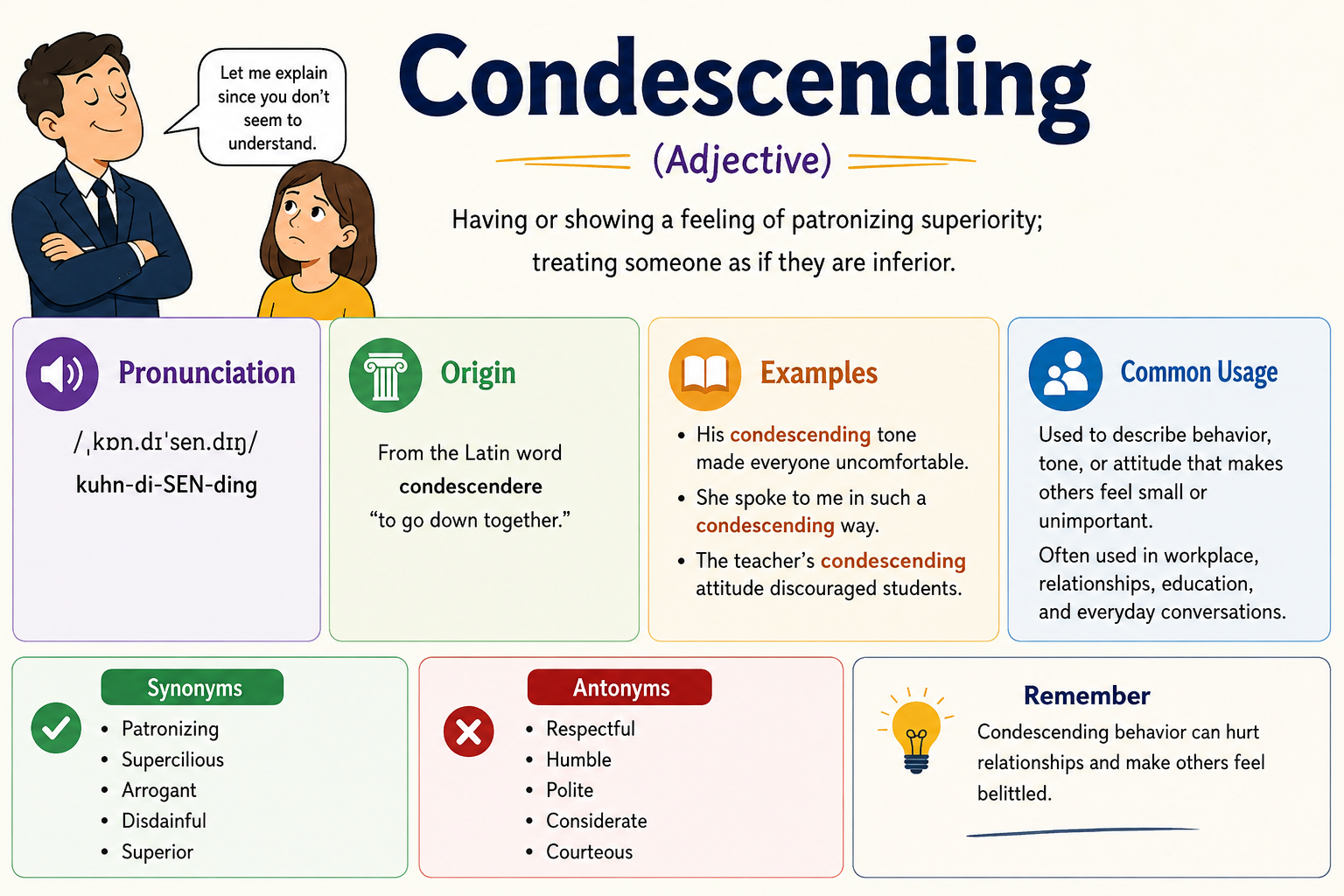
The simplest condescending meaning is acting as though you are better, smarter, or more important than someone else.
condescending (kon-duh-SEN-ding)
For example, imagine that someone asks a simple question because they do not understand something. Instead of answering normally, another person rolls their eyes and says, “You really don’t know that?” That response may be described as condescending.
The word is generally negative in modern English. Merriam-Webster defines it as showing or expressing a patronizing or superior attitude toward other people.
A useful way to remember it is:
Condescending = talking down to someone.
It does not necessarily mean that a person openly insults someone. Sometimes the behavior is subtle. A person may use an overly simple explanation, an exaggeratedly patient voice, or a sarcastic comment that makes another person feel small.
Condescending Meaning in Simple English
In very simple English, condescending means treating someone as if they are not as smart, capable, or important as you are.
Consider these two responses to a question:
Respectful:
“Sure, I can explain that. Which part is confusing?”
Condescending:
“Seriously? You don’t understand that yet?”
Both responses address the same situation, but the second one suggests superiority.
Condescending behavior can appear in conversations between friends, classmates, coworkers, family members, teachers, managers, or strangers. It can also appear in writing, social media comments, advertisements, interviews, and public discussions.
The important point is that condescension is about attitude as well as words. A sentence may appear harmless when written down but sound condescending because of the speaker’s tone or manner.
Pronunciation of Condescending
The pronunciation of condescending differs slightly between American and British English.
American English: approximately kon-duh-SEN-ding
British English: approximately kon-di-SEN-ding
The stress usually falls on the “sen” part of the word.
The related noun condescension is pronounced approximately kon-duh-SEN-shun in American English and kon-di-SEN-shun in British English.
The verb condescend is pronounced approximately kon-duh-SEND.
Origin and History of Condescending
The history of condescending is interesting because the word did not always have the strongly negative meaning it has today.
The verb condescend comes from Middle English and traces back through Anglo-French to Late Latin condescendere. The Latin elements are associated with the idea of coming or going down. Merriam-Webster traces the word to Latin com- and descendere, meaning “to descend.”
The original idea was therefore connected with lowering oneself or coming down from a higher position.
Historically, this could have a positive meaning. A person of high rank might “condescend” to communicate with someone considered lower in social position. Over time, however, the word developed a more negative sense: instead of simply lowering oneself, it came to suggest that the person was making a show of superiority while doing so.
Etymological research notes that the negative modern sense developed from the idea of someone merely appearing to lower themselves toward others.
Today, condescending almost always carries a negative meaning when it describes someone’s attitude toward another person.
How Is Condescending Used in a Sentence?
The adjective condescending can describe a person’s attitude, voice, words, behavior, expression, or manner.
Here are some natural examples:
- “His condescending tone made the conversation uncomfortable.”
- “She gave me a condescending smile when I asked for help.”
- “The manager’s condescending attitude frustrated the team.”
- “I don’t appreciate your condescending comments.”
- “He sounded condescending when he explained the basic rules.”
- “Her response was polite, but there was something condescending about it.”
- “The speaker avoided using a condescending tone with beginners.”
Notice that condescending often appears before words such as tone, attitude, manner, remark, comment, behavior, and voice. Oxford lists combinations such as “condescending attitude,” “condescending manner,” and “condescending tone” as common usage.
Examples of Condescending Behavior
Understanding examples can make the condescending meaning much easier to recognize.
Speaking to Someone Like a Child
One common form of condescension is using an unnecessarily childish tone with someone who clearly understands the subject.
For example:
“Okay, let’s use very simple words so you can understand.”
If the person is already capable of understanding the topic, this statement can sound insulting rather than helpful.
Making Someone Feel Stupid for Asking a Question
Questions are a normal part of learning. A condescending response may make the person regret asking.
For example:
“You don’t know that? I thought everyone knew it.”
The speaker may know the answer, but the way they respond communicates superiority.
Overexplaining Something Obvious
Explaining a difficult idea clearly is helpful. However, explaining an extremely simple idea to someone who already understands it can sometimes feel condescending.
For instance:
“A calendar is something that shows the days and months.”
If you are explaining this to an adult who obviously knows what a calendar is, the statement may sound patronizing.
Using Sarcasm
Sarcasm can sometimes make a comment sound condescending.
For example:
“Wow, you finally figured it out.”
Depending on the situation and tone, the speaker may be suggesting that the other person is slow or incapable.
Acting Surprised by Someone’s Ability
Another example is reacting with surprise when someone performs a task successfully.
For example:
“Oh, you actually did it correctly.”
The speaker may intend to praise the person, but the wording implies that they expected failure.
Condescending vs. Condescension vs. Condescend
These three related words are easy to confuse.
Condescending
Condescending is an adjective.
It describes someone or something that shows superiority toward another person.
Example:
“His condescending tone annoyed everyone.”
Condescension
Condescension is a noun.
It refers to the behavior or attitude itself.
Example:
“She could hear the condescension in his voice.”
Dictionary.com describes condescension as behavior that is patronizing or condescending.
Condescend
Condescend is a verb.
In its common modern sense, it means to behave as though you are superior to another person.
Example:
“Please don’t condescend to me.”
Merriam-Webster also records another sense of condescend: to lower oneself to a less formal or dignified level or to do something considered beneath one’s dignity.
Condescending vs. Patronizing
Condescending and patronizing are very close in meaning, and they are often used interchangeably.
Both can describe behavior in which someone acts superior toward another person. However, patronizing has additional meanings. For example, patronize can mean supporting a business by being its customer, or supporting an artist or organization.
The negative sense of patronizing specifically involves treating someone in a way that suggests superiority.
Merriam-Webster notes that the two words overlap but can have slightly different shades of meaning.
A simple distinction is:
- Condescending: acting as though you are superior.
- Patronizing: treating someone as though they need your superior guidance, approval, or help.
In everyday conversation, however, either word may be appropriate when describing someone who talks down to others.
Synonyms of Condescending
Several English words are related to the condescending meaning.
Patronizing
This is probably the closest common synonym. It describes behavior that treats another person as inferior.
Arrogant
An arrogant person has an exaggerated sense of their own importance or abilities.
Haughty
Haughty describes someone who behaves as though they are better than other people.
Superior
This can describe an attitude in which someone considers themselves better or more capable than others.
Pompous
A pompous person may behave or speak in an overly important and self-important way.
Snobbish
Snobbish describes someone who places too much importance on social position, wealth, education, taste, or status.
Disdainful
Disdainful describes an attitude showing that someone considers another person or thing unworthy of respect.
Cambridge lists related words such as arrogant, haughty, imperious, overbearing, patronizing, pompous, self-important, and sneering.
Antonyms of Condescending
The opposite of being condescending is treating people with respect and equality.
Useful antonyms include:
- Respectful
- Humble
- Polite
- Considerate
- Friendly
- Courteous
- Patient
- Modest
- Understanding
- Approachable
- Egalitarian
For example:
Condescending:
“You obviously don’t understand this.”
Respectful:
“Let me explain it another way.”
The second response recognizes that someone may need information without making them feel inferior.
Common Phrases With Condescending
The word appears frequently with certain nouns.
Condescending Tone
A condescending tone is a way of speaking that makes the listener feel talked down to.
Example:
“Her condescending tone made the discussion difficult.”
Condescending Attitude
A condescending attitude describes a general belief or manner that suggests superiority.
Example:
“His condescending attitude affected the entire conversation.”
Condescending Remark
A condescending remark is a comment that suggests another person is less intelligent, capable, or important.
Example:
“That was an unnecessary and condescending remark.”
Condescending Behavior
This refers to actions as well as speech.
Example:
“The employee complained about the supervisor’s condescending behavior.”
Condescending Manner
This describes someone’s overall way of interacting with others.
Example:
“He spoke in a condescending manner throughout the meeting.”
Is Condescending Always Negative?
In modern everyday English, condescending is normally negative.
If you describe someone as condescending, you are usually saying that they are behaving in an arrogant or patronizing way.
Historically, however, condescend and related words could carry more positive or neutral meanings. The word could refer to a person of higher status willingly lowering themselves to interact with someone else. The modern negative meaning developed over time.
So, when reading older literature, you may encounter condescension in a context where it does not mean simple rudeness.
For modern conversations, though, it is safest to understand condescending as a criticism of someone’s attitude.
What Is a Condescending Person Like?
A condescending person may behave as though their knowledge, experience, status, or abilities make them more valuable than others.
They may interrupt people, dismiss questions, use an exaggeratedly patient voice, make sarcastic comments, or explain basic information unnecessarily. Sometimes the behavior is obvious, while at other times it is subtle.
Importantly, being knowledgeable does not automatically make someone condescending.
A person can know much more about a subject and still communicate respectfully. The problem arises when that knowledge is used to make another person feel inferior.
For example, a skilled teacher can explain a difficult topic to a beginner without being condescending. A good explanation respects the learner instead of making fun of what they do not know.
Why Does Condescending Behavior Feel Rude?
Condescending communication can feel particularly unpleasant because it attacks more than the subject of a conversation. It can make someone feel that their intelligence, judgment, or ability is being questioned.
Imagine asking someone for help and receiving an answer that makes you feel embarrassed for asking. Even if the information is correct, the attitude can damage the conversation.
Respectful communication focuses on solving the problem. Condescending communication often adds an unnecessary message: “I am better than you.”
That is why a simple sentence can become offensive when it is delivered with the wrong attitude.
How to Avoid Sounding Condescending
If you want to communicate clearly without sounding condescending, focus on respect.
First, avoid assuming that another person is unintelligent simply because they do not know something. Everyone has different experiences and areas of knowledge.
Second, ask questions before giving a long explanation. Instead of saying, “Let me explain this in very simple terms,” try asking, “Which part would you like me to explain?”
Finally, pay attention to your tone. Words are only one part of communication. Facial expressions, pauses, volume, and body language can completely change how a sentence is received.
A respectful explanation does not require you to hide your knowledge. It simply means sharing that knowledge without making someone else feel inferior.
Frequently Asked Questions About Condescending Meaning
What is the simple meaning of condescending?
Condescending means acting as though you are better, smarter, or more important than another person. It often involves speaking to someone in a patronizing or disrespectful way.
Is condescending an insult?
The word itself is not an insult, but describing someone’s behavior as condescending is usually criticism. It suggests that the person’s attitude makes others feel inferior.
What is an example of a condescending sentence?
A sentence such as “Don’t worry, I’ll explain it in words you can understand” can be condescending if the speaker is implying that the other person is not intelligent enough to understand normal language.
What is the difference between rude and condescending?
Rude is a broad term for behavior that lacks politeness or respect. Condescending is more specific: it involves treating someone as though they are inferior or less capable.
Is patronizing the same as condescending?
They are very similar and often interchangeable when describing someone’s attitude. Both can describe behavior that makes another person feel inferior. However, patronizing also has neutral meanings unrelated to this negative sense.
What is the noun form of condescending?
The noun is condescension.
For example:
“His condescension was obvious during the discussion.”
What is the verb form of condescending?
The verb is condescend.
For example:
“Please don’t condescend to people who are learning.”
Can a teacher be condescending?
Yes. A teacher can be knowledgeable and helpful without being condescending. If a teacher regularly makes students feel stupid for asking questions, that behavior may be described as condescending.
Is condescending the same as arrogant?
Not exactly. Arrogant describes an exaggerated sense of one’s own importance or abilities. Condescending specifically focuses on how someone treats people they consider less knowledgeable, capable, or important.
Final Thoughts on Condescending Meaning
The condescending meaning is simple once you understand the central idea: treating someone as though you are superior to them. It can appear in a person’s words, tone, facial expressions, attitude, or behavior.
The word is usually negative in modern English and is closely connected with terms such as patronizing, arrogant, haughty, pompous, and disdainful. Common expressions include “condescending tone,” “condescending attitude,” and “condescending remark.”
Its history is especially interesting because the word originally carried the idea of voluntarily lowering oneself or coming down from a higher position. Over centuries, that idea developed into its modern sense of displaying superiority toward others.
In everyday communication, the best way to understand condescending is to think of the phrase “talking down to someone.” If a person communicates in a way that makes another person feel unintelligent, unimportant, or inferior, their behavior may be described as condescending.