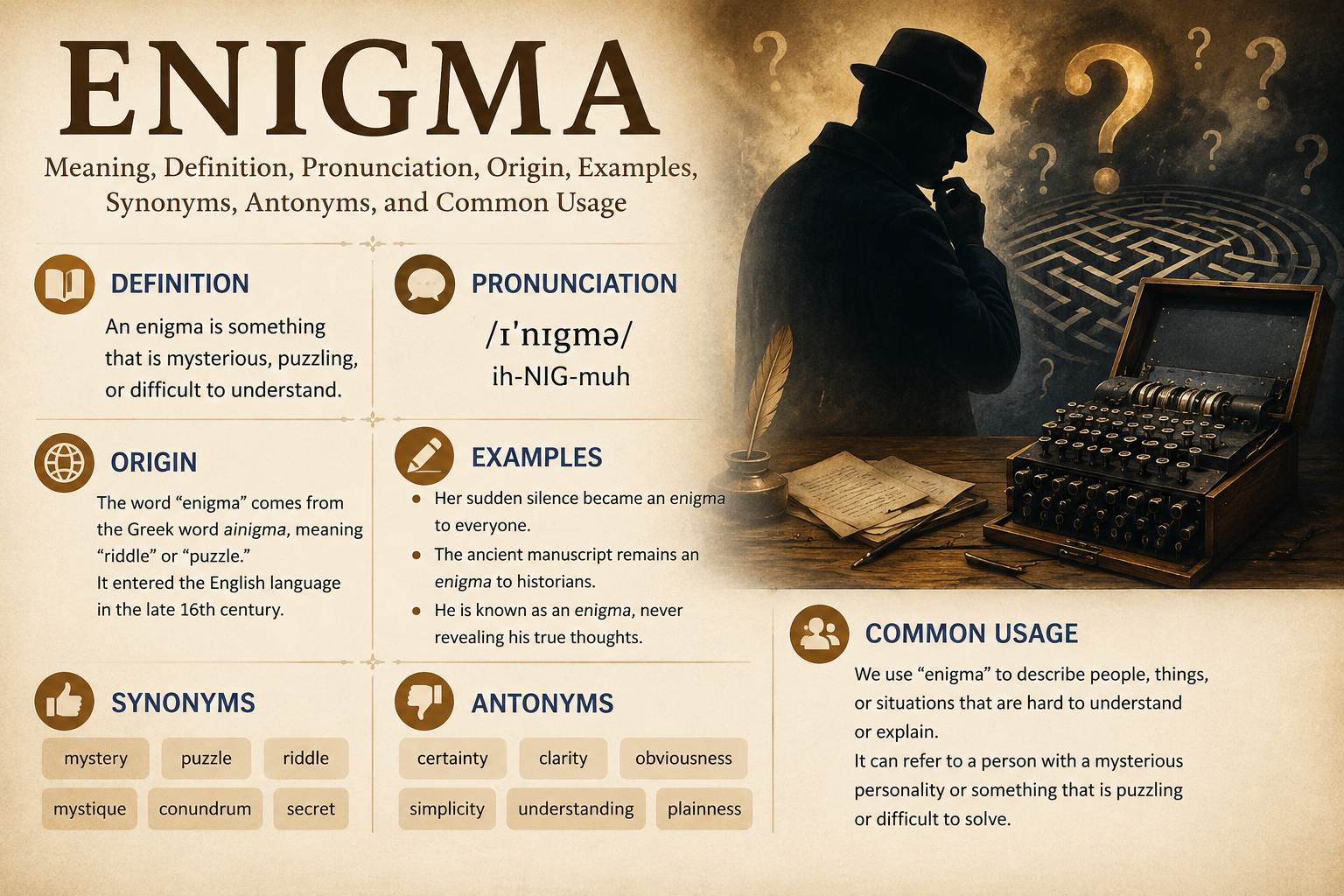
The word enigma describes something that is difficult to understand, explain, or solve. When people call a person, event, statement, or situation an enigma, they usually mean that it seems mysterious or puzzling because the answer is not clear.
You may hear someone say, “She is an enigma,” or “The disappearance remains an enigma.” In both cases, the word suggests that something is not easy to figure out.
Understanding the enigma meaning is useful because the word appears in books, newspapers, films, academic writing, everyday conversations, and discussions about mysteries. It can describe anything from a difficult puzzle to a person whose thoughts and behavior are hard to understand.
This guide explains enigma meaning in simple English, along with its pronunciation, origin, examples, synonyms, antonyms, common uses, and frequently asked questions.
Enigma Meaning in Simple English
The simplest enigma meaning is:
An enigma is a person, thing, or situation that is mysterious, confusing, or difficult to understand.
If something has an obvious explanation, it is not usually called an enigma. An enigma is different because there is something hidden, unclear, unusual, or puzzling about it.
For example:
- “The strange message was an enigma.”
- “His personality is an enigma to his classmates.”
- “The scientist tried to solve the enigma.”
- “The old building remains an enigma.”
In each sentence, enigma refers to something that people cannot easily understand.
The word can have a slightly different feeling depending on the situation. Sometimes it refers to a literal puzzle. At other times, it describes a mystery or something that remains unexplained.
Enigma Definition
According to its standard English usage, an enigma is something that is difficult to interpret, understand, or explain.
A useful dictionary-style definition is:
Enigma: A mysterious, puzzling, or difficult-to-understand person, thing, or situation.
The word can be used for both physical and abstract things. A complicated scientific question may be an enigma. A person’s unusual behavior may also be an enigma.
What makes something an enigma?
Something is often called an enigma when:
- Its meaning is unclear.
- There is not enough information to explain it.
- Its behavior seems unusual.
- It creates questions without easy answers.
- People disagree about what it means.
- Attempts to understand it have not produced a clear solution.
The word therefore combines the ideas of mystery, uncertainty, and difficulty.
How to Pronounce Enigma
The word enigma is pronounced:
uh-NIG-muh
It has three syllables:
e-nig-ma
The stress usually falls on the middle syllable.
enigma (uh-NIG-muh)
The pronunciation is relatively simple once you remember that the middle part sounds like “nig.”
Enigma pronunciation in a sentence
You could say:
“The scientist described the problem as an enigma.”
Here, the word sounds like uh-NIG-muh.
Origin and Etymology of Enigma
The word enigma comes from Ancient Greek. It is related to the Greek word ainigma, meaning something like a riddle or obscure saying.
The term entered English through Latin and later French before becoming established in English. Its historical connection with the idea of a riddle helps explain its modern meaning.
The original idea was associated with something expressed in an indirect or puzzling way. Instead of giving a straightforward statement, a riddle makes the listener think carefully to discover the intended meaning.
Over time, enigma developed a broader meaning. It no longer refers only to a verbal riddle. It can now describe almost anything mysterious or difficult to understand.
This history also explains why the word often sounds more sophisticated or literary than simple words such as mystery or puzzle.
Enigma as a Noun
Enigma is a noun.
A noun is a word used to name a person, place, thing, or idea. In this case, enigma names a mysterious or puzzling thing, situation, or person.
For example:
- “The case is an enigma.”
- “She remains an enigma.”
- “The ancient structure is an enigma.”
- “The question became an enigma for researchers.”
You can use enigma after verbs such as is, remains, became, and seems.
It can also be used with descriptive words:
- A complete enigma
- A mysterious enigma
- A fascinating enigma
- A complex enigma
- A historical enigma
- A scientific enigma
What Does It Mean to Call Someone an Enigma?
Calling a person an enigma means that the person’s thoughts, personality, motives, or behavior are difficult to understand.
For example:
“My new teacher is an enigma.”
This does not necessarily mean the teacher is doing anything wrong. It could simply mean that the teacher is difficult to read.
Another example is:
“The actor has always been an enigma to the public.”
This might suggest that the actor keeps their private life away from the public or behaves in ways that people find difficult to interpret.
The expression can therefore be positive, negative, or neutral depending on context.
Is calling someone an enigma an insult?
Not necessarily.
Sometimes it suggests that someone is mysterious in an interesting or attractive way. In other cases, it can indicate frustration because their behavior is difficult to understand.
The surrounding sentence usually tells you what the speaker means.
Enigma vs. Mystery
Enigma and mystery are close in meaning, but they are not always interchangeable.
A mystery is something unknown or unexplained.
An enigma is usually something especially puzzling, complex, or difficult to interpret.
For example:
“The missing object is a mystery.”
This simply tells us that the object cannot be found or its disappearance is unexplained.
“His sudden change in behavior is an enigma.”
This suggests that his behavior is especially difficult to understand.
In everyday conversation, mystery is more common. Enigma often sounds more formal, literary, or dramatic.
Enigma vs. Riddle
A riddle is generally a question or statement designed to challenge someone to find an answer.
An enigma is broader.
A riddle is usually deliberately created as a puzzle. An enigma can occur naturally.
For example, a crossword-style question might be a riddle. An unexplained historical event could be an enigma.
Therefore:
Riddle = a puzzle that usually requires an answer.
Enigma = something mysterious or difficult to understand.
Enigma vs. Puzzle
The word puzzle can refer to a game, problem, or situation that requires thought.
An enigma usually carries a stronger sense of mystery.
Consider these examples:
- “This math problem is a puzzle.”
- “The scientist’s discovery remains an enigma.”
The first sentence suggests a problem that can probably be solved through logical thinking. The second suggests that the answer may be much less obvious.
Enigma Synonyms
There are many words that can have a similar meaning to enigma.
Common synonyms
- Mystery
- Puzzle
- Riddle
- Conundrum
- Mystery
- Problem
- Question
- Paradox
- Abstraction
- Unknown
However, these words do not always work in exactly the same situations.
Enigma vs. conundrum
A conundrum is a difficult problem or confusing question. It often emphasizes the difficulty of choosing or finding an answer.
An enigma emphasizes mystery and lack of understanding.
Enigma vs. mystery
Mystery is the closest everyday synonym.
If you want simple language, use mystery. If you want a more sophisticated or literary tone, enigma may be appropriate.
Enigma vs. puzzle
Puzzle emphasizes something that requires solving.
Enigma emphasizes something that remains mysterious or difficult to interpret.
Enigma Antonyms
An antonym is a word with an opposite meaning.
Because enigma means something mysterious or difficult to understand, possible conceptual antonyms include:
- Explanation
- Answer
- Solution
- Clarity
- Certainty
- Understanding
- Transparency
- Simplicity
There is not always one exact opposite of enigma.
For example:
“The mystery was finally solved.”
Here, the solution or explanation represents the opposite condition of the enigma.
Enigma Examples in Everyday Sentences
Learning the enigma meaning becomes easier when you see how the word works in real sentences.
Example one
“The strange noise was an enigma.”
Meaning: Nobody could easily understand where the strange noise came from.
Example two
“Her sudden decision remains an enigma.”
Meaning: People still do not understand why she made that decision.
Example three
“The ancient artifact is an enigma to historians.”
Meaning: Historians have difficulty understanding its purpose or history.
Example four
“The child’s unusual drawing became an enigma for his parents.”
Meaning: His parents could not understand what the drawing represented.
Example five
“The scientist described the phenomenon as an enigma.”
Meaning: The phenomenon was difficult for scientists to explain.
Example six
“His quiet personality made him something of an enigma.”
Meaning: People found it difficult to understand his personality.
Example seven
“The origin of the tradition remains an enigma.”
Meaning: Nobody knows exactly how the tradition began.
Common Phrases With Enigma
Several expressions using enigma appear frequently in English.
An enigma
This is the most basic construction.
“The problem is an enigma.”
Remain an enigma
This means something continues to be mysterious.
“The true reason remains an enigma.”
A complete enigma
This emphasizes that something is extremely difficult to understand.
“The strange behavior was a complete enigma.”
An enigma to someone
This means that a particular person or thing is difficult for someone to understand.
“The subject remains an enigma to researchers.”
An enduring enigma
This describes a mystery that has remained unsolved or unexplained for a long time.
“The origin of the ancient symbol is an enduring enigma.”
When Should You Use the Word Enigma?
You can use enigma when you want to emphasize that something is mysterious or difficult to understand.
It works particularly well in:
- Formal writing
- Journalism
- Academic discussions
- Literature
- Historical writing
- Scientific discussions
- Personal descriptions
- Mystery-related conversations
In casual speech, people may be more likely to say mystery, puzzle, or something I don’t understand.
For example, instead of saying:
“Your new hairstyle is an enigma.”
A person might casually say:
“I don’t understand your new hairstyle.”
But in creative writing, enigma can create a more intriguing tone.
Enigma in Literature and Popular Culture
The concept of the enigma is common in literature because stories often depend on unanswered questions.
Mystery novels frequently introduce an unknown person, unexplained event, hidden motive, or strange object. The reader is encouraged to investigate the clues and eventually understand what happened.
The word is also common in descriptions of fictional characters.
A writer might describe a character as an enigma because the character reveals very little about their thoughts or motives. This creates curiosity and encourages readers to keep reading.
In popular culture, the word can also describe celebrities, historical figures, fictional characters, or public personalities whose private lives or motivations are not easy to understand.
Enigma in History
History contains many events and objects that people describe as enigmas.
An ancient inscription whose meaning has not been fully understood can be called an enigma. An unexplained historical event may also receive this description.
The word is especially useful when evidence exists but does not provide a complete answer.
For example:
“The purpose of the ancient structure remains an enigma.”
This does not necessarily mean nobody knows anything about it. Researchers may understand many aspects of the structure while still being uncertain about its original purpose.
That distinction is important. Something can be partly understood and still remain an enigma.
Enigma in Science
Scientists sometimes use words such as enigma to describe questions that are not yet fully explained.
For example, a newly discovered natural phenomenon could be called a scientific enigma when researchers have observations but lack a complete explanation.
The word does not mean that science has given up. Instead, it can highlight an area where additional research is needed.
This makes enigma a useful word when discussing unanswered scientific questions.
Enigma Meaning in Different Contexts
The meaning remains similar, but the emphasis can change depending on context.
| Context | Meaning of Enigma |
| Everyday conversation | Something difficult to understand |
| Literature | A mysterious person, event, or idea |
| History | An unexplained historical question |
| Science | A phenomenon not yet fully explained |
| Relationships | A person whose feelings or behavior are unclear |
| Journalism | An unresolved mystery or unusual situation |
| Puzzles | A difficult problem or riddle |
This flexibility is one reason the word appears in many types of writing.
Is Enigma a Positive or Negative Word?
Enigma is generally neutral, but its emotional effect depends on context.
It can be positive when mystery creates fascination.
For example:
“Her mysterious personality made her an enigma that everyone found fascinating.”
Here, enigma sounds interesting and intriguing.
It can also suggest frustration:
“His refusal to explain his decision made him an enigma to his colleagues.”
In this case, people may find his behavior confusing.
Therefore, enigma itself does not automatically mean something good or bad.
Frequently Asked Questions About Enigma Meaning
What is the simple meaning of enigma?
An enigma is something or someone that is mysterious, confusing, or difficult to understand.
What is an example of enigma?
“The strange disappearance remains an enigma.”
This means that the disappearance has not been adequately explained.
Is enigma the same as mystery?
They are very similar. Mystery is the more common everyday word, while enigma often suggests something particularly puzzling, complex, or difficult to interpret.
What is the synonym of enigma?
Common synonyms include mystery, puzzle, riddle, conundrum, and unknown. The best choice depends on the context.
What is the antonym of enigma?
Possible conceptual antonyms include answer, explanation, solution, clarity, certainty, and understanding.
How do you pronounce enigma?
Enigma is pronounced uh-NIG-muh.
Is enigma a noun?
Yes. Enigma is a noun used to describe a mysterious or difficult-to-understand person, thing, question, or situation.
Can enigma describe a person?
Yes. Calling someone an enigma means that their personality, motives, feelings, or behavior are difficult to understand.
Is enigma a formal word?
Enigma is common in English, but it can sound more formal, literary, or sophisticated than words such as mystery or puzzle.
What is the origin of enigma?
Enigma comes from the Ancient Greek word ainigma, associated with a riddle or obscure saying. It entered English through other European languages and developed its modern meaning of something mysterious or puzzling.
Can enigma be used in everyday English?
Yes. It is perfectly acceptable in everyday English, although mystery is often more common in casual conversation.
What does “remain an enigma” mean?
“Remain an enigma” means that something continues to be mysterious or unexplained.
For example:
“The reason for the unusual event remains an enigma.”
This means the reason is still unknown or unclear.
Final Thoughts on Enigma Meaning
The enigma meaning is simple once you understand the central idea: an enigma is something mysterious, puzzling, or difficult to understand.
The word can describe a complicated question, an unexplained event, a difficult problem, an unusual object, or even a person whose thoughts and motives are hard to read. Its connection to the ancient Greek idea of a riddle explains why it has long been associated with mystery and interpretation.
In everyday English, mystery is often the easiest substitute for enigma. However, enigma can add a stronger sense of complexity, uncertainty, and intrigue. That makes it especially useful in literature, journalism, academic writing, historical discussions, and descriptions of fascinating people or unexplained events.