If you spend time on social media, send text messages, or chat online, you have probably seen the abbreviation SMH. It appears in comments, memes, tweets, and conversations across many platforms. While it is only three letters long, it carries a strong emotional meaning and helps people express disappointment, frustration, disbelief, or embarrassment without typing a long sentence.
Understanding SMH meaning can help you communicate more naturally online. Whether you are a student, professional, or simply curious about internet slang, learning how to use this abbreviation correctly will make digital conversations easier to understand.
This guide explains everything about SMH meaning in simple English. You will learn its pronunciation, origin, common uses, examples, synonyms, antonyms, and frequently asked questions.
What Does SMH Mean?
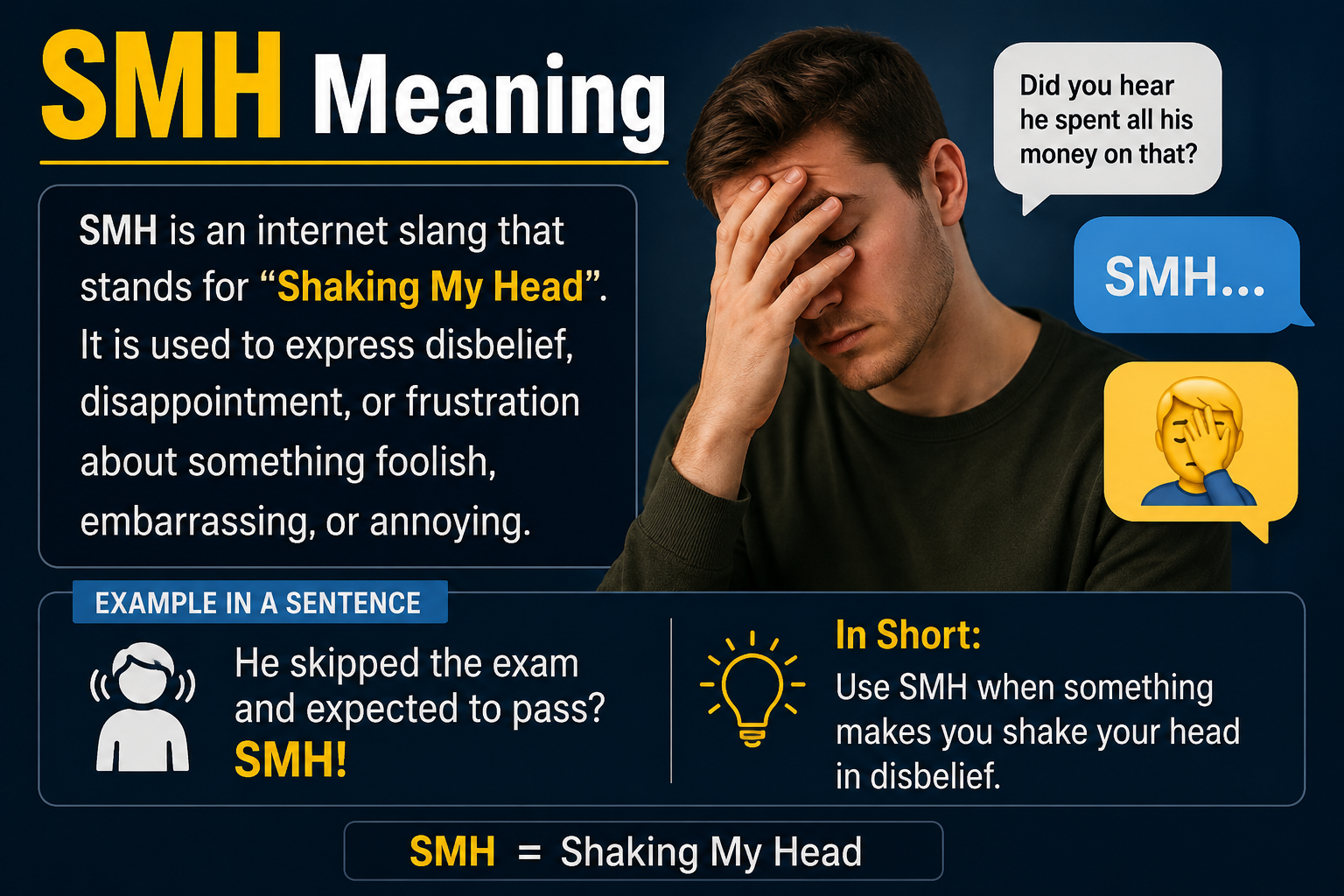
SMH stands for “Shaking My Head.”
People use it to show that they are disappointed, frustrated, annoyed, or cannot believe something that has happened. Instead of writing a full sentence like, “I can’t believe this,” someone may simply type SMH.
The phrase represents the physical action of shaking your head when something seems foolish, surprising, or disappointing. Even though most people are not literally shaking their heads while typing, the abbreviation effectively communicates the same emotion.
Simple Definition
In simple English, SMH means that someone thinks a situation is silly, disappointing, or unbelievable.
For example:
- “He forgot his wallet again. SMH.”
- “People still fall for that scam. SMH.”
- “The team missed an easy goal. SMH.”
In each example, the writer expresses disappointment without needing many words.
Pronunciation of SMH
Unlike normal words, SMH is usually pronounced by saying each letter individually.
Pronunciation:
S – M – H
People say:
“Ess Em Aitch.”
Some people never pronounce it aloud because it is mainly used in text messages and online communication. However, when speaking about internet slang, people commonly read the letters one by one.
What Is the Origin of SMH?
The exact creator of SMH is unknown, but the abbreviation became popular during the early days of internet chat rooms, texting, and online forums.
As mobile phones became more common, users wanted shorter ways to express emotions while typing quickly. Instead of writing:
- “I am shaking my head.”
- “I cannot believe this.”
- “That is disappointing.”
People simply typed SMH.
Its popularity increased rapidly with the growth of social media platforms, where character limits encouraged shorter messages. Today, it is recognized worldwide and appears across nearly every social media platform and messaging app.
Why Do People Use SMH?
There are many reasons people use SMH in conversations.
To Express Disappointment
Someone may use it when another person makes a poor decision.
Example:
“My brother left the front door open all night. SMH.”
To Show Disbelief
Sometimes people cannot believe what they just heard.
Example:
“They spent hundreds of dollars on something they never used. SMH.”
To React to Silly Behavior
People often use it when someone behaves carelessly.
Example:
“He wore flip-flops in the snow. SMH.”
To Respond Without Writing a Long Sentence
Instead of explaining feelings in detail, SMH quickly communicates frustration.
Example:
“They canceled the event at the last minute. SMH.”
Different Situations Where SMH Is Used
Social Media
Many users include SMH in posts reacting to trending news, sports events, celebrity stories, or everyday situations.
Example:
“Another delayed flight. SMH.”
Text Messages
Friends often use SMH while chatting.
Example:
Friend: “I forgot my homework.”
Reply:
“SMH.”
Online Gaming
Gamers sometimes use SMH when teammates make obvious mistakes.
Example:
“We had an easy win. SMH.”
Family Conversations
Family members may jokingly use SMH when someone forgets something.
Example:
“Dad left the TV remote in the refrigerator again. SMH.”
Examples of SMH in Sentences
Learning through examples makes understanding easier.
Here are several examples.
- “SMH, I cannot believe I missed the bus.”
- “He forgot my birthday again. SMH.”
- “The movie ended without explaining anything. SMH.”
- “People still believe fake news. SMH.”
- “She locked herself outside her house. SMH.”
- “SMH, the internet stopped working during my meeting.”
- “The restaurant forgot our order again. SMH.”
- “He failed the test because he never studied. SMH.”
- “SMH, that was such an easy question.”
- “The store closed just before we arrived. SMH.”
Is SMH Positive or Negative?
Generally, SMH has a negative meaning.
It usually expresses:
- Frustration
- Disappointment
- Annoyance
- Embarrassment
- Disbelief
However, people sometimes use it jokingly among friends. In those situations, it is not meant to offend anyone.
For example:
“My friend put cereal in the fridge instead of the pantry. SMH 😂”
Here, the abbreviation is playful rather than serious.
When Should You Use SMH?
You can use SMH when:
- Someone makes an obvious mistake.
- Something disappointing happens.
- A surprising event leaves you speechless.
- You want to react quickly in a text message.
- You are commenting on funny but silly behavior.
It works best in casual conversations rather than formal writing.
When Should You Avoid Using SMH?
Although SMH is common online, it is not suitable everywhere.
Avoid using it in:
- Business emails
- Academic papers
- Professional reports
- Formal presentations
- Official letters
- Job applications
In professional settings, complete sentences appear more respectful and easier to understand.
Instead of writing:
“SMH.”
Write:
“I was disappointed by the outcome.”
or
“I found the situation surprising.”
Synonyms of SMH
Although there is no perfect one-word replacement, several expressions communicate a similar feeling.
Similar Expressions
- Shaking my head
- I can’t believe it
- Seriously?
- What a shame
- That’s disappointing
- Unbelievable
- Really?
- Oh no
- That’s unfortunate
- Come on
Each of these expresses surprise, disappointment, or frustration in different situations.
Antonyms of SMH
The opposite of SMH would express approval, happiness, or satisfaction.
Examples include:
- Great!
- Awesome!
- Excellent!
- Well done!
- Amazing!
- Fantastic!
- Impressive!
- Nice job!
- Wonderful!
- Perfect!
These expressions communicate positive emotions instead of disappointment.
Common Places You Will See SMH
You may notice SMH on many online platforms.
Some of the most common include:
- Text messages
- Social media posts
- Comment sections
- Online forums
- Group chats
- Gaming chats
- Meme pages
- Video comments
- Live streams
- Community discussions
Its short length makes it ideal for quick online communication.
SMH Meaning in Modern Internet Culture
Internet slang changes quickly, but SMH meaning has remained popular for many years. Unlike some abbreviations that disappear after a short time, SMH continues to be used because it is simple, easy to understand, and useful in many situations.
Today, people of different ages use SMH on social media, messaging apps, gaming platforms, and online communities. While younger users introduced it to many internet spaces, adults now use it as well when reacting to frustrating or unbelievable situations.
Its popularity also comes from the fact that it saves time. Instead of typing several sentences to explain disappointment, users can simply type “SMH” and most readers immediately understand the emotion behind it.
Common Mistakes When Using SMH
Although SMH is easy to use, people sometimes make mistakes with it. Understanding these errors can help you use the abbreviation correctly.
Using It in Formal Writing
SMH is internet slang, so it does not belong in formal communication.
For example, avoid writing:
“SMH, the project was delayed.”
Instead, write:
“I was disappointed that the project was delayed.”
Using It for Happy Situations
SMH expresses disappointment or disbelief, not excitement.
Incorrect:
“I got promoted today. SMH.”
Correct:
“I got promoted today. I’m so excited!”
Overusing It
Using SMH in every message can make conversations feel repetitive.
Instead of writing:
“SMH. SMH. SMH.”
Mix it with other expressions depending on the situation.
Assuming Everyone Understands It
While many internet users know the abbreviation, some people—especially those who are less familiar with online slang—may not recognize it. When communicating with someone you are unsure about, writing the full phrase may be clearer.
SMH vs. Other Popular Internet Slang
Many internet abbreviations express emotions, but they have different meanings. Here is how SMH compares with some common ones.
| Abbreviation | Meaning | Typical Emotion |
| SMH | Shaking My Head | Disappointment or disbelief |
| LOL | Laughing Out Loud | Amusement |
| OMG | Oh My God | Surprise or shock |
| BRB | Be Right Back | Leaving briefly |
| BTW | By The Way | Adding information |
| IMO | In My Opinion | Sharing an opinion |
| IDK | I Don’t Know | Uncertainty |
| TBH | To Be Honest | Honesty or opinion |
Knowing the differences helps you choose the right abbreviation for each conversation.
Can SMH Be Funny?
Yes. Many people use SMH humorously.
Friends often joke with one another by typing SMH after a harmless mistake.
For example:
- “You burned toast again? SMH.”
- “You watched the entire movie before realizing it was the sequel? SMH.”
- “You forgot your own birthday password. SMH.”
In these situations, SMH adds humor rather than criticism.
SMH in Social Media
Social media has played a huge role in making SMH popular.
You can often find it in:
- Facebook comments
- Instagram captions
- X (formerly Twitter) posts
- TikTok comments
- YouTube discussions
- Reddit conversations
- Snapchat messages
- Discord chats
Because social media encourages short, quick responses, abbreviations like SMH fit naturally into online conversations.
Why SMH Became So Popular
Several factors explain why SMH continues to be widely used.
It Saves Time
Typing three letters is much faster than writing a complete sentence.
It Expresses Emotion Clearly
Readers instantly understand that the writer feels disappointed, frustrated, or shocked.
It Works Across Many Topics
SMH can be used for sports, school, work, entertainment, daily life, and news.
It Is Easy to Remember
The abbreviation is short and simple, making it easy for people to learn and use.
Is SMH Still Popular?
Yes. Even after many years, SMH remains one of the most recognized internet abbreviations.
Although new slang appears every year, SMH continues to be used because it expresses a common feeling that people experience every day. Whether someone is reacting to a funny mistake or a disappointing event, the abbreviation still feels natural in online conversations.
Tips for Using SMH Naturally
If you want to sound more natural online, keep these tips in mind.
- Use SMH only in casual conversations.
- Avoid using it in professional communication.
- Make sure it matches the situation.
- Do not overuse it in every message.
- Consider whether the other person understands internet slang.
- Pair it with emojis if you want a lighter tone.
For example:
- “You forgot your keys again. SMH 😂”
- “Another delayed train. SMH.”
Frequently Asked Questions About SMH Meaning
What does SMH stand for?
SMH stands for Shaking My Head. It is used to express disappointment, frustration, disbelief, or embarrassment.
Is SMH considered rude?
Not usually. It depends on the context. Friends often use it jokingly, but it can seem rude if directed at someone in a serious conversation.
Can I use SMH in business emails?
No. SMH is informal internet slang and should not be used in professional or academic writing.
Is SMH only used by young people?
No. While younger users helped popularize it, people of many ages now use SMH in text messages and on social media.
Can SMH be used in spoken conversation?
Yes. Some people say the letters aloud as “Ess Em Aitch,” especially when discussing internet culture, although it is more common in writing.
Does SMH always mean disappointment?
Most of the time, yes. However, it can also express disbelief, annoyance, or playful frustration depending on the context.
Is SMH still popular today?
Yes. SMH remains one of the most widely recognized internet abbreviations and is still commonly used across social media and messaging platforms.
What is the difference between SMH and LOL?
SMH expresses disappointment or disbelief, while LOL means “Laughing Out Loud” and expresses amusement or laughter.
Final Thoughts
Understanding SMH meaning makes it easier to follow modern online conversations and communicate naturally on social media and messaging apps. Although it is a simple three-letter abbreviation, it conveys emotions such as disappointment, frustration, disbelief, and mild embarrassment in a quick and effective way.
Whether you see it in a text message, a meme, a social media comment, or a gaming chat, SMH almost always signals that someone is reacting to something they find surprising, foolish, or disappointing. Remember that it is best suited for casual communication and should be avoided in formal writing or professional settings.
As internet language continues to evolve, SMH remains one of the most recognizable and widely used abbreviations. Knowing when and how to use it correctly will help you better understand online conversations and express your reactions in a natural, modern way.