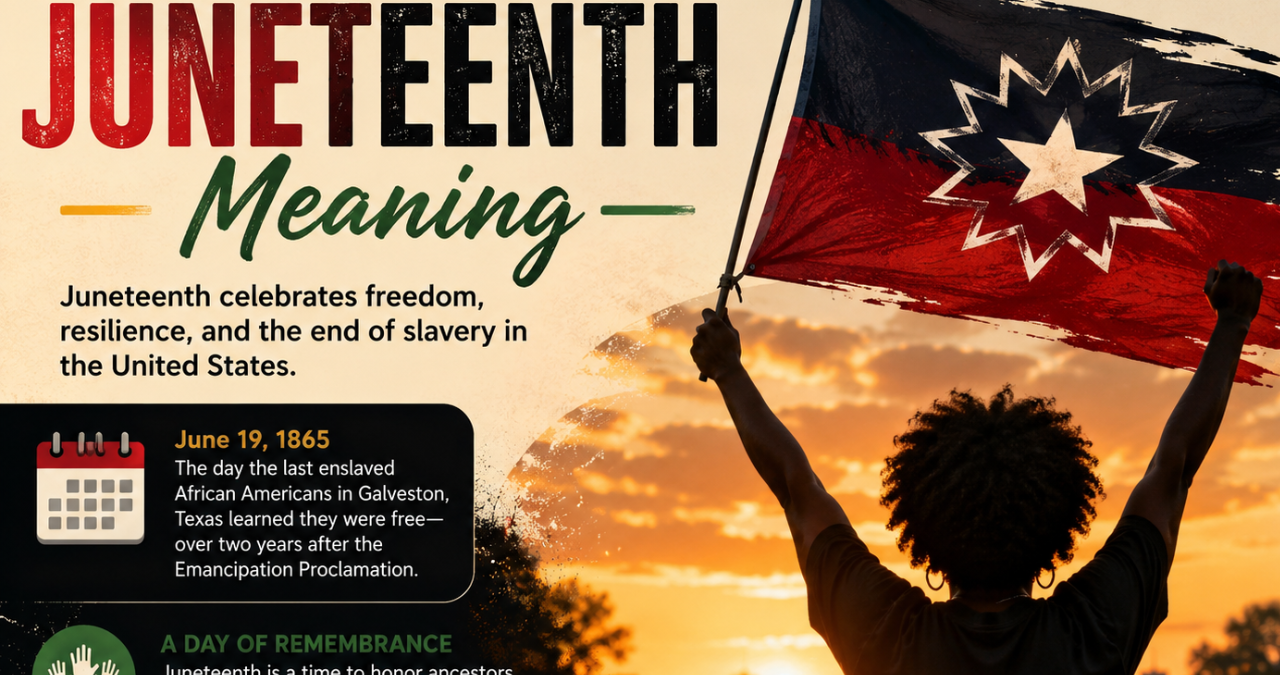
The Juneteenth meaning is closely connected to freedom, emancipation, African American history, and the long struggle to end slavery in the United States. Juneteenth is observed every year on June 19 and remembers the day in 1865 when enslaved people in Texas were informed that they were free. The date has become an important symbol of freedom, hope, equality, remembrance, and cultural heritage.
The word Juneteenth combines “June” and “nineteenth.” Although President Abraham Lincoln’s Emancipation Proclamation had taken effect in 1863, the proclamation could not be fully enforced in areas controlled by the Confederacy. In Texas, enslaved African Americans remained in bondage until Union forces arrived in Galveston in June 1865. On June 19, Union Major General Gordon Granger issued General Order No. 3 announcing that enslaved people in Texas were free.
Today, Juneteenth is both a celebration and a day of reflection. It gives people an opportunity to learn about American history, honor the experiences of African Americans, celebrate freedom and culture, and think about the continuing importance of equality and justice. Juneteenth became a federal holiday in the United States in 2021.
What Is the Juneteenth Meaning?
The simplest Juneteenth meaning is a celebration of freedom and the end of slavery in the United States. More specifically, it remembers June 19, 1865, when news of emancipation reached enslaved people in Texas.
The day has a deep historical meaning because freedom did not arrive for everyone at the same time. The Emancipation Proclamation had declared enslaved people in the Confederate states free beginning in 1863, but the order could not be effectively enforced in territories still controlled by Confederate forces. Texas was one of the places where enforcement was delayed.
When Union troops arrived in Galveston in June 1865, General Granger announced that enslaved people in Texas were free under federal authority. This event became the foundation of the Juneteenth holiday.
Juneteenth therefore represents more than a date on a calendar. It is a reminder that freedom can involve both a legal declaration and the difficult work of making that freedom real.
How Do You Pronounce Juneteenth?
The word Juneteenth is generally pronounced like:
It sounds roughly like “June-teenth.”
The name is a shortened combination of June and nineteenth. The name itself directly points to the date that became central to the holiday. The National Archives describes Juneteenth as a combination of “June” and “19th.”
A simple way to remember the pronunciation is to think of the word as:
June + teenth = Juneteenth
It is normally written as one word with a capital J because it is the name of a recognized holiday.
What Is the Origin of Juneteenth?
The origin of Juneteenth goes back to Texas during the final period of the American Civil War. On June 19, 1865, Union Major General Gordon Granger arrived in Galveston with Union troops and issued General Order No. 3.
The order informed people in Texas that, under the Emancipation Proclamation, enslaved people were free. The National Archives identifies this order as the document associated with the historical event that gave Juneteenth its significance.
The event happened more than two years after the Emancipation Proclamation took effect. This delay is an important part of understanding Juneteenth. The proclamation was issued during the Civil War and applied to enslaved people in states and areas in rebellion against the United States, but federal authorities could not immediately enforce it everywhere.
Texas was geographically distant from the main areas of Union military control. As the war continued, slavery remained in place there. After the Confederate military collapse, Union troops entered Texas and enforced federal authority.
The arrival of the Union Army in Galveston made June 19 a historic day for the state’s enslaved African American population.
Juneteenth and the Emancipation Proclamation
Understanding the Juneteenth meaning requires knowing the difference between the Emancipation Proclamation and the events of June 1865.
President Abraham Lincoln issued the Emancipation Proclamation in 1863. It declared enslaved people in the states and areas then in rebellion against the United States to be free. However, the proclamation depended heavily on Union military success and enforcement.
This is why the existence of the proclamation did not mean that every enslaved person immediately experienced freedom in daily life.
In Texas, the message and enforcement of emancipation came later. General Granger’s order in Galveston provided the official announcement that became associated with Juneteenth.
It is also important to understand that slavery was not abolished nationwide solely by the Emancipation Proclamation. The Thirteenth Amendment, ratified later in 1865, abolished slavery throughout the United States, with a constitutional exception for punishment for a crime.
Therefore, Juneteenth should be understood as an important milestone in emancipation rather than as a claim that every enslaved person in America became free on one single day.
Why Is Juneteenth Important?
Juneteenth is important because it connects history with the idea of freedom. It encourages people to remember the lives of enslaved African Americans and the generations that worked toward greater freedom and equality.
The holiday also highlights the importance of remembering history accurately. Learning about Juneteenth helps explain why emancipation was complicated and why legal freedom did not immediately create equal conditions for formerly enslaved people.
The Smithsonian’s National Museum of African American History and Culture describes Juneteenth as an opportunity to reflect on freedom, African American history, culture, and the continuing effort to achieve meaningful freedom.
For many people, Juneteenth carries several meanings at once:
- Freedom from slavery
- Remembrance of African American history
- Celebration of resilience
- Recognition of cultural heritage
- Reflection on equality
- Family and community connection
- Education about the past
- Hope for a better future
Because of these different meanings, Juneteenth can be both joyful and thoughtful.
What Happened on June 19, 1865?
On June 19, 1865, Union Major General Gordon Granger arrived in Galveston, Texas, with Union troops. He issued General Order No. 3, informing the people of Texas that enslaved people were free under the authority of the United States government.
The arrival of Union forces was especially significant because Texas had remained under Confederate control for much of the Civil War. Federal authority had not been fully established there, which delayed enforcement of emancipation.
The Smithsonian reports that roughly 2,000 Union troops arrived in Galveston Bay and that more than 250,000 enslaved Black people in Texas were affected by the announcement.
For formerly enslaved people, freedom created enormous possibilities as well as serious challenges. Families worked to reunite, communities developed schools and institutions, and formerly enslaved people sought greater control over their lives.
Juneteenth grew from this historic moment and eventually became an annual celebration.
How Did Juneteenth Become a Holiday?
Juneteenth was celebrated in Texas by African American communities for generations before it became widely recognized across the United States.
Early celebrations often involved families, churches, community gatherings, food, speeches, music, and remembrance. Over time, the tradition expanded beyond Texas and became associated with broader African American cultural and historical celebrations.
The holiday faced periods when public recognition declined. However, community leaders and activists continued working to preserve its history.
One important figure in the modern movement to increase awareness of Juneteenth is Opal Lee, who became widely known for her efforts to promote national recognition of the holiday.
In 2021, Juneteenth received federal recognition. President Joe Biden signed the Juneteenth National Independence Day Act, establishing June 19 as a federal holiday.
This national recognition brought Juneteenth into greater public awareness while also encouraging people to learn about its much longer history within African American communities.
Juneteenth as a Federal Holiday
Juneteenth became a federal holiday in 2021. It is officially known as Juneteenth National Independence Day.
Federal recognition means that Juneteenth has the same federal-holiday status as other nationally recognized holidays. It also reflects the importance of recognizing African American history as part of the broader history of the United States.
However, federal recognition did not create Juneteenth. African American communities had already celebrated and preserved the tradition for generations.
This distinction matters. The modern federal holiday is relatively new, but the cultural tradition behind Juneteenth has a much longer history.
How Is Juneteenth Celebrated?
Juneteenth celebrations can look different from one community to another. Some are large public events, while others are small family gatherings.
Common activities include:
- Community festivals
- Parades
- Educational programs
- Historical presentations
- Family reunions
- Church services
- Music and performances
- Cultural programs
- Public speeches
- Art exhibitions
- Community meals
- Storytelling
- Readings about African American history
Food is also an important part of many Juneteenth gatherings. Barbecue, traditional family recipes, fruit drinks, and other foods may appear at celebrations, although there is no single required Juneteenth menu.
The Smithsonian notes that Juneteenth celebrations have historically included family-centered gatherings, food, music, and community traditions.
The Juneteenth Flag and Its Meaning
The Juneteenth flag is another recognizable part of modern Juneteenth observances. It was created to give the holiday a visual symbol and is commonly displayed at celebrations.
The flag uses red, white, and blue, which connect Juneteenth with the United States and its national identity. It also includes a star representing Texas and freedom.
The design is often seen at festivals, educational events, community gatherings, and public celebrations.
While the flag is now widely associated with Juneteenth, the deeper meaning of the holiday does not depend on any particular symbol. The central ideas remain freedom, history, remembrance, community, and hope.
Juneteenth Meaning in Simple English
If you need a very simple explanation, the Juneteenth meaning can be stated this way:
Juneteenth is a U.S. holiday that remembers June 19, 1865, when enslaved people in Texas were informed that they were free. It celebrates freedom and honors African American history and culture.
This short definition works well for students, children, language learners, or anyone encountering the word for the first time.
Another simple explanation is:
Juneteenth means remembering the day freedom was announced to enslaved people in Texas in 1865.
The word carries historical, cultural, and emotional meaning, so a complete definition should go beyond simply saying that it is a holiday.
Synonyms and Related Terms for Juneteenth
Juneteenth does not have exact synonyms because it is the proper name of a specific historical observance. However, several terms are closely related to its meaning.
Freedom Day
Freedom Day is one of the names associated with Juneteenth. It highlights the holiday’s connection to emancipation and freedom. The National Archives also identifies Freedom Day as another name for Juneteenth.
Emancipation Day
Emancipation Day can refer to celebrations marking emancipation from slavery. It is closely connected with Juneteenth, although different communities and places have used the term for different historical dates.
Independence
Independence is related to Juneteenth because the holiday celebrates freedom from slavery and is officially named Juneteenth National Independence Day.
Liberation
Liberation means being released from oppression or control. It is closely connected to the broader historical ideas represented by Juneteenth.
Freedom
Freedom is perhaps the most important concept associated with Juneteenth. The holiday gives people a chance to consider what freedom meant to formerly enslaved people and what it means today.
Antonyms of Juneteenth
Because Juneteenth is the name of a holiday rather than an ordinary descriptive word, it does not have a direct antonym.
However, concepts that contrast with the ideas celebrated by Juneteenth include:
- Slavery
- Bondage
- Oppression
- Enslavement
- Inequality
- Injustice
- Forced labor
- Denial of freedom
These words are not literal antonyms of “Juneteenth.” They are contrasting concepts that help explain why the holiday is historically meaningful.
Juneteenth Examples in Sentences
Here are some natural examples showing how Juneteenth is used in everyday English:
- Juneteenth is observed on June 19 each year.
- Our community held a Juneteenth celebration with music and educational activities.
- Students learned about the history of Juneteenth in class.
- Juneteenth provides an opportunity to discuss freedom and African American history.
- Many families gather together to recognize Juneteenth.
- The city organized a public event for Juneteenth.
- Juneteenth became a federal holiday in 2021.
These examples show that the word can be used in conversations about history, education, culture, government, family events, and community activities.
Common Usage of Juneteenth
The word Juneteenth is commonly used when discussing American history, African American culture, federal holidays, community events, and educational programs.
For example, someone might say:
“What does Juneteenth celebrate?”
A natural answer would be:
“It commemorates the June 19, 1865, announcement of emancipation in Texas and celebrates freedom and African American history.”
The word is also frequently used as an adjective in phrases such as:
- Juneteenth celebration
- Juneteenth event
- Juneteenth festival
- Juneteenth holiday
- Juneteenth history
- Juneteenth program
- Juneteenth education
- Juneteenth parade
These phrases are common in news reports, school materials, government communications, community announcements, and cultural discussions.
Is Juneteenth the Same as the Fourth of July?
Juneteenth and the Fourth of July are both important American observances, but they commemorate different historical events.
The Fourth of July marks the adoption of the Declaration of Independence in 1776 and is associated with the founding of the United States as an independent nation.
Juneteenth remembers the emancipation of enslaved people in Texas in 1865 and the broader end of slavery in the United States.
The distinction is important because American independence in 1776 did not mean freedom for enslaved African Americans. Slavery continued for generations afterward.
Juneteenth provides an opportunity to recognize this part of American history and to consider the meaning of freedom from the perspective of people who had been denied it.
Juneteenth and African American History
Juneteenth has a special place in African American history because it represents a moment when legal emancipation reached one of the last major populations of enslaved people in the Confederacy.
But the story does not end with the announcement of freedom.
Formerly enslaved people faced difficult economic, political, and social conditions after emancipation. They worked to build families, schools, churches, businesses, communities, and political organizations.
The Smithsonian explains that formerly enslaved people pursued family reunification, education, political participation, and other forms of self-determination after emancipation.
This history helps explain why Juneteenth is about more than one event. It is also about what people did with freedom after it was announced.
Why Learning the Juneteenth Meaning Matters
Learning the Juneteenth meaning can help people understand American history in a fuller way.
History is not only about famous leaders and major battles. It is also about ordinary people whose lives were affected by laws, wars, economic systems, and social change.
Juneteenth brings attention to the experiences of enslaved African Americans and their descendants. It also shows how legal changes can take time to become real experiences for people on the ground.
For students, Juneteenth can be a useful starting point for learning about slavery, the Civil War, emancipation, Reconstruction, civil rights, and African American cultural history.
For families and communities, it can be a time to share stories, discuss history, celebrate culture, and think about the meaning of freedom.
Juneteenth for Students
Students may encounter Juneteenth in history classes, social studies lessons, books, school events, or community programs.
A good way to study the holiday is to connect several events rather than memorizing one date.
Students can explore:
- The history of slavery in the United States
- The American Civil War
- The Emancipation Proclamation
- General Order No. 3
- The arrival of Union troops in Galveston
- The Thirteenth Amendment
- Reconstruction
- The development of Juneteenth celebrations
- The holiday’s federal recognition
This broader approach helps students understand why June 19, 1865, became historically important.
Frequently Asked Questions About Juneteenth
What does Juneteenth mean?
Juneteenth is a holiday that commemorates June 19, 1865, when Union General Gordon Granger announced in Galveston, Texas, that enslaved people in Texas were free under federal authority. It also celebrates freedom and African American history.
Why is it called Juneteenth?
The name Juneteenth combines the words June and nineteenth. It refers to June 19, the date in 1865 associated with the announcement and enforcement of emancipation in Texas.
When is Juneteenth celebrated?
Juneteenth is observed every year on June 19.
Is Juneteenth a federal holiday?
Yes. Juneteenth became a federal holiday in the United States in 2021 after the Juneteenth National Independence Day Act was signed into law.
What happened on Juneteenth?
On June 19, 1865, Union Major General Gordon Granger issued General Order No. 3 in Galveston, Texas, informing people that enslaved people were free under the authority of the United States government.
Is Juneteenth only celebrated by African Americans?
Juneteenth has deep roots in African American communities, particularly in Texas, but people from many backgrounds now observe and learn about the holiday. Its history is part of the broader history of the United States.
What is another name for Juneteenth?
Juneteenth is also known as Freedom Day and Emancipation Day.
Why is Juneteenth important today?
Juneteenth is important because it encourages people to remember the history of slavery and emancipation while celebrating freedom, African American culture, resilience, and community. It also provides an opportunity to reflect on the continuing importance of equality and justice.
How do people celebrate Juneteenth?
Celebrations may include festivals, parades, family gatherings, educational programs, music, food, speeches, church services, cultural activities, and historical presentations. The exact traditions vary between communities.
What is the easiest way to explain Juneteenth to a child?
A simple explanation is: “Juneteenth is a holiday that remembers when enslaved people in Texas learned they were free in 1865. It is a day to learn about history and celebrate freedom.”
Final Thoughts on Juneteenth Meaning
The Juneteenth meaning goes far beyond the combination of two words. It represents a major moment in American history when enslaved people in Texas were officially informed of their freedom on June 19, 1865.
The holiday also reminds us that freedom can take time to reach people, especially when laws are not immediately enforced. The history of Juneteenth connects the Emancipation Proclamation, the Civil War, General Order No. 3, the Thirteenth Amendment, and the experiences of formerly enslaved African Americans.
Today, Juneteenth is a federal holiday and a widely recognized occasion for education, celebration, remembrance, and community.
Understanding Juneteenth meaning helps people understand why history matters. It gives families, students, teachers, and communities a chance to discuss freedom and African American heritage while remembering the people whose lives were transformed by emancipation.
At its heart, Juneteenth is a reminder of freedom, resilience, memory, and hope. It encourages people not only to remember what happened in the past but also to think about how the lessons of history can shape a more informed and equal future.