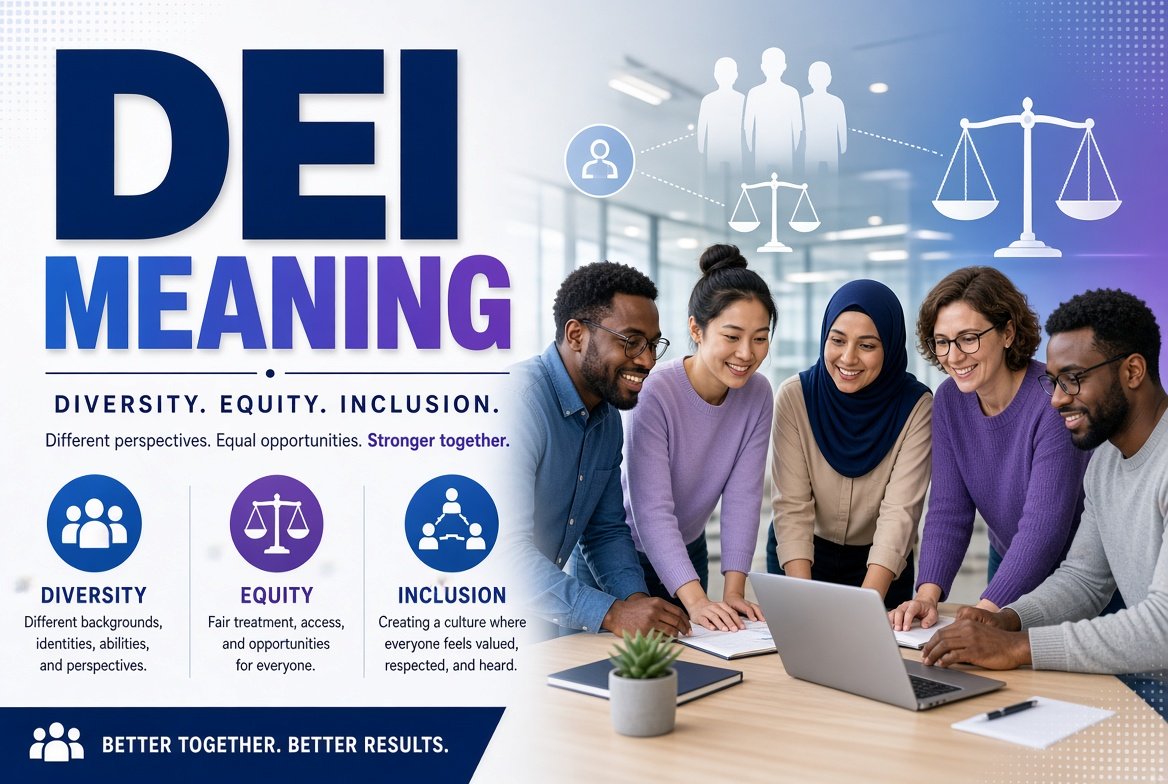
The DEI meaning is Diversity, Equity, and Inclusion. The term is commonly used when people talk about creating workplaces, schools, organizations, and communities where people from different backgrounds can participate, contribute, and have fair opportunities. DEI is often discussed in business, education, government, healthcare, technology, and community organizations.
In simple English, DEI is about recognizing differences between people, promoting fairness, and making sure people feel welcomed and able to participate. The three words in the acronym have related but different meanings. Diversity focuses on differences among people, equity focuses on fairness and addressing different needs, and inclusion focuses on creating an environment where people can participate and feel respected.
The term has become widely used in modern conversations about workplaces and society. At the same time, DEI can mean different things depending on the organization using it. Some programs focus on hiring and recruitment, while others focus on accessibility, education, workplace culture, leadership development, or reducing barriers to participation.
Understanding the DEI meaning is useful because the acronym appears frequently in news articles, job descriptions, company websites, school policies, and everyday conversations.
What Does DEI Mean?
DEI stands for Diversity, Equity, and Inclusion.
Each part of the acronym describes a different idea:
- Diversity means recognizing and valuing differences among people.
- Equity means working toward fair access, opportunity, and treatment while recognizing that people may face different barriers.
- Inclusion means creating an environment where people are welcomed, respected, and able to participate.
Together, these ideas are used to describe efforts that make organizations and communities more accessible and fair.
For example, imagine a workplace where employees come from different cultural, educational, age, and personal backgrounds. Having a diverse workforce is one part of DEI. Making sure employees have fair access to opportunities is another part. Creating a workplace where employees can contribute their ideas and feel respected is the inclusion part.
DEI is therefore broader than simply hiring people from different backgrounds. It can involve policies, workplace practices, education, accessibility, leadership, communication, and organizational culture.
How Do You Pronounce DEI?
DEI is an acronym, and it is usually pronounced by saying each letter separately:
It sounds like “D-E-I.”
The full phrase is pronounced:
Diversity, Equity, and Inclusion
You may hear the term in conversations about human resources, education, corporate policies, government programs, or social issues.
Because DEI is an acronym, it is generally not pronounced as one single word.
What Is the Origin of DEI?
The modern DEI meaning developed from several different historical movements and ideas rather than from one specific event or person.
The concepts behind DEI have roots in long-running discussions about civil rights, equal opportunity, workplace discrimination, disability rights, educational access, gender equality, and social participation. Different organizations and movements used different terminology over time.
The word diversity became increasingly common in workplace and educational discussions during the twentieth century. The idea of equal opportunity was also strongly connected to civil rights laws and workplace policies.
The word equity became important in discussions about whether treating everyone exactly the same always produces fair results. Equity-based approaches generally recognize that people can have different circumstances and barriers.
Inclusion became increasingly important as organizations began focusing not only on who was present but also on whether people were able to participate fully and feel respected.
The acronym DEI eventually became a widely used shorthand for these connected ideas.
DEI Meaning in Simple English
The easiest way to understand DEI meaning is:
DEI means creating environments where different kinds of people are represented, treated fairly, and included.
Here is an even simpler breakdown:
Diversity: Different people are represented.
Equity: People have fair opportunities and support based on their circumstances.
Inclusion: People are welcomed, respected, and able to participate.
These three concepts overlap, but they are not identical.
For example, a company could have employees from many different backgrounds but still have problems with inclusion if some employees feel ignored during meetings. Similarly, an organization could have an inclusive culture but still need to examine whether its recruitment practices create unnecessary barriers.
This is why DEI is often discussed as a combination of ideas rather than a single policy.
What Does Diversity Mean in DEI?
Diversity refers to differences among people.
These differences can include many characteristics and experiences, such as:
- Culture
- Language
- Age
- Disability
- Education
- Geographic background
- Work experience
- Family background
- Race and ethnicity
- Gender
- Socioeconomic background
- Personal perspectives
Diversity can also involve differences in professional experience and ways of thinking.
For example, a technology company might employ software developers, designers, marketers, researchers, and customer-support specialists. Their different professional experiences can contribute different perspectives to a project.
Diversity does not simply mean counting how many different types of people are present. In many DEI discussions, it also means recognizing that people bring different experiences and viewpoints.
What Does Equity Mean in DEI?
Equity refers to fairness while recognizing that people may have different circumstances or barriers.
This is sometimes confused with equality.
Equality generally means providing the same treatment or resources to everyone. Equity asks whether people have fair access to opportunities and whether different barriers need to be addressed.
For example, imagine a school has an online learning system. Providing every student with the same website is equal treatment. Making sure the website can be used by students with disabilities may be an equity consideration because accessibility barriers can prevent some students from using the same resource effectively.
Equity does not necessarily mean giving everyone identical support. Instead, it focuses on removing unfair barriers and improving access to opportunities.
What Does Inclusion Mean in DEI?
Inclusion means creating an environment where people feel welcomed, respected, and able to participate.
A workplace can be diverse without being inclusive.
For example, a company may employ people from many backgrounds, but if only a small group of employees are regularly invited to important discussions, the organization may still have an inclusion problem.
Inclusive practices can include:
- Encouraging different viewpoints
- Making meetings accessible
- Listening to employee feedback
- Using respectful communication
- Providing reasonable accommodations
- Creating opportunities for participation
- Addressing inappropriate behavior
- Making organizational information accessible
Inclusion is therefore concerned with people’s experiences after they become part of an organization or community.
DEI Examples in the Workplace
The DEI meaning becomes easier to understand through practical examples.
A company might review its job advertisements to make sure the language is clear and does not create unnecessary barriers for qualified applicants.
Another company might improve accessibility in its offices and digital systems so employees with disabilities can participate more effectively.
A workplace could also provide professional development opportunities to employees across different departments and backgrounds.
Other examples may include:
- Accessible workplace technology
- Inclusive meeting practices
- Fair promotion processes
- Employee feedback systems
- Mentoring programs
- Training on respectful workplace behavior
- Broader recruitment strategies
- Flexible communication methods
The exact practices vary from organization to organization. DEI is not one universal program with a single required structure.
DEI Examples in Education
Schools and universities may use DEI concepts when discussing access, belonging, accessibility, and educational opportunities.
For example, a school may examine whether students with disabilities can access classroom materials. It might also consider whether students from different backgrounds have reasonable access to educational resources.
Inclusive teaching can involve presenting information in different ways, encouraging respectful classroom discussion, and making sure students have opportunities to participate.
DEI discussions in education can also involve curriculum, student support, campus accessibility, admissions, extracurricular activities, and school culture.
The goal is generally to help create learning environments where students have meaningful opportunities to learn and participate.
DEI Examples in Everyday Life
DEI is not limited to large companies or universities.
The same ideas can appear in everyday situations.
For example, a community organization might provide information in multiple languages so more residents can understand it. A public event might include accessible facilities so people with disabilities can participate.
A sports club might create clear rules that promote respectful behavior among members.
A neighborhood group could also make an effort to ensure that meetings are accessible and that different members have opportunities to share their views.
These examples show that DEI can be connected to ordinary decisions about participation, communication, access, and respect.
Synonyms and Related Terms for DEI
DEI does not have one perfect synonym because it is an acronym containing three separate concepts. However, several expressions are closely related.
Diversity and Inclusion
Diversity and inclusion is a common phrase that focuses on representation and participation.
Equal Opportunity
Equal opportunity refers to the idea that people should have fair access to opportunities without unfair discrimination.
Belonging
Belonging is often used alongside DEI. It describes the feeling that a person is accepted, respected, and genuinely part of a group.
Accessibility
Accessibility refers to making products, services, buildings, information, or systems usable by people with different needs, particularly people with disabilities.
Fairness
Fairness is a broad term connected to the equity component of DEI.
Representation
Representation refers to the presence of people from different backgrounds within a group, organization, institution, or decision-making process.
These terms overlap with DEI but should not automatically be treated as exact replacements.
Antonyms of DEI
DEI does not have a single direct antonym because it represents several concepts. However, ideas that contrast with DEI include:
- Exclusion
- Discrimination
- Unfair treatment
- Inequality
- Inaccessibility
- Intolerance
- Bias
- Marginalization
- Lack of representation
These words describe conditions that DEI initiatives may attempt to address.
It is important to remember that individual DEI programs can have different goals. Therefore, the presence of a DEI policy does not automatically mean that every possible form of inequality has been eliminated.
DEI Examples in Sentences
Here are some examples of how DEI is commonly used:
- The company created a DEI strategy for its workplace.
- The university published a new DEI policy.
- The manager attended a DEI training session.
- The organization included DEI goals in its annual plan.
- The team discussed accessibility as part of its DEI efforts.
- The company wants to improve inclusion across its workforce.
- DEI can involve policies related to hiring, accessibility, and workplace culture.
These examples demonstrate that DEI can function as a noun or as a modifier before another noun, such as “DEI policy” or “DEI program.”
Common Usage of DEI
The term DEI is especially common in professional and institutional settings.
You may encounter it in:
- Job descriptions
- Company websites
- Human resources documents
- University policies
- Government publications
- Nonprofit organizations
- Workplace training
- News reports
- Educational materials
- Corporate reports
A company might describe someone as a DEI manager, meaning that the person’s role involves responsibilities related to diversity, equity, and inclusion.
You may also see phrases such as DEI initiatives, DEI programs, DEI strategy, DEI training, and DEI policies.
The meaning can vary somewhat depending on the context, so it is useful to read the specific organization’s definition rather than assuming every DEI program is identical.
Why Is DEI Important?
DEI is important to many organizations because people do not all have the same experiences, opportunities, or barriers.
A workplace may contain employees with different skills, cultures, communication styles, experiences, and needs. Understanding these differences can help organizations think more carefully about how policies affect employees.
DEI can also encourage organizations to examine whether their systems unintentionally create barriers.
For example, a hiring process may require unnecessary qualifications that do not actually relate to job performance. An organization reviewing that process might ask whether those requirements are essential or whether they unnecessarily reduce the pool of qualified candidates.
The value of DEI therefore depends heavily on how thoughtfully an organization applies its principles.
DEI and Workplace Culture
Workplace culture describes the shared behaviors, expectations, communication styles, and values that shape an organization.
DEI can become part of workplace culture when employees are encouraged to communicate respectfully, managers listen to different perspectives, and organizational policies are applied fairly.
A healthy workplace culture is not created by a single training session. It can develop through everyday practices such as how meetings are conducted, how feedback is handled, how promotions are evaluated, and how workplace concerns are addressed.
This is why many organizations view DEI as an ongoing process rather than a one-time project.
DEI and Accessibility
Accessibility is an important area connected to inclusion and equity.
A service, website, classroom, or workplace may be technically available to everyone but still difficult for some people to use.
For example, an online video without captions may create a barrier for some viewers. A building without appropriate access features can create physical barriers. A document that cannot be used with assistive technology can create a digital barrier.
Accessibility efforts aim to reduce these obstacles and make participation more practical.
Is DEI the Same as Equality?
No. DEI and equality are related but not identical.
Equality generally focuses on treating people equally or providing equal opportunities. Equity recognizes that people may begin from different circumstances and may encounter different barriers.
A simple example is education.
Suppose every student receives the same digital learning material. That represents equal distribution. If some students cannot access or use the material because of accessibility barriers, addressing those barriers is an equity concern.
The distinction does not mean that equality is unimportant. Instead, DEI discussions often use equity to explore whether equal treatment actually produces fair access.
DEI vs. EEO
Another term people sometimes encounter alongside DEI is EEO, which means Equal Employment Opportunity.
EEO generally refers to legal and organizational principles concerning fair employment opportunities and protection against unlawful employment discrimination.
DEI is broader as a concept. Organizations may use DEI to describe efforts involving representation, workplace culture, inclusion, accessibility, belonging, and opportunity.
The two terms can overlap, but they should not automatically be treated as interchangeable.
Common Misunderstandings About DEI
One common misunderstanding is that DEI only means hiring people based on personal characteristics. In reality, DEI can cover many areas, including accessibility, workplace culture, education, recruitment, leadership, communication, and organizational policies.
Another misunderstanding is that diversity and inclusion mean exactly the same thing. They do not. Diversity concerns differences and representation, while inclusion focuses more on participation and belonging.
A third misunderstanding is that equity means treating everyone unfairly or giving people special treatment without reason. In DEI discussions, equity generally means considering different circumstances and working to remove unfair barriers.
Understanding these distinctions makes conversations about DEI clearer and more productive.
Frequently Asked Questions About DEI
What does DEI stand for?
DEI stands for Diversity, Equity, and Inclusion.
What is the simple meaning of DEI?
In simple English, DEI means recognizing differences among people, promoting fair opportunities, and creating environments where people can participate and feel respected.
How do you pronounce DEI?
DEI is pronounced by saying each letter separately: “D-E-I,” or “dee-ee-eye.”
What does diversity mean in DEI?
Diversity refers to the presence and recognition of differences among people, including differences in background, experience, culture, perspective, and other characteristics.
What does equity mean in DEI?
Equity focuses on fairness and recognizes that people may face different circumstances or barriers. It seeks to improve fair access to opportunities.
What does inclusion mean in DEI?
Inclusion means creating an environment where people are welcomed, respected, able to participate, and able to contribute.
Is DEI only used in workplaces?
No. DEI concepts can be discussed in workplaces, schools, universities, government, healthcare, nonprofits, community organizations, and other settings.
What is another word for DEI?
There is no exact single synonym for DEI. Related expressions include diversity and inclusion, equal opportunity, accessibility, fairness, representation, and belonging.
What is the opposite of DEI?
There is no exact opposite of the acronym. Related contrasting concepts include exclusion, discrimination, inequality, intolerance, inaccessibility, and lack of representation.
Why do companies have DEI programs?
Companies may create DEI programs to address issues involving workplace culture, access, recruitment, representation, employee participation, accessibility, and fair opportunity.
Is DEI the same as equality?
No. Equality generally emphasizes equal treatment or opportunity, while equity considers different circumstances and barriers when thinking about fairness.
Why is DEI sometimes controversial?
DEI can involve questions about workplace policies, education, hiring, social issues, and public policy. People can disagree about which approaches are most effective or appropriate. Understanding the specific policy or program is therefore important rather than assuming all DEI initiatives are identical.
Final Thoughts on DEI Meaning
The DEI meaning is Diversity, Equity, and Inclusion. The term describes a group of connected ideas about recognizing differences, promoting fair opportunities, reducing unnecessary barriers, and creating environments where people can participate and feel respected.
The three words are important individually. Diversity focuses on differences and representation. Equity focuses on fairness while recognizing different circumstances. Inclusion focuses on participation, respect, and belonging.
DEI can appear in many areas of modern life, from company policies and school programs to accessibility efforts and community organizations. Because different organizations use different approaches, the exact meaning of a DEI program depends on its goals and practices.
Ultimately, understanding DEI meaning does not require complicated language. At its simplest, DEI is about creating opportunities for people with different backgrounds and experiences while working toward fairness, participation, and respect.