Understanding the gaslighting meaning can help people recognize an important type of unhealthy communication. The word is now common in conversations about relationships, friendships, workplaces, family situations, and social media. However, it is sometimes used too broadly, so knowing its real meaning is important.
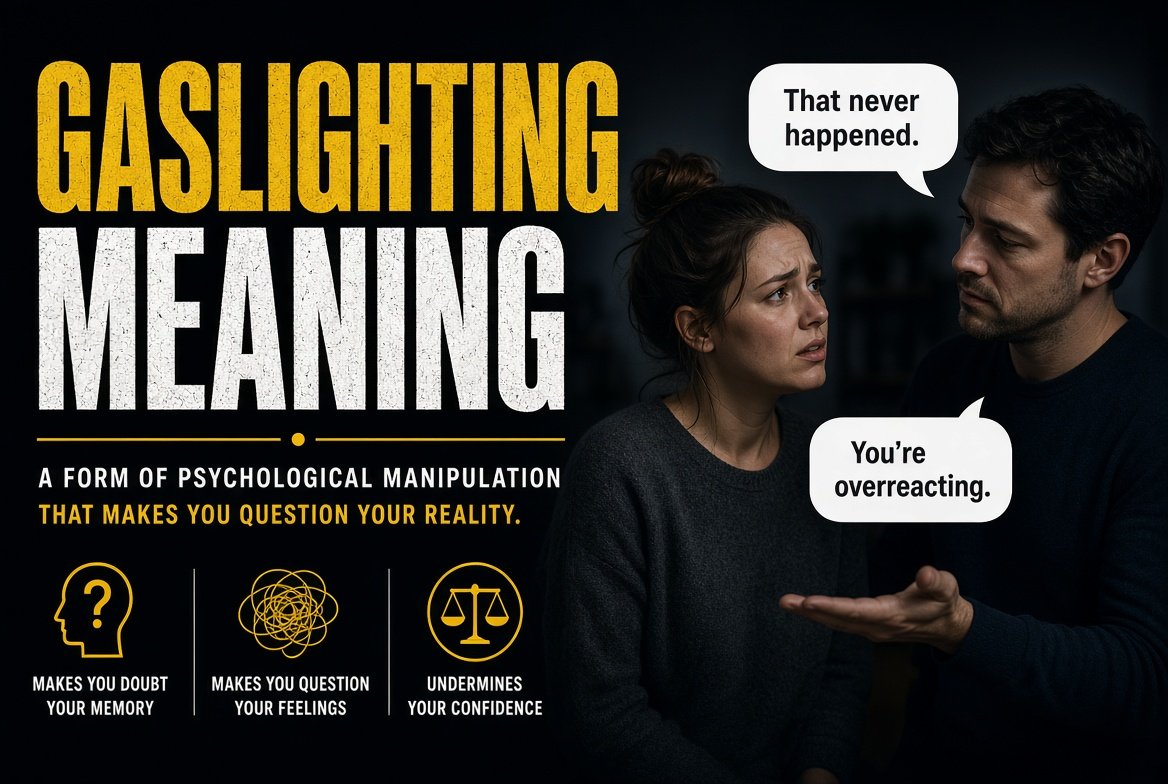
In simple English, gaslighting means trying to make another person doubt their own memory, feelings, understanding, or perception of events. It usually involves repeated manipulation rather than one simple disagreement. A person may deny something that happened, change the story, dismiss another person’s concerns, or insist that the other person is remembering events incorrectly.
Gaslighting can be difficult to recognize because it often happens gradually. The person experiencing it may begin questioning themselves instead of questioning the behavior around them. Learning the meaning, examples, pronunciation, history, and common uses of the term can make the concept easier to understand.
What Is the Gaslighting Meaning?
The gaslighting meaning is the use of psychological manipulation to make someone question their own understanding of reality, memory, feelings, or experiences. The term is generally associated with repeated behavior designed to create uncertainty and make another person less confident in their own judgment.
For example, imagine someone clearly remembers that a friend promised to do something. Later, the friend repeatedly says, “I never said that. You always misunderstand me.” If this kind of response happens repeatedly and causes the person to seriously doubt their memory, it may be an example of gaslighting.
It is important to understand that not every disagreement is gaslighting. People can remember the same event differently, misunderstand one another, forget details, or genuinely make mistakes. Gaslighting usually involves a pattern of manipulation rather than an ordinary difference of opinion.
Gaslighting in Simple English
In very simple terms, gaslighting can mean:
“Making someone doubt what they know, remember, feel, or experienced.”
The behavior can involve denying facts, changing explanations, blaming the other person, or repeatedly telling someone that their reactions are unreasonable when there is a genuine reason for concern.
How Do You Pronounce Gaslighting?
The word gaslighting is pronounced approximately like “GASS-light-ing.”
The word comes from gaslight, which refers to a type of lamp that uses gas for illumination. The term later developed a figurative meaning connected with psychological manipulation.
What Is the Origin of the Word Gaslighting?
The origin of the word gaslighting comes from the stage play Gas Light, written by British playwright Patrick Hamilton. The play was first produced in the nineteen-thirties and later adapted into films.
The story involves a husband whose behavior causes his wife to question her perception and memory. Among the events in the story are changes involving the home’s gas lights. When his wife notices the lights changing, he attempts to convince her that she is imagining what she sees.
This basic idea gave rise to the modern figurative use of “gaslighting.” Over time, the word moved beyond entertainment and became a widely used term for manipulative behavior that causes someone to doubt their own perception.
Why Is It Called Gaslighting?
The name comes from the gas lights featured in the story. The manipulation surrounding those lights became a memorable example of someone attempting to convince another person that something they clearly noticed was not actually happening.
Today, the word is no longer limited to situations resembling the original story. It can describe certain patterns of manipulation in personal relationships, workplaces, families, friendships, and other social situations.
Common Examples of Gaslighting
Understanding examples can make the gaslighting meaning much easier to recognize. The following examples are general situations rather than diagnoses of any particular person.
Denying Something That Clearly Happened
A person may repeatedly deny saying or doing something even when there is strong evidence that the event occurred.
For example:
“I never said that. You completely imagined the conversation.”
One disagreement does not automatically mean gaslighting. However, repeated denial used to make someone distrust their own memory can be part of gaslighting.
Changing the Story
Another example involves changing an explanation whenever the original story no longer makes sense.
Someone might first say they were at one location and later insist they said something completely different. When questioned, they may accuse the other person of being confused rather than addressing the contradiction.
Dismissing Feelings
Gaslighting can also involve repeatedly dismissing someone’s emotions.
Statements such as “You’re too sensitive,” “You’re making a big deal out of nothing,” or “You’re always overreacting” can sometimes be used manipulatively. However, these phrases alone do not prove gaslighting. Context and repeated patterns matter.
Blaming the Other Person
A manipulative person may avoid responsibility by making the other person responsible for the problem.
For example, instead of discussing why a hurtful comment was made, they might say, “You made me say it because you are impossible to deal with.”
This shifts attention away from the original behavior.
Making Someone Doubt Their Memory
Repeatedly telling someone that they remember everything incorrectly can cause them to become uncertain about their own experiences.
A person might eventually start asking others for confirmation about ordinary events because they no longer trust their own recollection.
Gaslighting in Relationships
The term is often used when discussing romantic relationships, but gaslighting can occur in many types of relationships. In an unhealthy relationship, one person may repeatedly manipulate the other person’s understanding of events.
For example, someone may deny hurtful behavior, rewrite conversations, or insist that concerns are completely imaginary. Over time, the other person may become hesitant to express themselves because they expect their perspective to be rejected.
Healthy relationships do not require two people to remember every event in exactly the same way. People can disagree respectfully. A healthy disagreement allows both people to discuss what happened without deliberately trying to undermine the other’s sense of reality.
Gaslighting in Friendships
Gaslighting can also appear in friendships. A friend might repeatedly deny things they said, make another friend feel guilty for raising reasonable concerns, or insist that problems exist only because the other person is “too sensitive.”
Again, one argument or misunderstanding is not enough to label a friendship as gaslighting. Friendship conflicts are normal. The important question is whether there is a continuing pattern of manipulation and denial.
Good friendships allow people to communicate honestly, admit mistakes, apologize, and respect different perspectives.
Gaslighting at Work
The gaslighting meaning can also apply to certain workplace situations. For example, a colleague or supervisor might repeatedly deny giving instructions, change what they previously agreed to, or insist that an employee misunderstood important conversations.
However, workplace disagreements can have many causes, including poor communication, unclear instructions, memory differences, or organizational problems. It is therefore better to consider the full pattern rather than immediately using the label “gaslighting.”
Keeping clear records of important workplace instructions and decisions can help reduce misunderstandings and make communication more precise.
Gaslighting vs. Lying
Gaslighting and lying are related concepts, but they are not exactly the same.
A lie generally involves intentionally giving false information. Gaslighting is broader. It refers to a pattern of manipulation that can include lying, denial, blame, contradiction, and other tactics intended to make another person question their own understanding.
For example, someone could tell one lie without gaslighting anyone. Gaslighting usually involves a continuing pattern that affects the other person’s confidence in their own perception or memory.
Gaslighting vs. Manipulation
Gaslighting is a form of manipulation, but not every form of manipulation is gaslighting.
Manipulation means attempting to influence another person’s behavior, emotions, or decisions, often in an unfair or deceptive way. Gaslighting specifically focuses on undermining someone’s confidence in their perception, memory, feelings, or understanding of events.
This distinction is useful because the word “gaslighting” has become popular online and is sometimes used for almost any unpleasant behavior.
Gaslighting vs. Disagreement
A disagreement is not automatically gaslighting.
Two people can experience the same situation differently. One person may remember an event one way while another remembers it differently. That can happen without malicious intent.
Healthy disagreement usually leaves room for questions and uncertainty. Someone might say, “I remember it differently, but maybe I’m mistaken.” Gaslighting is more concerning when someone repeatedly attempts to make another person distrust their own reality through manipulation.
Synonyms for Gaslighting
There is no perfect synonym for gaslighting because the term describes a specific pattern of behavior. However, depending on the context, related words include:
- Psychological manipulation
- Emotional manipulation
- Reality manipulation
- Deception
- Denial
- Undermining
- Coercion
- Blame-shifting
- Invalidating
- Psychological control
These words are not always interchangeable. For example, “deception” is much broader than gaslighting.
Related Words and Expressions
Some expressions that can appear in discussions about gaslighting include:
- “Making someone doubt themselves”
- “Questioning someone’s perception”
- “Denying what happened”
- “Rewriting events”
- “Invalidating someone’s experience”
- “Making someone question their memory”
These phrases can sometimes explain the idea more clearly than the word itself.
Antonyms of Gaslighting
There is no single exact opposite of gaslighting, but several positive behaviors contrast with it.
Possible antonyms or contrasting ideas include:
- Honesty
- Validation
- Respect
- Transparency
- Accountability
- Open communication
- Trust
- Empathy
- Understanding
- Mutual respect
Instead of trying to make someone doubt their experience, healthy communication allows people to discuss different perspectives honestly.
How Gaslighting Is Used in Everyday Language
The word gaslighting has become common in everyday conversations, particularly online. People may use it when talking about relationships, politics, workplaces, family conflicts, entertainment, or public debates.
For example, someone might say:
“He kept denying what happened, and it made me question my own memory.”
Another example is:
“The conversation felt manipulative because she repeatedly insisted that I imagined the entire situation.”
The term is especially common on social media, where discussions about emotional health and relationships have become widespread.
When Should You Use the Word Gaslighting?
Use the word carefully when describing a situation. It is most useful when there is evidence of a repeated pattern in which someone is deliberately or persistently undermining another person’s confidence in their perception or memory.
If two people simply disagree, terms such as “misunderstanding,” “conflict,” or “different perspectives” may be more accurate.
Using precise language matters because calling every disagreement “gaslighting” can make the term less meaningful and can make ordinary communication problems appear more serious than they are.
Signs That a Conversation May Be Gaslighting
There is no single statement that proves someone is gaslighting another person. Instead, look at the broader pattern.
Possible warning signs include:
- Repeated denial of events you clearly remember
- Frequent rewriting of previous conversations
- Persistent blame-shifting
- Being told that your feelings are always unreasonable
- Pressure to distrust your own memory
- Repeated contradictions designed to confuse you
- Refusal to acknowledge obvious mistakes
- Feeling increasingly uncertain about your own judgment
One or two of these experiences can occur in normal disagreements. A repeated pattern is more significant.
Why Is Gaslighting Harmful?
Gaslighting can be harmful because confidence in one’s own judgment is an important part of everyday life. People rely on their memories, observations, emotions, and decisions when communicating with others.
When someone repeatedly undermines those abilities, the person experiencing it may become confused or hesitant. They might start depending heavily on another person’s version of events instead of trusting their own reasonable observations.
Recognizing the pattern can be an important first step toward healthier communication and stronger boundaries.
How Can Someone Respond to Gaslighting?
If a person feels that someone is repeatedly trying to undermine their perception, it can help to slow down the conversation rather than trying to win every argument.
Writing down important events, saving relevant messages, or discussing the situation with a trusted person can help someone organize what they remember. It is also reasonable to say, “I remember the situation differently, and I do not agree with your description.”
A person does not need to prove every detail immediately. Maintaining healthy boundaries and seeking support from trustworthy people can be useful when communication becomes consistently confusing or distressing.
Why the Term Is Sometimes Misused
Because gaslighting has become a popular word, it is sometimes used incorrectly. Someone disagreeing with you, correcting you, forgetting something, or expressing a different opinion is not necessarily gaslighting.
The original concept is more specific. It involves manipulation that causes someone to question their own perception or understanding. The intention and pattern can matter, although it may not always be possible to know another person’s private intentions.
Using the term carefully makes it more useful. Instead of labeling every difficult conversation as gaslighting, it is often better to describe exactly what happened.
Gaslighting Meaning in Social Media
On social media, the word gaslighting is frequently used in discussions about relationships, public figures, workplace culture, and online arguments.
The internet has helped the term become widely recognized, but it has also encouraged broader and sometimes inaccurate usage. A disagreement in a comment section is not necessarily gaslighting. Someone having a different opinion is not automatically manipulating another person’s reality.
Understanding the original concept can help people use the word more accurately.
Frequently Asked Questions About Gaslighting Meaning
What does gaslighting mean in simple words?
Gaslighting means repeatedly manipulating someone in a way that makes them question their own memory, feelings, perception, or understanding of events.
Is gaslighting the same as lying?
No. Lying means giving false information, while gaslighting describes a broader pattern of manipulation that can involve lying, denial, blame, contradiction, and attempts to undermine another person’s confidence in their own perception.
Is every disagreement gaslighting?
No. People can honestly remember events differently or have different opinions. A disagreement becomes more concerning when there is a repeated pattern of manipulation intended to make someone doubt their own experience.
Can gaslighting happen between friends?
Yes. Gaslighting is not limited to romantic relationships. It can occur between friends, family members, colleagues, or other people who interact regularly.
Can parents gaslight their children?
Manipulative behavior can occur in family relationships, including between parents and children. However, it is important to consider the entire pattern rather than labeling a single disagreement as gaslighting.
What is the opposite of gaslighting?
There is no exact one-word antonym. Honesty, validation, transparency, accountability, empathy, and respectful communication are behaviors that contrast with gaslighting.
Where did the word gaslighting come from?
The term comes from Gas Light, a play by Patrick Hamilton. The story helped establish the idea of deliberately causing another person to question their perception of reality.
Why is gaslighting difficult to recognize?
It can be difficult to recognize because it may develop gradually. Repeated denial and blame can make a person increasingly uncertain about their own memory or judgment.
Is saying “you’re too sensitive” always gaslighting?
No. A single statement does not automatically constitute gaslighting. Context, frequency, intent, and the overall communication pattern are important.
How can I explain gaslighting to someone?
A simple explanation is: “Gaslighting is when someone repeatedly manipulates another person into doubting their own memory, feelings, perception, or understanding of what happened.”
Final Thoughts on Gaslighting Meaning
The gaslighting meaning is best understood as a pattern of psychological manipulation that can make someone question their own memory, perception, feelings, or understanding of events. The term has its roots in the story Gas Light, but its modern use applies to many different social situations.
Knowing the difference between gaslighting and ordinary disagreement is important. People naturally remember things differently, misunderstand one another, and make mistakes. Gaslighting is more specific and involves a repeated pattern of undermining another person’s confidence in their own experience.
Understanding the word can help people communicate more clearly and recognize unhealthy patterns. At the same time, using the term carefully prevents it from becoming a label for every conflict. Healthy relationships are built on honesty, accountability, respect, empathy, and the freedom to express different perspectives without being deliberately made to doubt reality.