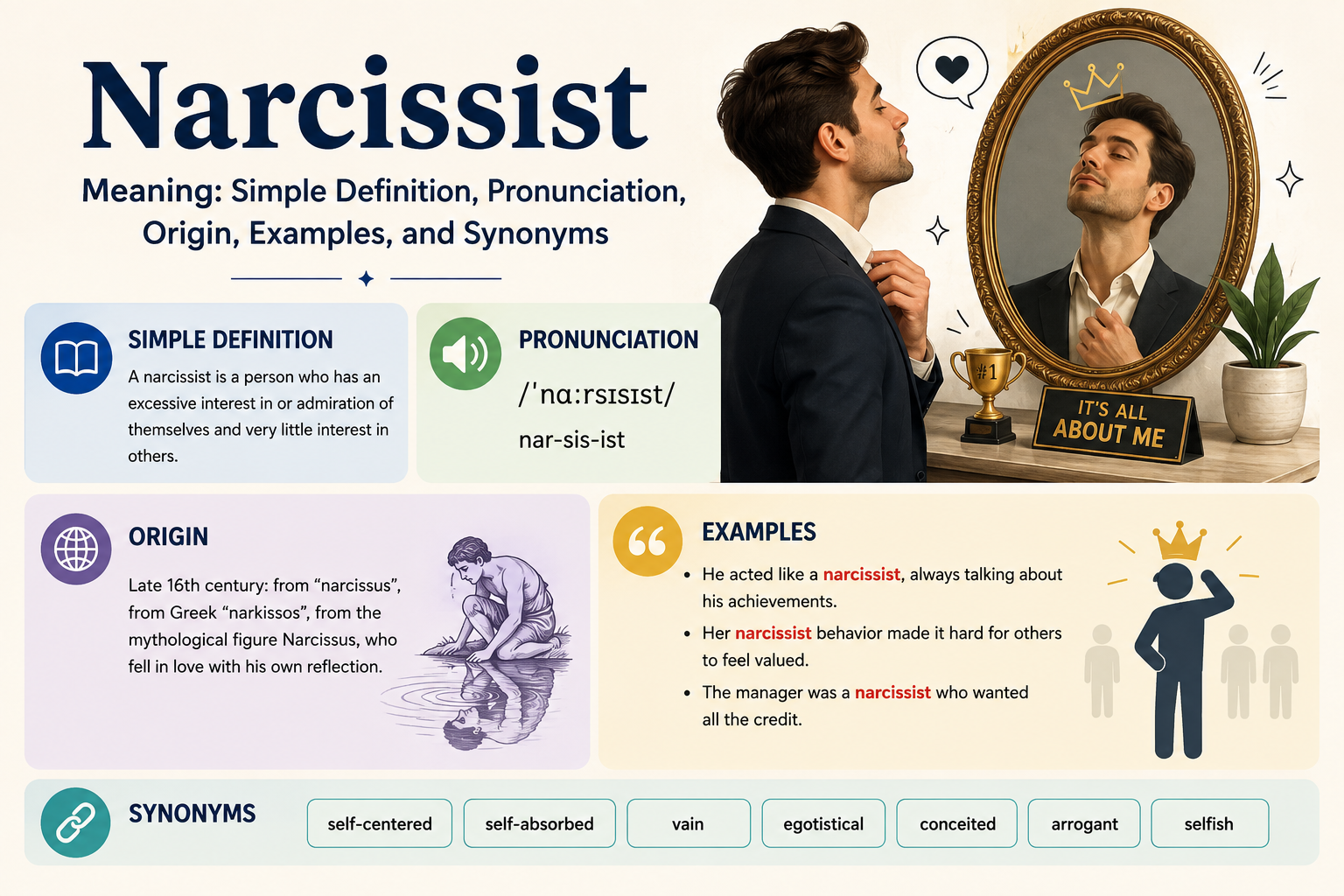
Narcissist Meaning: The word narcissist is commonly used to describe someone who is very focused on themselves, especially someone who has an exaggerated sense of self-importance or strongly seeks admiration. In everyday English, the word can describe a person who seems extremely self-centered, vain, or overly concerned with their own image. Merriam-Webster defines a narcissist as an individual showing narcissism, including someone who is extremely self-centered or has an exaggerated sense of self-importance.
However, narcissist does not automatically mean that someone has a mental health disorder. People sometimes use the word casually to describe selfish or attention-seeking behavior, while narcissistic personality disorder (NPD) is a specific clinical condition that can only be diagnosed by a qualified professional. Understanding this difference helps people use the term accurately and respectfully.
What Does Narcissist Mean?
A narcissist is generally a person who is excessively focused on themselves, their importance, their appearance, achievements, or how other people see them. They may strongly want praise and attention and may have difficulty considering other people’s feelings in certain situations.
In everyday conversation, calling someone a narcissist usually means that the speaker believes the person is unusually self-centered. For example, if someone constantly turns every conversation back to themselves and expects everyone to admire them, another person might describe them as a narcissist.
The meaning can change slightly depending on context. In casual speech, the word is often an insult or criticism. In psychology, however, narcissism is a much broader concept involving patterns of thoughts, emotions, and behavior. Merriam-Webster also distinguishes the general meaning from the medical sense connected with narcissism or narcissistic personality disorder.
Narcissist Pronunciation
The word narcissist is pronounced approximately:
NAR-suh-sist
The dictionary pronunciation is represented as ˈnär-sə-sist.
narcissist (NAR-suh-sist)
The related adjective narcissistic is pronounced approximately nar-suh-SIS-tik.
Related Word Forms
Here are some common forms of the word:
| Word | Meaning |
| Narcissist | A person displaying narcissistic traits |
| Narcissism | Excessive self-focus or self-importance |
| Narcissistic | Describing behavior related to narcissism |
| Narcissistically | In a narcissistic manner |
These words are related but are not always interchangeable.
Origin of the Word Narcissist
The word narcissist comes from narcissism, which ultimately comes from the name Narcissus, a figure from Greek mythology. The myth tells of Narcissus, who became fascinated with his own reflection.
This story became associated with excessive self-love and self-absorption. From this idea developed the modern concept of narcissism. Merriam-Webster records narcissism as dating to the early nineteenth century and narcissist as a noun from 1917.
The connection with Narcissus explains why the modern word is linked to excessive self-admiration. The name itself has ancient Greek roots, although the modern psychological meaning developed much later.
What Is Narcissism?
Narcissism refers broadly to excessive self-focus, self-admiration, or an exaggerated sense of one’s own importance. Merriam-Webster lists related concepts such as egoism, egocentrism, vanity, and self-absorption.
Some degree of self-confidence is normal and healthy. Being proud of an accomplishment, enjoying compliments, or caring about your appearance does not automatically make someone narcissistic.
The concern arises when self-focus becomes extreme or repeatedly interferes with relationships, responsibilities, or a person’s ability to understand other people’s perspectives.
Narcissist vs. Narcissistic Personality Disorder
One of the most important things to understand about the narcissist meaning is that the everyday word and a clinical diagnosis are not identical.
People may casually call someone a narcissist because that person appears selfish, arrogant, controlling, or attention-seeking. That description does not prove that the person has narcissistic personality disorder.
Narcissistic personality disorder is a recognized mental health condition involving a persistent pattern of narcissistic traits that significantly affects a person’s functioning and relationships. A diagnosis requires professional assessment rather than a checklist from social media or a casual observation.
This distinction matters because personality is complex. A person can behave selfishly at one moment without having a personality disorder. Likewise, someone can have narcissistic traits without meeting the criteria for a clinical diagnosis.
Common Characteristics Associated With Narcissistic Behavior
Narcissistic behavior can appear in different ways. Not every person who displays one of these behaviors should be labeled a narcissist.
Excessive Need for Admiration
A person with strong narcissistic traits may place great importance on praise and recognition. They might frequently seek compliments or become uncomfortable when they are not receiving attention.
For example, someone might repeatedly talk about their achievements and expect others to praise them even when the conversation is supposed to focus on someone else.
Strong Sense of Self-Importance
Another common characteristic is an exaggerated belief in one’s own importance, abilities, or status.
A person might believe they deserve special treatment simply because they consider themselves more talented, intelligent, attractive, or successful than other people.
Difficulty Considering Other Perspectives
Some people with strong narcissistic traits may struggle to recognize or appreciate another person’s feelings.
This does not mean they are incapable of understanding emotions. Rather, their own needs and opinions may repeatedly take priority in particular situations.
Sensitivity to Criticism
Although someone may appear extremely confident, criticism can sometimes be difficult for a person with strong narcissistic traits to handle.
They may react defensively when their abilities or behavior are questioned. The response can vary greatly from person to person.
Focus on Image
A strong concern with reputation, status, appearance, or public image can also be associated with narcissistic behavior.
For example, someone might care intensely about how successful they appear to other people, even when their private circumstances are different.
Examples of Narcissist in a Sentence
Understanding the word becomes easier when you see it used naturally.
Everyday Examples
- “He acted like a narcissist because he kept making every conversation about himself.”
- “Calling someone a narcissist is a strong criticism, so it is important to consider the context.”
- “Her friend described her as a narcissist because she constantly demanded attention.”
- “Being confident does not automatically make someone a narcissist.”
- “The character in the movie was written as a narcissist who wanted everyone to admire him.”
These examples show how the word is normally used to describe a person’s behavior or personality.
Example in a More Formal Context
A writer might say:
“The term narcissist is often used in everyday conversation to describe someone who appears extremely self-centered.”
This is more precise because it does not automatically claim that the person has a clinical diagnosis.
Narcissist Synonyms
The best synonym depends on the exact meaning intended.
Common related words include:
- Egotist
- Egoist
- Egocentric person
- Self-centered person
- Self-absorbed person
- Vain person
- Egomaniac
- Self-important person
- Conceited person
- Arrogant person
Merriam-Webster specifically lists terms such as egotist, egomaniac, egoist, and egocentric among its synonyms.
However, these words are not perfect replacements. Someone can be arrogant without being narcissistic, and someone can be vain without having an exaggerated sense of personal importance.
Narcissist Antonyms
There is no single perfect opposite of narcissist, but several words describe qualities that contrast with narcissistic behavior.
Possible antonyms include:
- Humble person
- Selfless person
- Considerate person
- Empathetic person
- Unassuming person
- Modest person
- Generous person
- Altruistic person
For example, if narcissistic behavior is associated with excessive self-focus, selfless can describe someone who regularly considers other people’s needs.
Still, real people rarely fit neatly into one category. Someone can be confident and humble at the same time, just as someone can occasionally act selfishly without being narcissistic.
Narcissist vs. Selfish Person
A selfish person generally puts their own needs or interests before those of others. Everyone can behave selfishly from time to time.
A narcissist, in the everyday sense, is usually described as having a broader and more noticeable pattern of excessive self-focus, self-importance, or desire for admiration.
For example, refusing to share something once might be selfish. Constantly believing that your needs are more important than everyone else’s and expecting special treatment could be described as narcissistic behavior.
The difference is mainly about pattern, intensity, and context.
Narcissist vs. Confident Person
Confidence and narcissism are also different.
A confident person can feel proud of their abilities while still recognizing other people’s strengths. They can accept that they make mistakes and can appreciate constructive feedback.
A narcissistic person, in the everyday sense, may be excessively focused on superiority, admiration, or personal importance.
Confidence says, “I know I can do this.”
Narcissistic self-importance may sound more like, “I am better than everyone else, and everyone should recognize it.”
That distinction is useful because healthy confidence should not be confused with narcissism.
How the Word Narcissist Is Used Today
The word narcissist has become increasingly common in everyday conversations, particularly when people discuss friendships, family relationships, school environments, workplaces, and social media.
People may use it when describing someone who constantly seeks attention, dominates conversations, exaggerates achievements, or appears unable to accept criticism.
However, popular use can sometimes make the word too broad. A person who is rude, selfish, immature, or simply confident is not automatically a narcissist.
Using precise language can make communication more helpful. Instead of immediately labeling someone, it can be clearer to describe the actual behavior: “He constantly interrupts people,” “She expects special treatment,” or “They rarely consider other people’s opinions.”
Why Context Matters When Using Narcissist
Words describing personality can strongly affect how people view someone. Calling a person a narcissist can sound like a judgment about their entire character.
For that reason, context matters. If the goal is to explain a problem, describing specific behavior is often more useful than applying a broad label.
For example, saying “He frequently dismisses other people’s opinions” gives more information than simply saying “He’s a narcissist.”
This approach also avoids making an unsupported mental health diagnosis.
Common Mistakes About Narcissist Meaning
Mistake: Every Self-Centered Person Has NPD
This is one of the biggest misunderstandings. The everyday word narcissist does not automatically mean someone has narcissistic personality disorder.
Mistake: Confidence Equals Narcissism
Confidence by itself is not narcissism. Healthy confidence can exist alongside humility, empathy, and respect for others.
Mistake: One Bad Action Proves Narcissism
Everyone can behave selfishly, defensive, or inconsiderately sometimes. A single incident is not enough to understand someone’s overall personality.
Mistake: Narcissist and Narcissistic Mean Exactly the Same Thing
They are closely related, but narcissist is commonly used as a noun for a person, while narcissistic is an adjective describing something associated with narcissism. Merriam-Webster defines narcissistic as relating to or characterized by narcissism.
Frequently Asked Questions About Narcissist Meaning
What does narcissist mean in simple English?
A narcissist is generally a person who is extremely focused on themselves and may have an exaggerated sense of importance or a strong desire for admiration.
Is narcissist a bad word?
It can be. In everyday conversation, calling someone a narcissist is usually a criticism. The word can also have a psychological meaning, so using it as a casual diagnosis is not appropriate.
What is the difference between narcissist and narcissistic?
Narcissist is usually a noun referring to a person. Narcissistic is an adjective describing behavior, attitudes, or characteristics associated with narcissism.
What is the opposite of narcissist?
There is no exact single opposite, but words such as humble, selfless, considerate, empathetic, and unassuming can describe qualities that contrast with narcissistic behavior.
Where does the word narcissist come from?
The word is connected to Narcissus, a figure from Greek mythology associated with excessive fascination with his own reflection. The modern term developed through the concept of narcissism. Merriam-Webster records the first known use of narcissist as a noun in 1917.
Is narcissist the same as selfish?
Not exactly. Selfishness means putting your own interests ahead of others. Narcissism generally refers to a broader pattern of excessive self-focus, self-importance, or desire for admiration.
Can a confident person be called a narcissist?
Someone can be confident without being narcissistic. Confidence involves belief in one’s abilities, while narcissism generally involves excessive self-focus or exaggerated self-importance.
Can you tell if someone has narcissistic personality disorder from their behavior?
Not reliably. A mental health diagnosis requires appropriate professional evaluation. Internet descriptions and isolated behaviors are not enough to diagnose another person.
Final Thoughts on Narcissist Meaning
The simplest narcissist meaning is a person who is excessively self-focused and may have an exaggerated sense of self-importance or a strong need for admiration. The word is commonly used in everyday English, but it also has connections to psychological concepts involving narcissism.
The word comes from the story of Narcissus and has developed into a modern term used in both ordinary conversation and psychology. It is important, however, not to confuse the everyday label narcissist with the clinical diagnosis of narcissistic personality disorder.
Understanding the difference makes the word easier to use accurately. When discussing someone’s behavior, focusing on specific actions and patterns is often more informative than applying a broad label.