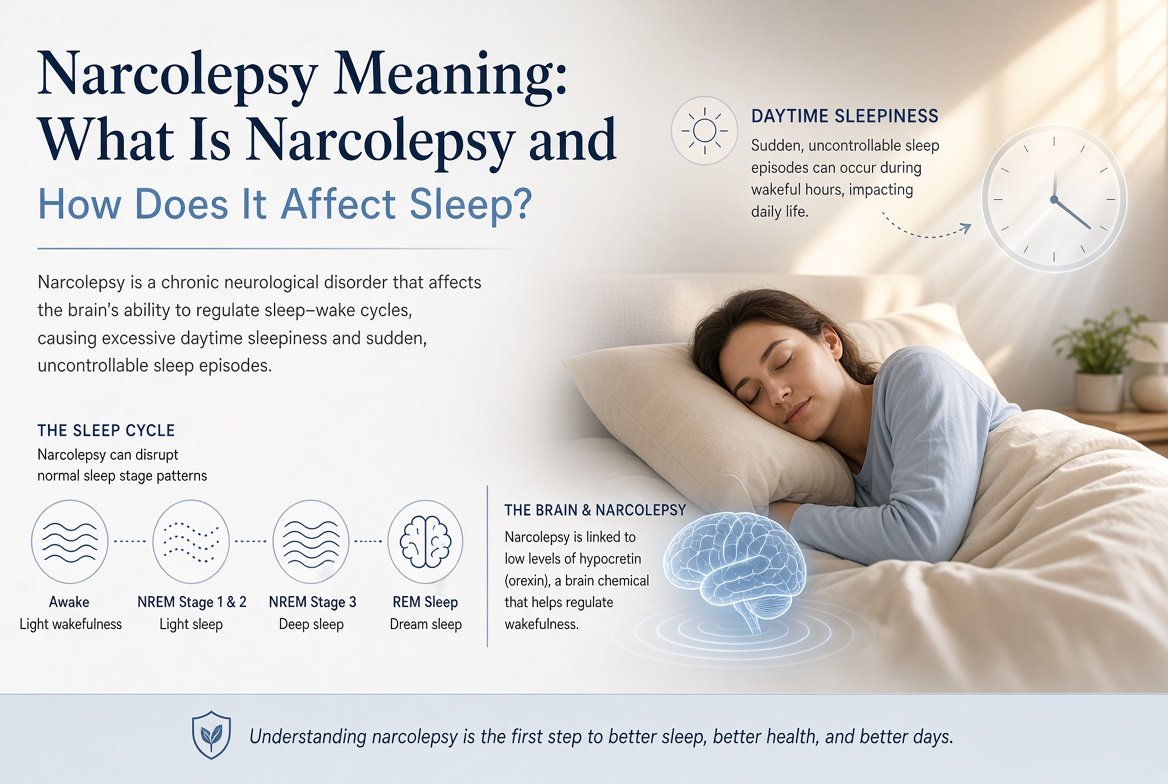
Narcolepsy Meaning is a chronic sleep disorder that affects the brain’s ability to control the normal sleep-wake cycle. In simple English, narcolepsy means a person can become extremely sleepy during the day and may fall asleep suddenly, even when they are trying to stay awake. It can also cause unusual sleep-related experiences, including temporary muscle weakness, sleep paralysis, and vivid dream-like experiences.
Narcolepsy is more than simply feeling tired after a busy day or not getting enough sleep. Someone with narcolepsy may experience an overwhelming need to sleep that is difficult to control. The condition can affect school, work, concentration, social activities, and everyday routines, but proper medical care and practical sleep-management strategies can help people manage its effects.
Medical note: This article explains narcolepsy in simple language for general education. If someone regularly experiences uncontrollable daytime sleepiness or sudden sleep episodes, they should speak with a qualified healthcare professional rather than trying to diagnose the condition themselves.
What Does Narcolepsy Mean?
The simple narcolepsy meaning is a long-term neurological sleep disorder that causes excessive daytime sleepiness and problems with the normal control of sleep and wakefulness. A person with narcolepsy may feel very sleepy during the day, experience sudden sleep episodes, or have difficulty maintaining normal alertness.
Narcolepsy can also affect nighttime sleep. Someone may wake frequently, have vivid dreams, or experience sleep paralysis around the transition between sleeping and waking. Some people also experience cataplexy, a temporary loss of muscle control that can happen after strong emotions such as laughter, excitement, anger, or surprise.
The important point is that narcolepsy is a medical condition, not simply laziness or a lack of discipline. A person with narcolepsy may genuinely struggle to stay awake even when they want to remain alert.
Narcolepsy Pronunciation
The word narcolepsy is commonly pronounced like “NAR-kuh-lep-see.”
The pronunciation may sound slightly different depending on the speaker’s accent, but the main parts are generally similar: nar + kuh + lep + see.
The word is a medical noun. The related adjective narcoleptic is used to describe something associated with narcolepsy, although in respectful everyday language it is usually better to say “a person with narcolepsy.”
What Is the Origin of the Word Narcolepsy?
The word narcolepsy has a medical history dating back to the nineteenth century. The term was introduced in French by physician Jean-Baptiste-Édouard Gélineau in 1880. It was formed from Greek roots associated with numbness or drowsiness and an attack or seizure.
The name reflects the sudden nature of the sleep episodes associated with the disorder. Historical medical descriptions helped establish narcolepsy as a distinct condition, and later research greatly expanded understanding of how the brain regulates sleep, wakefulness, and rapid eye movement, or REM, sleep.
Today, scientists understand narcolepsy much better than they did when the term was first created. Research has connected many cases, particularly narcolepsy with cataplexy, with reduced levels of hypocretin, also called orexin, a brain chemical involved in maintaining wakefulness.
What Are the Main Symptoms of Narcolepsy?
Narcolepsy does not look exactly the same in everyone. Some people experience several symptoms, while others have only some of the typical features. Symptoms can also develop gradually, which may make the condition difficult to recognize at first.
Excessive Daytime Sleepiness
One of the most important signs is excessive daytime sleepiness. A person may feel unusually sleepy during the day even after what seems like enough nighttime sleep.
This sleepiness can interfere with concentration, studying, conversations, work, hobbies, and other everyday activities. It may sometimes be mistaken for laziness or a lack of interest, even though the person is dealing with a genuine neurological sleep problem.
Sleep Attacks
A sleep attack refers to a sudden and difficult-to-control episode of sleepiness or sleep. These episodes can occur during different activities and may last from a very short period to several minutes.
For someone experiencing this symptom, staying awake is not simply a matter of trying harder. The brain is having difficulty maintaining normal wakefulness.
Cataplexy
Cataplexy is a temporary loss of muscle control. It can be triggered by strong emotions such as laughter, surprise, excitement, or anger.
The person generally remains conscious during the episode. The effects can vary, with some people experiencing mild weakness and others having more noticeable difficulty controlling their muscles. Cataplexy is particularly associated with narcolepsy type one.
Sleep Paralysis
Some people with narcolepsy experience sleep paralysis, which means being temporarily unable to move or speak while falling asleep or waking up.
Sleep paralysis can feel frightening, but the episode itself is temporary. It occurs because features of REM sleep can overlap with the transition between sleep and wakefulness.
Vivid Dreams and Hallucinations
Narcolepsy may cause vivid dream-like experiences when a person is falling asleep or waking up. These are sometimes called hypnagogic or hypnopompic hallucinations, depending on when they occur.
Although the experiences can feel very real, they are connected to abnormal transitions between sleep and wakefulness. They should not automatically be interpreted as evidence of a separate mental health condition.
Disrupted Nighttime Sleep
Narcolepsy does not mean someone sleeps perfectly at night and simply becomes sleepy during the day. Many people with the condition also have fragmented or disturbed nighttime sleep.
They may wake repeatedly, have vivid dreams, or find it difficult to maintain continuous sleep. This can make the overall sleep-wake pattern even more complicated.
What Causes Narcolepsy?
The exact cause of narcolepsy is not completely understood. However, researchers have identified important biological factors.
In many people with narcolepsy, especially those with cataplexy, levels of hypocretin or orexin are very low. This chemical helps the brain maintain wakefulness. Research suggests that, in some cases, the immune system may mistakenly damage cells involved in producing hypocretin.
Family history and genetics can also play a role. Having certain genetic factors may increase a person’s likelihood of developing narcolepsy, although genetics alone do not explain every case.
Narcolepsy can also sometimes occur secondary to another condition or injury affecting areas of the brain involved in sleep regulation. Possible examples include certain brain injuries, tumors, multiple sclerosis, or encephalitis.
What Are the Types of Narcolepsy?
Doctors commonly distinguish between narcolepsy type one and narcolepsy type two.
Narcolepsy Type One
Narcolepsy type one is generally associated with excessive daytime sleepiness and cataplexy. Low levels of hypocretin are also strongly associated with this form.
Cataplexy is an important clue because it involves temporary muscle weakness connected with emotional triggers.
Narcolepsy Type Two
Narcolepsy type two involves excessive daytime sleepiness but does not typically include cataplexy.
The distinction between the two types is based on clinical features and specialist testing. A healthcare professional should make the diagnosis rather than relying on symptoms alone.
How Is Narcolepsy Diagnosed?
Narcolepsy can be difficult to identify because excessive sleepiness has many possible causes. A healthcare professional may first ask about sleeping habits, daytime symptoms, medical history, and other possible explanations for tiredness.
A doctor may recommend keeping a sleep diary or completing a sleepiness questionnaire. If narcolepsy is suspected, a referral to a sleep specialist may be appropriate.
Sleep Studies
A specialist may use polysomnography, an overnight sleep study that monitors different aspects of sleep. This can help doctors understand brain activity, breathing, muscle activity, heart activity, and eye movements during sleep.
Another test called the multiple sleep latency test, or MSLT, measures how quickly someone falls asleep during scheduled daytime nap opportunities. It can help specialists identify patterns associated with narcolepsy.
Because other conditions can also cause severe daytime sleepiness, doctors may need to rule out problems such as sleep apnea, certain neurological conditions, thyroid problems, medication side effects, or insufficient sleep.
How Is Narcolepsy Treated?
There is currently no universal cure for narcolepsy, but treatment can reduce symptoms and make daily life easier. The appropriate approach depends on the person’s symptoms, age, health, and other individual factors.
Healthcare professionals may recommend structured sleep habits, planned short naps, and a consistent bedtime and wake-up schedule. Medicines may also be prescribed when symptoms are more troublesome. Because narcolepsy treatments can have important side effects and interactions, medication decisions should be made with a qualified healthcare professional.
For children and teenagers, parents, teachers, and healthcare professionals may also need to work together so that excessive sleepiness is not mistaken for poor effort or lack of attention.
Everyday Examples of Narcolepsy
Understanding examples can make the meaning of narcolepsy easier to remember.
Example:
“Her doctor referred her to a sleep specialist because she had severe daytime sleepiness and repeatedly struggled to stay awake.”
Example:
“His narcolepsy made it difficult to remain alert during long periods of quiet activity.”
Example:
“She learned that narcolepsy is a neurological sleep disorder rather than simply being very tired.”
Example:
“The student explained her narcolepsy to her teacher so her daytime sleepiness would not be misunderstood.”
These examples show how the word is normally used in medical, educational, and everyday discussions.
Narcolepsy Synonyms and Related Terms
Narcolepsy does not have a perfect everyday synonym because it is the specific medical name of a neurological sleep disorder.
Some related terms include:
- Sleep disorder — a broad term covering many conditions involving sleep.
- Sleep-wake disorder — a condition involving problems with the normal timing or regulation of sleep and wakefulness.
- Excessive daytime sleepiness — a major symptom of narcolepsy, but not a synonym for the condition itself.
- Sleep attacks — sudden episodes of overwhelming sleepiness or sleep that can occur with narcolepsy.
- Narcoleptic disorder — a related medical expression.
It is important not to treat terms such as “tiredness” or “fatigue” as exact synonyms. Many people feel tired without having narcolepsy.
Narcolepsy Antonyms
There is no exact antonym for narcolepsy because it is the name of a medical condition rather than a simple descriptive adjective.
However, in ordinary language, concepts that contrast with some of its symptoms include:
- Alertness
- Wakefulness
- Normal sleep-wake regulation
- Being fully awake
- Sustained attention
These are conceptual opposites, not medical antonyms.
For example, “alertness” describes a state of being awake and attentive, while excessive daytime sleepiness describes the opposite type of experience.
Common Usage of the Word Narcolepsy
The word narcolepsy is most often used in medical and health-related contexts. It commonly appears in discussions about sleep disorders, neurological health, daytime sleepiness, sleep studies, cataplexy, and treatment.
Common phrases include:
- narcolepsy symptoms
- narcolepsy diagnosis
- narcolepsy treatment
- narcolepsy causes
- narcolepsy with cataplexy
- narcolepsy sleep attacks
- living with narcolepsy
- narcolepsy and daytime sleepiness
When discussing a person, respectful wording such as “a person with narcolepsy” is generally preferable to defining the person entirely by the condition.
Is Narcolepsy the Same as Being Very Tired?
No. Ordinary tiredness is common and can happen because of a busy schedule, insufficient sleep, stress, illness, or many other reasons.
Narcolepsy involves a persistent problem with the regulation of sleep and wakefulness. Its symptoms can include excessive daytime sleepiness and sudden sleep episodes, and some people also experience cataplexy, sleep paralysis, or unusual dream-like experiences.
This difference matters because assuming that someone with narcolepsy is simply lazy or not trying hard enough can be unfair and inaccurate.
Is Narcolepsy a Lifelong Condition?
Narcolepsy is generally considered a chronic or lifelong condition. Symptoms can vary from person to person, and their intensity may change over time.
Although there is currently no cure that eliminates narcolepsy completely, appropriate treatment and daily management can help reduce its impact.
A diagnosis does not mean someone cannot have meaningful goals, education, friendships, hobbies, or a career. It simply means they may need appropriate medical support and adjustments.
Frequently Asked Questions About Narcolepsy
What does narcolepsy mean in simple English?
Narcolepsy means a long-term sleep-wake disorder in which a person has excessive daytime sleepiness and may experience sudden, difficult-to-control sleep episodes. Some people also have cataplexy, sleep paralysis, or vivid dream-like experiences.
How do you pronounce narcolepsy?
Narcolepsy is commonly pronounced “NAR-kuh-lep-see.” The pronunciation can vary slightly by English accent.
Is narcolepsy a sleep disorder?
Yes. Narcolepsy is a chronic neurological sleep disorder that affects the normal regulation of sleep and wakefulness.
What is the main symptom of narcolepsy?
One of the main symptoms is excessive daytime sleepiness. People may also experience sudden sleep episodes, and some people have cataplexy, sleep paralysis, or vivid dream-like experiences.
Can narcolepsy affect nighttime sleep?
Yes. Narcolepsy can affect nighttime sleep as well as daytime wakefulness. Some people wake frequently or experience vivid dreams and other unusual sleep-related experiences.
Is narcolepsy the same as insomnia?
No. Narcolepsy and insomnia are different sleep disorders. Narcolepsy primarily involves abnormal regulation of sleep and wakefulness with prominent daytime sleepiness, while insomnia involves difficulty falling asleep, staying asleep, or getting adequate sleep despite having the opportunity to sleep.
Can narcolepsy be treated?
Yes. Although there is currently no universal cure, treatments and lifestyle strategies can help control symptoms and improve everyday functioning. A healthcare professional can determine which options are appropriate.
When should someone talk to a doctor about excessive sleepiness?
Anyone who regularly experiences severe daytime sleepiness, uncontrollable sleep episodes, or other unusual sleep-related symptoms should discuss them with a healthcare professional. Similar symptoms can have several different causes, so proper evaluation is important.
Final Thoughts on Narcolepsy Meaning
The simplest narcolepsy meaning is a chronic neurological sleep disorder that makes it difficult for the brain to regulate normal sleep and wakefulness. Excessive daytime sleepiness is a central feature, while some people also experience sleep attacks, cataplexy, sleep paralysis, vivid dream-like experiences, and disrupted nighttime sleep.
The word has an interesting history, dating to the nineteenth century and drawing from Greek roots connected with drowsiness and sudden attacks. Modern research has helped explain the role of hypocretin, also known as orexin, in maintaining wakefulness and has improved the understanding and management of the condition.
Most importantly, narcolepsy should not be confused with ordinary tiredness or laziness. If someone regularly struggles to stay awake during the day or experiences sudden sleep episodes, getting professional medical advice is a sensible next step. With proper evaluation, support, and treatment, people with narcolepsy can work toward managing their symptoms and participating fully in everyday life.