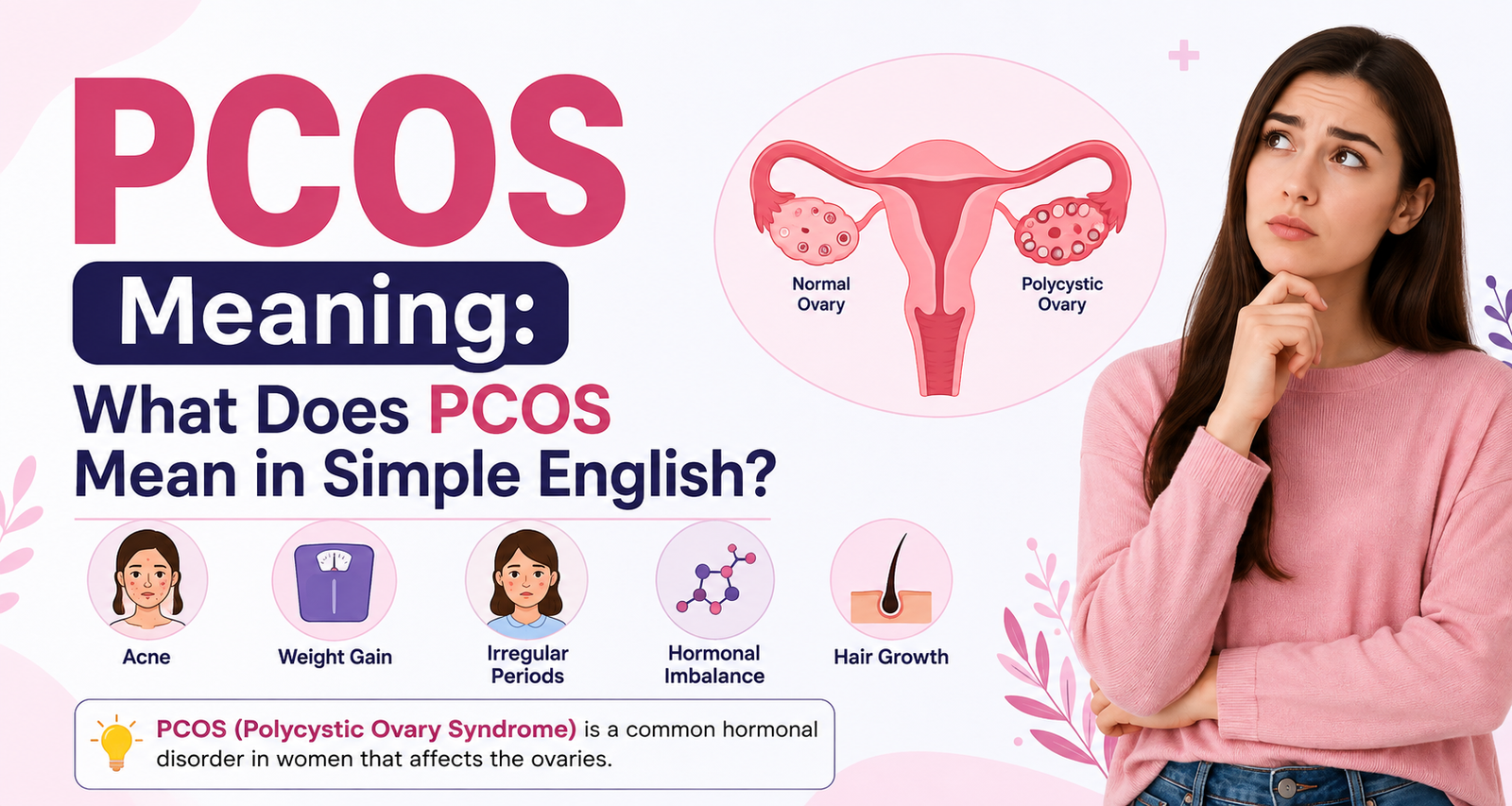
If you have searched for PCOS meaning, you may have seen the term in a medical article, social media post, health report, or conversation about periods and hormones. PCOS stands for polycystic ovary syndrome. It is a common hormonal and metabolic condition that can affect the ovaries, menstrual cycles, skin, hair growth, and fertility.
In simple English, PCOS means that certain hormones and body processes are not working in their usual balance. This can interfere with ovulation and may cause irregular periods, acne, increased facial or body hair, scalp hair thinning, or difficulty becoming pregnant. Not everyone with PCOS experiences the same symptoms, and having one symptom does not automatically mean someone has PCOS.
This guide explains the PCOS meaning, pronunciation, word origin, common usage, examples, related terms, and frequently asked questions in clear language. It is designed to help readers understand the term without confusing medical information or unnecessary jargon.
What Does PCOS Mean?
PCOS means polycystic ovary syndrome. It is a condition involving hormonal and metabolic changes that can affect how the ovaries function. One of the most noticeable effects can be irregular ovulation, which may lead to irregular or missed periods.
The name can be confusing because having PCOS does not simply mean that someone has ordinary ovarian cysts. The ovaries can contain many small follicles, which are structures where eggs develop. Some people with PCOS may have this appearance on an ultrasound, while others can meet diagnostic criteria without having a polycystic appearance of the ovaries.
In everyday language, you can think of PCOS as a hormone-related condition that can affect periods, ovulation, and other parts of the body. Its effects can differ considerably from one person to another.
PCOS Meaning in Simple English
The simplest definition of PCOS is:
PCOS is a hormonal condition that can affect periods, ovulation, hormone levels, and the way the body responds to insulin.
The word syndrome means a group of signs and symptoms that tend to occur together. PCOS is therefore not defined by one single symptom. A healthcare professional considers several factors when evaluating whether someone may have the condition.
For example, one person might mainly experience irregular periods, while another might notice increased facial hair or acne. Someone else may discover PCOS while being evaluated for difficulty becoming pregnant. Symptoms can be mild, significant, or sometimes absent.
What Does Each Letter in PCOS Stand For?
PCOS is an abbreviation made from the words polycystic ovary syndrome.
- P = Poly
- C = Cystic
- O = Ovary
- S = Syndrome
What Does “Polycystic” Mean?
“Polycystic” literally suggests the presence of many cyst-like structures. However, the term can create a misleading impression when people first hear it.
In PCOS, the small structures seen in the ovaries are generally follicles, which contain developing eggs. They are not necessarily the same thing as the larger ovarian cysts people may think of when they hear the word “cyst.”
What Does “Ovary” Mean?
An ovary is one of the reproductive organs that stores and develops eggs and produces hormones involved in the menstrual cycle.
What Does “Syndrome” Mean?
A syndrome is a collection of signs, symptoms, or biological changes that occur together. That is why PCOS is not identified simply by one symptom.
How Do You Pronounce PCOS?
PCOS is normally pronounced by saying each letter separately:
P-C-O-S — “pee-see-oh-ess.”
The full medical term is pronounced:
polycystic ovary syndrome
Knowing the pronunciation can be useful when speaking with a healthcare professional, reading medical information aloud, or discussing the condition with family members.
Origin and History of the Term PCOS
The medical term polycystic ovary syndrome comes from the words used to describe the appearance and function of the ovaries and the collection of related symptoms.
The condition has been recognized in medical literature for many decades. The modern name became widely associated with research describing people who had irregular periods, enlarged ovaries containing multiple small follicles, and signs of increased androgen activity.
Over time, medical understanding of PCOS has changed. Researchers now recognize that PCOS is more complicated than simply having “many cysts.” Hormonal regulation, ovulation, and metabolic factors can all be involved.
This is why the word PCOS is more useful than interpreting its name literally.
Common PCOS Symptoms
PCOS can affect people differently. Some common signs include irregular menstrual periods, increased facial or body hair, acne, scalp hair thinning, and difficulties with ovulation. Weight changes can also occur, although body size alone cannot be used to determine whether someone has PCOS.
Other possible features include skin changes such as darker patches or skin tags. Some people may also experience metabolic problems associated with insulin resistance. Importantly, not everyone with PCOS has every possible symptom.
Irregular Periods
One of the most familiar signs associated with PCOS is an irregular menstrual cycle. Someone may have long gaps between periods, fewer periods than expected, or unpredictable cycles.
Irregular periods can happen for many reasons, so having an irregular cycle does not automatically mean a person has PCOS. A healthcare professional can help determine what may be causing the change.
Acne and Oily Skin
Changes in androgen activity can contribute to acne and oily skin in some people with PCOS. Acne can appear on the face or other areas of the body.
Because acne has many possible causes, it should not be used on its own as proof of PCOS.
Increased Hair Growth
Some people with PCOS develop more noticeable hair growth on areas such as the face, chest, or abdomen. This is often called hirsutism.
Again, increased hair growth can have different causes. A medical evaluation is needed to understand why it is happening.
Scalp Hair Thinning
Hormonal changes associated with PCOS may contribute to thinning hair or hair loss from the scalp in some people. This can be frustrating, but it is one of the symptoms that healthcare professionals may consider when evaluating hormonal conditions.
Fertility Problems
PCOS can interfere with regular ovulation. Because ovulation is important for pregnancy, irregular ovulation can make becoming pregnant more difficult for some people. PCOS is recognized as a common cause of infertility related to irregular ovulation.
However, PCOS does not mean that pregnancy is impossible. Many people with PCOS can become pregnant, sometimes naturally and sometimes with medical support.
What Causes PCOS?
There is no single confirmed cause of PCOS. Researchers believe that genetics, hormone regulation, and metabolic factors may all contribute.
PCOS can run in families, meaning that having a close relative with the condition may increase the likelihood of developing it. Insulin resistance is also associated with PCOS in many people.
The Role of Hormones
Hormones act as chemical messengers throughout the body. In PCOS, changes involving reproductive hormones can affect the normal development of ovarian follicles and ovulation.
Androgens are often called “male hormones,” but everyone produces some androgens. People with PCOS may have higher-than-usual androgen activity, which can contribute to symptoms such as increased facial hair and acne.
The Role of Insulin
Insulin helps the body regulate blood glucose. Insulin resistance happens when the body’s cells do not respond to insulin as effectively as usual.
Insulin resistance is common in PCOS, although it is not present in every person with the condition. Higher insulin levels can influence ovarian hormone activity and contribute to some PCOS-related changes.
Is PCOS the Same as Having Ovarian Cysts?
No. This is one of the most important points when understanding the PCOS meaning.
The name “polycystic” can make people think PCOS is simply a condition involving ovarian cysts. In reality, the small structures associated with PCOS are often follicles containing developing eggs. Also, a person can have ovaries with a polycystic appearance without having the full syndrome.
Therefore, an ultrasound image alone does not necessarily establish that someone has PCOS. Diagnosis depends on the overall clinical picture and appropriate medical assessment.
How Is PCOS Diagnosed?
There is no single test that automatically confirms PCOS for everyone. Healthcare professionals may consider menstrual history, symptoms, hormone levels, medical history, and sometimes an ultrasound examination.
In commonly used diagnostic approaches, clinicians look for features such as irregular ovulation, signs of increased androgen activity, and polycystic ovarian morphology, while also considering other possible explanations for the symptoms.
This is important because symptoms such as irregular periods, acne, or changes in hair growth can occur for many different reasons. Self-diagnosing from an internet search is therefore not reliable.
Is PCOS Treatable?
PCOS is generally considered a long-term condition that can be managed, rather than something with one simple cure. Treatment depends on the person’s symptoms, goals, age, overall health, and whether pregnancy is being considered.
Healthcare professionals may recommend lifestyle measures or medicines to address particular symptoms. Treatments can focus on menstrual regularity, acne, unwanted hair growth, metabolic health, or fertility, depending on individual needs.
People should not start, stop, or change prescription medicines based only on information found online. A qualified healthcare professional can explain which options are appropriate.
PCOS Meaning in Everyday Conversation
People commonly use PCOS as a short form rather than saying the full phrase polycystic ovary syndrome.
For example:
- “My doctor is checking whether I have PCOS.”
- “She has been learning more about PCOS.”
- “Can PCOS cause irregular periods?”
- “I read about PCOS and hormone changes.”
- “My healthcare provider explained what PCOS means.”
In medical records, health websites, social media discussions, and conversations about reproductive health, the abbreviation is much more common than the full name.
Examples of PCOS in a Sentence
Here are simple examples showing how the term can be used naturally:
Example One
“PCOS can cause irregular menstrual cycles.”
This sentence uses PCOS to describe a possible reason for changes in the menstrual cycle.
Example Two
“She talked to her doctor after learning more about PCOS.”
Here, PCOS refers to the medical condition being discussed.
Example Three
“PCOS may affect ovulation and fertility.”
This example highlights one of the ways the condition can affect reproductive function.
Example Four
“Not everyone with PCOS has the same symptoms.”
This is an important point because PCOS can look different from one person to another.
Example Five
“The doctor explained the PCOS meaning in simple language.”
This sentence uses the exact phrase people may search for when they want an easy explanation of the abbreviation.
Synonyms and Related Terms for PCOS
PCOS does not have a perfect everyday synonym because it is the name of a specific medical condition. However, several terms may appear in health information.
Polycystic Ovary Syndrome
This is the full form of PCOS and is the standard expanded name.
Polycystic Ovarian Syndrome
This phrase is sometimes used as an alternative wording. However, polycystic ovary syndrome is the more commonly recognized full name.
Hormonal Disorder
This is a broad descriptive phrase rather than a true synonym. PCOS involves hormonal changes, but many other conditions are also hormonal disorders.
Reproductive Hormone Condition
This is another general description. It can help explain PCOS to someone unfamiliar with medical terminology, but it should not replace the formal name.
Does PCOS Have an Antonym?
PCOS does not have a true antonym.
An antonym is a word with the opposite meaning, such as “hot” and “cold.” PCOS is the name of a medical condition, so there is no single opposite word.
In some contexts, people might describe someone as having regular ovulation or no evidence of PCOS, but these phrases are not antonyms of PCOS. They simply describe a different health situation.
Common Misunderstandings About PCOS
Several myths can make the meaning of PCOS harder to understand.
One common misunderstanding is that everyone with PCOS has ovarian cysts. That is not correct. The condition is broader than the appearance of the ovaries, and diagnostic assessment considers several features.
Another misconception is that PCOS always causes infertility. PCOS can make conception more difficult when ovulation is irregular, but it does not mean that pregnancy is impossible. Many people with PCOS are able to become pregnant.
It is also incorrect to assume that one symptom proves someone has PCOS. Irregular periods, acne, hair changes, and weight changes can all have many causes.
PCOS and Teenagers
PCOS can become noticeable during or after puberty, but symptoms that occur during the teenage years can overlap with normal changes associated with puberty. For this reason, it is especially important not to assume that a teenager has PCOS simply because of acne or irregular periods.
If menstrual changes or other symptoms are persistent or concerning, talking with a parent, guardian, school health professional, doctor, or another trusted healthcare professional can be a good way to get accurate information.
A healthcare professional can consider the person’s age, development, symptoms, medical history, and other possible explanations before deciding whether further evaluation is appropriate.
When Should Someone Talk to a Healthcare Professional?
A person should consider speaking with a healthcare professional if they are concerned about persistent irregular periods, significant changes in hair growth, ongoing acne, unexplained hormonal symptoms, or problems related to fertility.
Irregular periods can have many causes, including stress, changes in weight, exercise patterns, hormonal contraception, thyroid conditions, and PCOS.
Getting professional advice is particularly useful because symptoms alone cannot reliably establish a diagnosis. A healthcare professional can decide whether testing or further evaluation is necessary.
Frequently Asked Questions About PCOS Meaning
What does PCOS stand for?
PCOS stands for polycystic ovary syndrome. It is a hormonal and metabolic condition that can affect ovulation, menstrual cycles, hormone levels, and other aspects of health.
What is the simple meaning of PCOS?
In simple English, PCOS is a condition in which hormonal and metabolic changes can interfere with normal ovarian function. It may cause irregular periods, changes in hair growth, acne, and difficulties with ovulation.
How do you pronounce PCOS?
PCOS is pronounced by saying the letters separately: “pee-see-oh-ess.”
Is PCOS a disease?
PCOS is generally described as a syndrome or health condition involving a group of hormonal and metabolic features. The word “syndrome” refers to a collection of signs and symptoms rather than one isolated problem.
Does PCOS mean you have cysts?
No. The name can be misleading. The ovarian structures associated with PCOS are often follicles containing developing eggs rather than ordinary ovarian cysts. Also, not everyone with PCOS has a polycystic appearance of the ovaries.
Can someone have PCOS without symptoms?
Some people may have few obvious symptoms, while others experience several. PCOS can vary considerably between individuals, which is one reason professional assessment is important.
Can PCOS affect periods?
Yes. Irregular, infrequent, or absent periods can occur because PCOS may interfere with regular ovulation. However, irregular periods can also have many other causes.
Can PCOS affect fertility?
Yes. PCOS can make pregnancy more difficult for some people because irregular ovulation can reduce the chances of an egg being released regularly. However, PCOS does not mean that someone cannot become pregnant.
Is there a cure for PCOS?
There is not one universal cure for PCOS. Instead, healthcare professionals generally focus on managing symptoms and reducing health risks through individualized treatment and lifestyle approaches.
Does having acne mean someone has PCOS?
No. Acne has many possible causes. Although acne can occur with PCOS, acne alone is not enough to establish that someone has the condition.
Is PCOS common?
Yes. PCOS is a common health condition. The U.S. Office on Women’s Health reports that it affects roughly one in ten women of reproductive age, although estimates can vary depending on the population and diagnostic criteria used.
Final Thoughts on PCOS Meaning
The PCOS meaning is simple once the medical terminology is broken down: PCOS stands for polycystic ovary syndrome, a condition involving hormonal and metabolic changes that can affect ovulation, periods, and other aspects of health.
The name can be confusing because PCOS is not simply a matter of having ovarian cysts. Its symptoms can vary widely, and not everyone experiences the same combination of signs. Irregular periods, acne, increased hair growth, scalp hair thinning, and fertility difficulties are among the possible features, but none of these symptoms alone proves that someone has PCOS.
Understanding the PCOS meaning is a useful first step, but online information cannot replace personal medical advice. If someone is worried about their periods, hormones, or other symptoms, speaking with a qualified healthcare professional is the safest way to understand what may be happening.