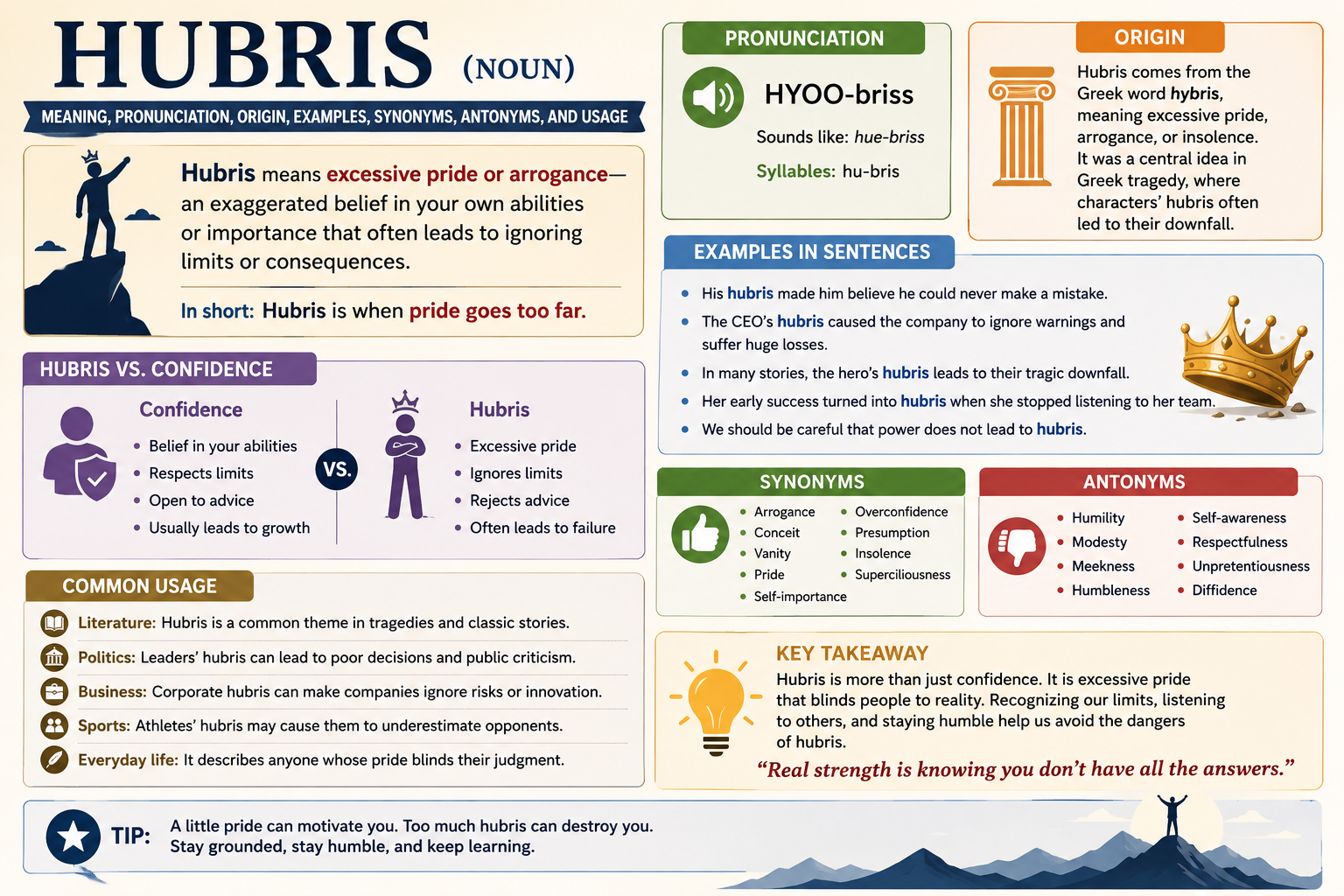
Hubris Meaning: If you have come across the word hubris, you may have noticed that it often appears in books, news articles, history, politics, literature, and everyday discussions about personality. It is a powerful word because it describes more than simple confidence. Hubris refers to excessive pride, arrogance, or self-confidence that can cause someone to ignore limits, advice, or the possible consequences of their actions.
Understanding hubris meaning becomes easier when you think of it as “too much pride.” A confident person may believe in their abilities while still respecting other people and accepting their own limitations. A person showing hubris, however, may become so convinced of their own superiority that they dismiss warnings, underestimate challenges, or believe ordinary rules do not apply to them.
This article explains hubris meaning in simple English, along with its pronunciation, origin, examples, synonyms, antonyms, common usage, and frequently asked questions. Whether you encountered the word in a novel, classroom, article, or conversation, this guide will help you understand exactly what it means.
Hubris Meaning in Simple English
Hubris means excessive pride, arrogance, or an exaggerated belief in your own abilities or importance.
In simple English, hubris happens when someone becomes so confident and proud that they stop recognizing their own limitations.
For example, imagine a talented business leader who has been successful for many years. Instead of listening to advice, the person begins to believe that they can never make a mistake. They ignore warnings, make careless decisions, and eventually face serious consequences. That excessive confidence can be described as hubris.
The word usually carries a negative meaning. Being confident is generally positive, but hubris suggests that confidence has gone too far.
Quick Definition of Hubris
| Feature | Explanation |
| Word | Hubris |
| Part of speech | Noun |
| Simple meaning | Excessive pride or arrogance |
| Pronunciation | HYOO-briss |
| Tone | Usually negative |
| Common contexts | Literature, history, leadership, politics, business, everyday speech |
| Opposite ideas | Humility, modesty, self-awareness |
How Do You Pronounce Hubris?
The word hubris is commonly pronounced:
The pronunciation sounds roughly like “HYOO-briss.”
The first syllable sounds like “hue,” while the second sounds similar to “briss.”
Is Hubris a Noun?
Yes. Hubris is a noun.
You can use it to describe an attitude or quality of excessive pride.
For example:
- “His hubris caused him to ignore good advice.”
- “The character’s hubris eventually led to failure.”
- “The story explores the dangers of power and hubris.”
The word does not normally describe ordinary confidence. It is used when pride becomes excessive or unreasonable.
What Is the Origin of the Word Hubris?
The origin of hubris can be traced to Ancient Greek, where the word hybris referred to excessive pride, arrogance, insolence, or outrageous behavior. In ancient Greek thought, hubris could involve behavior that violated accepted boundaries or showed disrespect toward others.
The idea became especially important in Greek literature and tragedy. Characters who became excessively proud often believed they were more powerful or capable than they really were. Their arrogance could lead them to make serious mistakes, setting up the tragic consequences that followed.
Over time, the word entered English and developed into the modern meaning of excessive pride or self-confidence.
Today, you do not need to know Greek mythology or classical literature to use the word. It is commonly used when describing people, leaders, organizations, characters, or decisions that show extreme arrogance.
Hubris in Greek Tragedy
The concept of hubris is strongly connected with ancient Greek tragedy.
Greek tragedies often explored the relationship between human beings, power, fate, morality, and the limits of human knowledge. A character might become extremely confident because of wealth, intelligence, power, beauty, or success. That confidence could eventually turn into arrogance.
The character’s problem was not simply being successful. Instead, the character failed to recognize limitations and acted as though ordinary boundaries did not apply.
This literary idea remains influential today. Modern writers still use characters with excessive pride to show how success can become dangerous when people stop listening, learning, or respecting others.
Hubris and Tragic Consequences
In literature, hubris is often connected with a character’s downfall.
A typical pattern might look like this:
Success → excessive confidence → arrogance → poor decisions → consequences
This does not mean that every person who behaves arrogantly will experience a dramatic downfall. Rather, it is a common storytelling pattern used to explore the dangers of unchecked pride.
Hubris vs. Confidence
One of the easiest ways to understand hubris meaning is to compare it with confidence.
Confidence means believing in your abilities. It can be healthy and useful. A confident student may believe they can complete a difficult assignment while still accepting help when necessary.
Hubris, on the other hand, involves excessive confidence. A person may believe they are so intelligent or capable that they cannot fail. As a result, they may ignore advice or refuse to consider other viewpoints.
For example:
Confidence:
“I have prepared carefully, so I believe I can handle this challenge.”
Hubris:
“I am better than everyone else, so there is no reason to prepare.”
The difference is not simply how confident someone feels. It is the person’s attitude toward limitations, other people, and reality.
Examples of Hubris in Everyday Life
You can find examples of hubris in many areas of life.
Example in School
A student performs extremely well on several tests and begins to believe studying is unnecessary. They stop preparing because they assume they are naturally smarter than everyone else. When they perform poorly later, their excessive confidence may be described as hubris.
Example in Business
A successful company becomes convinced that competitors cannot challenge it. Its leaders stop listening to customers and ignore changes in the market. Their excessive confidence may eventually contribute to poor decisions.
Example in Sports
An athlete wins several competitions and begins to believe that losing is impossible. They stop training seriously and dismiss their coach’s advice. That attitude can be described as hubris.
Example in Leadership
A leader becomes so confident in their own judgment that they refuse to listen to advisers or employees. They believe every decision they make must be correct. This is a common example of hubris.
Example in Everyday Conversation
Someone might say:
“His hubris made him believe he could never make a mistake.”
Here, hubris refers to an exaggerated sense of superiority and confidence.
Hubris Examples in Sentences
Learning how the word appears in real sentences can make its meaning easier to remember.
- “The leader’s hubris prevented him from accepting criticism.”
- “Her early success eventually turned into hubris.”
- “The novel presents hubris as a major cause of the hero’s downfall.”
- “His hubris made him underestimate his competitors.”
- “The character’s hubris blinded him to the obvious risks.”
- “The story warns readers about the dangers of unchecked hubris.”
- “His hubris was obvious when he refused everyone’s advice.”
- “The team’s unexpected defeat was partly caused by overconfidence and hubris.”
- “Power can sometimes encourage hubris.”
- “The film explores the relationship between ambition, power, and hubris.”
These examples demonstrate that hubris is especially useful when discussing situations where pride becomes excessive.
Synonyms for Hubris
There are several words that are similar to hubris, although none is always an exact replacement.
Arrogance
Arrogance means having an exaggerated sense of one’s importance, abilities, or superiority. It is one of the closest everyday synonyms for hubris.
Conceit
Conceit refers to excessive pride in yourself or your abilities.
Vanity
Vanity often describes excessive pride in one’s appearance, achievements, or qualities.
Pride
Pride can be positive or negative depending on context. When it becomes excessive, it can move closer to the meaning of hubris.
Self-importance
Self-importance describes the belief that you are more important or significant than you actually are.
Overconfidence
Overconfidence means having more confidence than a situation justifies. It is closely related to hubris, particularly when excessive confidence leads to poor decisions.
Presumption
Presumption can refer to an attitude of excessive confidence or assuming that something is true or acceptable without sufficient reason.
Insolence
Insolence means rude or disrespectful behavior, particularly toward someone who deserves respect or authority. It overlaps with the historical meaning of hubris but is not always a direct modern synonym.
Antonyms of Hubris
The opposite of hubris is generally connected with humility and realistic self-awareness.
Humility
Humility means having a modest view of your abilities and importance. A humble person can recognize their strengths without believing they are superior to everyone else.
Modesty
Modesty means avoiding excessive pride or boasting about yourself.
Self-awareness
Self-awareness means understanding your own strengths, weaknesses, feelings, and limitations.
Humbleness
Humbleness is another word for having a modest and respectful attitude toward yourself and others.
Meekness
Meekness can describe a gentle and unassuming attitude. It is not always the exact opposite of hubris, but it can contrast with arrogance.
Hubris vs. Arrogance
People often use hubris and arrogance as if they mean exactly the same thing. They are very close, but there can be a subtle difference.
Arrogance is a general attitude of superiority. Someone may act as though they are better, smarter, or more important than others.
Hubris often suggests that this excessive pride has gone further. It can involve overestimating one’s abilities and ignoring limits or warnings, sometimes leading to serious mistakes.
For example, someone who constantly boasts about being smarter than everyone else may be arrogant. If that belief becomes so extreme that the person makes reckless decisions because they think they cannot fail, the behavior may be described as hubris.
Hubris vs. Pride
Pride is not always negative.
You can feel proud after completing a difficult project, helping someone, learning a new skill, or achieving an important goal. Healthy pride can encourage motivation and satisfaction.
Hubris is different because it involves excessive pride. It suggests that a person’s positive feelings about themselves have crossed into arrogance or unrealistic self-belief.
A useful way to remember the difference is:
Pride: “I did something well.”
Hubris: “I am so great that I cannot possibly be wrong.”
The context determines whether pride is healthy or excessive.
Common Usage of Hubris
The word hubris is common in formal and analytical writing. You may see it in:
- Literature reviews
- Newspaper articles
- Political commentary
- Business analysis
- Historical discussions
- Sports writing
- Psychology-related discussions
- Movie and book reviews
- Academic writing
- Everyday conversations about arrogance
For example, a journalist might describe a powerful leader’s refusal to accept criticism as hubris. A book reviewer might describe a fictional character’s excessive ambition as hubris.
The word is particularly useful because it describes more than simple pride. It suggests that excessive confidence has affected a person’s judgment.
How to Use Hubris Correctly
When using hubris in a sentence, remember that it is usually a noun.
Correct examples include:
- “His hubris caused problems for the organization.”
- “The character’s hubris led to a serious mistake.”
- “She was criticized for her hubris.”
- “The story is a warning about political hubris.”
You would not normally say:
- “He is hubris.”
Instead, say:
- “He is arrogant.”
- “He displays hubris.”
- “His behavior shows hubris.”
- “His arrogance reflects his hubris.”
This distinction can help you use the word naturally.
Why Is Hubris Usually Negative?
Hubris is generally negative because it suggests that pride has become unreasonable.
A person affected by hubris may:
- Ignore useful advice
- Underestimate other people
- Refuse to admit mistakes
- Take unnecessary risks
- Overestimate their abilities
- Believe they are above ordinary rules
- Make decisions without considering consequences
- Dismiss criticism
These behaviors can damage relationships, careers, organizations, and reputations.
However, simply having confidence is not hubris. A healthy level of self-belief can help people face difficult situations. The problem begins when confidence becomes disconnected from reality.
Hubris in Literature and Storytelling
Hubris is an important literary concept because it creates conflict.
A character may begin with admirable qualities such as courage, intelligence, ambition, or determination. But when those qualities become excessive, they can create problems.
For example, a brilliant character might become convinced that nobody can outsmart them. Their intelligence turns into arrogance. Because they refuse to listen to others, they make a major mistake.
This makes hubris useful for storytelling because it creates a believable weakness. The character’s strength becomes connected to their greatest flaw.
Many classic stories use this pattern to remind readers that success does not make a person all-powerful.
Hubris in Modern Life
Although the word has ancient origins, hubris meaning remains highly relevant today.
Modern discussions about hubris can involve corporate leaders, political figures, celebrities, athletes, inventors, fictional characters, and ordinary people. Whenever someone becomes so confident that they stop recognizing limitations, the concept of hubris may apply.
The idea is especially relevant in leadership. Leaders have significant responsibilities, and excessive confidence can make it difficult for them to recognize mistakes. Listening to different perspectives and remaining open to criticism can help prevent the kind of behavior commonly associated with hubris.
Frequently Asked Questions About Hubris
What is the simplest meaning of hubris?
The simplest meaning of hubris is excessive pride or arrogance. It describes a person who has an exaggerated belief in their own importance or abilities.
Is hubris a positive or negative word?
Hubris is generally a negative word. It suggests that someone’s confidence or pride has become excessive and unreasonable.
What is the pronunciation of hubris?
Hubris is commonly pronounced “HYOO-briss.”
Is hubris the same as arrogance?
Hubris and arrogance are closely related. Arrogance means acting as though you are superior to others, while hubris often suggests extreme pride or confidence that causes someone to ignore limitations or consequences.
What is the opposite of hubris?
Common opposites include humility, modesty, self-awareness, and humbleness.
Can hubris be used for a group?
Yes. Hubris can describe an individual, organization, team, government, or other group when excessive confidence or pride affects its behavior.
For example:
“The company’s hubris prevented its leaders from recognizing the changing market.”
Is hubris always connected to failure?
No. Hubris does not automatically cause failure. However, in literature and everyday analysis, hubris is often associated with poor judgment and negative consequences because excessive confidence can make people ignore risks.
What is a good synonym for hubris?
Arrogance is probably the closest common synonym. Other related words include conceit, overconfidence, vanity, and self-importance.
Is pride the same as hubris?
Not exactly. Pride can be healthy and appropriate. Hubris specifically suggests excessive pride, arrogance, or an exaggerated sense of superiority.
Why is hubris important in literature?
Hubris is important in literature because it can explain why a character makes serious mistakes. It often creates a conflict between a character’s confidence and the limits of reality.
Final Conclusion: Hubris Meaning
The simplest way to remember hubris meaning is excessive pride or arrogance that causes someone to overestimate themselves or ignore their limitations. Unlike ordinary confidence, hubris suggests that a person’s self-belief has gone too far.
The word comes from Ancient Greek and has a long connection with literature, especially Greek tragedy. Over time, it became an English word used to describe excessive pride in people, leaders, organizations, and fictional characters.
Understanding the difference between confidence, pride, arrogance, and hubris is important. Confidence can encourage people to take on challenges, while healthy pride can come from genuine achievement. Hubris goes beyond these ideas by suggesting an exaggerated belief in one’s own importance or abilities.
If you remember just one definition, remember this: hubris is confidence without enough humility or awareness of one’s limits. That simple idea captures why the word continues to be useful in modern English, from everyday conversations to literature, history, business, and public commentary.