The Cantab meaning is a term that often appears in formal writing, academic biographies, university-related discussions, and British English. At first glance, “Cantab” may look like an ordinary abbreviation, but it has a specific connection to the University of Cambridge. Understanding this word can make historical, academic, and professional writing much easier to follow.
In simple terms, Cantab is an abbreviation derived from the Latin name associated with Cambridge. It is commonly used to refer to someone who studied at or graduated from the University of Cambridge. The term can also appear after a person’s name as an academic abbreviation.
This guide explains the Cantab meaning in simple English, including its pronunciation, origin, history, examples, synonyms, antonyms, common usage, and frequently asked questions.
What Does Cantab Mean?
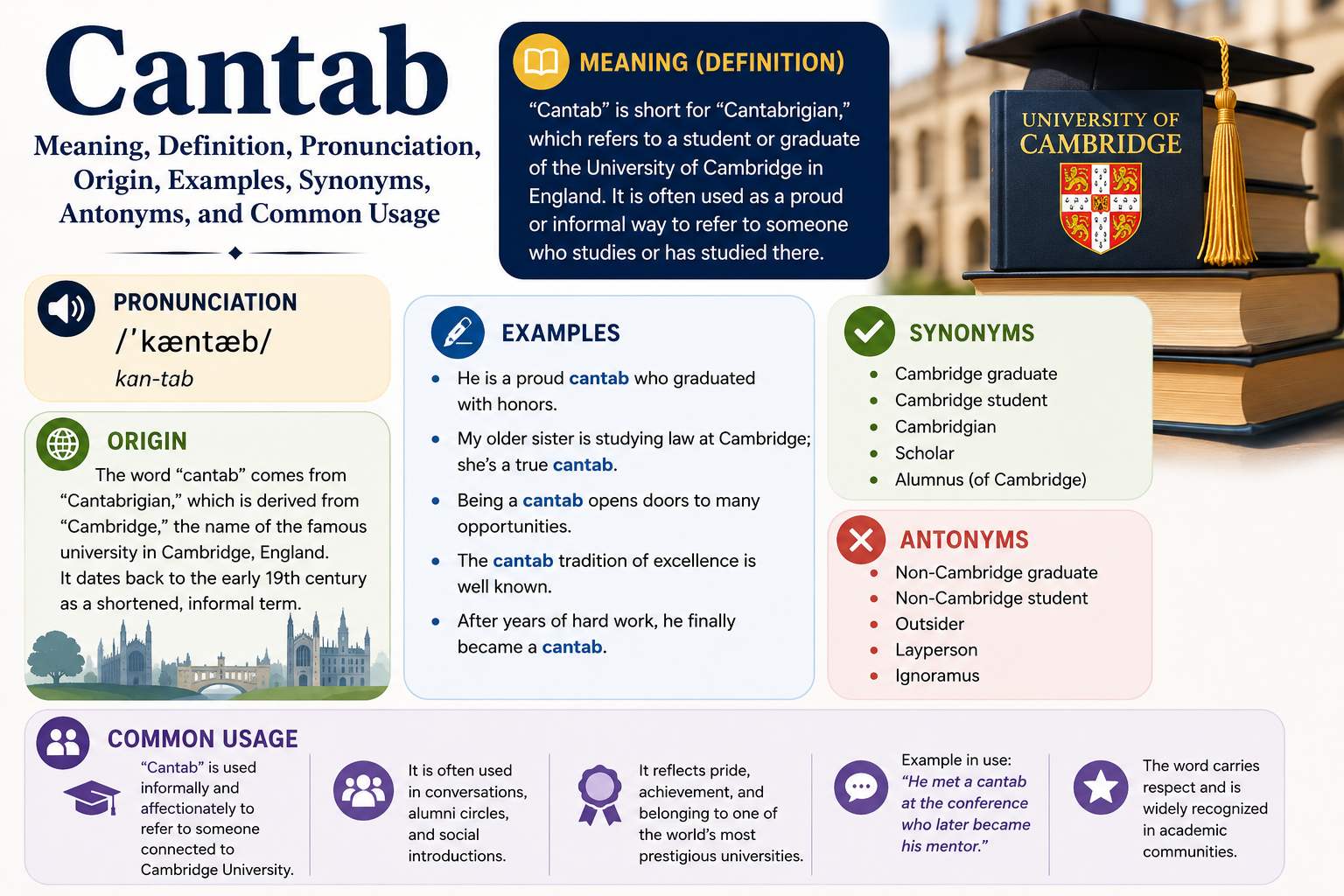
Cantab is a traditional abbreviation connected with Cambridge, particularly the University of Cambridge. It comes from the Latin form Cantabrigia, the Latin name for Cambridge.
In British usage, Cantab can be used after a person’s name to indicate that the person is a Cambridge graduate or alumnus. For example, a person might be described in an academic context using “Cantab” after their name.
In simple English:
Cantab means something or someone connected with Cambridge, especially a graduate or former student of the University of Cambridge.
The exact meaning depends on the context. In an academic setting, it may refer specifically to a Cambridge degree or Cambridge graduate status.
The abbreviation is particularly associated with formal British academic traditions rather than everyday conversation.
Cantab Pronunciation
The word Cantab is generally pronounced approximately as:
KAN-tab
The first part sounds like “can,” while the second part sounds like “tab.”
In phonetic form, dictionaries commonly represent the pronunciation using symbols such as /ˈkæntæb/.
Because “Cantab” is an abbreviation rather than an ordinary modern English word, people who encounter it for the first time may be unsure how to say it. The straightforward pronunciation is KAN-tab.
Cantab Meaning in Simple English
The easiest way to understand the Cantab meaning is to connect it with Cambridge University.
Imagine you are reading an old academic biography and see a person’s name followed by “Cantab.” The term is telling you that the individual has a connection with Cambridge, usually through studying there or receiving a degree.
For example:
“John Smith, BA Cantab”
In this type of context, “Cantab” indicates Cambridge.
The word is therefore useful for identifying academic backgrounds without writing out the full name of the institution every time.
What Is the Origin of Cantab?
The origin of Cantab goes back to the Latin name for Cambridge: Cantabrigia.
Cambridge has been known by different names throughout its history. The Latin form Cantabrigia developed from the historical name of the city, and “Cantab” became a shortened form used in academic contexts.
The University of Cambridge has a long academic tradition, and Latin abbreviations have historically been common in university records, degrees, academic titles, and formal references.
The word is therefore closely connected with the long history of Cambridge and its university.
Cantab and the University of Cambridge
The strongest association of Cantab is with the University of Cambridge, one of the world’s oldest universities.
Cambridge has traditionally used Latin in academic contexts, which helps explain why Latin-derived abbreviations appear in references to its graduates and degrees.
When “Cantab” appears after a person’s academic qualification, it can function as a compact way of identifying Cambridge as the awarding institution.
For readers unfamiliar with British academic abbreviations, the term can initially seem mysterious. Once its Cambridge connection is understood, however, its use becomes much clearer.
Is Cantab an Academic Abbreviation?
Yes. Cantab is most commonly encountered as an academic abbreviation.
Academic abbreviations can be used to identify universities, qualifications, professional associations, or other educational connections. Many of these abbreviations come from Latin because Latin was historically important in European academic traditions.
“Cantab” belongs to this older academic style.
It may appear in biographies, directories, formal publications, historical documents, and descriptions of people’s educational backgrounds.
Cantab Meaning After a Name
One of the most important uses of the word is after a person’s name.
For example:
“Elizabeth Brown, MA Cantab”
Here, “Cantab” indicates that the academic qualification is associated with Cambridge.
The exact conventions surrounding Cambridge degrees can vary according to the qualification, historical period, and context. Therefore, readers should not assume that every appearance of “Cantab” has precisely the same grammatical or academic function.
Still, the central idea remains the same: Cantab signals a Cambridge academic connection.
What Does MA Cantab Mean?
You may sometimes see the expression “MA Cantab.”
This refers to a Master of Arts degree associated with the University of Cambridge.
Cambridge has particular traditions surrounding its degrees, and the use of “MA” in the Cambridge context can differ from how people commonly understand a master’s degree in other universities or countries.
This is why context matters when reading academic abbreviations.
If you encounter “MA Cantab” in a biography or professional profile, “Cantab” is identifying Cambridge.
Cantab Meaning in British English
The Cantab meaning is especially relevant to British English.
British academic writing has a long tradition of abbreviating university names and academic qualifications. Latin-derived terms can therefore appear in formal documents even when they are uncommon in everyday speech.
Someone in casual conversation is unlikely to say, “I am a Cantab.” More commonly, they would simply say:
“I studied at Cambridge.”
However, “Cantab” can be useful in formal writing where qualifications need to be presented briefly.
Examples of Cantab in a Sentence
Understanding examples makes the word much easier to recognize.
Example One
“The author was educated at Cambridge and later became known as a Cantab.”
Here, “Cantab” refers to the person’s Cambridge connection.
Example Two
“The biography lists the scholar as BA Cantab.”
In this context, “Cantab” identifies Cambridge as the university associated with the degree.
Example Three
“Several distinguished Cantabs attended the academic ceremony.”
Here, “Cantabs” refers to Cambridge graduates or members of the Cambridge academic community.
Example Four
“His professional biography notes that he is MA Cantab.”
The abbreviation shows that his academic qualification is associated with Cambridge.
Example Five
“The historian wrote about the experiences of young Cantabs.”
In this sentence, “Cantabs” refers to people associated with Cambridge, particularly students or graduates depending on context.
Cantab as a Noun
Cantab can function as a noun when referring to a person associated with Cambridge.
For example:
“She is a Cantab.”
The word is being used as a label for a person connected with Cambridge University.
The plural form can be written as Cantabs.
For example:
“The reunion brought together former Cantabs.”
The plural simply refers to multiple people with a Cambridge connection.
Cantab as an Abbreviation
The term can also appear as an abbreviation in academic qualifications.
This is different from using “Cantab” as an ordinary descriptive word.
For example, a formal academic entry may include:
Degree + Cantab
The abbreviation helps identify Cambridge without spelling out the institution.
This style is more likely to appear in formal biographies, professional directories, historical records, and academic publications than in ordinary conversation.
Synonyms of Cantab
There is no perfect synonym for Cantab because it is a specialized term.
Depending on the context, possible alternatives include:
- Cambridge graduate
- Cambridge alumnus
- Cambridge alumna
- Cambridge alumnus or alumna
- Cambridge graduate
- Cambridge student
- Cambridge academic
- Cambridge university graduate
- Cambridge alumnus
These alternatives should not always be treated as exact replacements.
For example, “Cambridge student” generally means someone currently studying there, while “Cantab” may refer to a graduate or someone connected with Cambridge in a broader academic sense.
Antonyms of Cantab
“Cantab” does not have a direct antonym in the same way that words such as “hot” and “cold” do.
It identifies a particular academic connection, so the opposite would usually be expressed through context rather than a single word.
For example, someone who did not attend Cambridge could simply be described as:
- A non-Cambridge graduate
- A graduate of another university
- A university graduate from elsewhere
- A student of another institution
These are contextual contrasts rather than true dictionary antonyms.
Cantab vs Cambridge Graduate
The terms Cantab and Cambridge graduate can overlap, but they are not identical in style.
“Cambridge graduate” is clear modern English and can be understood by almost everyone.
“Cantab” is shorter and more traditional. It carries an academic and historical flavor and is more likely to appear in formal or specialized contexts.
For general readers, “Cambridge graduate” is usually clearer.
For formal academic writing, biographies, or historical material, “Cantab” may be appropriate when the established style calls for it.
Cantab vs Oxon
Another academic abbreviation you may encounter is Oxon.
Oxon is traditionally associated with the University of Oxford and comes from the Latin name Oxonia.
By contrast, Cantab is associated with Cambridge and comes from Cantabrigia.
These abbreviations reflect an old British academic tradition.
| Term | Associated institution | Origin |
| Cantab | University of Cambridge | Latin Cantabrigia |
| Oxon | University of Oxford | Latin Oxonia |
Seeing these terms together can help explain why older British academic writing contains unusual abbreviations.
Common Usage of Cantab
The word Cantab is not normally used in casual everyday English.
Instead, you are more likely to encounter it in:
- Academic biographies
- University records
- Professional biographies
- Historical writing
- Formal directories
- Books about British universities
- Academic qualification lists
- Obituaries
- Traditional British publications
For example, a newspaper biography might include a person’s academic background using traditional abbreviations.
A modern social media profile, by contrast, would probably say “Cambridge graduate” or simply “University of Cambridge.”
Why Does Cantab Appear in Academic Biographies?
Academic biographies often need to communicate a person’s educational history in a concise format.
Instead of repeatedly writing the complete name of a university, traditional abbreviations can provide a shorter alternative.
“Cantab” also reflects the historical character of British academic writing.
Older records frequently used Latin because it was once an important language of scholarship, education, law, and religion in Europe. Some of those conventions remain visible today.
Is Cantab Still Used Today?
Yes, although it is not an everyday English word.
You may still encounter Cantab in formal academic contexts, biographies, professional profiles, and references to Cambridge graduates.
However, modern writers often prefer clearer expressions such as “Cambridge graduate” because they are easier for an international audience to understand.
The choice depends on the publication, audience, and writing style.
Why Is the Word Cantab Confusing?
The word can be confusing because it does not immediately look like “Cambridge.”
Most English speakers would not naturally guess that “Cantab” comes from a Latin form of the city’s name.
It is also uncommon in ordinary conversation. Someone who has never encountered British academic abbreviations may see “Cantab” and assume it is a person’s surname, organization, or technical term.
Learning its origin solves much of the confusion.
Once you know that Cantab is connected with Cambridge, the meaning becomes much easier to recognize.
How to Remember the Cantab Meaning
A simple memory trick is:
Cantab = Cambridge
Think of “Cantab” as a shortened academic form connected to the Latin Cantabrigia.
You can also remember the comparison:
Cantab → Cambridge
Oxon → Oxford
This simple association can help when reading academic biographies or historical British documents.
Frequently Asked Questions About Cantab Meaning
What does Cantab mean?
Cantab is a traditional abbreviation connected with Cambridge, especially the University of Cambridge. It can refer to a Cambridge graduate or appear as part of an academic qualification.
What is the pronunciation of Cantab?
Cantab is generally pronounced KAN-tab.
Where does the word Cantab come from?
The term comes from the Latin name Cantabrigia, associated with Cambridge.
Is Cantab a person?
It can be. When used as a noun, “Cantab” may refer to someone associated with Cambridge, particularly a Cambridge graduate.
What is the plural of Cantab?
The plural is commonly Cantabs.
For example:
“The event was attended by former Cantabs.”
What does MA Cantab mean?
“MA Cantab” refers to a Master of Arts qualification associated with the University of Cambridge. “Cantab” identifies Cambridge.
Is Cantab a synonym for Cambridge?
Not exactly. “Cantab” is an abbreviation derived from the Latin name associated with Cambridge and is often used in an academic context to indicate a Cambridge connection.
What is the opposite of Cantab?
There is no exact dictionary antonym for Cantab. A contextual contrast could be someone who graduated from a different university.
Is Cantab commonly used in everyday English?
No. It is mainly found in formal, academic, historical, and university-related contexts.
Is Cantab the same as Cambridge alumnus?
The meanings can overlap, particularly when “Cantab” refers to a Cambridge graduate. However, “Cambridge alumnus” is clearer and more modern wording.
Why do British academic abbreviations use Latin?
Latin historically played an important role in European education and scholarship. Traditional academic institutions retained some Latin-based terminology and abbreviations even after English became the dominant language of instruction.
Final Thoughts on Cantab Meaning
The Cantab meaning becomes simple once its connection with Cambridge is understood. Cantab is a traditional abbreviation derived from the Latin name associated with Cambridge and is especially connected with the University of Cambridge and its graduates.
The term is most useful in academic, historical, and formal contexts. You may encounter it after a person’s name, within an academic qualification, or in a biography describing someone’s education.
Although “Cantab” is less familiar than phrases such as “Cambridge graduate,” it remains an interesting part of British academic language. Its history also shows how Latin traditions continue to influence modern educational terminology.