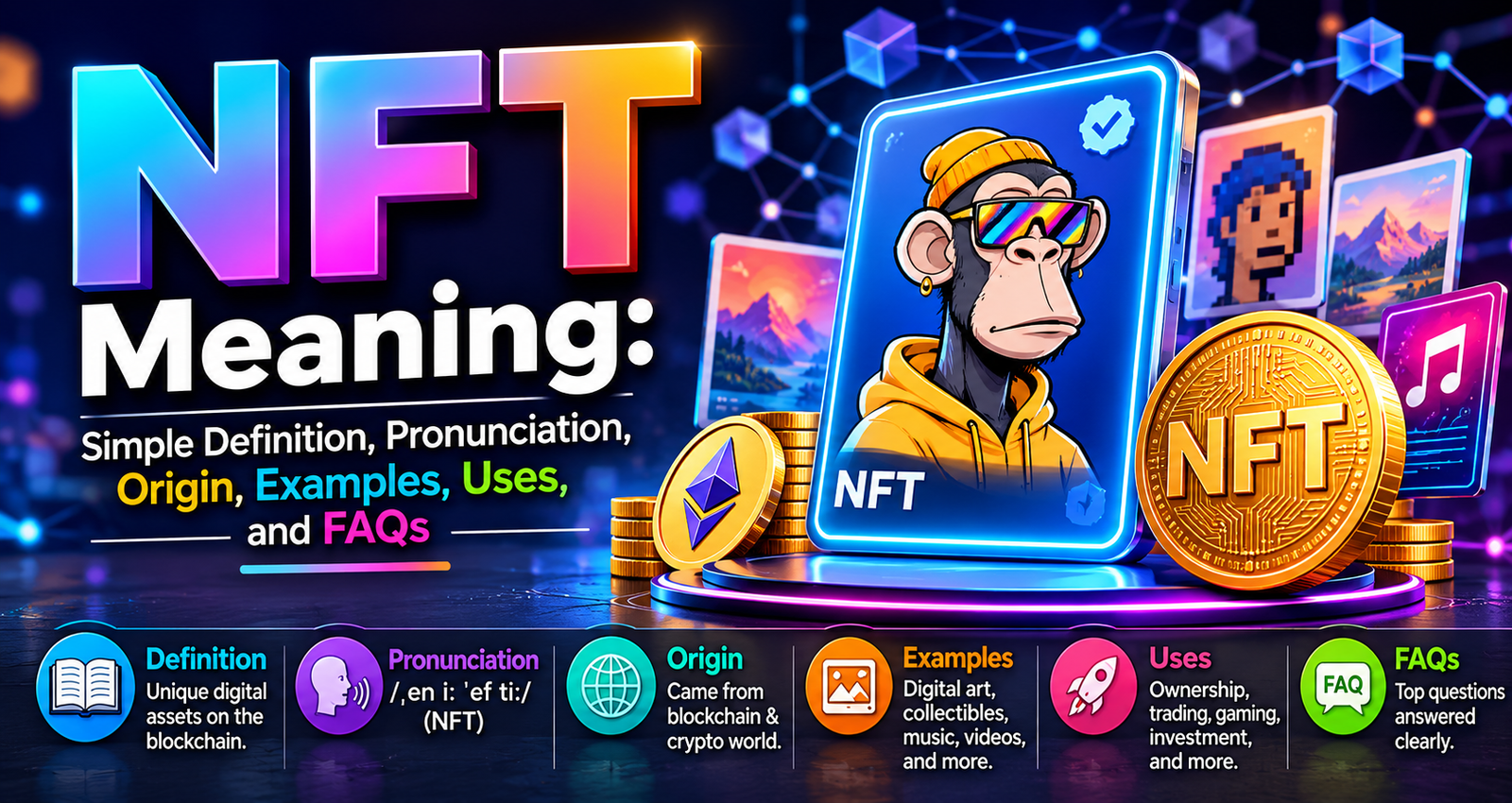
The NFT meaning is Non-Fungible Token. An NFT is a unique digital token recorded on a blockchain that can represent ownership or another type of verifiable connection to a digital or physical item. Unlike ordinary currencies or interchangeable digital tokens, each NFT is designed to have a distinct identity.
NFTs became widely known through digital art, collectibles, music, gaming items, and online communities. Although public interest has changed over time, the underlying idea remains important: blockchain technology can create a publicly verifiable record showing that a particular digital token exists and identifying its current or historical ownership.
Understanding NFTs can seem difficult at first because the subject combines technology, digital ownership, cryptocurrency, and online marketplaces. In simple terms, however, the basic idea is easier: an NFT is a unique blockchain-based token that can be connected to a particular digital or real-world asset.
What Does NFT Mean?
NFT stands for Non-Fungible Token.
The word “non-fungible” is the key to understanding the concept. Something fungible can be exchanged for another identical unit without changing its basic value or identity.
For example, one ordinary currency unit can generally be exchanged for another equivalent unit. One unit of a cryptocurrency may also be interchangeable with another unit of the same cryptocurrency.
An NFT works differently. Each NFT has its own identifiable record on a blockchain. Two NFTs from the same collection may look similar, but their individual token records can still be different.
This uniqueness is one of the main reasons NFTs became useful for digital collectibles, artwork, memberships, gaming assets, tickets, and other applications.
NFT Meaning in Simple English
In very simple English:
An NFT is a unique digital token stored on a blockchain that can be used to represent ownership, authenticity, membership, or another connection to an item.
Think of an NFT as a digital certificate whose information is recorded on a blockchain.
The certificate itself does not necessarily contain the entire artwork, song, video, or other file. Instead, it may contain information that identifies the token and points to related data.
This distinction is important because owning an NFT does not automatically mean owning the copyright or every legal right connected to the underlying content.
NFT Pronunciation
The abbreviation NFT is normally pronounced by saying each letter separately:
N-F-T
The full phrase Non-Fungible Token is pronounced approximately:
non-FUN-juh-bul TOH-kuhn
When people discuss NFTs online, they usually say “N-F-T” rather than the full phrase.
What Does Non-Fungible Mean?
The word fungible means something that can be exchanged for another identical unit.
For example, if you have one ordinary dollar and exchange it for another ordinary dollar, the basic monetary value remains the same. The individual dollar is not usually important as a unique object.
Non-fungible things are different because they have unique characteristics or identities.
A painting, signed baseball card, original manuscript, or one-of-a-kind collectible can be considered non-fungible because replacing it with another item does not create the exact same object.
An NFT applies this idea to blockchain-based digital tokens.
How Do NFTs Work?
NFTs operate using blockchain technology. A blockchain is a distributed digital record that stores transaction information across a network rather than relying on one central database.
When an NFT is created, commonly called minting, information about the token is recorded through a blockchain transaction.
Depending on the system and the NFT, the record may identify information such as:
- The token’s unique identifier
- The blockchain it uses
- The wallet associated with ownership
- Transaction history
- Collection information
- A reference to related digital content
When an NFT is transferred, another blockchain transaction records the change.
This creates a history that can often be publicly inspected using blockchain explorers or marketplace tools.
What Is Minting an NFT?
Minting is the process of creating and recording an NFT on a blockchain.
The exact process depends on the blockchain and platform. Generally, a creator connects a compatible digital wallet, prepares the NFT information, and submits a transaction that creates the token.
The creator may also provide information about the digital asset, such as an image, description, name, or external metadata.
Minting may involve transaction fees, often called gas fees, depending on the blockchain being used.
Not every NFT requires the same technical process, and platforms can make minting easier for people who do not have advanced blockchain knowledge.
NFT Examples
NFTs can represent many different things.
Digital Artwork
Digital art was one of the most visible early uses of NFTs.
An artist can create a digital illustration, animation, or other artwork and associate it with an NFT. The blockchain record can provide information about the token and its transaction history.
The NFT does not necessarily prevent other people from copying or viewing the image. Instead, it can provide a verifiable blockchain record connected to the token.
Digital Collectibles
NFTs can also represent collectible items.
A collection might contain thousands of individual NFTs, with each token having different characteristics or rarity levels.
Collectors may buy, sell, display, or trade these tokens depending on the platform and applicable rules.
Gaming Items
NFTs have also been proposed for gaming assets such as characters, virtual items, skins, weapons, land, or accessories.
One potential advantage is that blockchain-based items can have ownership records that exist outside a single game’s internal database.
However, whether an NFT can actually be used across multiple games depends on the technical design and agreements between developers. Simply putting a game item on a blockchain does not automatically make it compatible with every game.
Music and Entertainment
Musicians and entertainers have experimented with NFTs as a way to distribute collectibles, special experiences, digital releases, memberships, or other fan-related products.
An NFT may be connected to exclusive content or benefits, depending on the creator’s terms.
Tickets and Memberships
Another potential use is digital tickets.
An NFT could represent a ticket to an event and provide a blockchain record associated with that ticket.
Similarly, organizations can experiment with NFTs as membership passes, access credentials, or digital badges.
NFT vs. Cryptocurrency
NFTs and cryptocurrencies both use blockchain technology, but they are not the same.
Cryptocurrency tokens such as Bitcoin are generally designed to be fungible. One unit can be exchanged for another unit of the same currency.
NFTs are designed to be individually identifiable.
| Feature | NFT | Cryptocurrency |
| Meaning | Non-Fungible Token | Digital currency or token |
| Interchangeability | Generally unique | Generally interchangeable |
| Main identity | Individual token | Unit of a currency or token |
| Common uses | Collectibles, art, memberships | Payments, transfers, investments |
| Blockchain-based | Yes | Usually |
| Individual uniqueness | Important | Usually not |
The exact technical properties can vary between blockchain systems, but the distinction between fungible and non-fungible is the central idea.
NFT vs. Digital File
One of the most common misunderstandings about NFTs is thinking that the NFT and the digital file are automatically the same thing.
They are not necessarily the same.
An NFT is a blockchain token. The associated digital artwork, video, music file, or other content can be stored somewhere else.
For example, an NFT might contain metadata pointing toward an image file. The blockchain can record the token’s identity and transaction history while the image itself is stored separately.
This is why people should carefully examine what an NFT actually provides before assuming that buying a token means acquiring copyright or unrestricted ownership of the underlying content.
NFT Ownership Explained
NFT ownership can be understood as ownership of a particular blockchain token according to the blockchain’s rules and the relevant platform or agreement.
This does not automatically give the buyer every possible legal right over the associated content.
For example, purchasing an NFT connected to a digital illustration does not necessarily give the buyer the right to reproduce that illustration commercially.
Copyright ownership, licensing rights, commercial permissions, and other legal issues depend on the creator’s terms and applicable law.
Therefore, anyone considering an NFT should read the associated terms carefully.
What Is a Blockchain?
Because NFTs depend heavily on blockchain technology, understanding blockchain makes the NFT meaning easier to understand.
A blockchain is a digital ledger that records transactions in a structured sequence. Copies of the ledger are maintained across a network of computers.
Instead of relying entirely on one central database, blockchain systems use network-based methods to verify and record transactions.
When an NFT is transferred, the transaction can become part of the blockchain’s history.
This makes blockchain technology useful for creating verifiable records of token transfers.
What Is a Crypto Wallet?
A crypto wallet is a tool that allows users to interact with blockchain networks.
Depending on the wallet, it may allow users to:
- Hold digital assets
- Send tokens
- Receive tokens
- Approve transactions
- Connect to decentralized applications
- Interact with NFT marketplaces
The wallet does not necessarily “store” an NFT in the same way that a physical wallet stores a card. Instead, blockchain assets are recorded on the network, while the wallet manages the cryptographic keys needed to interact with them.
Keeping wallet credentials secure is extremely important.
NFT Marketplaces
NFT marketplaces are online platforms where users may create, display, buy, sell, or trade NFTs.
Different marketplaces support different blockchains and types of NFTs.
A marketplace may provide information such as:
- NFT name
- Creator information
- Collection
- Token identifier
- Transaction history
- Current listing price
- Ownership information
- Related media
Users should be cautious when interacting with NFT marketplaces because scams, fake collections, impersonation, and misleading listings can occur.
What Are NFT Gas Fees?
A gas fee is a transaction fee associated with certain blockchain operations.
Depending on the blockchain, users may need to pay a fee when minting, buying, selling, transferring, or otherwise interacting with an NFT.
Gas fees can vary based on network activity and the blockchain’s design.
This means the final cost of an NFT transaction may be higher than the listed purchase price.
Anyone learning about NFTs should consider both the asset’s price and possible transaction fees.
NFT Synonyms and Related Terms
NFT does not have a perfect synonym because it is a specific technical abbreviation.
However, related expressions include:
- Non-fungible token
- Unique digital token
- Blockchain-based collectible
- Digital collectible
- Blockchain asset
- Tokenized digital asset
- Digital ownership certificate
These terms are related but may not mean exactly the same thing.
For example, digital collectible is broader than NFT because not every digital collectible has to use blockchain technology.
NFT Antonyms
NFT also does not have a direct antonym in ordinary English.
The closest contrasting concept is a fungible token or fungible asset.
A fungible asset consists of interchangeable units. Each equivalent unit is generally treated as having the same value and function.
Examples can include:
- Traditional currency
- Bitcoin
- Many cryptocurrency tokens
- Commodities traded in standardized units
The key difference is uniqueness versus interchangeability.
Common Usage of NFT
The abbreviation NFT is commonly used in discussions about:
- Blockchain
- Cryptocurrency
- Digital art
- Online collectibles
- Gaming
- Music
- Entertainment
- Digital memberships
- Virtual worlds
- Web technology
- Digital ownership
You may see phrases such as:
“NFT marketplace” — a platform for trading NFTs.
“NFT collection” — a group of related NFTs.
“NFT creator” — someone who creates NFTs or associated digital content.
“NFT minting” — the process of creating an NFT on a blockchain.
“NFT wallet” — a crypto wallet used to interact with NFT assets.
Advantages of NFTs
NFTs can offer several potential benefits depending on how they are designed.
Verifiable Transaction History
Blockchain records can make it easier to inspect the history of an NFT.
Digital Uniqueness
NFTs provide a technical method for creating individually identifiable digital tokens.
New Opportunities for Creators
Artists, musicians, game developers, and other creators can experiment with new ways of distributing digital products and experiences.
Programmable Features
Some NFTs can include smart-contract functionality that supports royalties, access systems, or other programmed features.
However, the exact benefits depend heavily on the technology and terms behind each NFT.
Limitations and Risks of NFTs
NFTs also have important limitations.
Prices Can Change Dramatically
NFT markets can be highly speculative. An NFT that sells for a high price may later be worth much less.
Ownership Does Not Equal Copyright
Buying an NFT does not automatically transfer copyright.
Scams Exist
Fake collections, impersonation, fraudulent websites, and other scams can target people interested in NFTs.
Technical Risks
Wallet security, smart-contract vulnerabilities, lost credentials, and blockchain-related problems can create risks.
Environmental Concerns Vary
The environmental impact of NFTs depends heavily on the blockchain used. Modern proof-of-stake networks generally have very different energy profiles from older proof-of-work systems.
Are NFTs Still Relevant?
NFTs received enormous attention during the early twenty-twenties, especially through digital art and collectibles.
Public interest and market activity have changed substantially since the peak of the NFT boom. Some speculative projects lost significant value, while other blockchain applications continued to develop.
NFT technology can still be relevant even when a particular collection becomes unpopular.
The broader concept of using blockchain-based tokens for identity, ownership records, memberships, tickets, gaming assets, and digital goods remains an area of experimentation.
Therefore, the long-term importance of NFTs should not be judged only by the price of individual collectible projects.
How to Understand NFT Prices
An NFT does not have a universal fixed value.
Its price can depend on factors such as:
- Demand
- Scarcity
- Creator reputation
- Utility
- Community interest
- Historical significance
- Market conditions
- Perceived future value
Unlike ordinary goods with established retail prices, many NFTs have highly uncertain market values.
A high previous sale price does not guarantee that another buyer will pay the same amount later.
Frequently Asked Questions About NFT Meaning
What does NFT stand for?
NFT stands for Non-Fungible Token.
What is an NFT in simple words?
An NFT is a unique blockchain-based token that can represent ownership, authenticity, membership, or another connection to a digital or physical item.
How do you pronounce NFT?
NFT is normally pronounced by saying the individual letters: N-F-T.
What does non-fungible mean?
Non-fungible means unique or individually identifiable rather than directly interchangeable with another identical unit.
What is the opposite of NFT?
The closest contrasting concept is a fungible asset or token, where individual units are generally interchangeable.
Is an NFT a cryptocurrency?
Not exactly. NFTs and cryptocurrencies can both use blockchain technology, but cryptocurrencies are generally fungible while NFTs are individually identifiable.
Can an NFT be copied?
The underlying digital image, video, or other content may often be copied. The NFT itself is a blockchain token with a specific token record.
This is an important distinction between copying digital content and owning a particular NFT.
Does buying an NFT give you copyright?
Not automatically. Copyright and licensing rights depend on the creator’s terms and applicable law.
What is NFT minting?
Minting is the process of creating and recording an NFT on a blockchain.
What is an NFT collection?
An NFT collection is a group of related NFTs, often created around a common theme, artistic style, project, or community.
What is an NFT marketplace?
An NFT marketplace is a platform where NFTs may be created, displayed, bought, sold, or traded.
Are NFTs only digital art?
No. NFTs can potentially be used for collectibles, gaming assets, memberships, tickets, digital experiences, and other applications.
Why are NFTs valuable?
Their value can come from scarcity, demand, utility, creator reputation, community interest, cultural significance, or speculation. There is no guarantee that an NFT will retain its value.
Are NFTs safe?
NFTs are a technology rather than a guarantee of safety. Users can face scams, fraudulent projects, compromised wallets, smart-contract risks, and financial losses.
Final Thoughts on NFT Meaning
The NFT meaning is Non-Fungible Token, a unique blockchain-based token that can be connected to a digital or physical asset, membership, collectible, or other use case.
The central idea is the difference between fungible and non-fungible. Fungible assets are generally interchangeable, while NFTs are individually identifiable.
NFTs became famous through digital art and online collectibles, but the technology has broader potential applications. At the same time, NFTs come with important limitations, including market volatility, scams, technical risks, and confusion about copyright and ownership.
The easiest way to understand an NFT is to think of it as a unique digital token with a blockchain-based record. That simple idea explains why NFTs have attracted attention across art, gaming, entertainment, technology, and digital commerce.