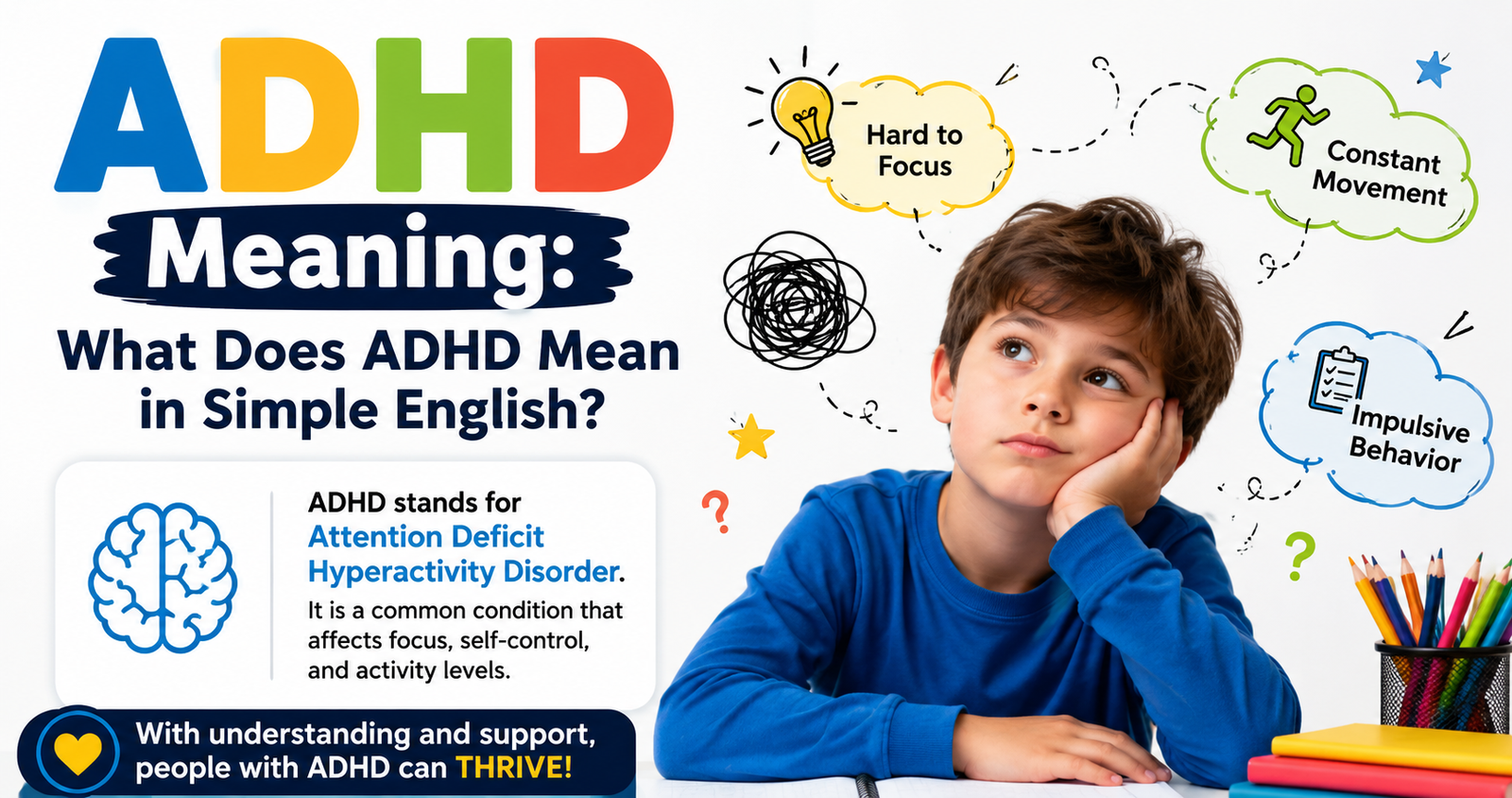
If you have seen the term ADHD online, in school discussions, in health articles, or in everyday conversations, you may wonder about the exact ADHD meaning. ADHD stands for Attention-Deficit/Hyperactivity Disorder. It is a neurodevelopmental disorder that can affect attention, activity level, impulse control, organization, and other areas of daily life.
In simple English, ADHD means that a person’s brain may handle attention, self-control, activity, and organization differently. It is not simply a matter of being lazy, careless, or unwilling to concentrate. ADHD can affect children, teenagers, and adults, and its symptoms can look different from one person to another.
Understanding the ADHD meaning is important because the term is sometimes used casually or incorrectly. Someone who gets distracted occasionally does not automatically have ADHD. ADHD is a recognized health condition that involves a persistent pattern of symptoms that can interfere with everyday functioning.
This guide explains the ADHD meaning in simple English, including its pronunciation, origin, symptoms, examples, related words, common usage, FAQs, and important points to remember.
What Does ADHD Mean?
ADHD stands for Attention-Deficit/Hyperactivity Disorder.
The name describes several areas that can be affected:
- Attention-deficit relates to difficulties with attention, concentration, or staying organized.
- Hyperactivity refers to unusually high levels of activity or restlessness.
- Impulsivity involves acting or responding quickly without always thinking through the consequences.
However, ADHD is more complex than its name might suggest. Not everyone with ADHD is noticeably hyperactive. Some people mainly experience difficulties with attention and organization, while others experience more hyperactive or impulsive symptoms.
According to the U.S. Centers for Disease Control and Prevention, ADHD is one of the most common neurodevelopmental disorders of childhood, although it can continue into adolescence and adulthood.
ADHD Meaning in One Simple Sentence
ADHD is a condition that can affect how a person manages attention, activity, impulses, and everyday tasks.
It is important to understand that ADHD is not a person’s entire personality. People with ADHD have different strengths, interests, abilities, and experiences.
How Do You Pronounce ADHD?
ADHD is usually pronounced by saying each letter separately:
A-D-H-D
It sounds like “ay-dee-aych-dee.”
The full phrase, Attention-Deficit/Hyperactivity Disorder, is pronounced as individual words rather than as one abbreviation.
What Is ADHD in Simple English?
To understand ADHD in simple English, imagine that the brain’s systems for managing attention, impulses, activity, and organization work somewhat differently.
A person with ADHD may have difficulty staying focused on a task that feels repetitive or uninteresting. They might forget instructions, lose track of belongings, interrupt conversations, move around frequently, or struggle to organize several tasks.
At the same time, a person with ADHD may become deeply focused on something they find especially interesting. ADHD is therefore not simply an inability to pay attention. It can involve difficulty regulating attention depending on the task, environment, and level of interest.
What Does the “Attention-Deficit” Part Mean?
The “attention-deficit” part of ADHD can be misunderstood.
It does not mean that a person has no attention. Instead, someone with ADHD may have difficulty controlling where and when their attention is directed.
For example, a student might find it difficult to stay focused during a long lecture but become highly engaged while working on a favorite subject. Another person may start several tasks but struggle to finish them because their attention shifts.
Common attention-related difficulties can include:
- Making careless mistakes
- Difficulty staying focused
- Not seeming to listen when spoken to
- Struggling to finish tasks
- Difficulty organizing activities
- Losing things
- Being easily distracted
- Forgetting everyday responsibilities
These experiences can vary greatly between individuals.
What Does the “Hyperactivity” Part Mean?
Hyperactivity is another part of the ADHD meaning. It can involve more than simply being energetic.
A person with hyperactive symptoms may feel restless, have difficulty sitting still, talk frequently, or feel uncomfortable when expected to remain inactive for long periods.
For some people, hyperactivity is obvious. For others, it may be experienced more internally as a feeling of restlessness or a constant need to stay occupied.
Importantly, not everyone with ADHD experiences significant hyperactivity.
What Does Impulsivity Mean in ADHD?
Impulsivity refers to acting or responding quickly without always pausing to consider what comes next.
Examples can include interrupting someone, answering before a question has been completed, making quick decisions, or having difficulty waiting for a turn.
Impulsivity does not mean that a person is intentionally rude or irresponsible. It can be connected to the way ADHD affects self-regulation.
Learning strategies for pausing, planning, and considering consequences can be useful for people who experience impulsive symptoms.
The Main Presentations of ADHD
ADHD does not look exactly the same in everyone. Health professionals commonly describe three presentations.
Predominantly Inattentive Presentation
People with this presentation mainly experience symptoms related to attention and organization.
They may frequently forget things, lose belongings, have trouble completing tasks, become distracted, or struggle to follow lengthy instructions.
Because there may be little obvious hyperactivity, this presentation can sometimes be less noticeable to other people.
Predominantly Hyperactive-Impulsive Presentation
People with this presentation have more symptoms related to hyperactivity and impulsivity.
They may feel restless, talk frequently, have difficulty waiting, interrupt others, or find it challenging to remain still when required.
Again, symptoms can vary considerably between individuals.
Combined Presentation
A person with combined presentation experiences significant symptoms from both inattentive and hyperactive-impulsive areas.
A qualified healthcare professional determines the appropriate diagnosis and presentation based on established criteria.
ADHD Meaning and Everyday Examples
Examples can make the ADHD meaning easier to understand.
Imagine a student receives several instructions for an assignment. They understand the instructions but later forget one part and become distracted while completing the work. That could illustrate an attention or organization difficulty, although it does not by itself prove ADHD.
Another example might be someone who frequently starts organizing their room, notices something else that needs attention, moves to that activity, and eventually has several unfinished tasks. This may reflect difficulty managing attention and completing tasks.
A person may also struggle to wait during conversations and accidentally interrupt because they have difficulty controlling an immediate response.
These examples show why ADHD is more than simply “being distracted.” A diagnosis requires a broader pattern of symptoms and their impact on daily functioning.
What Causes ADHD?
There is no single cause of ADHD.
Research suggests that genetics and differences in brain development and functioning play important roles. Environmental factors may also influence risk. ADHD is not caused simply by poor parenting, laziness, or a lack of discipline.
The National Institute of Mental Health explains that researchers continue to study the factors involved in ADHD, including genetic and environmental influences.
This is important because outdated explanations can create unnecessary blame. ADHD is a recognized neurodevelopmental condition, and understanding it accurately can help people receive appropriate support.
Is ADHD Only Found in Children?
No. ADHD can affect people across the lifespan.
Symptoms may become noticeable during childhood, but some people continue to experience difficulties during adolescence and adulthood. In some cases, a person may not receive a diagnosis until later in life.
Adults with ADHD may experience challenges involving organization, time management, concentration, planning, work responsibilities, or everyday routines.
The way ADHD appears can also change with age. A young child may be visibly active, while an older person may experience more internal restlessness or difficulties with organization.
ADHD Meaning in School
The term ADHD frequently appears in conversations about education because attention, organization, and impulse control can affect learning.
A student with ADHD might have difficulty completing long assignments, remembering homework, keeping track of materials, or maintaining focus during lengthy lessons.
However, ADHD does not determine intelligence or academic potential. Students with ADHD can have many different abilities and interests.
Helpful support can include clear instructions, structured routines, appropriate breaks, organizational tools, and other individualized strategies. Educational support should be based on the student’s specific needs rather than assumptions about ADHD.
ADHD Meaning in Adults
ADHD is not only a childhood topic.
Adults with ADHD may experience difficulties with time management, organization, remembering appointments, completing projects, or maintaining attention during repetitive activities.
For example, an adult might understand exactly what needs to be done but struggle to begin the task, especially when the task feels overwhelming or uninteresting.
This does not mean every procrastination problem is ADHD. Occasional forgetfulness and distraction are normal human experiences. ADHD involves a persistent pattern that can meaningfully affect functioning.
Common Misunderstandings About ADHD
There are several myths surrounding ADHD.
“ADHD Just Means Someone Is Hyper”
This is incorrect. ADHD can involve inattentive symptoms, hyperactive symptoms, impulsive symptoms, or combinations of these.
“People With ADHD Cannot Concentrate”
This is also misleading. People with ADHD can concentrate, sometimes very deeply. The challenge may be regulating attention consistently, especially when a task is repetitive or not especially engaging.
“ADHD Is Just Laziness”
ADHD should not be reduced to laziness. Difficulties with starting, organizing, remembering, or completing tasks can occur even when someone genuinely wants to succeed.
“Only Children Have ADHD”
ADHD can continue into adolescence and adulthood. It is not exclusively a childhood condition.
ADHD Synonyms and Related Terms
Because ADHD is the name of a medical condition, it does not have true synonyms in the same way ordinary descriptive words do.
However, related terms include:
- Attention-deficit/hyperactivity disorder
- Neurodevelopmental disorder
- Attention difficulties
- Hyperactivity
- Impulsivity
- Inattention
- Executive-function difficulties
These terms should not be treated as interchangeable. For example, someone can experience attention difficulties without having ADHD.
ADHD Antonyms
ADHD does not have a direct antonym because it is the name of a specific condition.
In everyday language, people sometimes use contrasting concepts such as:
- Sustained attention
- Strong organization
- Impulse control
- Calmness
- Consistent task management
These are not medical opposites of ADHD. They simply describe abilities that may contrast with some difficulties associated with ADHD.
Origin of the Term ADHD
The history of the condition’s terminology has changed over time.
Earlier medical descriptions used different terms for children who displayed patterns of hyperactivity, impulsivity, and attention difficulties. The terminology developed as researchers and clinicians learned more about the condition.
The modern name Attention-Deficit/Hyperactivity Disorder emphasizes both attention-related and hyperactive-impulsive symptoms.
The history of ADHD terminology is useful because it shows that scientific understanding can develop over time. Older labels should not always be treated as identical to the modern diagnostic concept.
Common Usage of ADHD
Today, ADHD is widely used in health information, education, social media, workplace discussions, and everyday conversations.
Examples include:
- “I am learning more about ADHD.”
- “The article explains ADHD symptoms.”
- “ADHD can affect organization and attention.”
- “She is researching ADHD support strategies.”
- “The teacher discussed ways to support students with ADHD.”
It is best to use the term respectfully. Saying someone “has ADHD” is different from casually labeling a person “ADHD” because they are energetic or forgetful.
ADHD vs. Normal Distractibility
Everyone gets distracted sometimes.
People can forget appointments, lose their keys, procrastinate, daydream, or have trouble concentrating when tired. These experiences alone do not mean someone has ADHD.
ADHD involves a broader and more persistent pattern. Symptoms need to be considered in context, including how they affect school, work, relationships, or other areas of everyday life.
Only an appropriately qualified healthcare professional can determine whether someone meets diagnostic criteria.
Why Understanding ADHD Meaning Matters
Understanding the ADHD meaning can reduce stereotypes and improve communication.
When people understand that ADHD is a neurodevelopmental condition rather than simply a lack of effort, they may become more supportive of people experiencing related challenges.
Accurate information can also help people distinguish between everyday experiences and symptoms that may deserve professional attention.
Most importantly, ADHD should not be used as an insult or a casual explanation for every mistake, energetic behavior, or moment of distraction.
Frequently Asked Questions About ADHD Meaning
What does ADHD stand for?
ADHD stands for Attention-Deficit/Hyperactivity Disorder.
What is the simple ADHD meaning?
In simple English, ADHD is a neurodevelopmental disorder that can affect attention, activity level, impulse control, organization, and self-regulation.
How do you pronounce ADHD?
ADHD is pronounced “ay-dee-aych-dee.”
Is ADHD a mental illness?
ADHD is generally classified as a neurodevelopmental disorder. It affects brain development and functioning and can influence behavior, attention, learning, and everyday activities.
Can adults have ADHD?
Yes. ADHD can affect children, teenagers, and adults. Symptoms and challenges can change as a person gets older.
Does ADHD mean someone cannot focus?
No. People with ADHD can focus. They may have difficulty regulating attention consistently, particularly during tasks that are repetitive, lengthy, or less engaging.
Is ADHD caused by laziness?
No. ADHD is not simply laziness or a lack of discipline. Research points to genetic and neurodevelopmental factors, along with other influences.
Can you diagnose ADHD from a few symptoms?
No. Having occasional forgetfulness, restlessness, or distraction does not establish an ADHD diagnosis. Diagnosis requires a comprehensive evaluation by a qualified professional.
Is ADHD the same for everyone?
No. ADHD varies from person to person. Some people mainly experience inattentive symptoms, some experience more hyperactive-impulsive symptoms, and some experience both.
What are common ADHD symptoms?
Common symptoms can include difficulty sustaining attention, disorganization, forgetfulness, distractibility, restlessness, interrupting, and difficulty waiting. The exact symptoms and their severity vary.
Final Thoughts on ADHD Meaning
The simplest ADHD meaning is Attention-Deficit/Hyperactivity Disorder, a neurodevelopmental condition that can affect attention, activity, impulses, organization, and self-regulation.
ADHD is much more complicated than simply being distracted or energetic. People with ADHD can have different symptoms, strengths, challenges, and experiences. Some may struggle mainly with attention and organization, while others may experience more hyperactivity and impulsivity.
Understanding the term correctly helps replace stereotypes with accurate information. If someone is concerned that they or another person may have ADHD, it is better to seek guidance from a qualified healthcare professional rather than relying on a few symptoms or online checklists.
Most importantly, ADHD does not define a person’s intelligence, character, potential, or worth. With accurate information and appropriate support, people with ADHD can learn, work, build relationships, and pursue their goals in many different ways.