Autonomy Meaning: The word autonomy describes the ability, freedom, or right to make your own decisions and manage your own actions without being controlled by someone else. In simple English, autonomy means having the freedom to decide for yourself. It can describe a person, group, organization, region, or country.
For example, if a student is trusted to choose how to complete a project, that student has some autonomy. If a region can make certain decisions without direct control from a central government, it may also have autonomy. The word is commonly used in everyday conversations, education, workplaces, politics, philosophy, law, healthcare, and technology.
According to Merriam-Webster, autonomy can mean being independent, free, and self-directing, as well as having the right or ability to govern oneself.
What Does Autonomy Mean?
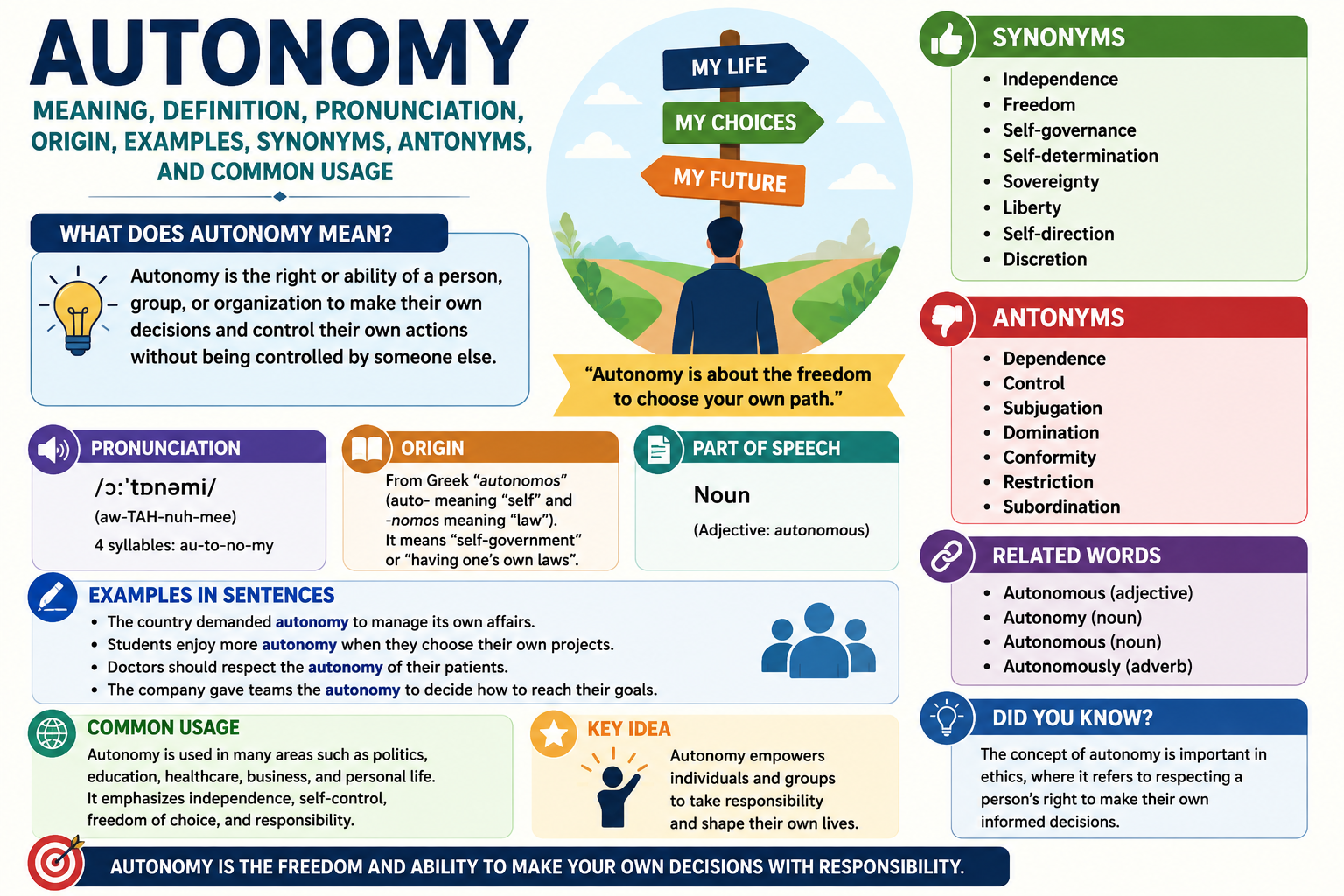
Autonomy means having the freedom or ability to make your own choices and decisions. It suggests that a person or group can direct their own actions instead of simply following someone else’s control.
In everyday English, autonomy is closely connected with independence, freedom, choice, and self-direction. However, autonomy does not always mean complete independence. A person can have autonomy while still following reasonable rules or working with other people.
For example, an employee may have autonomy over how they organize their daily tasks while still following the company’s overall policies. Similarly, a school may have autonomy to make certain educational decisions while remaining part of a larger education system.
The exact meaning can change slightly depending on the context. In politics, autonomy often refers to self-government. In personal situations, it usually means having control over one’s own choices. Oxford describes it as both the freedom of a country, region, or organization to govern itself and the ability of individuals to act and make decisions without being controlled by others.
Autonomy Pronunciation
The word autonomy is pronounced:
The pronunciation can vary slightly between British and American English, but the main stress falls on the middle part of the word.
Autonomy: aw-TAH-nuh-mee
The word has four syllables:
au-tot-o-my
When speaking, make the “TAH” sound more prominent. Learning the pronunciation can make the word easier to recognize and use naturally in conversation.
Simple Definition of Autonomy
A simple definition of autonomy is:
Autonomy is the freedom or ability to make your own decisions and control your own actions.
In even simpler terms, autonomy means “being able to decide for yourself.”
Consider a simple example. Imagine a teacher tells a student that the student can choose which topic to research, which sources to use, and how to present the final project. The teacher still provides general rules, but the student has freedom within those rules. That freedom is a form of autonomy.
The same idea applies to adults, organizations, communities, and governments. Autonomy is about having meaningful control over decisions that affect you.
What Is the Origin of Autonomy?
The word autonomy has an interesting history. It comes from Greek autonomía, meaning self-government, independence, or living according to one’s own laws. The Greek word is connected to autónomos, meaning independent or having one’s own laws.
The word is built from two important Greek elements. Autos means “self,” while nomos means “law” or “custom.” Together, the original idea was essentially “having one’s own laws.”
Merriam-Webster records the first known English use of autonomy in the late sixteenth century, while Oxford traces its word origin to Greek and places its English development in the early seventeenth century.
Over time, the meaning expanded beyond political self-government. Today, autonomy can describe personal decision-making, professional independence, ethical choices, organizations, technology, and many other areas.
Autonomy Meaning in Simple English
If someone asks, “What does autonomy mean?”, the easiest answer is:
Autonomy means having the freedom and ability to make your own decisions.
Here are a few simple examples:
- A student chooses how to complete an assignment.
- An employee decides how to organize a project.
- A community makes certain decisions for itself.
- A region has authority over some of its internal affairs.
- A person makes personal choices without unnecessary control from others.
In each example, the central idea is self-direction.
Autonomy does not necessarily mean doing everything alone. A person can ask for advice, cooperate with others, and still make their own final decisions.
Examples of Autonomy in Sentences
Understanding examples makes the meaning of autonomy much clearer.
Example:
“The manager gave the team greater autonomy over its daily work.”
Here, autonomy means the team received more freedom to decide how to handle its work.
Example:
“Students need some autonomy to develop confidence and responsibility.”
In this sentence, autonomy refers to allowing students to make appropriate choices for themselves.
Example:
“The region was granted greater political autonomy.”
Here, autonomy means the region received more power to govern its own affairs.
Example:
“She values her autonomy and prefers to make important decisions herself.”
In this example, autonomy means personal independence and decision-making freedom.
Example:
“The researcher wanted greater autonomy in designing the study.”
Here, autonomy refers to professional freedom.
Example:
“The organization gives local offices considerable autonomy.”
This means local offices can make certain decisions without needing constant approval from the main office.
Autonomy in Everyday Life
Autonomy is a common part of everyday life, even when people do not use the word itself.
Choosing what to study, deciding how to organize your time, selecting personal goals, and making reasonable decisions are all examples of personal autonomy. As people gain experience and responsibility, they often receive more opportunities to make decisions independently.
Autonomy can also exist within relationships, families, schools, and workplaces. Healthy cooperation does not require every decision to be controlled by one person. Instead, people can share responsibilities while still respecting each other’s ability to make appropriate choices.
This is why autonomy is often connected with trust and responsibility. When someone is given more freedom, they are generally expected to use that freedom thoughtfully.
Personal Autonomy Meaning
Personal autonomy means having the ability and freedom to make decisions about your own life.
For example, a person may have personal autonomy when choosing their educational goals, deciding how to spend their free time, or determining which activities fit their personal interests and responsibilities.
Personal autonomy does not mean ignoring other people. Decisions can have consequences, and people still need to respect laws, safety rules, and the legitimate rights of others.
The key idea is that a person has a meaningful role in making decisions that concern them rather than simply having every choice made by someone else.
Autonomy in Education
Autonomy is an important concept in education. Students often learn more effectively when they have opportunities to make appropriate choices about their learning.
For instance, a teacher might allow students to select a research topic, choose between different project formats, or decide how to organize a presentation. The teacher still provides guidance and academic requirements, but students have some control over the learning process.
Student autonomy can also help develop responsibility, decision-making skills, creativity, and confidence. However, autonomy works best when it is balanced with appropriate support and clear expectations.
Autonomy in the Workplace
In the workplace, autonomy usually means having freedom over how to perform assigned responsibilities.
An employee with professional autonomy might be trusted to organize tasks, choose suitable methods, solve problems, or manage a project without asking for approval at every step.
Workplace autonomy can encourage creativity and ownership. When employees understand their responsibilities and are trusted to make reasonable decisions, they may feel more responsible for the results of their work.
However, workplace autonomy does not mean that employees can ignore company policies or established responsibilities. It generally means having decision-making freedom within a defined role.
Autonomy in Politics and Government
In politics, autonomy commonly refers to the right or ability of a region, community, or political unit to govern itself in certain areas.
An autonomous region may have authority over particular internal matters while still being connected to a larger country or political system. This is different from complete independence.
For example, a territory may be allowed to create or manage certain local policies while remaining under the broader constitutional authority of a central government.
This political meaning is closely related to the original idea of self-government. Merriam-Webster specifically defines autonomy as the quality or state of being self-governing and, in some contexts, the right of self-government.
Autonomy in Philosophy
Autonomy has an important meaning in philosophy, especially in discussions about morality and human decision-making.
In philosophical contexts, autonomy can refer to the ability to direct one’s actions according to reason rather than simply being controlled by outside forces. Merriam-Webster notes a specific Kantian meaning involving moral self-determination based on reason.
This makes philosophical autonomy more than simply “doing whatever you want.” It involves thinking about reasons, values, responsibilities, and principles before making decisions.
In this sense, an autonomous person is not necessarily someone who rejects advice or rules. Instead, autonomy can involve thoughtfully deciding what one should do and taking responsibility for that decision.
Autonomy in Healthcare
The term autonomy is also widely used in healthcare and medical ethics.
In this context, patient autonomy generally refers to respecting a patient’s ability to participate in decisions concerning their own care. Healthcare professionals may provide information, explain options, and discuss possible benefits and risks, while the patient may have a role in making informed decisions where appropriate.
The concept is important because healthcare involves personal choices and individual values. Respecting autonomy means recognizing that patients are not simply passive recipients of care.
Oxford specifically gives patient autonomy as an example of the word’s use in professional settings.
Autonomy in Technology
In technology, autonomy can describe a system’s ability to perform tasks with limited direct human control.
For example, an autonomous software system may perform certain operations automatically according to its design. The adjective autonomous is closely related to autonomy and can describe systems that carry out tasks without direct human guidance or intervention.
The technological use of the word comes from the same broad concept: a system is capable of performing some actions independently.
However, technological autonomy can exist at different levels. A system may be partly autonomous rather than completely independent. The amount of human supervision can therefore be an important part of understanding the term.
Autonomy vs. Independence
Autonomy and independence are closely related, but they are not always identical.
Independence often emphasizes being free from reliance, control, or influence from another person or institution. Autonomy focuses more specifically on the ability or right to make one’s own decisions and direct one’s own actions.
For example, a person can depend on a teacher for guidance while still having autonomy over how they approach a project.
Similarly, a regional government can have political autonomy without being a completely independent country.
So, a useful distinction is:
Independence = freedom from dependence or control.
Autonomy = freedom or authority to make one’s own decisions.
The two concepts overlap, and dictionaries often list independence as a synonym for autonomy.
Synonyms of Autonomy
Common synonyms and closely related words include:
- Independence
- Freedom
- Self-determination
- Self-government
- Self-governance
- Self-direction
- Sovereignty
- Choice
- Free will
- Liberty
- Discretion
The best synonym depends on the sentence. For example, self-government works particularly well in political contexts, while independence and self-direction often work better in personal or professional contexts. Merriam-Webster’s thesaurus includes terms such as choice, self-determination, independence, sovereignty, freedom, and self-government among words related to autonomy.
Antonyms of Autonomy
Words that can contrast with autonomy include:
- Dependence
- Control
- Subjection
- Domination
- Restriction
- Powerlessness
- Submission
- Constraint
- Heteronomy
Again, the best antonym depends on context.
For example, if autonomy means freedom from outside control, dependence may be an appropriate opposite. If autonomy means self-government, subjection or external control may better express the contrast.
Merriam-Webster’s thesaurus lists dependence, subjection, heteronomy, and unfreedom among antonyms or near-antonyms of autonomy.
Common Phrases With Autonomy
The word autonomy appears in several common expressions.
Personal Autonomy
This refers to an individual’s freedom to make decisions about their own life.
Individual Autonomy
This has a similar meaning and emphasizes the decision-making rights of an individual.
Political Autonomy
This refers to self-government or decision-making power within a political system.
Regional Autonomy
This describes a region’s ability to manage certain matters independently of a central authority.
Professional Autonomy
This refers to freedom within a profession to make appropriate decisions according to professional knowledge and standards.
Financial Autonomy
This means having enough financial independence or control to make decisions without excessive reliance on another party.
Bodily Autonomy
This refers broadly to a person’s ability to make decisions concerning their own body. It is frequently discussed in ethical, legal, medical, and social contexts.
How to Use Autonomy Correctly
Because autonomy is a formal noun, it often appears in academic, professional, legal, political, and educational writing.
Common patterns include:
“have autonomy”
Example: “The department has greater autonomy.”
“give someone autonomy”
Example: “The supervisor gave the employee more autonomy.”
“greater autonomy”
Example: “The new policy gives schools greater autonomy.”
“personal autonomy”
Example: “Personal autonomy is important when making individual decisions.”
“political autonomy”
Example: “The movement called for greater political autonomy.”
These patterns can help you use the word naturally rather than simply memorizing its dictionary definition.
Is Autonomy Always a Good Thing?
Autonomy is often viewed positively because it allows people and organizations to make meaningful decisions for themselves. It can support responsibility, creativity, confidence, and self-direction.
However, autonomy also comes with responsibility. Having freedom to make a decision means that a person may need to accept the consequences of that decision.
There can also be situations where complete autonomy is not practical. Organizations need shared rules, governments need laws, schools need standards, and teams need coordination. Therefore, autonomy is often about finding an appropriate balance between individual freedom and shared responsibilities.
Autonomy and Responsibility
Autonomy and responsibility are strongly connected.
When people receive greater freedom to make decisions, they may also need to take greater responsibility for the outcomes. For example, an employee who can independently manage a project is generally expected to meet deadlines and produce quality work.
The same principle applies to students. Giving students autonomy does not mean removing expectations. Instead, it can mean allowing them to make appropriate choices while still being accountable for completing their responsibilities.
This balance makes autonomy useful in real-world situations. Freedom works best when it is combined with good judgment.
Autonomy vs. Authority
Autonomy and authority are related but different concepts.
Authority generally refers to the power or right to give orders, make decisions, or control something. Autonomy, by contrast, emphasizes the ability to make one’s own decisions without unnecessary external control.
A manager may have authority over a team, while an employee may have autonomy over how to complete a particular task.
In simple terms:
Authority = power to direct or decide.
Autonomy = freedom to direct or decide for yourself.
Understanding this distinction is especially useful when reading business, government, legal, or academic material.
Why Is Autonomy Important?
Autonomy matters because people generally need some degree of control over meaningful decisions in their lives.
In education, autonomy can encourage students to become more responsible learners. In workplaces, it can help employees take ownership of their tasks. In healthcare, it supports respect for patient decision-making. In politics, autonomy can describe a community’s ability to govern certain affairs.
The concept also helps explain why people value freedom and self-determination. Having a voice in decisions that affect you can be an important part of personal and social well-being.
At the same time, autonomy should be understood alongside responsibility, cooperation, and respect for others.
Frequently Asked Questions About Autonomy
What does autonomy mean in simple words?
Autonomy means the freedom or ability to make your own decisions and direct your own actions. It is closely connected with independence, choice, and self-direction.
What is an example of autonomy?
A simple example is an employee being trusted to decide how to organize a project while still following the company’s overall requirements. The employee has freedom over the method used to complete the work.
What is the synonym of autonomy?
Common synonyms include independence, freedom, self-determination, self-government, self-direction, sovereignty, and choice. The most suitable synonym depends on the context.
What is the opposite of autonomy?
Common opposites include dependence, control, subjection, restriction, domination, and constraint. The exact opposite depends on how autonomy is being used.
Is autonomy the same as independence?
Not exactly. The words overlap, but autonomy focuses more specifically on having the ability or right to make your own decisions, while independence can emphasize freedom from reliance or outside control.
What does personal autonomy mean?
Personal autonomy means having meaningful freedom and ability to make decisions concerning your own life. It involves self-direction while still recognizing responsibilities and reasonable limits.
What does political autonomy mean?
Political autonomy means that a region, territory, or community has some authority to govern its own affairs. It does not necessarily mean complete independence from the larger political system.
What is professional autonomy?
Professional autonomy means having appropriate freedom to make decisions within one’s professional role, knowledge, standards, and responsibilities.
Is autonomy a noun or adjective?
Autonomy is a noun. The related adjective is autonomous, which describes something or someone that is independent or self-governing.
How do you pronounce autonomy?
Autonomy is commonly pronounced “aw-TAH-nuh-mee.” The main stress falls on the middle syllable.
Conclusion
The meaning of autonomy is centered on freedom, self-direction, and the ability to make one’s own decisions. In simple English, autonomy means having a meaningful level of control over your own choices rather than being completely directed by someone else.
The word can be used in many contexts. Personal autonomy concerns individual decision-making, professional autonomy relates to freedom within a job or profession, political autonomy concerns self-government, and technological autonomy describes systems capable of performing certain tasks independently.
The word comes from Greek roots meaning essentially self + law, reflecting the original idea of governing oneself.
Understanding the autonomy meaning is useful because the term appears frequently in everyday discussions as well as education, business, philosophy, healthcare, politics, law, and technology. Whether you encounter the word in a dictionary, article, workplace document, or academic text, its central idea remains the same: the freedom or ability to direct oneself and make decisions independently.