The phrase “Jenny fascist meaning” has recently appeared in online searches, leaving many people wondering whether it has a specific definition or if it refers to a viral trend. Unlike many common English expressions, this phrase is not an officially recognized word or dictionary entry. Instead, it usually combines the personal name Jenny with the word fascist, often depending on the context in which it is used.
If you came across this phrase on social media, in an online discussion, or in a comment section, the meaning can vary. In most cases, it is not a fixed expression but rather a reference to a particular person, joke, meme, or conversation. Understanding each part of the phrase separately makes it much easier to understand what someone may have intended.
This guide explains the Jenny fascist meaning in simple English, including pronunciation, origin, examples, synonyms, antonyms, common usage, and frequently asked questions. By the end, you will understand why the phrase appears online and why its meaning depends heavily on context.
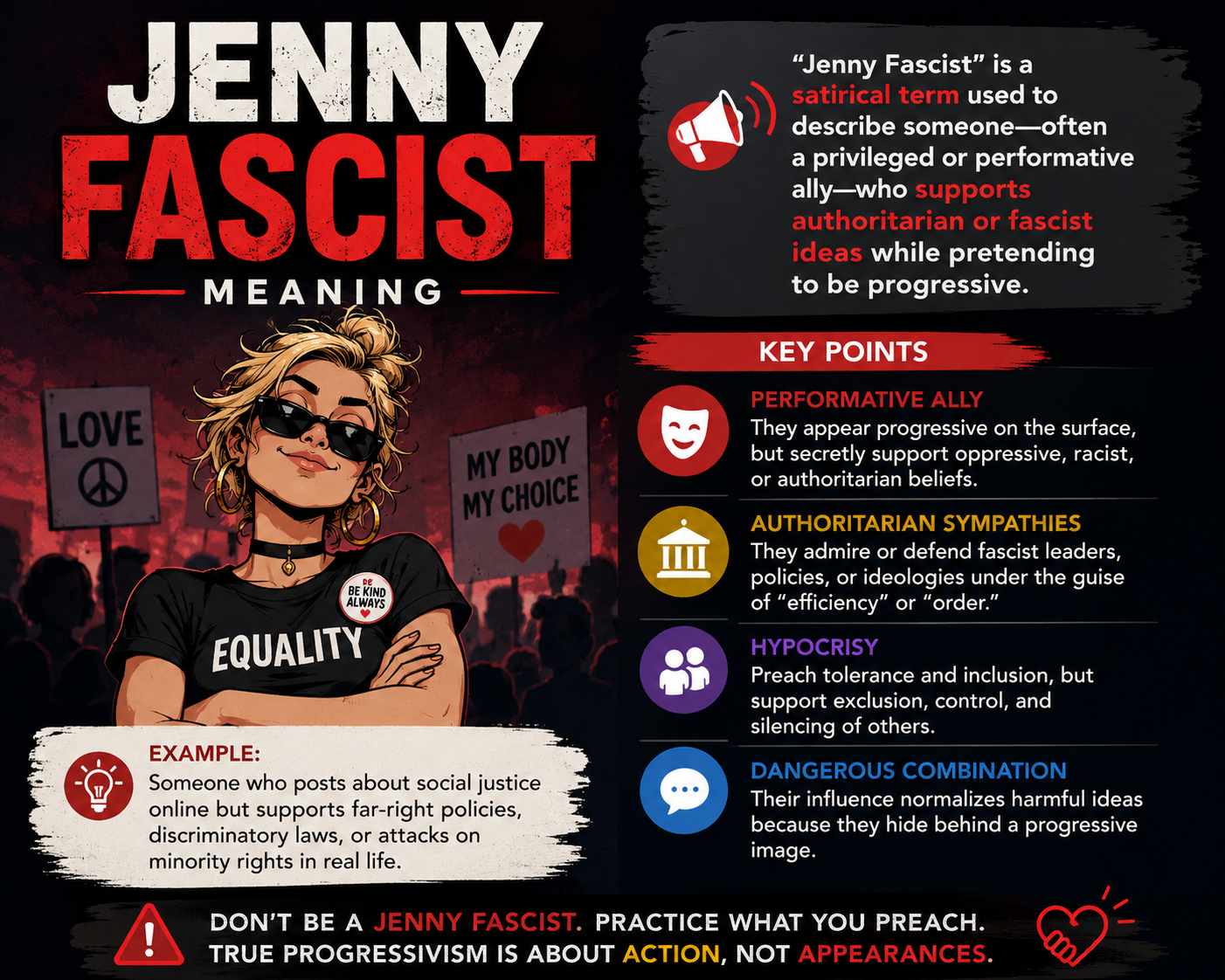
What Does “Jenny Fascist” Mean?
The phrase Jenny fascist does not have a universal definition. It generally combines:
- Jenny – a common first name.
- Fascist – a political term describing someone who supports or is associated with fascism, an authoritarian political ideology.
When these two words appear together, they usually refer to a specific individual named Jenny or are used humorously, sarcastically, or as part of an internet discussion. The phrase itself does not create a new dictionary word.
For example, someone might say:
- “People started calling Jenny a fascist after the debate.”
- “The phrase became popular because of a viral social media post.”
In these examples, the meaning depends entirely on the situation rather than on the phrase itself.
Pronunciation
The key word in the phrase is fascist, which is pronounced:
FASH-ist
Broken into syllables:
Fash • ist
The name Jenny is pronounced:
JEN-ee
Together, the phrase is spoken as:
JEN-ee FASH-ist
Correct pronunciation helps when discussing news articles, educational topics, or online conversations.
Origin of the Phrase
Unlike established English vocabulary, Jenny fascist has no confirmed linguistic origin. There is no evidence that it developed as an official expression, historical phrase, or recognized idiom.
Instead, searches for the phrase often arise because of:
- Social media discussions
- Viral memes
- Internet jokes
- Political debates
- Online nicknames
- References to a specific person named Jenny
Many internet phrases become popular for a short time before disappearing again. Without context, their meanings remain unclear because they are tied to individual events rather than to the English language itself.
Understanding the Word “Fascist”
To understand the phrase, it helps to know what fascist means.
A fascist traditionally refers to someone who supports or promotes fascism, a political ideology associated with:
- Authoritarian government
- Extreme nationalism
- Centralized power
- Opposition to political opposition
- Limited democratic freedoms
Today, the word is sometimes used accurately in discussions about political history. However, it is also frequently used online as an insult or exaggeration, even when it does not accurately describe someone’s political beliefs.
Because of this, readers should always consider the context before interpreting the word.
Why Are People Searching for “Jenny Fascist Meaning”?
There are several reasons why this search term has gained attention.
Curiosity After Seeing It Online
People often encounter unfamiliar phrases on social media and immediately search for their meanings.
Viral Content
Internet memes, videos, or screenshots can introduce unusual combinations of words that suddenly become popular.
Political Discussions
Sometimes a person’s name becomes linked to political debates or controversial comments, leading users to search for explanations.
Search Engine Trends
Occasionally, a phrase becomes popular simply because many people begin searching for it, even though it has no official definition.
These factors explain why Jenny fascist meaning appears in search results despite lacking a standard dictionary definition.
Examples of Usage
Because the phrase is context-dependent, here are some hypothetical examples.
Example One
“I searched for Jenny fascist meaning because I saw the phrase in a viral post.”
Example Two
“People were debating whether the nickname was serious or simply a joke.”
Example Three
“The article explained that the phrase depends on the specific conversation.”
These examples show that understanding the surrounding discussion is essential before drawing conclusions.
Is “Jenny Fascist” an Official English Phrase?
No.
The phrase is not recognized as an official English expression, dictionary entry, or established idiom.
Instead, it should be viewed as a search query or internet phrase whose meaning depends entirely on context.
Synonyms
Because “Jenny fascist” is not an established English phrase, it has no direct synonyms. However, depending on the context, people may use related expressions when referring to the word fascist or to internet discussions about political labels.
Some related terms include:
- Authoritarian supporter
- Dictatorial (in some contexts)
- Extremist (context-dependent)
- Political hardliner
- Internet nickname
- Viral label
Keep in mind that these are not exact replacements for the phrase “Jenny fascist.” The intended meaning always depends on the conversation in which it appears.
Antonyms
There is no direct antonym for “Jenny fascist” because it is not a recognized phrase. If discussing the political term fascist, possible contrasting ideas include:
- Democrat (political context)
- Liberal democracy supporter
- Advocate of civil liberties
- Pluralist
- Supporter of democratic values
These words represent different political ideas rather than exact opposites.
Common Usage
The phrase usually appears in places such as:
- Social media comments
- Internet forums
- Online memes
- Political discussions
- Search engine queries
Unlike everyday English expressions, Jenny fascist is rarely used in formal writing. Most appearances are connected to a specific online conversation, making the surrounding context essential for understanding what the writer means.
Common Misunderstandings
It Is a Dictionary Term
This is incorrect. Jenny fascist is not listed as a standard English word or phrase in major dictionaries.
It Has One Fixed Meaning
The phrase does not have a universal definition. Its meaning changes depending on the person, event, or discussion being referenced.
It Always Refers to Politics
Not necessarily. Sometimes the phrase may appear in jokes, memes, or sarcastic conversations where it is not being used as a serious political description.
Every Online Use Is Accurate
Words used on the internet are not always factually correct. Political labels are sometimes used loosely or as insults, so it is important to understand the context before accepting the intended meaning.
Why Context Matters
One of the biggest challenges with understanding Jenny fascist meaning is that the phrase lacks an official definition. Instead, readers need to ask questions such as:
- Where did the phrase appear?
- Was it part of a news story?
- Was it used in a meme?
- Was someone referring to a specific person named Jenny?
- Was the comment serious or sarcastic?
Answering these questions usually provides a much clearer understanding than focusing only on the words themselves.
Related Words
If you are researching this topic, you may also encounter these related terms:
Fascism
A political ideology characterized by authoritarian leadership, extreme nationalism, and centralized power.
Fascist
A person who supports or is associated with fascism.
Political Label
A word or phrase used to describe a person’s political beliefs or perceived ideology.
Internet Slang
Informal language that develops through online communities, social media platforms, and digital culture.
Understanding these related terms can make it easier to interpret unusual search queries or viral phrases.
Tips for Understanding Viral Search Terms
Internet trends often create phrases that appear confusing at first. When researching them:
- Look for the original source.
- Read the surrounding conversation.
- Avoid assuming the phrase has an official definition.
- Check whether it refers to a meme, a public figure, or a specific event.
- Use reliable sources when discussing political or historical terminology.
These habits help separate factual information from internet speculation.
Frequently Asked Questions
What does “Jenny fascist” mean?
There is no official definition. It is usually a phrase combining the name Jenny with the word fascist, and its meaning depends on the context.
Is “Jenny fascist” in the dictionary?
No. It is not recognized as a standard English word or expression.
How do you pronounce fascist?
It is pronounced FASH-ist.
Why are people searching for “Jenny fascist meaning”?
Most searches appear to be driven by social media posts, online discussions, or viral content where the phrase was mentioned.
Does the phrase always refer to one person?
Not necessarily. Without additional context, it is impossible to know whether it refers to a specific individual, a joke, or another online discussion.
Is the phrase commonly used?
No. It is not a common expression in everyday English and is mainly seen in online searches or internet conversations.
Can internet phrases have different meanings?
Yes. Many viral expressions change meaning depending on where they are used and who is using them.
Should I rely on social media for definitions?
It is better to verify unfamiliar terms with reliable sources, especially when the phrase involves political language or historical concepts.
Conclusion
The Jenny fascist meaning is not based on an official dictionary definition or a recognized English expression. Instead, it is best understood as a context-dependent phrase that combines the personal name Jenny with the political term fascist. In most cases, people search for it after seeing it in a viral post, online debate, meme, or social media discussion.
Because the phrase has no fixed meaning, understanding the surrounding conversation is essential before interpreting it. Rather than assuming it refers to a specific person or event, readers should consider where it appeared and how it was being used. This approach leads to a more accurate understanding and helps avoid misunderstandings when discussing unfamiliar internet terms.