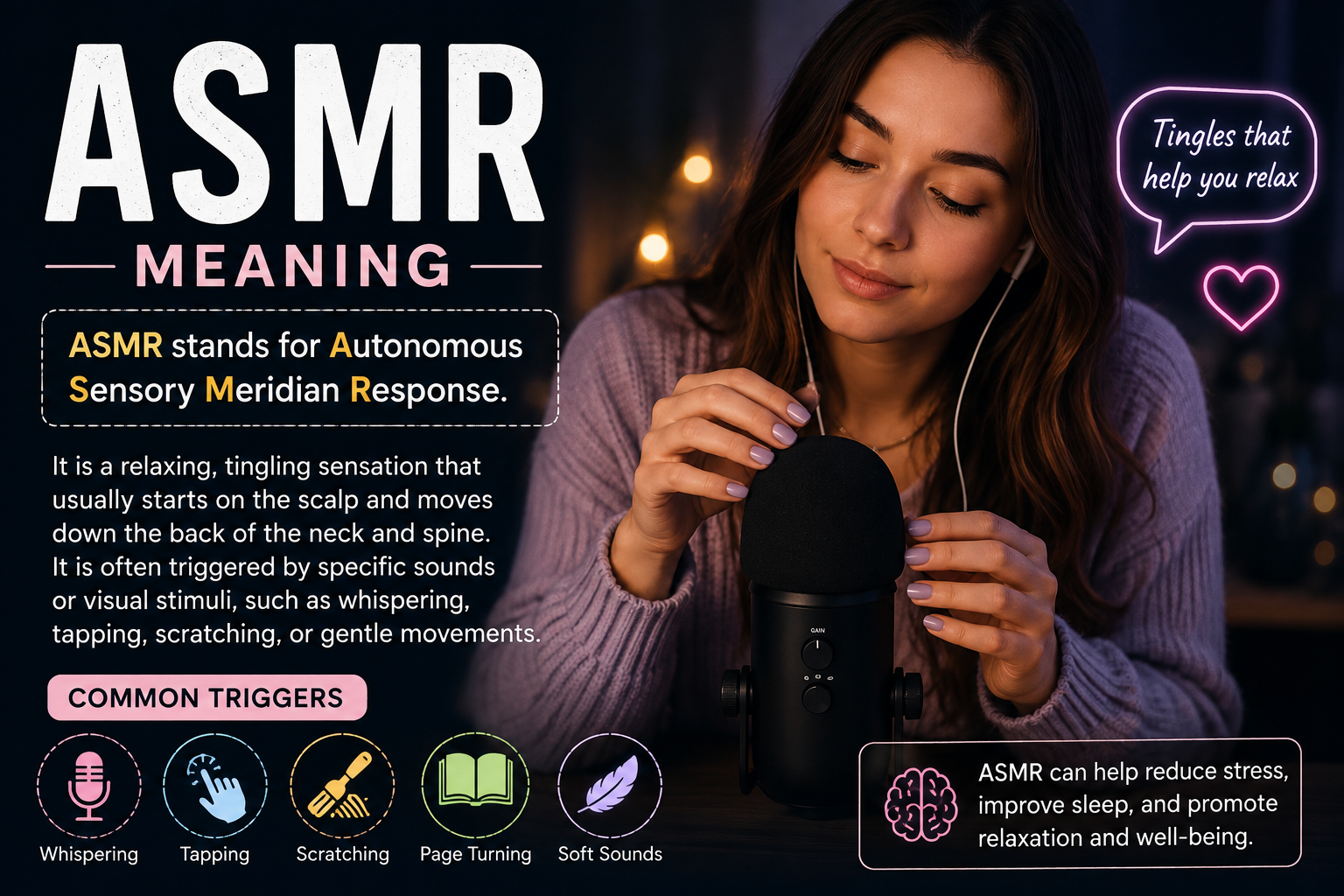
ASMR stands for Autonomous Sensory Meridian Response. It describes a pleasant, calming feeling that usually begins on the scalp and travels down the neck, shoulders, or back. Many people explain it as a gentle tingling sensation that helps them feel relaxed, peaceful, and comfortable.
The term ASMR meaning has become increasingly popular because millions of people watch ASMR videos online to reduce stress, improve sleep, or simply enjoy relaxing sounds. Although not everyone experiences ASMR, those who do often describe it as deeply soothing and enjoyable.
Understanding ASMR Meaning in Simple English
The easiest way to understand ASMR meaning is to think of it as a relaxing response to certain sounds, movements, or personal attention. It is not painful or uncomfortable. Instead, it creates a calm sensation that many people compare to a warm feeling of relaxation.
For example, someone may experience ASMR while listening to soft whispering, gentle tapping, pages turning in a book, or the sound of rain. Others may feel it when watching someone carefully draw, paint, fold towels, or perform slow and repetitive tasks.
How to Pronounce ASMR
The abbreviation ASMR is pronounced by saying each letter individually:
A – S – M – R
Some people also say the full phrase:
Autonomous Sensory Meridian Response
Although the complete name sounds scientific, most people simply use the abbreviation “ASMR” in conversations, social media, and online videos.
What Does Autonomous Sensory Meridian Response Mean?
Each word in the phrase has its own meaning.
Autonomous
Autonomous means something that happens naturally without conscious effort. The relaxing sensation appears automatically when a suitable trigger is experienced.
Sensory
Sensory relates to the senses such as hearing, sight, touch, and sometimes smell. ASMR is usually triggered through hearing and vision.
Meridian
The word meridian was chosen to describe a peak or high point of pleasant sensation rather than referring to medical or scientific anatomy.
Response
Response simply means the body’s reaction to certain triggers. Not everyone experiences the same response because every person is different.
Origin of the Term ASMR
The phrase Autonomous Sensory Meridian Response was created in 2010 by Jennifer Allen. She wanted a neutral, scientific-sounding term to describe the pleasant tingling feeling that many people experienced but could not easily explain.
Before the term existed, people discussed the sensation on internet forums using different descriptions such as “brain tingles” or “head tingles.” After the name ASMR became popular, online communities quickly formed around the topic, leading to thousands of creators producing relaxation videos.
Today, ASMR has become a worldwide internet trend with millions of viewers across platforms like YouTube, TikTok, and streaming services.
Why Is ASMR So Popular?
There are several reasons why ASMR videos attract such a large audience.
Stress Relief
Many viewers watch ASMR videos after work or school because the gentle sounds help them unwind and feel calmer.
Better Sleep
People struggling with insomnia often use ASMR videos before bedtime. The slow pace and soft sounds create a peaceful environment that may make falling asleep easier.
Relaxation
ASMR content encourages viewers to slow down and focus on calming experiences instead of daily worries.
Entertainment
Some people simply enjoy the creativity of ASMR artists who use unique objects and sounds to create relaxing experiences.
Common ASMR Triggers
Everyone experiences ASMR differently. A trigger that works for one person may have no effect on another.
Whispering
Soft whispering is one of the most common ASMR triggers. Many creators speak quietly to create a comforting atmosphere.
Tapping
Light tapping on wood, glass, plastic, or metal creates rhythmic sounds that many viewers find satisfying.
Page Turning
The gentle sound of turning book pages often creates a peaceful feeling.
Brushing Sounds
Hair brushing, makeup brushing, or microphone brushing can trigger relaxation for many listeners.
Crinkling
Paper, wrappers, foil, and plastic bags produce crisp sounds that many ASMR fans enjoy.
Keyboard Typing
Slow typing sounds are popular among viewers who enjoy office or study-related ASMR.
Personal Attention
Roleplay videos where someone pretends to provide medical exams, haircuts, spa treatments, or makeup sessions often trigger ASMR because they simulate caring personal attention.
Nature Sounds
Rainfall, ocean waves, birds singing, and flowing rivers create relaxing environments that many people associate with ASMR.
Does Everyone Experience ASMR?
No. Some people experience strong tingling sensations, while others simply feel relaxed without any tingles. Some individuals do not experience ASMR at all.
Scientists believe personal differences, brain activity, personality, and individual sensitivity all play a role. Because of these differences, there is no single trigger that works for everyone.
Is ASMR Scientifically Proven?
Research into ASMR is still developing. Several studies suggest that ASMR may lower heart rate, reduce stress, and improve mood for people who experience it.
Researchers continue studying why certain sounds produce calming effects and why only some individuals experience the characteristic tingling sensation. While more research is needed, many users report positive personal experiences.
Examples of ASMR in Everyday Life
ASMR is not limited to online videos. Many everyday situations may trigger it naturally.
Some examples include:
- Listening to a teacher speak softly during a lesson.
- Watching someone carefully draw or paint.
- Hearing gentle rain outside your window.
- Listening to someone slowly turn the pages of a magazine.
- Watching a librarian organize books.
- Hearing a hairstylist gently comb your hair.
- Listening to quiet knitting or sewing sounds.
- Watching someone wrap a gift with care.
These everyday experiences often produce feelings of calm even without intentionally seeking ASMR.
ASMR in Social Media
Social media has played a major role in introducing ASMR to millions of people worldwide.
YouTube contains dedicated ASMR channels with videos lasting from a few minutes to several hours. TikTok features short ASMR clips using whispering, tapping, cooking, and satisfying visual effects. Instagram creators also share relaxing reels featuring calming sounds and slow movements.
This widespread availability has helped people discover new triggers and understand ASMR meaning more easily.
ASMR in Different Types of Content
ASMR creators produce content across many categories.
Food ASMR
These videos focus on chewing, crunching, cooking, slicing, and eating sounds.
Study ASMR
Study-themed videos include writing, typing, highlighting books, and quiet library sounds.
Beauty ASMR
Makeup application, skincare routines, hair brushing, and spa treatments create soft and repetitive sounds.
Gaming ASMR
Some gamers speak softly while playing relaxing games to create a peaceful viewing experience.
Nature ASMR
Rainstorms, forests, rivers, fireplaces, and beaches provide calming natural soundscapes.
Craft ASMR
Drawing, painting, woodworking, pottery, knitting, and other handmade activities produce satisfying sounds that many viewers enjoy.
Synonyms of ASMR
Because ASMR is a specific experience rather than a standard dictionary word, there are no perfect synonyms. However, several words and phrases are often used to describe similar feelings or experiences.
Brain Tingles
This is the most common informal synonym. Many people use “brain tingles” to describe the pleasant sensation that ASMR creates.
Relaxation Response
Although broader in meaning, this phrase describes the calming effect many people experience while listening to ASMR content.
Calming Sensation
People who do not experience tingles often describe ASMR simply as a calming or soothing sensation.
Soothing Experience
This phrase is commonly used in reviews of ASMR videos and relaxation content.
Tingling Feeling
Some people use this expression to describe the light, pleasant sensation that travels from the scalp to the neck and shoulders.
Antonyms of ASMR
Since ASMR is associated with comfort and relaxation, its opposites are feelings or experiences that create stress or discomfort.
Some common antonyms include:
- Stress
- Anxiety
- Tension
- Discomfort
- Irritation
- Restlessness
- Agitation
- Uneasiness
While these words are not direct dictionary antonyms of ASMR, they represent emotional states opposite to the calm feeling that ASMR aims to produce.
Common Usage of ASMR
The term ASMR appears in many everyday conversations, especially online.
Here are some examples.
Example One
“I watch ASMR videos every night before going to sleep.”
Example Two
“Soft whispering always gives me ASMR.”
Example Three
“I don’t get ASMR tingles, but I still enjoy the relaxing sounds.”
Example Four
“My favorite ASMR videos include rain sounds and page turning.”
Example Five
“That haircut roleplay is one of the best ASMR videos I’ve watched.”
These examples show that people often use ASMR as both a noun and an adjective when talking about relaxing content.
Example Sentences Using ASMR
Understanding ASMR meaning becomes easier when you see it in real-life sentences.
- She listens to ASMR while studying because it helps her stay calm.
- Many people enjoy ASMR videos before bedtime.
- The soft tapping sounds created a relaxing ASMR experience.
- My friend experiences ASMR from gentle whispering.
- Rain sounds are one of the most popular ASMR triggers.
- Not everyone feels ASMR, and that is completely normal.
- Some creators specialize in makeup ASMR videos.
- ASMR has become one of the most popular relaxation trends online.
- I discovered ASMR through a YouTube recommendation.
- Slow hand movements can create an enjoyable ASMR experience.
Benefits Often Associated With ASMR
Although experiences differ from person to person, many viewers report several positive effects.
Helps Reduce Stress
People often watch ASMR after a busy day because the gentle sounds encourage relaxation and help reduce feelings of stress.
Supports Better Sleep
Many viewers include ASMR as part of their bedtime routine. Listening to quiet sounds may help create a peaceful environment before sleeping.
Improves Relaxation
ASMR encourages mindfulness by helping people focus on calm sounds instead of everyday worries.
Creates Positive Feelings
Many individuals say ASMR makes them feel safe, comfortable, and emotionally relaxed.
May Improve Focus
Some people use background ASMR while reading or working because soft sounds can help block distracting noises.
Common Misconceptions About ASMR
There are several misunderstandings about ASMR. Let’s clear up some of the most common ones.
ASMR Is Not Dangerous
Listening to ASMR is generally considered safe. It is simply a type of relaxation content that many people enjoy.
ASMR Is Not the Same for Everyone
Some people experience strong tingles, others feel only relaxed, and some people experience nothing at all.
ASMR Is Not Only Whispering
Whispering is popular, but ASMR can also include tapping, brushing, rain sounds, cooking, typing, page turning, and many other triggers.
ASMR Is Not a Medical Treatment
Although many users say ASMR helps them relax or sleep better, it should not replace professional medical care for stress, anxiety, or sleep disorders.
Why People Search for “ASMR Meaning”
The keyword ASMR meaning has become increasingly popular because people often encounter the term on YouTube, TikTok, Instagram, or streaming platforms without knowing what it stands for.
Some common reasons people search for the phrase include:
- They watched an ASMR video for the first time.
- A friend mentioned ASMR in conversation.
- They want to know why whispering videos receive millions of views.
- They experienced tingling sensations and want to understand them.
- They are looking for relaxation techniques.
Learning the definition helps users better understand why ASMR has become a global online trend.
ASMR Around the World
ASMR is popular across many countries and languages. Content creators produce videos in English, Spanish, Japanese, Korean, French, German, Arabic, Hindi, and many other languages.
Interestingly, language is not always important. Many viewers enjoy ASMR because of the sounds themselves rather than the spoken words. Gentle tapping, brushing, water sounds, and nature recordings can be relaxing regardless of where someone lives.
This worldwide appeal has helped build a large and diverse ASMR community.
Tips for Finding the Right ASMR Content
If you are new to ASMR, remember that everyone has different preferences. It may take some time to discover which sounds you enjoy most.
You can try:
- Whispering videos
- Rain and thunder sounds
- Ocean waves
- Keyboard typing
- Book page turning
- Hair brushing
- Wood tapping
- Cooking sounds
- Drawing or painting videos
- Soft-spoken storytelling
Experimenting with different styles can help you find content that feels the most relaxing.
Frequently Asked Questions
What does ASMR stand for?
ASMR stands for Autonomous Sensory Meridian Response. It refers to a pleasant tingling or deeply relaxing feeling triggered by certain sounds, movements, or forms of personal attention.
What is the simple meaning of ASMR?
In simple English, ASMR means a calming feeling that some people experience when they hear gentle sounds like whispering, tapping, or rainfall.
Is ASMR real?
Yes. Many people genuinely experience ASMR, although scientists are still studying why it happens and why only some individuals feel the tingling sensation.
Does everyone experience ASMR?
No. Some people experience strong tingles, some only feel relaxed, and others do not experience ASMR at all.
What are common ASMR triggers?
Popular triggers include whispering, tapping, page turning, brushing sounds, rain, keyboard typing, soft speaking, cooking sounds, and slow hand movements.
Can ASMR help with sleep?
Many people report that ASMR helps them relax before bedtime, making it easier to fall asleep. However, results vary from person to person.
Is ASMR only found in videos?
No. Everyday experiences such as listening to rain, watching someone draw, getting a haircut, or hearing pages turn can also trigger ASMR.
Is ASMR harmful?
For most people, ASMR is simply a relaxing form of entertainment and is generally considered safe.
Conclusion
Understanding ASMR meaning is easier once you know that it refers to Autonomous Sensory Meridian Response, a relaxing sensation often triggered by gentle sounds, slow movements, or caring personal attention. While many people experience pleasant tingles on the scalp and neck, others simply enjoy the calming atmosphere without feeling the physical sensation.
Over the past decade, ASMR has grown from a little-known internet topic into a worldwide phenomenon. Millions of people now use ASMR videos to relax after a long day, improve their bedtime routine, reduce stress, or simply enjoy peaceful sounds. Whether your favorite trigger is whispering, rain, tapping, page turning, or nature recordings, ASMR offers a unique way to slow down and unwind.
Although research is still ongoing, the popularity of ASMR continues to grow because many people find it comforting and enjoyable. If you have never explored it before, trying different types of ASMR content may help you discover what works best for you. Understanding the true ASMR meaning allows you to appreciate why this simple yet fascinating experience has become such an important part of online relaxation culture.