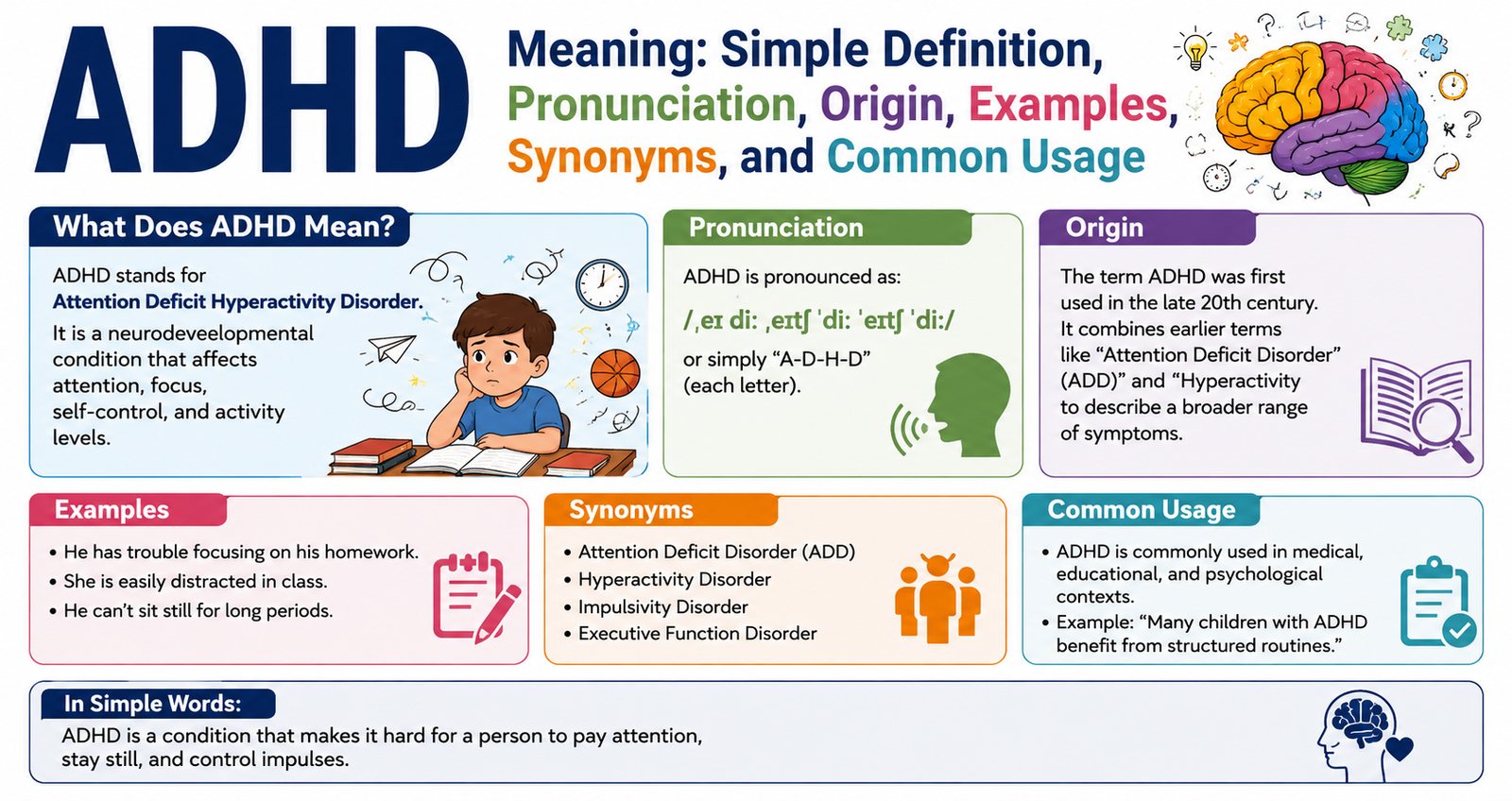
If you have searched for ADHD meaning, you may be wondering what this common abbreviation actually stands for and what it means in everyday language. ADHD stands for Attention-Deficit/Hyperactivity Disorder. It is a neurodevelopmental disorder associated with ongoing patterns of inattention, hyperactivity, and/or impulsivity that can affect daily life.
In simple English, ADHD means that a person’s brain may handle attention, activity level, organization, and impulse control differently. Someone with ADHD may have difficulty staying focused, finishing tasks, remembering details, sitting still, waiting their turn, or controlling an urge to act quickly. However, ADHD is much more than simply being distracted, energetic, or forgetful once in a while.
This guide explains the ADHD meaning in simple language. It covers its pronunciation, origin, examples, related words, common usage, symptoms, different presentations, diagnosis, and frequently asked questions. The goal is to make the term easier to understand without using confusing medical language.
What Does ADHD Mean?
ADHD means Attention-Deficit/Hyperactivity Disorder. The abbreviation comes from the first letters of the major words in the condition’s name. It describes a developmental disorder involving persistent patterns of inattention and/or hyperactivity-impulsivity that can interfere with functioning or development.
The word “attention” refers to the ability to focus on information or activities. “Deficit” suggests difficulty or reduced ability in an area, while “hyperactivity” refers to unusually high activity or restlessness. “Impulsivity” describes acting quickly without enough time to consider the consequences.
It is important to understand that the name does not mean every person with ADHD has exactly the same symptoms. ADHD can appear differently from person to person, and symptoms can also change as someone gets older.
ADHD Meaning in Simple English
In very simple terms, ADHD is a condition that can make attention, organization, activity level, and impulse control more difficult than usual.
For example, a person with ADHD might:
- Become distracted easily during a task.
- Forget appointments, instructions, or everyday items.
- Have trouble organizing schoolwork or other responsibilities.
- Start several tasks but struggle to finish them.
- Feel unusually restless.
- Talk frequently or interrupt conversations.
- Have difficulty waiting for a turn.
- Act quickly before fully thinking something through.
These experiences can happen to anyone occasionally. What makes ADHD different is that symptoms are persistent, occur in more than one situation, and can cause meaningful difficulties in everyday functioning.
How Do You Pronounce ADHD?
The abbreviation ADHD is usually pronounced by saying each letter separately:
A-D-H-D
You can hear the pronunciation here:
The full term, Attention-Deficit/Hyperactivity Disorder, is pronounced as a normal English phrase. In everyday conversations, however, people almost always use the shorter term “ADHD.”
What Does ADHD Stand For?
ADHD stands for:
A — Attention
D — Deficit
H — Hyperactivity
D — Disorder
The official term is generally written as Attention-Deficit/Hyperactivity Disorder, although you may also see variations in capitalization and punctuation.
What Is the Origin of the Term ADHD?
The ideas behind ADHD have a long history in medical and psychological literature. Researchers and doctors have described attention difficulties, impulsive behavior, and unusually high activity levels under different names over the years.
The terminology changed as scientific understanding developed. The Diagnostic and Statistical Manual of Mental Disorders introduced the term Attention Deficit Disorder in its third edition in 1980. The revised edition published in 1987 brought hyperactivity back into the name and used Attention-Deficit/Hyperactivity Disorder, or ADHD.
Modern understanding has continued to develop. Today, ADHD is recognized as a neurodevelopmental disorder rather than simply a problem with discipline, motivation, or personality. The National Institute of Mental Health describes ADHD as a developmental disorder involving persistent inattention and/or hyperactivity-impulsivity.
This history is useful because it shows why older books or conversations may use terms that are different from the language commonly used today.
What Are the Main Symptoms of ADHD?
ADHD symptoms generally fall into two broad areas: inattention and hyperactivity-impulsivity. Some people experience mostly inattentive symptoms, some experience mostly hyperactive-impulsive symptoms, and others experience a combination.
Inattention
Inattention can involve difficulty maintaining focus, following instructions, organizing tasks, or remembering everyday responsibilities.
Examples may include:
- Losing things regularly.
- Forgetting details.
- Making careless mistakes.
- Having trouble completing tasks.
- Becoming distracted by surrounding activity.
- Struggling to organize work.
- Finding it difficult to listen during conversations.
- Avoiding tasks that require prolonged mental effort.
This does not mean a person with ADHD is incapable of paying attention. Attention can vary depending on the situation, task, environment, and level of interest.
Hyperactivity
Hyperactivity involves unusually high levels of activity or restlessness. In children, it may be more noticeable as physical movement. In older teenagers and adults, it can sometimes appear more like an internal feeling of restlessness.
Examples can include:
- Fidgeting frequently.
- Feeling unable to stay still.
- Talking excessively.
- Moving around when remaining seated is expected.
- Feeling restless during quiet activities.
Not everyone with ADHD is visibly hyperactive. This is one reason the condition can sometimes be misunderstood.
Impulsivity
Impulsivity involves acting or responding quickly without enough time to consider the situation.
Examples may include:
- Interrupting someone.
- Answering before a question is finished.
- Having difficulty waiting for a turn.
- Making quick decisions.
- Acting on an immediate urge.
Again, occasional impulsive behavior is normal. ADHD involves a persistent pattern that can interfere with everyday functioning.
What Are the Different Presentations of ADHD?
The CDC identifies three main ADHD presentations based on the pattern of symptoms.
Predominantly Inattentive Presentation
A person with this presentation mainly experiences difficulties related to attention and organization. They may frequently forget things, lose items, become distracted, or have trouble completing tasks.
Because obvious hyperactivity may not be present, this presentation can sometimes be less noticeable to other people.
Predominantly Hyperactive-Impulsive Presentation
This presentation involves more symptoms related to hyperactivity and impulsivity. A person may have difficulty sitting still, waiting, controlling interruptions, or slowing down before acting.
The symptoms can look different depending on age and environment.
Combined Presentation
Combined presentation involves significant symptoms from both the inattentive and hyperactive-impulsive areas.
The presentation of ADHD can change over time. Symptoms that are especially noticeable during childhood may look different later in adolescence or adulthood.
ADHD Meaning in Everyday Conversation
The term ADHD is now common in everyday speech, social media, schools, workplaces, and healthcare settings. People may use it when discussing concentration, organization, restlessness, or impulsive behavior.
For example, someone might say:
- “I have trouble staying focused because of my ADHD.”
- “My doctor is evaluating me for ADHD.”
- “ADHD can affect organization and time management.”
- “She was diagnosed with ADHD when she was younger.”
- “He is learning more about what ADHD means for him.”
However, it is important not to use ADHD as a casual label for every moment of distraction or high energy. Being bored, forgetting something, or having a restless day does not automatically mean someone has ADHD.
ADHD Examples in Real-Life Situations
Understanding examples can make the ADHD meaning easier to grasp.
Example at School
A student may understand the lesson but repeatedly lose track of instructions, forget assignments, or struggle to organize several pieces of homework.
This does not necessarily mean the student has ADHD. A proper evaluation considers the broader pattern and whether difficulties occur consistently and across settings.
Example at Home
Someone may begin cleaning their room, notice something else that needs attention, switch activities, and later realize the original task was never completed.
Again, this behavior by itself does not establish ADHD. Many people experience occasional difficulty with organization.
Example During a Conversation
A person may become excited about an idea and interrupt before another person has finished speaking. If this happens frequently and is part of a broader pattern of impulsivity, it may be relevant when a professional evaluates ADHD.
These examples demonstrate why context matters. ADHD is not diagnosed from one behavior or one online checklist.
Is ADHD the Same as Being Distracted?
No. Occasional distraction is normal and does not automatically indicate ADHD.
Everyone can lose focus when they are tired, bored, stressed, worried, or surrounded by distractions. ADHD involves a persistent pattern of symptoms that can interfere with functioning in areas such as school, work, home life, or relationships.
This distinction is important because online discussions sometimes make ordinary experiences sound like proof of ADHD. Only a qualified healthcare professional can properly evaluate whether symptoms fit ADHD or another condition.
ADHD in Children, Teenagers, and Adults
ADHD often begins during childhood and can continue into adolescence and adulthood. However, the way symptoms appear can change with age.
Children may show noticeable difficulties with classroom attention, activity level, following instructions, or waiting their turn. Teenagers may experience challenges with organization, school responsibilities, time management, and impulsivity.
Adults may experience difficulties at work, at home, or in relationships. Hyperactivity may become less obvious physical movement and instead feel like significant restlessness.
A person does not need to look stereotypically hyperactive to have ADHD. The condition can present in different ways.
How Is ADHD Diagnosed?
There is no single behavior that proves someone has ADHD. Diagnosis involves looking at symptoms, their duration, their impact, and the settings in which they occur.
Healthcare professionals may gather information from the individual and, when appropriate, parents, teachers, partners, or other people who know the person well. They also consider whether another issue could better explain the difficulties.
The CDC notes that ADHD diagnosis can involve healthcare professionals such as mental health professionals or primary care providers.
Why Professional Evaluation Matters
Several different experiences can cause problems with concentration or behavior. Sleep difficulties, anxiety, learning difficulties, and other conditions can sometimes produce symptoms that overlap with ADHD.
That is why taking an online quiz should not be treated as the same thing as receiving a professional assessment.
If attention, organization, impulsivity, or activity-level difficulties are interfering with school, relationships, or everyday responsibilities, talking with a qualified healthcare professional can be a useful next step.
Synonyms and Related Terms for ADHD
ADHD does not have perfect synonyms because it is the name of a specific medical condition. However, several related terms may appear in discussions about it.
Commonly Related Terms
- Attention-deficit/hyperactivity disorder
- Attention difficulties
- Inattention
- Hyperactivity
- Impulsivity
- Attention regulation difficulties
- Executive-function difficulties
These terms are not interchangeable in every situation. For example, “inattention” describes a symptom area, while ADHD is a clinical diagnosis.
Is ADD a Synonym for ADHD?
You may still hear the term ADD, which stands for Attention Deficit Disorder. It is an older term that people sometimes use informally, especially when talking about attention difficulties without obvious hyperactivity.
Today, ADHD is the commonly used diagnostic term. Modern descriptions recognize different presentations, including predominantly inattentive presentation.
Does ADHD Have an Antonym?
There is no true antonym for ADHD because ADHD is the name of a specific developmental disorder rather than an ordinary descriptive word.
Words such as focused, organized, calm, or patient can describe qualities that may contrast with particular ADHD-related symptoms, but they are not medical opposites of ADHD.
For example, “focused” is related to attention, while ADHD can involve persistent difficulty maintaining attention. A person can also have ADHD and be highly focused in certain situations, so these words should not be treated as opposites.
Common Misunderstandings About ADHD
ADHD Does Not Mean Someone Is Lazy
Difficulty starting or completing a task does not automatically mean someone lacks effort. ADHD can involve challenges with attention, organization, and self-regulation.
ADHD Is Not Simply “Being Hyper”
Hyperactivity is only one possible area of ADHD symptoms. Some people primarily experience inattentive symptoms. Others experience a combination of inattentive and hyperactive-impulsive symptoms.
ADHD Is Not Only a Childhood Issue
ADHD can continue through adolescence and adulthood. Adult symptoms may look different from childhood symptoms, particularly when hyperactivity becomes less physically obvious.
ADHD Does Not Look Identical in Everyone
People can have different combinations and levels of symptoms. Their challenges may also change as responsibilities and environments change.
Why Understanding ADHD Meaning Matters
Learning the correct ADHD meaning can reduce misunderstandings and stereotypes. A person with ADHD is not simply “not trying” or “not listening.” The condition can affect how attention, activity, and impulse control are managed.
Better understanding can also encourage people to seek appropriate professional support when symptoms interfere with daily life. Information is not a substitute for diagnosis, but it can be a useful starting point for asking informed questions.
Schools, families, workplaces, and communities can all benefit from using respectful and accurate language when discussing ADHD.
Frequently Asked Questions About ADHD Meaning
What does ADHD stand for?
ADHD stands for Attention-Deficit/Hyperactivity Disorder. It is a neurodevelopmental disorder associated with persistent patterns of inattention and/or hyperactivity-impulsivity that can interfere with everyday functioning.
What does ADHD mean in simple words?
In simple words, ADHD is a condition that can make attention, organization, activity level, and impulse control more difficult. Symptoms vary from person to person and may change over time.
How do you pronounce ADHD?
ADHD is normally pronounced by saying each letter separately: A-D-H-D.
Is ADHD a mental illness or a developmental disorder?
ADHD is commonly described by major health organizations as a neurodevelopmental or developmental disorder. It begins during childhood and can continue into adolescence and adulthood.
Is ADD the same as ADHD?
ADD is an older term that is still used informally by some people. The current diagnostic terminology is ADHD, which includes different presentations, including predominantly inattentive presentation.
Can adults have ADHD?
Yes. ADHD can continue into adulthood, although symptoms may look different as people get older. Adults may experience difficulties involving attention, organization, restlessness, impulsivity, work, home responsibilities, or relationships.
Does being forgetful mean you have ADHD?
No. Forgetfulness is common and can happen for many reasons. ADHD involves a broader and persistent pattern of symptoms that can cause difficulties in everyday functioning.
Can ADHD symptoms change over time?
Yes. ADHD symptoms and their presentation can change with age and circumstances. For example, obvious physical hyperactivity may decrease or appear more like restlessness in adults.
How is ADHD diagnosed?
ADHD is diagnosed through a professional evaluation that considers symptoms, their persistence, their impact, and whether they occur across different situations. Healthcare professionals also consider other possible explanations for similar difficulties.
Is ADHD caused by a lack of discipline?
No. ADHD is a recognized developmental disorder. Describing it simply as poor discipline or laziness is an inaccurate oversimplification.
Final Thoughts on ADHD Meaning
The ADHD meaning is straightforward once the abbreviation is broken down: ADHD stands for Attention-Deficit/Hyperactivity Disorder, a neurodevelopmental disorder involving persistent patterns of inattention and/or hyperactivity-impulsivity.
ADHD can affect children, teenagers, and adults, but it does not look exactly the same in everyone. Some people mainly experience difficulties with attention and organization, while others experience more hyperactivity and impulsivity or a combination of symptoms.
Most importantly, everyday forgetfulness, distraction, or restlessness does not automatically mean someone has ADHD. Understanding the difference between ordinary experiences and a persistent pattern that affects daily functioning is essential.
If ADHD symptoms are creating difficulties at school, home, work, or in relationships, a qualified healthcare professional can provide a proper evaluation and explain the available options. Accurate information, patience, and support can make the subject much easier to understand and discuss.