Platonic Meaning: The word platonic is often used when people want to describe a close relationship, friendship, or feeling that is not romantic or sexual. You may hear someone say, “We are just platonic friends,” or “Our relationship is completely platonic.” But the word has a deeper history and can have more than one meaning depending on the context.
The platonic meaning is usually connected with affection, friendship, or love that does not involve romantic or sexual attraction. However, the term comes from the ideas of the ancient Greek philosopher Plato, so its original meaning is more philosophical than the way people commonly use it today.
Understanding this word can help you communicate more clearly when talking about friendship, relationships, philosophy, emotions, and personal connections. This guide explains the platonic meaning in simple English, along with its pronunciation, origin, examples, synonyms, antonyms, common uses, and frequently asked questions.
What Does Platonic Mean?
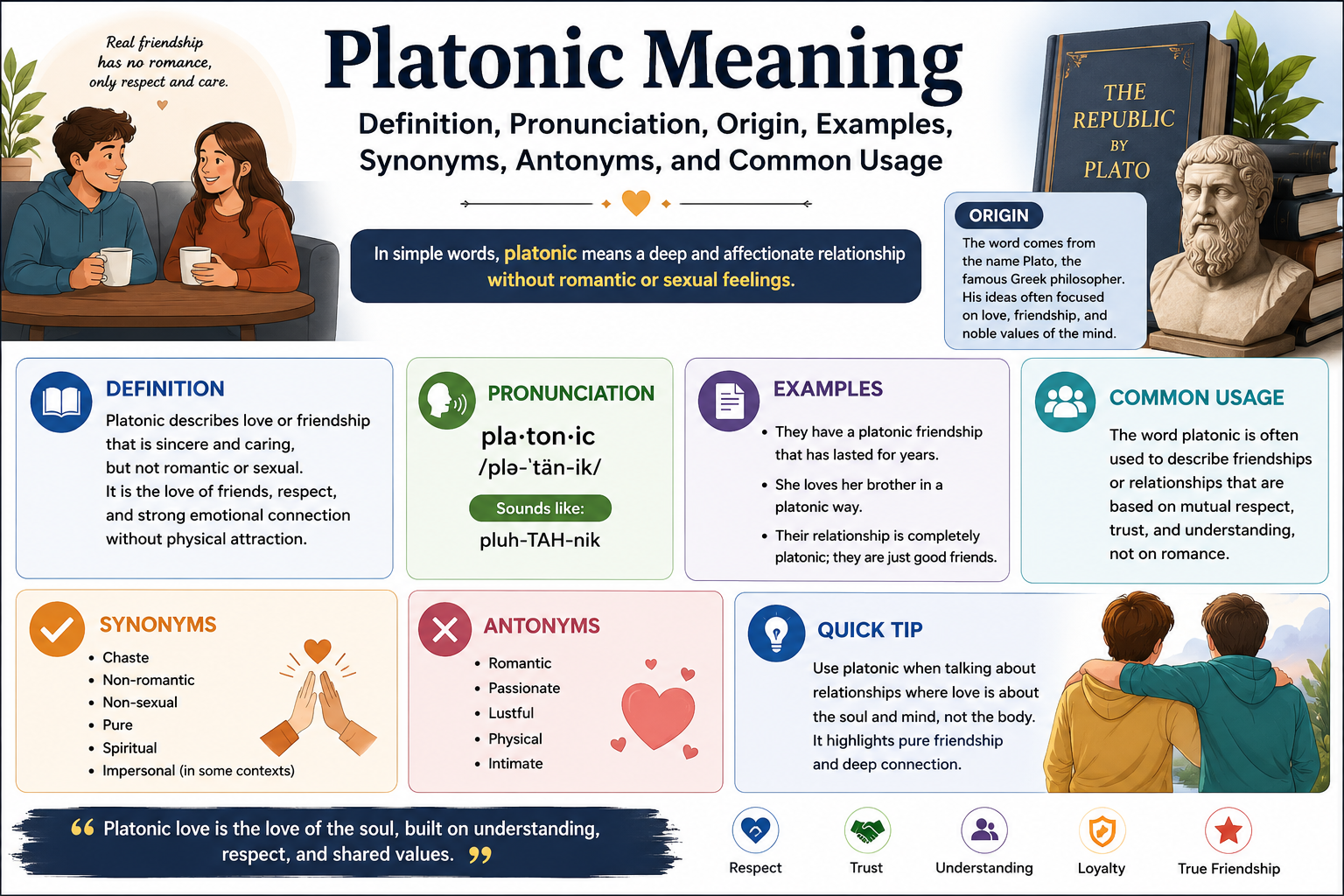
In everyday English, platonic usually means a close relationship or feeling that is not romantic or sexual.
For example, two people can care deeply about each other, spend a lot of time together, support one another, and have a strong emotional connection while still having a platonic relationship.
A simple definition is:
Platonic means affectionate or emotionally close without romantic or sexual involvement.
The word can describe friendships, relationships, love, feelings, or forms of affection. Its exact meaning depends on the sentence.
For example:
“They have a platonic friendship.”
This means they are close friends, but their relationship is not romantic.
The word can also be used in philosophy. In that setting, Platonic can relate to the philosophical ideas associated with Plato, especially ideas concerning ideal or non-material forms.
Platonic Meaning in Simple English
The easiest way to understand platonic meaning is to think of deep friendship without romance.
Imagine two friends who trust each other completely. They talk regularly, help each other through difficult moments, enjoy spending time together, and genuinely care about each other’s happiness. Their relationship can be very meaningful without being romantic.
That is a common example of a platonic relationship.
Platonic does not mean that the relationship is weak or unimportant. A platonic friendship can be one of the most valuable relationships in someone’s life.
The important distinction is that the connection is based on friendship, emotional closeness, mutual respect, companionship, or affection rather than romantic involvement.
Platonic Pronunciation
The word platonic is commonly pronounced:
pluh-TON-ik
The main stress falls on the middle syllable.
The pronunciation may sound slightly different depending on a speaker’s accent, but pluh-TON-ik is a useful pronunciation guide for English learners.
Origin and History of the Word Platonic
The word platonic comes from the name of the ancient Greek philosopher Plato. Plato lived in ancient Greece and is regarded as one of the most influential thinkers in Western philosophy.
The English word developed from the Latin form of Plato’s name and later became associated with philosophical ideas attributed to him.
Plato wrote extensively about love, beauty, knowledge, virtue, and the nature of reality. His discussions of love became especially influential in later interpretations of the concept now called Platonic love.
Over time, the meaning of platonic changed in everyday language. Today, when people use “platonic,” they often mean a relationship that is affectionate or emotionally close but not romantic.
This modern meaning is related to the historical philosophical meaning, but the two should not be treated as exactly identical.
What Is a Platonic Relationship?
A platonic relationship is a close relationship based on friendship, care, trust, respect, and companionship rather than romance.
Platonic relationships can exist between many different people. They can involve two friends, classmates, teammates, coworkers, relatives, or other people who share a meaningful connection.
A platonic relationship might include:
- Emotional support
- Trust
- Shared interests
- Honest conversations
- Companionship
- Mutual respect
- Encouragement
- Loyalty
- Enjoying activities together
None of these things automatically make a relationship romantic. People can have strong emotional bonds while remaining friends.
Example of a Platonic Relationship
Suppose Alex and Jordan have been friends for many years. They regularly talk about school, hobbies, goals, and everyday problems. They support each other and enjoy spending time together, but neither person views the relationship as romantic.
Their relationship can be described as platonic.
The word helps clarify the type of connection they share.
What Is Platonic Love?
Platonic love generally refers to deep affection or love that is not based on romantic or sexual attraction.
The term is connected to philosophical discussions inspired by Plato. However, modern people often use it more simply to describe powerful affection between friends.
For example, someone might say:
“I have a lot of platonic love for my best friend.”
They mean that they care deeply about their friend without describing romantic feelings.
Platonic love can involve loyalty, admiration, emotional support, respect, and genuine concern for another person’s well-being.
It is important to remember that love does not always mean romantic love. People use the word “love” in many ways, including family love, friendship, compassion, and affection.
Platonic vs. Romantic Relationships
The biggest difference between platonic and romantic relationships is the type of emotional connection involved.
A platonic relationship is generally based on friendship and affection without romantic involvement.
A romantic relationship involves romantic attraction or romantic feelings.
However, real human relationships can be complicated. Some relationships may have strong emotional closeness while people are still unsure how to describe their feelings. Labels can be useful, but they do not always capture every detail of a relationship.
The important point is that platonic does not mean emotionally distant.
A person can have an incredibly close friendship that is entirely platonic.
Platonic Meaning in Different Contexts
The meaning of platonic can change slightly depending on how it is used.
Platonic Friendship
A platonic friendship is a friendship without romantic involvement.
Example:
“We have been close friends for years, but our relationship is completely platonic.”
Platonic Love
Platonic love describes deep affection without romantic or sexual attraction.
Example:
“Her feelings for her longtime friend were completely platonic.”
Platonic Relationship
A platonic relationship is a non-romantic personal connection.
Example:
“They share a strong platonic relationship built on trust.”
Platonic Feelings
Platonic feelings are feelings of care, affection, admiration, or friendship that are not romantic.
Example:
“His feelings toward his teammate were purely platonic.”
Platonic Companion
A platonic companion is someone with whom a person shares friendship and companionship without a romantic relationship.
Example:
“They enjoy traveling together as platonic companions.”
Examples of Platonic in Sentences
Here are several examples that show how the word can naturally appear in everyday English:
- “They have a close but completely platonic friendship.”
- “Our relationship has always been platonic.”
- “She considers him her best platonic friend.”
- “Their bond is based on trust and platonic affection.”
- “He made it clear that his feelings were platonic.”
- “The two classmates developed a strong platonic friendship.”
- “They enjoy spending time together without being romantically involved.”
- “Their friendship is deeply meaningful but entirely platonic.”
- “I value our platonic friendship.”
- “The movie explores both romantic and platonic relationships.”
These examples show why context matters when interpreting the word.
Platonic Synonyms
There is no single synonym that perfectly replaces platonic in every sentence. However, several words and phrases can communicate similar ideas.
Common alternatives include:
- Non-romantic
- Friendly
- Affectionate
- Companionate
- Nonsexual
- Friendship-based
- Brotherly
- Sisterly
- Amicable
- Caring
- Non-romantic affection
For example, instead of saying:
“They have a platonic relationship.”
you might say:
“They have a close, non-romantic relationship.”
However, platonic is often more concise and natural.
Platonic Antonyms
The most common opposite of platonic in relationship contexts is romantic.
Other contrasting words may include:
- Romantic
- Amorous
- Passionate
- Sexual
- Intimate
The exact opposite depends on the context.
For example:
Platonic friendship contrasts with a romantic relationship.
However, it is important not to assume that every non-platonic relationship is sexual. “Romantic” and “sexual” describe different concepts, and a relationship may involve one, both, or neither.
Platonic Meaning in Philosophy
The philosophical meaning of Platonic is broader than the everyday meaning.
Plato’s philosophy is associated with the idea that reality includes perfect or ideal Forms, while the physical things people experience are imperfect representations.
In philosophical writing, capitalized Platonic may therefore refer to ideas, theories, or concepts associated with Plato.
For example:
“The philosopher discussed the Platonic concept of ideal forms.”
Here, “Platonic” does not mean “non-romantic.” It means related to Plato or his philosophy.
This distinction is important because the lowercase everyday use and the philosophical use are connected historically but have different practical meanings.
What Is the Difference Between Platonic and Plato?
The words Plato and platonic are related, but they are not interchangeable.
Plato is the name of the ancient Greek philosopher.
Platonic is an adjective derived from his name.
For example:
“Plato wrote philosophical dialogues.”
But:
“The book discusses Platonic philosophy.”
The second sentence uses an adjective to describe something connected with Plato.
In everyday relationship language, “platonic” has developed a more specific meaning related to non-romantic affection.
Is a Platonic Friendship Real?
Yes. Platonic friendships are real and common.
Friendship does not need romantic attraction to be meaningful. Two people can have a strong emotional bond based on trust, shared experiences, respect, humor, encouragement, and mutual support.
A platonic friendship may last for many years and become an important part of someone’s life.
The boundaries of every friendship are different. Some friends talk every day, while others communicate less often. Some spend a great deal of time together, while others remain close despite living far apart.
What makes a relationship platonic is not how much time people spend together. It is primarily the non-romantic nature of the relationship.
Why Do People Use the Word Platonic?
People often use the word platonic to remove confusion about the nature of a relationship.
For example, saying:
“She is my friend.”
does not always explain whether the relationship is casual, emotionally close, or romantic.
Saying:
“She is my platonic friend.”
makes the intended meaning clearer.
The word can be particularly useful when people want to explain that two people are emotionally close without suggesting that they are dating.
It can also help people describe meaningful friendships that might otherwise be misunderstood.
Common Misunderstandings About Platonic Relationships
One common misunderstanding is that platonic relationships are less important than romantic relationships. That is not necessarily true.
Friendships can provide companionship, encouragement, emotional support, and shared experiences. A person can value a friendship deeply without wanting it to become romantic.
Another misunderstanding is that platonic means “no affection.” In reality, platonic relationships can involve considerable affection and emotional closeness.
A third misconception is that a close friendship must eventually become romantic. There is no such rule. People can maintain strong friendships without changing the nature of their relationship.
How to Use Platonic Correctly
The word platonic is usually placed before a noun or used after a linking verb.
Examples include:
“They have a platonic friendship.”
“Their relationship is platonic.”
“She has a platonic bond with her childhood friend.”
“His feelings were entirely platonic.”
You can use the word in both casual and formal writing.
In relationship discussions, it is especially useful when you want to distinguish friendship from romance.
Platonic Meaning on Social Media
The word platonic is also common on social media and in online conversations.
People may describe someone as a “platonic best friend” or talk about “platonic soulmates.” The latter phrase is an informal way of describing two friends who feel exceptionally compatible and deeply connected.
Online usage can sometimes be playful or exaggerated, so the exact meaning depends on the person using it.
Still, the basic idea remains the same: a strong connection that is understood as friendship rather than romance.
Platonic vs. Friendly
The words platonic and friendly are similar, but they are not identical.
Friendly usually means pleasant, kind, or sociable.
Platonic specifically emphasizes the non-romantic nature of a relationship or feeling.
For example:
“He was friendly toward everyone.”
This simply means he behaved in a pleasant way.
But:
“They have a platonic relationship.”
provides information about the nature of their relationship.
Therefore, platonic is more specific than friendly when discussing relationships.
Platonic Meaning for English Learners
For English learners, platonic may initially seem confusing because it comes from a person’s name rather than an ordinary English word.
The easiest way to remember it is:
Platonic = close and caring, but not romantic.
When you see “platonic friendship,” think of deep friendship without dating or romance.
When you see “Platonic philosophy,” think of ideas connected with Plato.
The capital letter can sometimes provide a clue, although context remains the most important factor.
Frequently Asked Questions About Platonic Meaning
What is the exact meaning of platonic?
In everyday relationship language, platonic means non-romantic and generally non-sexual. It often describes a close friendship or affection that does not involve romantic attraction.
What does platonic mean in simple English?
Platonic means being close friends or caring about someone without having a romantic relationship.
What is a platonic relationship?
A platonic relationship is a meaningful personal relationship based on friendship, care, trust, or companionship rather than romance.
Can platonic friends be very close?
Yes. Platonic friends can be extremely close emotionally. A strong friendship does not automatically become romantic.
Is platonic the opposite of romantic?
In everyday relationship language, romantic is usually the closest opposite of platonic. Platonic describes a non-romantic connection, while romantic describes a relationship or feeling involving romance.
Does platonic mean no feelings?
No. Platonic relationships can involve strong feelings such as affection, loyalty, admiration, trust, and care. The important distinction is that the feelings are not romantic.
Where did the word platonic come from?
The word comes from the name of the ancient Greek philosopher Plato. Its modern relationship meaning developed from later interpretations of philosophical discussions about love.
How do you pronounce platonic?
Platonic is commonly pronounced “pluh-TON-ik.” The main emphasis is on the middle syllable.
What is platonic love?
Platonic love generally means deep affection that is not based on romantic or sexual attraction. In modern conversation, it is often used to describe powerful friendship.
Is platonic only used for friendships?
No. Platonic can describe relationships, affection, feelings, love, companionship, and other connections that are understood as non-romantic. It can also have a philosophical meaning related to Plato.
Final Thoughts on Platonic Meaning
The platonic meaning is easiest to understand as a close, caring, and meaningful connection without romance. The word is commonly used to describe friendships, affection, and relationships in which people care deeply about one another without being romantically involved.
The word has an interesting history because it comes from Plato, the ancient Greek philosopher. While its everyday meaning focuses on non-romantic relationships, its philosophical meaning can refer more broadly to Plato and ideas associated with his philosophy.
Whether you encounter the word in a conversation, social media post, book, or relationship discussion, context will help you understand its precise meaning.
The simplest definition to remember is:
Platonic means close and affectionate, but not romantic.
A platonic friendship can be supportive, meaningful, loyal, and deeply important. Understanding this word makes it easier to describe the many different kinds of relationships people can have and shows that meaningful connection does not always have to be romantic.