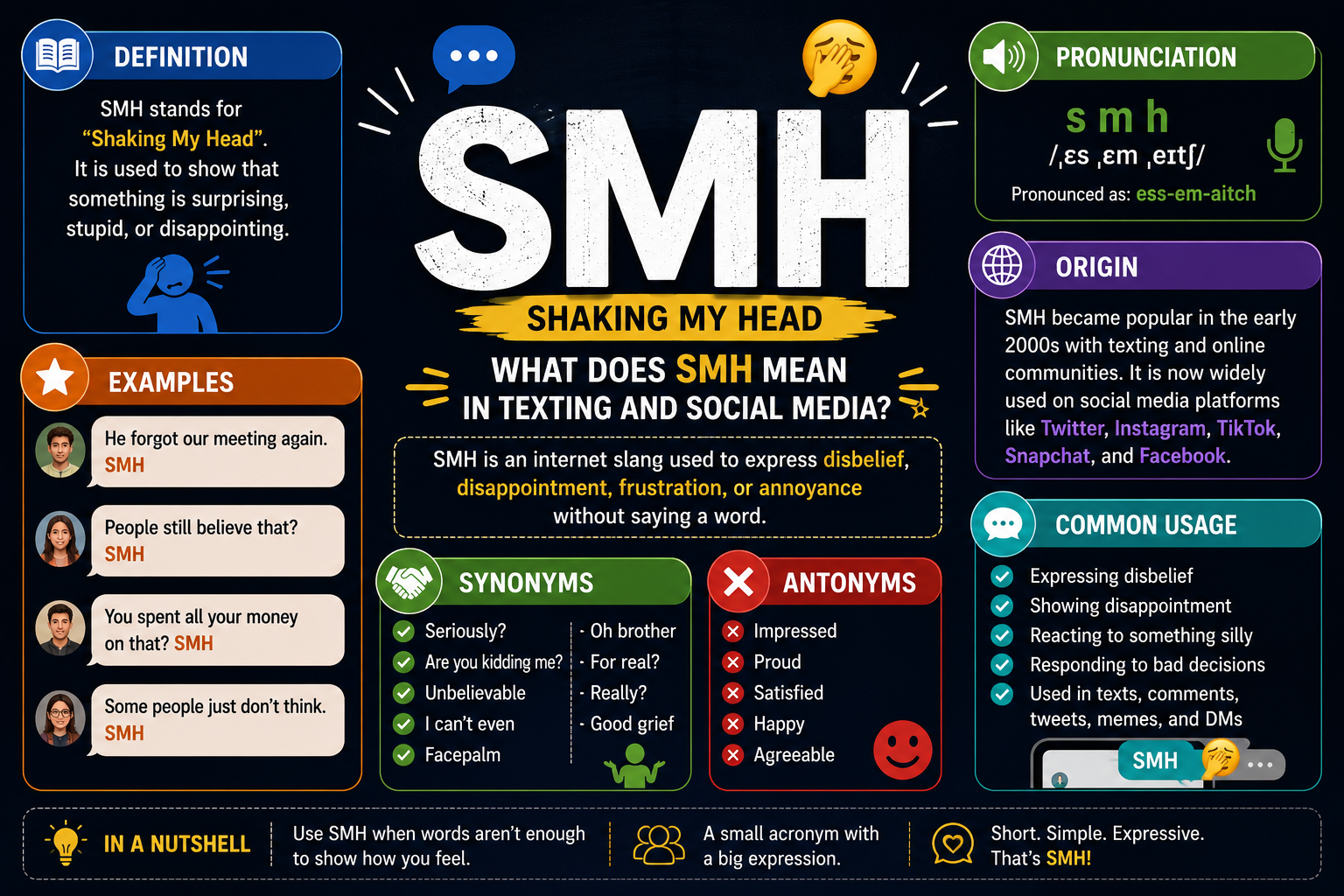
If you have ever received a text that simply says “SMH”, you may have wondered what those three letters mean. The SMH meaning is most commonly “shaking my head.” People use it online and in text messages to express disbelief, disappointment, frustration, disapproval, or mild annoyance. Cambridge Dictionary and Merriam-Webster both define SMH as an abbreviation for “shaking my head” and describe its use in digital communication.
SMH is part of modern internet slang, where short expressions help people communicate emotions quickly. Instead of writing, “I cannot believe someone actually did that,” a person might simply write, “SMH.” The abbreviation creates the same mental image as someone shaking their head because something seems surprising, frustrating, silly, or difficult to believe.
Although SMH is casual language, it has become widely recognized. You may see it in text messages, social media comments, group chats, memes, and online discussions. This guide explains the SMH meaning, pronunciation, origin, examples, synonyms, antonyms, common usage, and the situations where the expression works best.
What Does SMH Mean?
SMH stands for “shaking my head.” It is an informal internet abbreviation used when someone wants to communicate disapproval, disbelief, frustration, disappointment, or incredulity.
The expression comes from the physical gesture of shaking your head from side to side. People often make this gesture when they disagree with something or cannot believe what they are seeing. In digital communication, SMH turns that silent gesture into three quick letters.
For example, imagine your friend tells you they forgot their homework after spending the entire evening playing games. You might reply:
“SMH, you had all night!”
Here, SMH does not necessarily mean that you are seriously angry. It may simply communicate amused disappointment or disbelief.
How Do You Pronounce SMH?
SMH is an initialism, so people generally pronounce the individual letters rather than saying it as one word.
It is pronounced “ess-em-aitch.”
In everyday online communication, however, people usually write SMH rather than say it aloud. The written form is much more common because the expression developed as internet and texting slang.
What Is the Simple SMH Meaning?
In simple English, SMH means “I cannot believe this” or “I disapprove of this.”
Depending on the situation, it can express:
- Disbelief
- Disappointment
- Annoyance
- Frustration
- Disapproval
- Confusion
- Mild embarrassment
- Amusement at someone’s mistake
The exact emotion depends on context. For example, “SMH” after a serious mistake may sound disappointed, while “SMH 😂” can sound more playful.
Cambridge Dictionary describes SMH as something used on social media and in text messages when someone does not believe something or does not approve of it.
Where Did SMH Come From?
The exact origin of SMH is not completely certain. Like many pieces of internet slang, it developed through digital communication rather than being created by one clearly documented person or organization.
Merriam-Webster records examples of SMH from at least the 1990s, including a 1994 online discussion in which the abbreviation was used for “shaking my head.”
Dictionary.com notes that the expression became increasingly visible during the 2000s, with an Urban Dictionary entry appearing in 2004 and use spreading through social media in the following years.
This history shows how internet language can develop gradually. People began shortening common phrases to make online communication faster, easier, and more expressive.
Why Does SMH Mean “Shaking My Head”?
The phrase is based on a familiar human gesture.
When people hear something they strongly disagree with or find difficult to believe, they may physically shake their head from side to side. In face-to-face conversation, that gesture communicates an emotion without requiring many words.
Online, people cannot always see each other’s facial expressions or body language. Abbreviations such as SMH help replace some of that missing nonverbal communication.
So when someone writes:
“SMH, I can’t believe you forgot again.”
the letters suggest the imaginary action of shaking one’s head in reaction to the situation.
SMH Meaning in Text Messages
In texting, SMH is usually a quick emotional reaction. It can appear at the beginning, middle, or end of a message.
For example:
“SMH, why would you do that?”
or:
“You forgot your keys again smh.”
or simply:
“SMH.”
A standalone SMH can communicate a complete reaction when the context is already clear.
The tone is usually informal. It would be normal in a conversation with a friend, but it would generally be inappropriate in a formal letter, academic assignment, or professional document unless you are discussing internet slang itself.
SMH Meaning on Social Media
SMH is especially common in social media conversations. People use it when reacting to posts, comments, news, opinions, mistakes, or unexpected situations.
For example, someone might comment:
“People are still arguing about this? SMH.”
The commenter is expressing frustration or disbelief without writing a long explanation.
SMH can also appear in captions, replies, memes, and hashtags. Dictionary.com notes that the abbreviation became familiar enough to appear in mainstream online publishing without always being explained.
SMH Examples in Everyday Conversations
Understanding examples is one of the easiest ways to learn internet slang.
Example of Disbelief
Person A: “I forgot my presentation was today.”
Person B: “SMH, you were talking about it yesterday!”
Here, SMH communicates disbelief and mild frustration.
Example of Disappointment
“We were winning, and then the team stopped trying. SMH.”
The speaker is disappointed by what happened.
Example of Annoyance
“The website crashed right when I was about to submit the form. SMH.”
Here, SMH expresses frustration rather than anger toward a specific person.
Example of a Funny Mistake
“I spent ten minutes looking for my phone while holding it in my hand. SMH 😂”
This use is self-directed and humorous.
Example of Mild Disapproval
“You really left the door unlocked again? SMH.”
The person is expressing disapproval.
Can SMH Be Used About Yourself?
Yes. SMH does not have to be directed at another person.
Someone can use SMH when they make a silly mistake themselves.
For example:
“I studied the wrong chapter for the test. SMH.”
In this case, the speaker is essentially saying, “I cannot believe I did that.”
Self-directed SMH can make a message sound humorous rather than harsh. The surrounding words and emojis often help clarify the tone.
SMH Meaning in Different Situations
The meaning of SMH can change slightly depending on the situation.
| Situation | Possible meaning of SMH |
| Someone makes a silly mistake | “I can’t believe you did that.” |
| Someone breaks a promise | “That is disappointing.” |
| A confusing situation happens | “I don’t know what to say.” |
| Someone says something unbelievable | “Seriously?” |
| You make a mistake yourself | “I can’t believe I did that.” |
| A frustrating problem occurs | “This is so annoying.” |
| Something is funny and foolish | “That was ridiculous.” |
The basic idea remains the same: SMH communicates a reaction to something that seems disappointing, unbelievable, frustrating, or foolish.
SMH Synonyms and Similar Expressions
SMH does not have a perfect synonym because it combines a phrase with a particular emotional reaction. However, several expressions can communicate a similar idea.
Common alternatives include:
- “I can’t believe this.”
- “Seriously?”
- “Unbelievable.”
- “What were you thinking?”
- “That’s disappointing.”
- “Come on.”
- “Oh, please.”
- “I don’t even know what to say.”
- “You’ve got to be kidding.”
- “That’s ridiculous.”
The best alternative depends on the emotion you want to communicate.
For example, “seriously?” can show surprise, while “that’s disappointing” is more direct and polite.
SMH Antonyms
SMH does not have a direct antonym because it is an abbreviation rather than a conventional adjective or verb.
However, expressions with an opposite emotional tone might include:
- “Well done!”
- “Amazing!”
- “That’s great!”
- “I agree!”
- “Good idea!”
- “Excellent!”
- “I’m impressed!”
- “Absolutely!”
If SMH communicates disbelief or disapproval, these expressions can communicate approval, excitement, or admiration instead.
What Is the Difference Between SMH and SMDH?
SMDH usually means “shaking my damn head.” It is a stronger variation of SMH. Merriam-Webster identifies SMDH as a variant of the original expression.
The basic idea is the same, but SMDH generally adds stronger emphasis. Because it contains a mild profanity, it may not be suitable for every audience.
For most everyday conversations, SMH is the simpler and more widely appropriate choice.
SMH vs. LOL
SMH and LOL communicate very different reactions.
LOL usually means “laughing out loud” and is associated with amusement or humor.
SMH means “shaking my head” and is generally associated with disbelief, disappointment, frustration, or disapproval.
Sometimes both can appear together.
For example:
“You really forgot your own birthday party? SMH 😂”
The SMH communicates disbelief, while the laughing emoji makes the situation sound playful.
SMH vs. Facepalm
SMH and facepalm can have similar meanings, but they are not exactly the same.
A facepalm usually represents a reaction to something embarrassing, foolish, or frustrating. SMH focuses on the idea of shaking one’s head in response to the situation.
Both expressions can communicate:
- “I cannot believe this.”
- “That was a bad decision.”
- “What were you thinking?”
- “This is frustrating.”
The choice depends on the style of the conversation.
Other Meanings of SMH
Although “shaking my head” is by far the most common meaning in internet slang, SMH has occasionally been interpreted differently.
Some sources list “scratching my head” as another possible expansion, usually connected with confusion or puzzlement. Merriam-Webster also notes this alternative use.
Dictionary.com also records less common interpretations, including “so much hate,” while emphasizing that “shaking my head” is the established internet-slang meaning.
Because these alternatives are less common, context is important. In most modern texting and social media conversations, SMH means “shaking my head.”
How to Use SMH Correctly
Using SMH is easy once you understand the tone.
You can place it at the beginning of a message:
“SMH, you forgot your umbrella again.”
You can put it at the end:
“You forgot your umbrella again, smh.”
You can also use it by itself:
“SMH.”
The expression is informal, so it works best in casual communication. It is generally better to avoid it in formal schoolwork, business writing, official applications, or other situations where standard English is expected.
Is SMH Rude?
SMH can sound rude depending on how it is used.
If someone sends only “SMH” after you make a mistake, it could sound judgmental or dismissive. On the other hand, friends often use it playfully without intending to offend.
For example:
“You seriously ate the whole pizza? SMH 😂”
This could be playful between friends.
Tone is harder to understand in text because there is no facial expression or voice to provide additional information. Emojis, context, and the relationship between the people involved can make the intended meaning clearer.
Is SMH a Bad Word?
No. SMH itself is not a swear word. It stands for “shaking my head.”
However, some related variations contain profanity. For example, SMDH expands the phrase with “damn,” while other variations can contain stronger language.
If you want to keep your language clean and broadly appropriate, ordinary SMH is the safer option.
When Should You Not Use SMH?
Although SMH is widely understood online, it is not appropriate for every setting.
Avoid using it when:
- Writing a formal school assignment
- Applying for a job
- Writing a professional email
- Communicating with someone who may not understand internet slang
- Discussing a serious issue where the abbreviation could appear dismissive
- Speaking to someone who prefers formal communication
In those situations, write the full idea instead.
For example, rather than:
“SMH, that’s disappointing.”
you could write:
“I’m disappointed by what happened.”
That version is clearer and more professional.
Why Is SMH So Popular?
One reason for the popularity of SMH is efficiency. Digital conversations move quickly, and people often want to express an emotion without writing a complete sentence.
Three letters can communicate an entire reaction.
The expression also works because it represents something people already understand physically. A head shake can communicate disbelief or disapproval without words, and SMH recreates that gesture in written form.
Merriam-Webster explains that abbreviations such as SMH can represent a gesture rather than simply shortening a phrase.
Common Questions About SMH Meaning
What does SMH stand for?
SMH stands for “shaking my head.” It is an informal internet abbreviation commonly used to express disbelief, disappointment, frustration, or disapproval.
What does SMH mean in texting?
In texting, SMH usually means “shaking my head.” It tells the reader that the sender is reacting negatively or with disbelief to something that was said or happened.
What does SMH mean on Instagram or social media?
On social media, SMH generally means “shaking my head.” It can express disbelief, annoyance, disappointment, or disapproval toward a post, comment, event, or opinion.
How do you pronounce SMH?
SMH is pronounced by saying the letters individually: “ess-em-aitch.”
Is SMH rude?
It can be, depending on context. SMH may sound dismissive when directed at another person’s mistake or opinion, but friends can also use it jokingly.
What does SMH mean from a girl or boy?
The meaning does not change based on who uses it. Whether a girl, boy, or anyone else writes SMH, it generally means “shaking my head.”
What does SMH mean from a friend?
When a friend sends SMH, they may be joking, disappointed, surprised, or frustrated. Look at the rest of the conversation to understand the exact tone.
What does SMH mean in a comment?
In a comment, SMH usually shows that the person disagrees with, dislikes, or cannot believe something in the original post or conversation.
Is SMH still used?
Yes. SMH remains a recognized internet abbreviation and is listed by major dictionaries, including Merriam-Webster and Cambridge Dictionary.
What is the opposite of SMH?
There is no exact opposite. Expressions such as “well done,” “I agree,” “amazing,” or “great job” can communicate a more positive reaction.
Final Thoughts on SMH Meaning
The SMH meaning is simple: “shaking my head.” It is a popular internet and texting abbreviation used to express disbelief, disappointment, frustration, annoyance, or disapproval.
The expression comes from the familiar physical gesture of shaking your head when something seems unbelievable, foolish, frustrating, or disappointing. Although its exact beginnings are difficult to trace, documented online uses go back at least to the 1990s, while its popularity grew significantly during the 2000s and the rise of social media.
The easiest way to remember SMH is to think of it as a written version of a head shake. When someone says or does something that makes you think, “I can’t believe this,” SMH may be the perfect casual response.
Just remember that SMH is informal slang. It works naturally in texts, social media, memes, and casual conversations, but standard language is usually a better choice for formal communication.