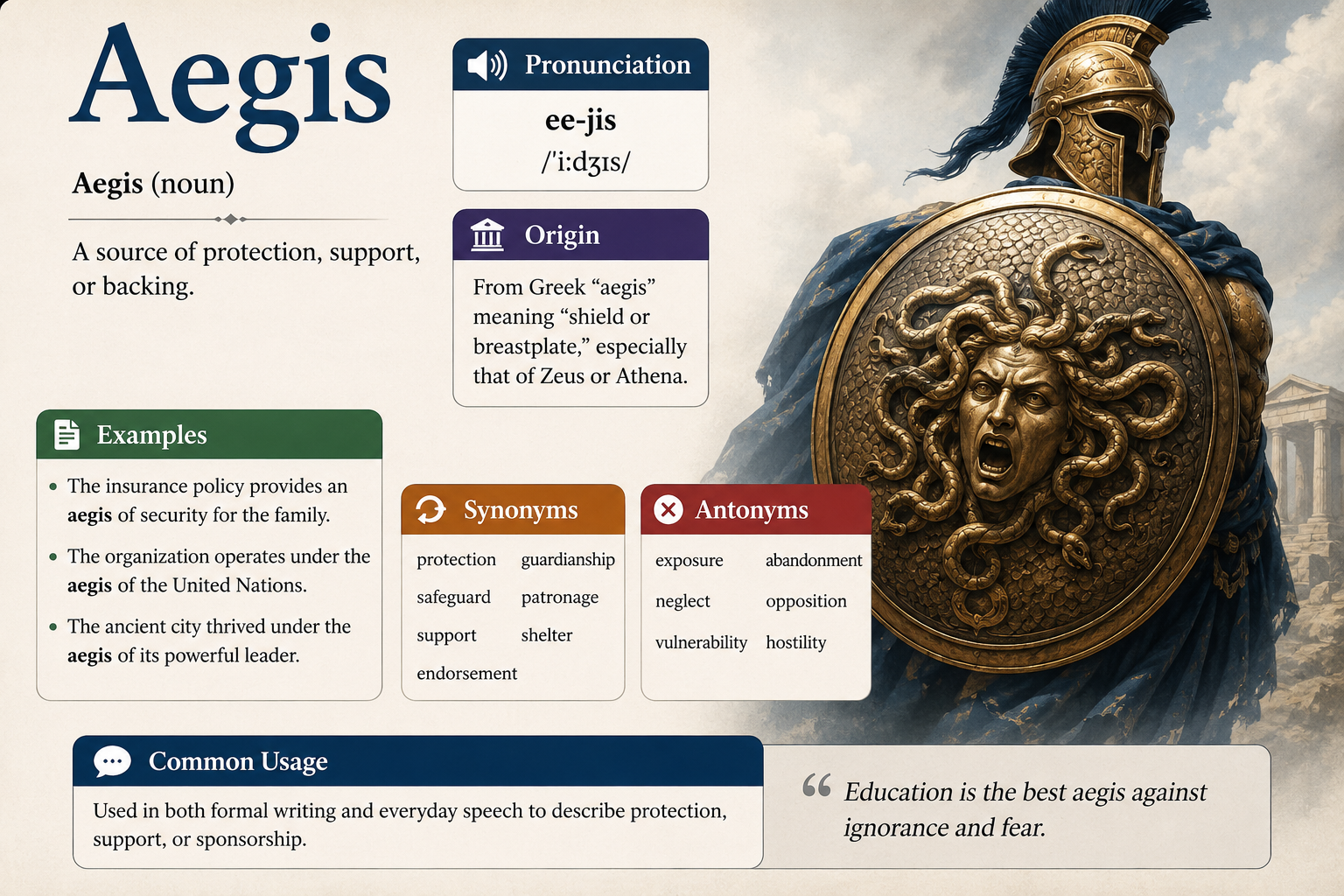
Aegis Meaning: If you have come across the word aegis in books, news articles, academic writing, or formal conversations, you may have wondered what it means. It is a somewhat uncommon word in everyday English, but it has a useful meaning and a fascinating connection to ancient Greek mythology.
In simple English, aegis means protection, support, guidance, or sponsorship. It is especially common in the expression “under the aegis of,” which means being protected, supported, guided, or sponsored by a person, organization, institution, or authority.
The word also has an older mythological meaning. In ancient Greek tradition, the aegis was associated with the protective shield or covering of Zeus and Athena. Over time, its literal mythological meaning developed into the broader modern meaning of protection and support.
What Does Aegis Mean?
The simplest definition of aegis is protection or support provided by someone powerful, influential, or responsible. It can also mean sponsorship, patronage, guidance, or authority, depending on the context.
For example, if someone says, “The program operates under the aegis of the university,” they mean that the university supports, oversees, sponsors, or provides an official framework for the program. Cambridge Dictionary similarly defines the common phrase “under the aegis of” as being with the protection or support of someone or something, particularly an organization.
The word is generally considered formal. You are more likely to see it in newspapers, academic writing, government documents, professional discussions, and historical texts than in casual conversation.
In modern English, aegis can carry several closely related meanings:
- Protection
- Support
- Sponsorship
- Patronage
- Guidance
- Authority
- Supervision
- Influence
The exact meaning depends on the sentence. The central idea, however, is that one person or organization provides some form of protection, backing, direction, or official support.
Aegis Pronunciation
Aegis is commonly pronounced “EE-jis.”
The pronunciation shown in major English dictionaries is approximately /ˈiːdʒɪs/. Merriam-Webster also records another pronunciation beginning with an “ay” sound, although “EE-jis” is the pronunciation commonly listed by Cambridge and Oxford.
A useful way to remember the pronunciation is:
Aegis = EE-jis
It is usually not pronounced the way the letters “ae” might initially suggest. Learning the pronunciation is especially helpful because aegis is often encountered in formal speech, where saying it correctly can make communication clearer.
Aegis Meaning in Simple English
If the word aegis seems complicated, think of it as a formal way of talking about being protected or supported by someone or something.
For example:
“The research was conducted under the aegis of the university.”
In simple English, this means:
“The university supported or supervised the research.”
Another example is:
“The organization works under the aegis of the government.”
This means the organization operates with the government’s support, authority, guidance, or protection.
The word does not always mean physical protection. In many modern sentences, the protection is institutional, legal, professional, financial, or symbolic.
That is why the word can be useful when describing projects, organizations, programs, research, cultural activities, and official initiatives.
Aegis Origin and Etymology
The history of aegis goes back to ancient Greek. The English word came through Latin from the Greek word aigís, traditionally associated with the shield or protective covering of Zeus.
Ancient Greek mythology gives the word its powerful association with protection. The aegis was connected with Zeus and Athena and was represented in different traditions as a shield, breastplate, or goatskin covering. Some descriptions connect it with the goat Amaltheia, which was said in mythology to have nourished Zeus when he was young.
The possible connection between the Greek word and the word for goat is also reflected in historical dictionaries. Merriam-Webster explains that English aegis ultimately comes from Greek aigís, meaning “goatskin,” related to a Greek word for goat.
The word entered English centuries ago with its mythological sense and later developed a broader figurative meaning. Modern English speakers generally use aegis to mean protection, support, sponsorship, or guidance rather than referring directly to a mythological shield.
Aegis in Greek Mythology
The mythological background helps explain why aegis became associated with protection.
In Greek mythology, the aegis was associated particularly with Zeus and Athena. Historical sources describe it in different ways, including as a protective goatskin or shield-like object. Artistic representations also sometimes show the aegis with the head of the Gorgon Medusa.
The object represented power and protection. Because Zeus was the chief deity in Greek mythology and Athena was associated with wisdom and warfare, the aegis carried strong symbolic importance.
This mythological meaning eventually gave the word a natural figurative development. If something is “under the aegis” of a powerful person or organization, it is metaphorically under that entity’s protective influence.
That connection explains why the modern word sounds more formal and powerful than ordinary words such as help or support.
Modern Meaning of Aegis
Today, aegis is most often used in a figurative sense.
It can describe a situation where an organization provides official support, oversight, protection, sponsorship, or authority. For example, a scientific project may operate under the aegis of a university, while a cultural event may take place under the aegis of a government department.
Merriam-Webster identifies several modern senses, including protection, controlling influence, sponsorship, guidance, and control.
This makes aegis a flexible word, but its meaning should always be understood from context.
For instance:
“Under the aegis of the law” suggests legal protection or authority.
“Under the aegis of the university” suggests institutional support or supervision.
“Under the aegis of a foundation” may suggest sponsorship or financial and organizational backing.
The Phrase “Under the Aegis Of”
The most common expression containing this word is “under the aegis of.”
It means under the protection, support, sponsorship, authority, or guidance of a particular person or organization. Oxford gives the phrase as a formal expression meaning “with the protection or support” of someone or something.
Here are some simple examples:
“The project was completed under the aegis of the university.”
This means the university supported or supervised the project.
“The conference was held under the aegis of an international organization.”
This means the organization sponsored or officially supported the conference.
“The community program operates under the aegis of the local authority.”
This suggests that the local authority provides official backing, supervision, or support.
The phrase is formal, so alternatives such as “with the support of” or “with the backing of” may sound more natural in casual English.
Aegis Examples in Sentences
Understanding aegis becomes easier when you see it in different contexts.
Academic Example
“The research team worked under the aegis of a leading university.”
Here, aegis refers to institutional support or supervision.
Government Example
“The initiative was launched under the aegis of the national government.”
In this sentence, the government provides official backing or authority.
Cultural Example
“The exhibition was organized under the aegis of the city museum.”
This means the museum supported, sponsored, or organized the exhibition.
Legal Example
“The residents sought protection under the aegis of the law.”
Here, the word means legal protection.
Professional Example
“The training program operates under the aegis of the professional association.”
This suggests that the association provides guidance, authority, or support.
Historical Example
“The kingdom developed under the aegis of a powerful ruler.”
In this context, the word suggests protection, influence, or guidance.
Aegis Synonyms
Several English words can be used as synonyms for aegis, although they are not interchangeable in every sentence.
Protection
Protection is one of the closest simple synonyms. It focuses on keeping someone or something safe from harm or difficulty.
Support
Support emphasizes help, encouragement, or assistance.
Sponsorship
Sponsorship is appropriate when an organization or individual provides official or financial backing.
Patronage
Patronage refers to support given by a person or organization, particularly for artistic, cultural, academic, or professional activities.
Guidance
Guidance emphasizes direction and advice rather than physical or legal protection.
Patronage
This can be especially close to aegis when the word describes an institution or influential person supporting a project or activity.
Safeguard
Safeguard focuses on protection from danger, loss, or damage.
Other related words include defense, backing, shelter, authority, supervision, and sponsorship. Merriam-Webster lists protection, defense, shield, and safeguard among related synonyms.
Aegis Antonyms
There is no single perfect antonym for aegis, because the word can mean protection, support, sponsorship, or guidance.
Depending on the context, possible opposites include:
- Exposure
- Vulnerability
- Abandonment
- Neglect
- Opposition
- Lack of support
- Independence
- Unprotected status
For example, if aegis means protection, vulnerability or exposure may be an opposite idea.
If it means sponsorship, lack of support may work better.
If it means control or guidance, independence could provide a contextual contrast.
How to Use Aegis Correctly
The easiest way to use aegis correctly is to remember that it is normally a noun and is often followed by “of” in the phrase “under the aegis of.”
A natural sentence would be:
“The program was established under the aegis of the ministry.”
You could replace aegis with “support” and say:
“The program was established with the support of the ministry.”
The second version is simpler and more conversational. The first sounds more formal and institutional.
Because aegis has a formal tone, avoid forcing it into ordinary sentences where simple words such as “help” or “support” would be clearer.
For example, saying “My friend gave me an aegis when I was confused” would sound unnatural.
A better sentence would be:
“My friend gave me support when I was confused.”
Common Usage of Aegis
The word aegis appears most frequently in formal contexts. It is particularly common when discussing institutions, governments, organizations, educational bodies, charities, research projects, and official programs.
Typical combinations include:
- Under the aegis of the government
- Under the aegis of the university
- Under the aegis of an organization
- Under the aegis of the law
- Under the aegis of a foundation
- Under the aegis of an international body
The expression is useful when you want to emphasize that an activity has some form of official backing, protection, sponsorship, or supervision.
Cambridge specifically identifies the phrase “under the aegis of” as a formal expression for operating with someone’s protection or support.
Aegis vs. Auspices
Aegis and auspices can sometimes be used in similar contexts, especially when talking about sponsorship or support.
For example:
“The event was held under the aegis of the university.”
and
“The event was held under the auspices of the university.”
Both can communicate the idea of institutional backing.
However, aegis has a stronger historical association with protection and the Greek mythological shield of Zeus or Athena. Auspices often emphasizes sponsorship, support, or favorable official circumstances.
The best choice depends on the exact context and the tone you want.
Aegis vs. Protection
The biggest difference between aegis and protection is formality.
Protection is an everyday English word. It can refer to physical safety, legal rights, emotional security, or other forms of defense.
Aegis is more formal and often suggests protection or support provided through an influential person or institution.
For example:
Simple: “The children were under the protection of the organization.”
Formal: “The children were under the aegis of the organization.”
The meaning is similar, but the second sentence has a more formal and institutional tone.
Why Is Aegis Considered a Formal Word?
The word has a long literary and historical background. Its connection to Greek mythology gives it a traditional, elevated character. Modern dictionaries classify its common expression as formal, particularly “under the aegis of.”
As a result, you may see aegis more often in formal reports, journalism, academic writing, historical discussions, and institutional descriptions than in casual speech.
That does not make the word difficult to use. Once you understand its central idea—protection or support—its meaning becomes straightforward.
Frequently Asked Questions About Aegis
What does aegis mean in simple English?
Aegis means protection, support, sponsorship, guidance, or official backing. It is often used in the phrase “under the aegis of,” meaning under the protection or support of a person or organization.
How do you pronounce aegis?
Aegis is commonly pronounced “EE-jis.” Cambridge and Oxford list the pronunciation approximately as /ˈiːdʒɪs/.
Is aegis a noun?
Yes. Aegis is a noun. It refers to protection, support, sponsorship, influence, or the mythological shield or protective covering associated with Zeus and Athena.
What does “under the aegis of” mean?
“Under the aegis of” means under the protection, support, sponsorship, guidance, or authority of someone or something. It is a formal expression commonly used for organizations and institutions.
Is aegis a positive word?
Generally, aegis is neutral to positive when it refers to protection, support, or sponsorship. However, the context can determine whether the influence being described is viewed positively or negatively.
What is a simple synonym for aegis?
The simplest synonym is protection or support. Depending on the sentence, sponsorship, patronage, guidance, backing, or safeguard may also work.
What is the origin of aegis?
Aegis comes through Latin from the ancient Greek aigís. It was associated with the shield or protective covering of Zeus and Athena and is traditionally connected with the Greek word for goat because of its goatskin association.
Can aegis be used in everyday conversation?
It can, but it sounds formal. In casual conversation, people generally use words such as support, protection, backing, or help instead.
Final Thoughts on Aegis Meaning
The word aegis may look unfamiliar at first, but its basic meaning is quite simple. In modern English, it generally refers to protection, support, sponsorship, guidance, or authority, especially when one person or organization provides that support to another.
Its most recognizable expression is “under the aegis of,” which means operating with the protection, backing, sponsorship, or guidance of a particular person or organization.
The word has an interesting journey from ancient Greek mythology to modern English. Originally connected with the protective object associated with Zeus and Athena, aegis gradually developed a figurative meaning that is still widely understood today.
So, if you encounter a sentence such as “The project was carried out under the aegis of the university,” you can read it simply as “The project was carried out with the university’s support or protection.”