If you have ever seen someone write “They are showing too much PDA” in a text, social media comment, or conversation, you may have wondered what PDA meaning actually is. In everyday modern English, PDA most commonly stands for “Public Display of Affection.” It describes affectionate behavior between people that happens where other people can see it.
Simple examples include holding hands, hugging, giving someone a friendly or romantic kiss, or showing other visible signs of affection. The meaning can change slightly depending on the situation, because PDA is also used as an abbreviation for terms in technology, medicine, and other fields. Collins Dictionary, for example, lists both “personal digital assistant” and “public display of affection” as meanings of PDA.
This guide explains the PDA meaning, pronunciation, origin, examples, synonyms, antonyms, common uses, and different meanings in simple English.
What Is the PDA Meaning?
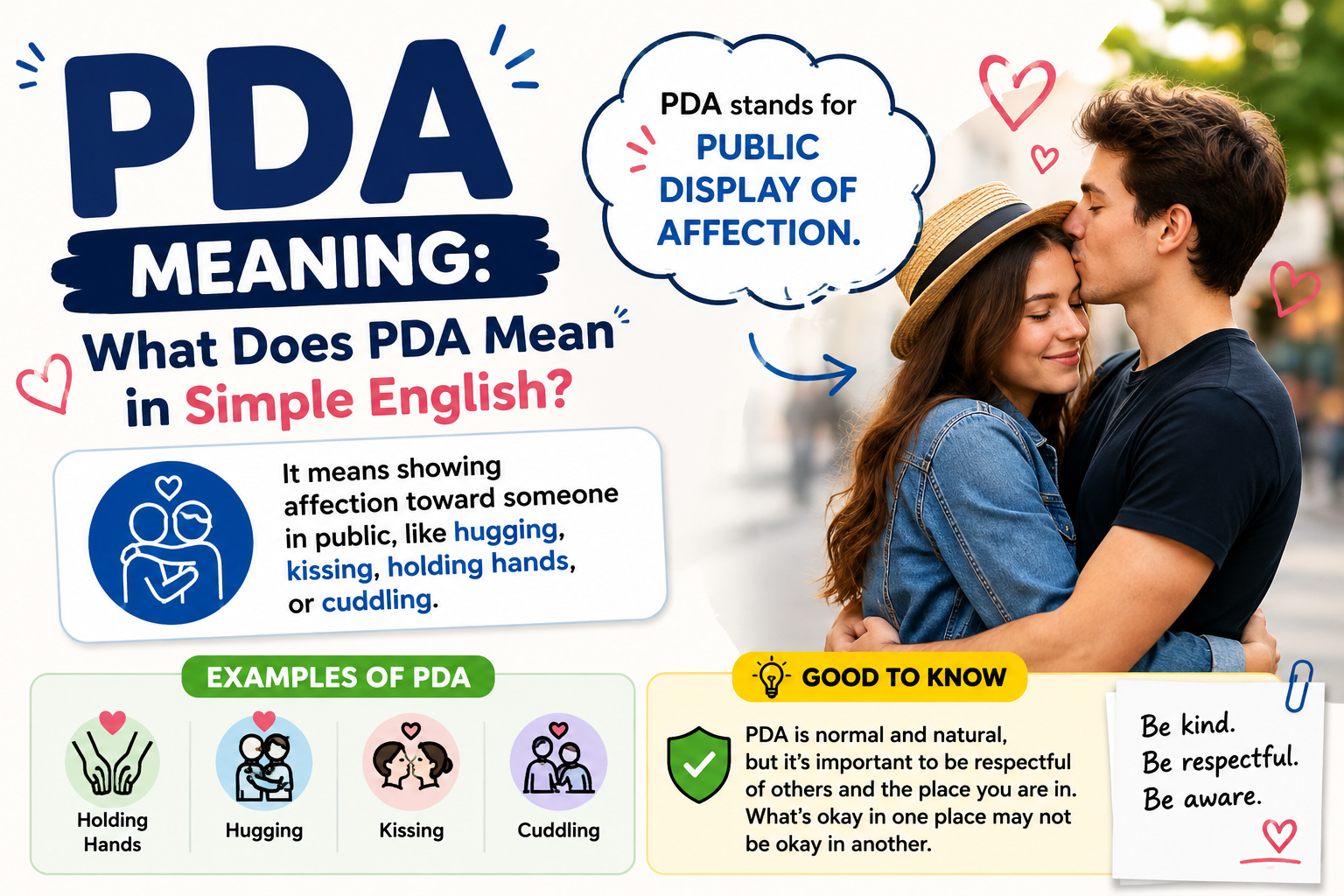
The most common meaning of PDA in casual conversation is Public Display of Affection. It refers to showing affection toward another person in a public place where other people can see the interaction.
For example, a couple holding hands while walking through a park may be described as showing PDA. A hug between close friends or family members can also be a public display of affection, although everyday conversations often use PDA when talking specifically about romantic couples.
The important idea is that the affection is visible to other people. PDA does not automatically mean that the behavior is inappropriate or excessive. Whether something feels comfortable or uncomfortable depends on the people involved, the location, cultural expectations, and the situation.
PDA Meaning in One Simple Sentence
PDA means showing affection toward another person openly in a public place.
For example:
“They were holding hands at the park, so they were showing PDA.”
The abbreviation is especially common in texting, social media, entertainment articles, relationship discussions, and casual conversations.
How Do You Pronounce PDA?
PDA is normally pronounced by saying each letter separately:
P-D-A
The pronunciation is approximately “pee-dee-ay.” Cambridge gives the pronunciation as /ˌpiːdiˈeɪ/ for English.
Because PDA is an abbreviation, you generally do not pronounce it as one ordinary word. You say the individual letter names.
What Does Public Display of Affection Mean?
The phrase Public Display of Affection can sound formal, but its basic idea is easy to understand. “Public” means that other people can see the behavior. “Display” means something is visibly shown. “Affection” means feelings of care, warmth, fondness, or closeness.
Put together, the phrase means showing affection openly where other people are present.
Common examples can include holding hands, hugging, sitting closely together, or giving a brief affectionate gesture. Different people have different comfort levels, so one person may see a particular action as completely normal while another may consider it too personal for a public setting.
PDA Meaning in Text and Social Media
When someone uses PDA meaning in a text message, they are usually talking about public affection rather than technology.
For example, someone might text:
- “They were doing so much PDA at the party.”
- “I don’t mind a little PDA.”
- “That movie had a lot of PDA.”
- “My friends think holding hands counts as PDA.”
- “They don’t like PDA in public.”
The term is useful because it turns a longer phrase into three simple letters. Instead of writing “public display of affection,” people can simply write “PDA.”
On social media, the abbreviation can appear in captions, comments, discussions about celebrities, relationship posts, and conversations about social behavior.
Examples of PDA
Understanding examples is one of the easiest ways to understand the PDA meaning.
A couple holding hands while walking down a street can be described as PDA. A brief hug between two people in a public place may also be considered a public display of affection.
Other everyday examples may include:
- Holding hands while walking
- Giving someone a brief hug
- Putting an arm around someone
- Sitting closely together
- Giving an affectionate gesture when greeting someone
- Showing warmth or closeness in front of others
Whether these behaviors are considered PDA can depend on the people involved and the social setting.
Example Sentences
Here are some natural examples of how PDA can be used:
Example: “I don’t mind a little PDA, such as holding hands.”
Example: “They were showing PDA while waiting for the bus.”
Example: “The school has rules about appropriate behavior, including public displays of affection.”
Example: “Some people are comfortable with PDA, while others prefer to keep affection private.”
Example: “The couple became known for their public displays of affection.”
These sentences show that PDA can be used both positively and negatively, depending on the speaker’s opinion.
Is PDA Always Romantic?
No. Affection itself is not limited to romantic relationships. People can show affection toward friends and family members as well.
For example, a hug between relatives can be an affectionate public interaction. Friends may also hug or show friendly warmth in public. However, in ordinary slang and relationship conversations, PDA most often refers to visible romantic affection.
The context usually makes the intended meaning clear. If someone says, “That couple is showing too much PDA,” they are almost certainly discussing romantic behavior.
Why Do People Have Different Opinions About PDA?
People have different opinions about PDA because everyone has different personal boundaries and cultural expectations.
Some people see small affectionate gestures as normal and sweet. Others prefer to keep personal affection private. Neither reaction automatically means that someone is right or wrong; comfort levels can vary significantly.
The setting also matters. Behavior that feels ordinary during a walk with friends may feel less appropriate in a classroom, workplace, religious setting, or formal event. Social expectations can also differ between families, communities, and cultures.
A useful approach is to respect the people around you while also respecting personal boundaries.
PDA Etiquette
There is no single worldwide rule that defines exactly how much PDA is acceptable. However, basic social awareness can help people decide whether an affectionate gesture is suitable for a particular setting.
Think about where you are, who is around you, and whether everyone involved feels comfortable. Public spaces are shared spaces, so being considerate of other people is important.
In schools, workplaces, and other organized environments, there may also be specific rules about physical affection. Following those rules helps prevent misunderstandings and keeps the environment comfortable for everyone.
PDA Meaning in Different Contexts
One reason PDA meaning can be confusing is that the abbreviation has several meanings.
The intended meaning depends on the context in which you see it.
| PDA Meaning | Context | Simple Explanation |
| Public Display of Affection | Relationships/social media | Showing affection where others can see it |
| Personal Digital Assistant | Technology | A small handheld computer used for organizing information |
| PDA | Medical contexts | An abbreviation that can refer to several medical terms depending on the subject |
The relationship meaning is especially common in casual online conversations, while the technology meaning was historically important.
PDA Meaning in Technology
Before smartphones became the everyday devices people use for calendars, contacts, notes, communication, and other tasks, PDA commonly meant Personal Digital Assistant.
A personal digital assistant was a small handheld computer designed to help people organize information. Dictionary.com describes a PDA as a handheld computer that could provide organizational functions such as an appointment calendar and communication-related hardware.
Cambridge also defines PDA in this context as an abbreviation for personal digital assistant and describes it as a small computer that could be carried around.
This older technology meaning is still found in dictionaries, historical discussions, and technology-related material. However, if you see PDA in a modern relationship conversation, the meaning is usually Public Display of Affection.
Other Meanings of PDA
PDA can have additional meanings in specialized areas. For example, the abbreviation can appear in medical terminology, where its meaning depends on the specific subject being discussed.
This is why context matters. If you see PDA in a medical document, technology manual, school discussion, or social media post, you should not automatically assume it means Public Display of Affection.
The surrounding words usually provide the clue.
For everyday texting and social media, however, Public Display of Affection is one of the most recognizable meanings.
Synonyms for PDA
There is no single perfect synonym for the abbreviation PDA, but several phrases can communicate a similar idea.
Some alternatives include:
- Public affection
- Open affection
- Visible affection
- Public display of love
- Affection shown in public
- Open display of affection
- Romantic affection in public
The exact wording depends on the sentence. “Public affection” is shorter, while “public display of affection” is the full expression represented by PDA.
Antonyms of PDA
PDA does not have a perfect opposite because it describes a type of public behavior rather than a single quality. Still, several phrases can express the contrasting idea.
Examples include:
- Private affection
- Keeping affection private
- Discreet affection
- Personal affection
- Affection shown in private
For example, someone might say, “They prefer to keep their affection private.” This communicates the opposite preference from someone who is comfortable with public displays of affection.
Common Phrases Using PDA
You may encounter several common expressions involving PDA.
“Too Much PDA”
This usually means that someone thinks the amount of visible affection is excessive for the setting.
Example:
“I think they were showing too much PDA at the restaurant.”
The phrase is subjective because different people have different comfort levels.
“I Don’t Mind PDA”
This means that a person is comfortable with seeing or participating in reasonable public affection.
Example:
“I don’t mind PDA as long as it is appropriate for the setting.”
“I Hate PDA”
This means someone strongly dislikes public displays of affection or feels uncomfortable seeing them.
Example:
“She prefers private relationships and says she hates PDA.”
“A Little PDA”
This usually refers to small, subtle affectionate gestures.
Example:
“They are comfortable with a little PDA, such as holding hands.”
PDA Meaning vs. Being Affectionate
PDA and affection are related, but they are not exactly the same thing.
Affection is a broad concept involving feelings and expressions of care, warmth, fondness, or closeness. It can happen privately or publicly.
PDA specifically focuses on affection that is visible to other people.
For example, talking kindly to someone at home is affection, but it would not normally be called PDA. Holding hands with that person while walking through a public place may be described as PDA.
How to Understand PDA From Context
When you encounter the abbreviation PDA, look at the surrounding words before deciding what it means.
If the conversation includes words such as “couple,” “dating,” “holding hands,” “hugging,” “relationship,” or “public,” PDA probably means Public Display of Affection.
If the discussion includes words such as “computer,” “handheld,” “calendar,” “software,” or “technology,” it may mean Personal Digital Assistant.
This simple context check can prevent confusion.
Frequently Asked Questions About PDA Meaning
What does PDA stand for?
In everyday relationship and social conversations, PDA usually stands for Public Display of Affection. It describes visible expressions of affection in public.
What is an example of PDA?
Holding hands, hugging, or showing another appropriate affectionate gesture in a public place can be examples of PDA. Whether something is considered PDA can depend on the setting and social expectations.
What does PDA mean in texting?
In texting, PDA commonly means Public Display of Affection. Someone might use it while talking about couples, relationships, or affectionate behavior in public.
Is PDA a bad thing?
Not necessarily. PDA is simply a description of visible affection. Whether it is considered appropriate depends on the people involved, their comfort levels, the setting, and local social expectations.
What is the pronunciation of PDA?
PDA is pronounced by saying each letter: “pee-dee-ay.”
Does PDA have another meaning?
Yes. PDA can also mean Personal Digital Assistant, a type of handheld computer. It can also have specialized meanings in fields such as medicine.
Is holding hands considered PDA?
It can be. Holding hands in public is commonly described as a mild or subtle form of PDA, especially when discussing romantic couples.
Why do people say “too much PDA”?
People use “too much PDA” when they feel that the amount or type of visible affection is uncomfortable or unsuitable for the particular setting. This is a matter of personal and social judgment rather than a universal rule.
Final Thoughts on PDA Meaning
The simplest PDA meaning to remember is Public Display of Affection. It describes affection that people show openly in places where others can see it. Holding hands, hugging, and other appropriate affectionate gestures can all be described as PDA depending on the situation.
PDA is especially common in texting, social media, relationship discussions, and everyday conversation. At the same time, the abbreviation has other meanings, including Personal Digital Assistant, so context is always important.
If you remember the basic distinction between public affection and private affection, understanding the term becomes very easy. Whether someone likes PDA or prefers to keep affection private is largely a matter of personal comfort, social setting, and cultural expectations.