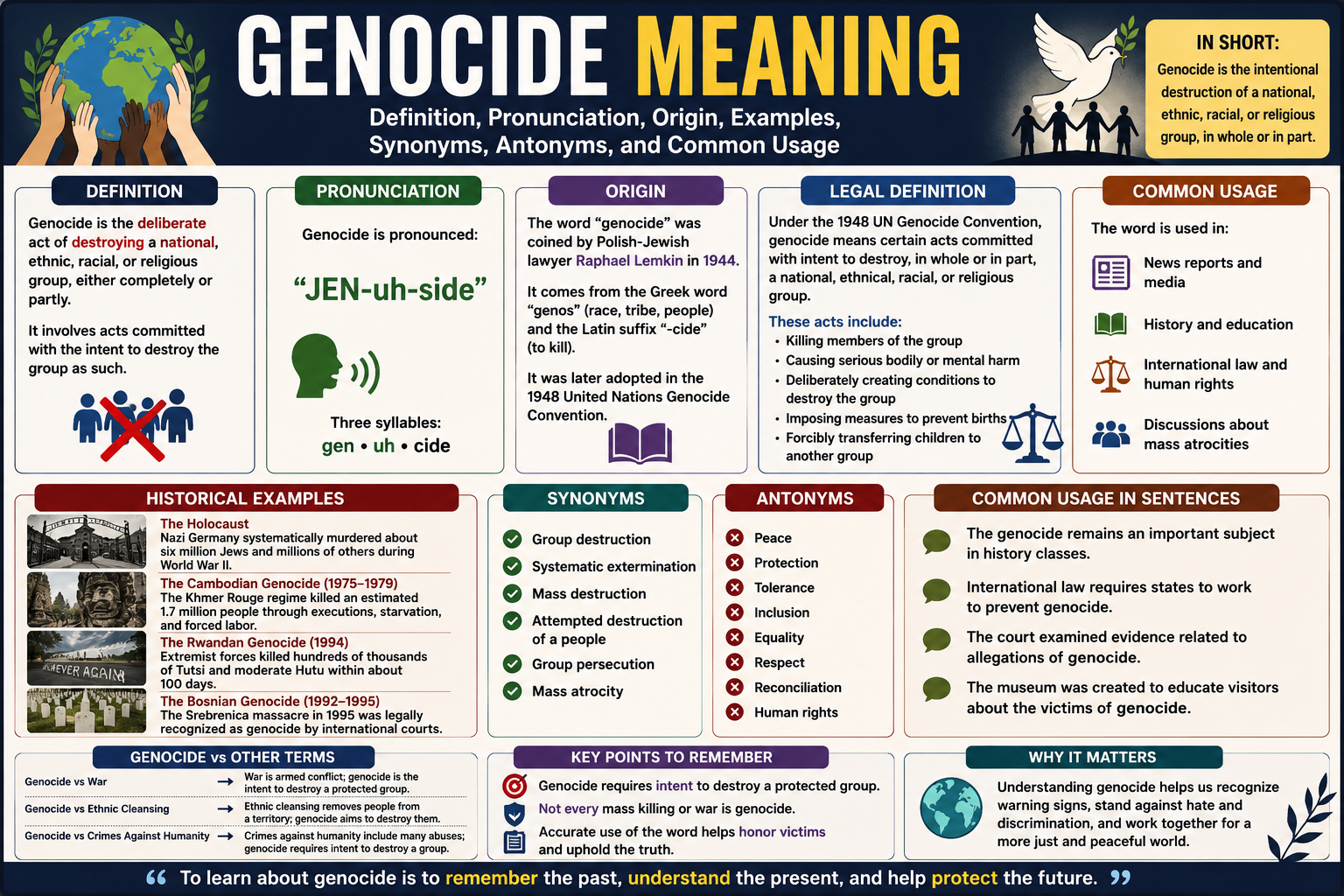
Genocide Meaning: The word genocide describes one of the most serious crimes against humanity. It refers to deliberate actions carried out with the intent to destroy, in whole or in part, a national, ethnic, racial, or religious group. Because the term has a specific legal meaning, it is important to understand it carefully rather than using it as a general word for violence, war, or mass suffering.
In everyday discussions, people may encounter the word in news reports, history books, international law, politics, documentaries, and human-rights discussions. Understanding the genocide meaning can help readers follow these conversations and recognize why the term carries such significant historical and legal weight.
This guide explains the meaning of genocide in simple English, along with its pronunciation, origin, legal definition, examples from history, related words, opposite concepts, common usage, frequently asked questions, and important distinctions.
What Does Genocide Mean?
Genocide means the intentional destruction of a protected human group because of its national, ethnic, racial, or religious identity.
The key idea is intent. Genocide is not simply a situation in which a large number of people die. The term describes acts committed with the specific purpose of destroying a group, at least in substantial part, because it belongs to that group.
The internationally recognized legal definition comes from the Convention on the Prevention and Punishment of the Crime of Genocide, adopted by the United Nations in the aftermath of World War II. The convention identifies several acts that can constitute genocide when they are committed with the required intent.
These acts can include killing members of the group, causing serious physical or mental harm, deliberately creating conditions intended to bring about the group’s physical destruction, imposing measures intended to prevent births, and forcibly transferring children from the group to another group.
Genocide Pronunciation
The word genocide is commonly pronounced “JEN-uh-side.”
The word has three main sound parts: gen, uh, and cide. The ending “-cide” appears in several English words connected with killing or destruction, such as “homicide.”
Simple Genocide Meaning
In simple English, genocide means:
The intentional attempt to destroy a particular national, ethnic, racial, or religious group, either completely or in part.
This definition contains several important ideas.
First, there must be a group that falls within the categories protected under international law. Second, the acts must involve conduct recognized by the legal definition. Third, and most importantly, there must be an intent to destroy the group, in whole or in part.
This last point separates genocide from many other forms of violence.
For example, a terrible natural disaster can kill thousands of people, but it is not genocide because there is no human intention to destroy a protected group. Similarly, ordinary warfare can cause civilian deaths without every such death automatically constituting genocide.
Origin of the Word Genocide
The word genocide is relatively modern. It was coined during World War II by Raphael Lemkin, a Polish-Jewish lawyer and scholar who devoted much of his work to describing and preventing the systematic destruction of human groups.
Lemkin combined the Greek word genos, meaning a race, nation, or people, with the Latin suffix -cide, associated with killing. The resulting word was “genocide.”
Lemkin wanted the international community to have a clear term for the organized destruction of groups. His work helped influence the development of international law after World War II.
The United Nations later adopted the Genocide Convention in 1948, establishing genocide as an international crime and creating obligations for countries to prevent and punish it.
What Is the Legal Definition of Genocide?
The legal meaning of genocide is narrower than some everyday uses of the word.
Under the Genocide Convention, genocide involves certain acts committed with the intent to destroy, in whole or in part, a national, ethnical, racial, or religious group.
The recognized acts include:
- Killing members of the group
- Causing serious bodily or mental harm to members
- Deliberately creating living conditions intended to bring about the group’s physical destruction
- Imposing measures intended to prevent births within the group
- Forcibly transferring children of the group to another group
The definition is important because not every mass killing or humanitarian catastrophe meets the legal requirements for genocide.
Why Intent Matters in Genocide
Intent is one of the most important parts of understanding the genocide meaning.
Imagine two different situations. In the first, civilians die during a military conflict even though the attacking force does not intend to destroy a particular protected group. In the second, leaders deliberately organize actions designed to eliminate members of a particular group because of their identity.
Both situations can involve enormous suffering and serious crimes, but they are not necessarily legally classified in the same way.
Genocide requires a specific form of intent. This is why courts, investigators, historians, and international organizations may examine evidence such as statements by leaders, patterns of conduct, orders, policies, and the broader circumstances surrounding alleged crimes.
Historical Examples of Genocide
History contains several events that are widely recognized as genocides. Studying them is important because it helps people understand how prejudice, dehumanization, propaganda, persecution, and organized violence can develop into catastrophic crimes.
The Holocaust
The Holocaust is one of the clearest and most extensively documented examples of genocide. Nazi Germany and its collaborators systematically persecuted and murdered approximately six million Jews during World War II.
The Holocaust also involved the persecution and murder of other groups, including Roma, disabled people, and others targeted by Nazi policies. The destruction of European Jewry was a central part of the Nazi regime’s genocidal program.
The Holocaust remains a major subject of historical study and education because of its enormous human cost and the lessons it offers about antisemitism, racism, authoritarianism, propaganda, and mass persecution.
The Cambodian Genocide
Cambodia experienced mass killings and persecution under the Khmer Rouge regime from 1975 to 1979.
Large numbers of people were killed or died because of executions, forced labor, starvation, disease, and brutal conditions. The regime targeted various groups and perceived enemies.
The Cambodian case is often discussed in studies of genocide and crimes against humanity, although the precise legal classification of particular acts and groups can vary according to the evidence and legal framework being applied.
The Rwandan Genocide
In 1994, Rwanda experienced a devastating genocide in which extremist forces targeted the Tutsi population as well as moderate Hutu who opposed the violence.
The genocide lasted roughly one hundred days and resulted in the deaths of hundreds of thousands of people.
The Rwandan Genocide demonstrates how extremist propaganda, political instability, organized violence, and dehumanizing language can contribute to mass atrocities.
The Bosnian Genocide
The conflict in Bosnia and Herzegovina during the 1990s included numerous atrocities against civilians and ethnic communities.
The Srebrenica massacre of 1995 was legally determined by international courts to constitute genocide. Thousands of Bosniak Muslim men and boys were murdered after the fall of the UN-declared safe area of Srebrenica.
The Bosnian case is significant because international courts examined the evidence and developed important legal findings concerning genocide and responsibility.
Genocide vs. War
Genocide and war are not interchangeable terms.
A war is an armed conflict involving states, organized groups, or other parties. Wars can involve many different causes, including political disputes, territorial conflicts, or struggles for power.
Genocide, by contrast, focuses on the intentional destruction of a protected group.
A war can contain acts of genocide, crimes against humanity, war crimes, and other violations of international law. However, the existence of a war does not automatically mean genocide is taking place.
This distinction is especially important when reading news reports or historical accounts. Serious violence should always be taken seriously, but legal terms should be used accurately.
Genocide vs. Ethnic Cleansing
Another commonly confused term is ethnic cleansing.
Ethnic cleansing generally refers to efforts to remove a particular ethnic or religious population from a territory through force, intimidation, displacement, or other coercive measures.
Genocide is different because it requires the specific intent to destroy a protected group, in whole or in part.
The two concepts can overlap. A campaign involving forced removal may also include genocidal acts if there is evidence of an intent to physically destroy the group. However, ethnic cleansing and genocide are not automatically the same thing.
Genocide vs. Crimes Against Humanity
Crimes against humanity are another major category under international criminal law.
They can include acts such as murder, deportation, imprisonment, torture, sexual violence, persecution, and other serious abuses when committed as part of a widespread or systematic attack directed against a civilian population.
Genocide is narrower because it requires the special intent to destroy a protected group.
Therefore, a crime can be a crime against humanity without being genocide.
Genocide Synonyms
There is no perfect synonym for genocide because the term has a specific legal and historical meaning.
Depending on the context, related expressions may include:
- Group destruction
- Systematic extermination
- Mass destruction
- Attempted destruction of a people
- Group persecution
- Mass atrocity
However, these expressions should not automatically replace the word genocide. Each may have a different meaning, and some are much broader.
For precise historical or legal writing, it is better to use genocide only when the facts support that specific description.
Genocide Antonyms
Genocide does not have one exact antonym. However, concepts that stand in strong contrast to genocide include:
- Peace
- Protection
- Tolerance
- Inclusion
- Human rights
- Equality
- Cooperation
- Preservation
- Reconciliation
- Respect
These ideas reflect the opposite of policies that target people because of their group identity.
Common Usage of the Word Genocide
The word genocide appears in several kinds of writing.
In History
Historians use the term when discussing events that meet the relevant historical and legal criteria.
In International Law
Lawyers and international courts use genocide as a specific legal category. Evidence and intent are carefully examined.
In News Reports
Journalists may use the term when reporting allegations, investigations, court findings, or statements by governments and international organizations.
In Human Rights Discussions
Human-rights organizations may discuss genocide alongside other mass atrocities and violations of international law.
Because the word is so serious, responsible writers should avoid using it merely as an exaggerated synonym for something they strongly dislike.
Examples of Genocide in Sentences
Here are some simple, non-graphic examples showing correct usage:
- “The genocide remains an important subject in history classes.”
- “International law requires states to work to prevent genocide.”
- “Researchers examined evidence related to allegations of genocide.”
- “The museum was created to educate visitors about the victims of genocide.”
- “The court considered whether the evidence demonstrated genocidal intent.”
These examples show how the word can be used in historical, legal, educational, and journalistic contexts.
Why the Word Genocide Should Be Used Carefully
Genocide is not simply another word for something terrible.
Using the word accurately matters because it identifies a specific type of international crime. Careless use can weaken the meaning of the term and make serious discussions less precise.
When discussing a current conflict or political event, it is especially important to distinguish between allegations, investigations, expert assessments, and final legal findings.
For example, saying that an organization has “alleged genocide” is different from saying that an international court has legally determined that genocide occurred.
Careful language helps readers understand what is known, what is disputed, and what has been legally established.
Frequently Asked Questions About Genocide Meaning
What does genocide mean in simple words?
Genocide means intentionally trying to destroy a national, ethnic, racial, or religious group, either completely or partly.
Who coined the word genocide?
The word genocide was coined by Raphael Lemkin, a Polish-Jewish lawyer and scholar, during World War II.
What does the word genocide come from?
The term combines the Greek word genos, referring to a people, race, or nation, with the Latin-derived suffix -cide, associated with killing.
Is genocide the same as mass killing?
No. Mass killing and genocide are not automatically the same. Genocide requires specific intent to destroy a protected group, in whole or in part.
Is genocide the same as war?
No. War is armed conflict, while genocide is a specific international crime involving the intent to destroy a protected group. Genocide can occur during a war, but not every war involves genocide.
What is the opposite of genocide?
There is no single exact opposite. Ideas such as peace, equality, tolerance, protection, inclusion, and respect for human rights stand in strong contrast to genocide.
Is genocide a legal term?
Yes. Genocide is recognized as an international crime under international law. The Genocide Convention adopted by the United Nations in 1948 is one of the central legal instruments concerning the crime.
Why is intent important when defining genocide?
Intent is essential because genocide requires an intention to destroy a protected group, in whole or in part. Without that specific intent, an event may constitute another serious international crime but not necessarily genocide.
Can genocide happen during peacetime?
Genocide does not require a formal war. The defining issue is the prohibited conduct and the intent to destroy a protected group, not whether a country is officially at war.
Why is it important to learn about genocide?
Learning about genocide helps people understand history, human rights, international law, prejudice, discrimination, and the warning signs that can precede mass atrocities. Education can also help preserve the memory of victims and support efforts to prevent future crimes.
Final Thoughts on Genocide Meaning
Understanding the genocide meaning requires more than knowing that it refers to mass destruction. The word has a specific legal definition centered on the intentional destruction of a national, ethnic, racial, or religious group, in whole or in part.
The term was coined by Raphael Lemkin and later became part of international law through the United Nations Genocide Convention. Historical events such as the Holocaust, the Rwandan Genocide, and the genocide at Srebrenica demonstrate why the concept remains an important subject of study.
The most important distinction is that genocide is not simply a synonym for war, violence, mass death, or suffering. The specific intent behind the acts matters. Using the word carefully helps preserve its legal meaning and ensures that discussions about history and current events remain accurate.
For students, readers, and anyone encountering the term online, the simplest definition to remember is this: genocide is the intentional destruction of a protected group, in whole or in part, because of its identity. Understanding that meaning provides a foundation for learning about history, international law, human rights, and the importance of preventing mass atrocities.