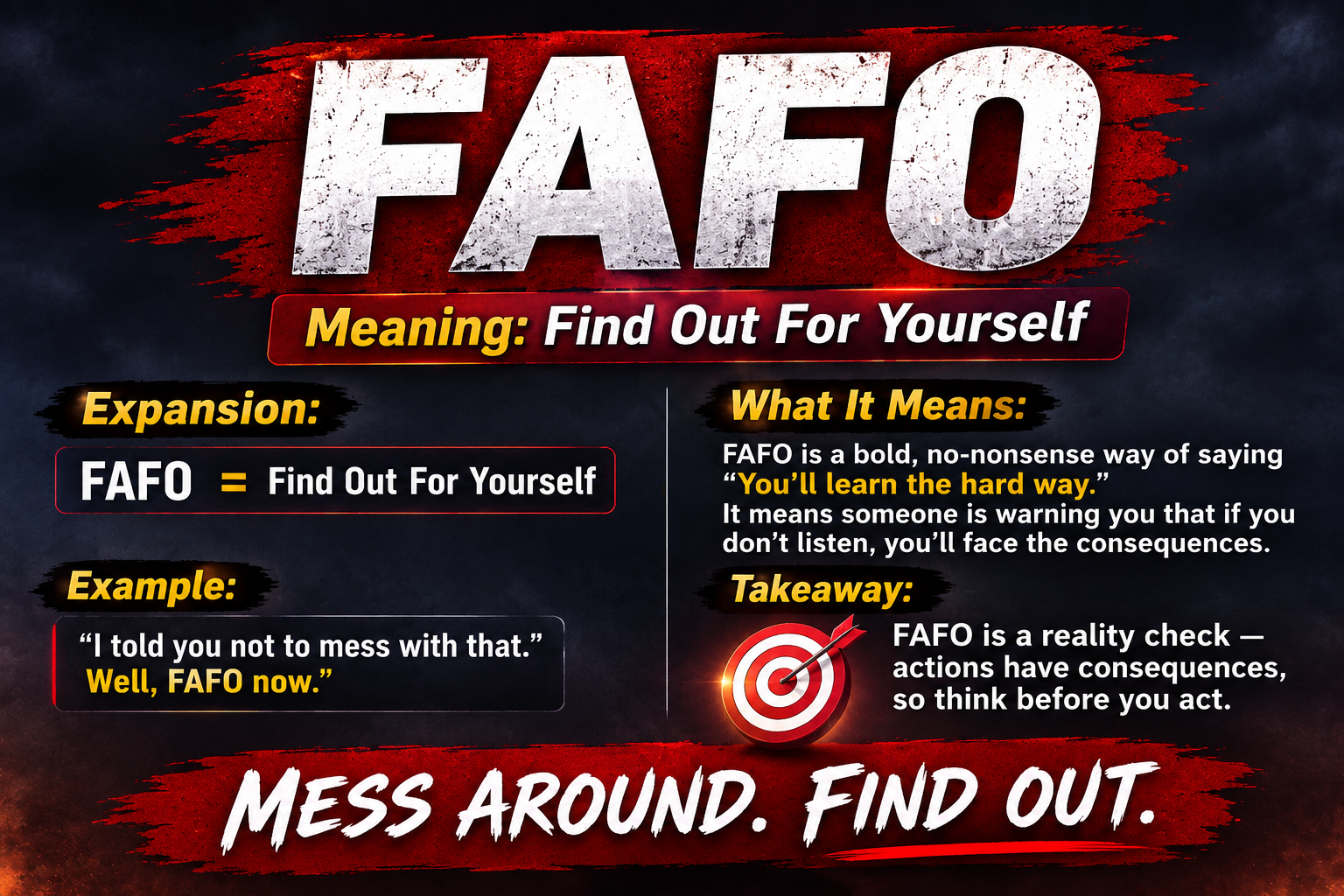
The internet introduces new slang words and abbreviations every year, and one of the most popular expressions in recent times is FAFO. You may have seen it in social media comments, memes, online discussions, or even everyday conversations. While the abbreviation is short, its message is direct and memorable.
Understanding the can help you better interpret online content and communicate more confidently in informal settings. Like many internet slang terms, FAFO is often used humorously, but it can also carry a serious warning about the consequences of risky decisions.
In this guide, you’ll learn the in simple English, its pronunciation, origin, examples, synonyms, antonyms, and common usage. Whether you’re new to internet slang or simply curious about the phrase, this article explains everything you need to know in an easy-to-understand way.
Pronunciation
FAFO (fay-foh)
Simple pronunciation: FAY-foh
Some people also pronounce it by saying each letter individually:
F-A-F-O
Both pronunciations are commonly understood in casual conversations.
What Does FAFO Mean?
FAFO is an internet abbreviation for the vulgar phrase “F* Around and Find Out.”** Because the original phrase contains profanity, people often use the acronym FAFO instead.
In simple English, FAFO means that if someone takes unnecessary risks, ignores warnings, or behaves recklessly, they may have to face the consequences of their actions.
It is often used as a warning before something happens or as a comment after someone experiences the predictable result of a poor decision.
For example:
- Someone ignores repeated safety instructions and gets injured.
- A person continues provoking another individual despite several warnings.
- Someone breaks important rules and later faces penalties.
In each situation, people might simply comment:
“FAFO.”
The message suggests that actions have consequences.
The Origin of FAFO
The comes from American slang and military-style expressions that became popular long before social media existed.
The full phrase gradually spread through:
- Military communities
- Law enforcement culture
- Internet forums
- Meme pages
- Online gaming
- Social media platforms
As online communication became faster, users shortened the phrase into the easy-to-type acronym FAFO.
Today, it appears across platforms such as X (formerly Twitter), Reddit, TikTok, Instagram, YouTube comments, and online discussion forums.
Although the wording is modern, the underlying idea is much older: every action has consequences.
Why Has FAFO Become So Popular?
There are several reasons why the has become widely recognized.
It Is Short and Memorable
Internet users prefer quick expressions that communicate a complete idea in just a few letters.
Instead of writing an entire sentence explaining someone’s mistake, people simply type FAFO.
It Fits Many Situations
FAFO can describe situations involving:
- Poor decisions
- Risk-taking
- Arguments
- Sports
- Workplace mistakes
- Politics
- Everyday life
- Online debates
Its flexibility has helped it spread across many communities.
It Works in Memes
Internet humor often relies on short captions.
A funny video showing someone making an obvious mistake may only need one word underneath:
FAFO
Because many viewers already know the abbreviation, no additional explanation is needed.
The Simple Meaning Behind FAFO
Although the phrase contains profanity, its basic lesson is straightforward.
The reminds people that choices often produce predictable results.
If someone:
- Ignores advice
- Breaks rules
- Takes unnecessary risks
- Challenges others without reason
- Acts irresponsibly
they may eventually experience the consequences.
This idea exists in many cultures and is reflected in sayings such as:
- Actions have consequences.
- You reap what you sow.
- Cause and effect.
- Every choice has a result.
Is FAFO Positive or Negative?
The tone depends on how it is used.
Sometimes it is humorous.
Example:
A friend ignores cooking instructions and burns dinner.
Another friend laughs and says:
“Well… FAFO.”
Here the phrase is playful.
Other times, it carries a serious warning.
Example:
Someone repeatedly ignores workplace safety rules.
A coworker may warn them that continuing this behavior could lead to disciplinary action or injury.
In this case, FAFO is much more serious.
Common Situations Where FAFO Is Used
The appears in many everyday situations.
Social Media
People often use FAFO when reacting to viral videos showing someone making an obviously poor decision.
Example:
A person attempts a dangerous stunt without preparation.
Comment:
“That’s FAFO.”
Sports
Fans sometimes use the expression when one team underestimates another and loses unexpectedly.
Example:
“They thought the game would be easy.”
“FAFO.”
School
Students may jokingly use FAFO when someone ignores classroom rules and receives detention.
The phrase highlights that the outcome was predictable.
Workplace
Employees occasionally use FAFO informally when discussing avoidable mistakes.
However, because the original phrase contains profanity, it is usually inappropriate in professional emails or official communication.
Everyday Conversations
Friends may use FAFO jokingly when discussing harmless situations.
For example:
“I ignored the weather forecast and got soaked.”
“FAFO.”
Examples of FAFO in Sentences
Here are some examples showing how the expression is commonly used.
- He ignored every warning and eventually FAFO.
- Don’t keep provoking people—you might FAFO.
- The company ignored customer complaints and later FAFO.
- She underestimated the competition and FAFO during the tournament.
- He thought the rules didn’t apply to him, but he quickly FAFO.
- They laughed at the instructions until they FAFO.
- Sometimes life teaches lessons through FAFO moments.
These examples show that the phrase usually appears after someone experiences the natural consequences of their own actions.
Cultural Significance of FAFO
The popularity of FAFO reflects modern internet culture.
Online communities often value quick, memorable expressions that communicate an entire idea with just a few letters.
FAFO also appeals to people because it expresses a universal principle:
Actions have consequences.
Whether discussing sports, business, politics, relationships, or everyday mistakes, the phrase reminds people that decisions often produce expected outcomes.
Because of this broad message, FAFO has become more than just internet slang—it has become a recognizable cultural expression.
When Should You Avoid Using FAFO?
Although the abbreviation is common online, it isn’t suitable for every situation.
You should avoid using FAFO in:
- Business emails
- Academic writing
- Job interviews
- Formal presentations
- Professional reports
- Official customer communication
Since the acronym represents a vulgar phrase, some readers may find it offensive even when the profanity is hidden.
Instead, consider more professional alternatives such as:
- Actions have consequences.
- Learn from the outcome.
- Experience is the best teacher.
- Cause and effect.
These alternatives communicate a similar idea without informal language.
Why Understanding Internet Slang Matters
Internet language changes quickly. New abbreviations appear every year, and understanding them helps you:
- Follow online conversations.
- Understand memes and social media posts.
- Communicate more naturally with friends.
- Avoid misunderstanding jokes or comments.
- Recognize when language is appropriate for different situations.
Learning the is one example of how modern internet slang continues to shape everyday communication.
Synonyms of FAFO
Although there is no exact synonym for FAFO, several words and phrases express a similar idea. These alternatives are often more suitable in formal conversations because they avoid profanity.
Common synonyms include:
- Actions have consequences
- Learn the hard way
- Cause and effect
- Face the consequences
- Reap what you sow
- Get what you deserve (depending on context)
- Reality check
- Hard lesson
- Consequence of your choices
- Experience teaches
Each of these phrases highlights the same basic message: decisions often lead to predictable outcomes.
Antonyms of FAFO
Antonyms describe ideas that are opposite to the message behind FAFO.
Examples include:
- Avoid consequences
- Stay safe
- Make wise decisions
- Think before acting
- Learn from others
- Prevent mistakes
- Exercise caution
- Be responsible
- Follow good advice
- Act carefully
These expressions focus on avoiding unnecessary risks instead of learning through negative experiences.
Common Usage of FAFO
The has become popular across many online communities. People commonly use it as a reaction rather than as part of a long sentence.
Typical examples include:
- “He ignored every warning. FAFO.”
- “She thought the rules didn’t matter. FAFO.”
- “That’s a classic FAFO moment.”
- “Don’t push your luck unless you’re ready to FAFO.”
- “The internet never forgets. FAFO.”
The phrase is usually informal and should be reserved for casual conversations or social media.
FAFO on Social Media
Social media has played a major role in spreading the popularity of FAFO. Platforms such as TikTok, X (formerly Twitter), Instagram, Reddit, and YouTube often feature the abbreviation in comments and captions.
Creators may use FAFO when sharing videos of:
- Someone ignoring safety warnings
- A prank that backfires
- A failed challenge
- A sports upset
- A public argument
- A humorous mistake
Because the abbreviation is short and easy to remember, it fits well in memes and comment sections.
FAFO in Memes
Memes often rely on simple captions that quickly explain what’s happening. FAFO has become one of those captions because it summarizes an entire situation in just four letters.
For example:
- A person jumps over a fence marked “Do Not Enter” and immediately gets chased.
- Someone refuses to read instructions before assembling furniture and ends up with leftover parts.
- A player underestimates an opponent and loses badly.
In each case, viewers may simply comment:
“FAFO.”
The humor comes from the obvious connection between the person’s actions and the result.
FAFO in Everyday Life
While FAFO is mainly internet slang, the underlying idea appears in everyday life.
Examples include:
At School
A student chooses not to study for an important exam and receives a poor grade. Friends may jokingly describe it as a FAFO moment.
At Work
An employee repeatedly ignores company procedures and later faces disciplinary action. The situation reflects the same lesson about consequences.
In Sports
An athlete underestimates the competition and loses the match. Spectators might describe it as a classic FAFO situation.
In Daily Decisions
Someone ignores weather warnings, leaves home without an umbrella, and gets caught in heavy rain. While lighthearted, it still illustrates the phrase’s central idea.
Difference Between FAFO and Similar Expressions
Several English expressions have meanings close to FAFO, but they are not exactly the same.
FAFO vs. “Actions Have Consequences”
This phrase is more formal and suitable for professional or educational settings. FAFO expresses the same idea in informal internet slang.
FAFO vs. “Learn the Hard Way”
“Learn the hard way” focuses on gaining knowledge after making a mistake. FAFO emphasizes both the risky action and its consequences.
FAFO vs. “Reap What You Sow”
This proverb highlights that your actions influence future results. It carries a similar message but has a more traditional tone.
Why People Relate to FAFO
The popularity of FAFO comes from its universal message. Nearly everyone has experienced moments when a poor decision led to an expected outcome.
The phrase resonates because it reflects real life:
- Ignoring advice can create problems.
- Taking unnecessary risks can have consequences.
- Learning from mistakes is part of personal growth.
Many people appreciate the phrase because it reminds them to think before acting.
Is FAFO Offensive?
The abbreviation itself does not contain profanity, but it represents a phrase that does.
Because of this, some people may consider FAFO inappropriate in formal or professional settings.
When communicating with:
- Teachers
- Employers
- Clients
- Older audiences
- Professional organizations
it is usually better to use alternatives such as:
- Actions have consequences.
- Learn from the experience.
- Think before acting.
- Face the results of your choices.
Choosing the right language depends on your audience and the situation.
Tips for Using FAFO Correctly
If you decide to use FAFO, keep these tips in mind:
Know Your Audience
Friends may understand the slang, while coworkers or clients may not.
Use It Informally
FAFO works best in casual conversations, text messages, and social media posts.
Avoid Overusing It
Using the abbreviation too often can make your writing repetitive. Save it for situations where it fits naturally.
Remember the Meaning
The phrase should describe situations where someone’s choices directly lead to expected consequences.
Frequently Asked Questions
What does FAFO stand for?
FAFO stands for “F* Around and Find Out.”** Because the original phrase contains profanity, people often use the abbreviation instead.
What is the FAFO meaning in simple English?
In simple English, FAFO means that if someone makes risky choices or ignores warnings, they will likely experience the consequences of those actions.
Is FAFO a bad word?
The abbreviation itself is not a swear word, but it represents a phrase containing profanity. Some people may therefore consider it inappropriate in formal settings.
Where did FAFO come from?
The phrase became popular through American slang, military culture, internet forums, memes, and social media before spreading to mainstream online conversations.
Is FAFO used only online?
No. Although it is most common on social media, some people also use it in casual face-to-face conversations.
Can I use FAFO at work?
It is generally better to avoid FAFO in professional environments because it refers to a vulgar expression. More formal alternatives are usually more appropriate.
Why is FAFO so popular?
Its popularity comes from its short length, memorable wording, and universal message that actions often have consequences.
Is FAFO always negative?
Not always. It is often used humorously in lighthearted situations, but it can also be used seriously when discussing risky or irresponsible behavior.
Conclusion
The has become one of the most recognizable pieces of modern internet slang. Short for “F* Around and Find Out,”** it conveys a simple but powerful message: actions have consequences. Whether used humorously in memes or seriously to describe the results of risky decisions, the phrase reminds people that choices often lead to predictable outcomes.
Although is widely understood on social media, it is best suited for casual conversations because it refers to a profane expression. In professional or formal settings, alternatives such as “actions have consequences” or “learn the hard way” are usually more appropriate.
Understanding the helps you interpret online discussions, memes, and everyday conversations with greater confidence. More importantly, it highlights a timeless lesson that applies both online and offline: thoughtful decisions often lead to better outcomes, while careless actions can bring consequences that could have been avoided.